Uncontested / Simple Divorce in Quebec: A Plain-English Guide to Amicable Divorce, Joint Applications, and the Mandatory Quebec Paperwork
If you and your spouse agree that your marriage is over and you want to avoid a long, expensive court fight, an uncontested divorce in Quebec is most commonly handled as an Amicable Divorce (sometimes called a “divorce by agreement”).
Quebec is different from the rest of Canada in one big way: Quebec family law is rooted in the Civil Code and uses its own legal vocabulary. That means using generic terms like “petition” can hurt credibility. In many cooperative cases, the highest-intent pathway is filing together with a written agreement (often described in French as a demande conjointe with a projet d’accord).
Important disclaimer: PlainDivorce is not a law firm and does not provide legal advice. This article is general legal information only. Court rules, forms, and fees can change, and every situation is different. If you are unsure about your rights or what is fair in your situation, speak with a Quebec family lawyer, a notary, or a legal clinic.
Fee information in this guide was last checked on December 4, 2026. Always confirm the latest amounts with official Quebec government sources before you file.
Feedback check (what was correct vs. incorrect)
- Correct: Form I is the divorce application (the regulation states the divorce application must conform to Formulaire I).
- Correct: Form III is the sworn financial disclosure used for support-related requests (the regulation requires using Formulaire III for support matters and also references using it with the child support determination form).
- Partly correct (but needed a precision fix): Quebec does require an État du patrimoine familial (statement of family patrimony) in divorce cases, but in current official sources this requirement is tied to the Code of Civil Procedure and a form established/published by the court, rather than a reliable “Form IV = patrimony” label you can safely use in public content.
- Correct concept: Quebec courts expect official civil status documents (not religious certificates or hospital records). For Quebec-issued documents, that typically means certificates from the Directeur de l’état civil.
- Incorrect: The “~$376 joint filing fee” figure does not match current Quebec government guidance for opening a joint divorce file; the commonly stated court fee is $128 (subject to change).
Table of Contents
- 1. What is an uncontested (amicable) divorce in Quebec?
- 2. The “golden keyword” in Quebec: Joint application with a draft agreement
- 3. Who qualifies for an amicable divorce in Quebec?
- 4. Quebec-specific paperwork: the mandatory stack (Form I, Form III, Family Patrimony Statement, child support form)
- 5. The Directeur de l’état civil hard stop: required certificates (marriage + birth)
- 6. Step-by-step overview of the Quebec uncontested divorce process
- 7. Special issues when you have children (financial disclosure + child support form)
- 8. How long does an uncontested divorce take in Quebec?
- 9. What does an uncontested divorce cost in Quebec?
- 10. When a DIY divorce might not be right for you
- 11. Where a self-help divorce kit fits into the process
- 12. FAQ
1. What is an uncontested (amicable) divorce in Quebec?
In Quebec, the wording you will often see is Amicable Divorce, meaning you and your spouse are not asking the court to resolve a dispute. Instead, you present your agreement (especially about children and support, if applicable) and ask the Superior Court of Quebec to grant the divorce.
Divorce is granted under Canada’s federal Divorce Act, but the Superior Court of Quebec is the court that issues the Divorce Judgment in Quebec.
2. The “golden keyword” in Quebec: Joint application with a draft agreement
If you are truly cooperative, the strongest uncontested path is usually filing together with a written agreement (often described as a joint application supported by a draft agreement or projet d’accord). The practical benefit is simple: when both spouses sign and file together, you usually avoid the cost and stress of formal service.
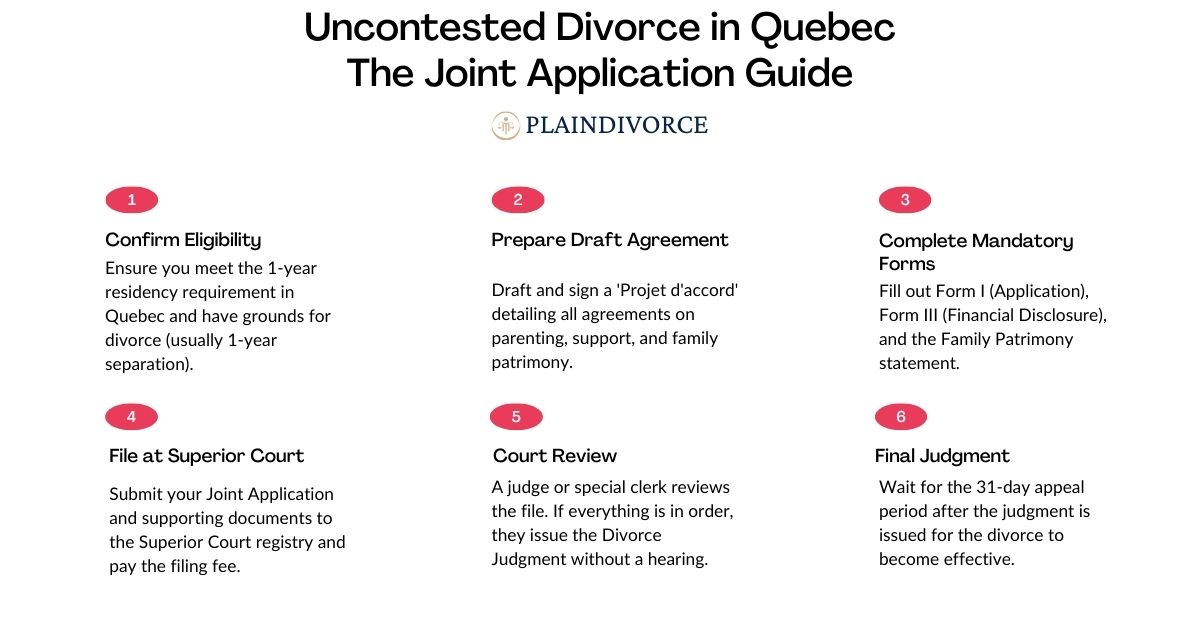
Process overview: Joint amicable path (file together + signed agreement) vs. sole path (one spouse files + service of process + possible contest).
Download Our Quebec Uncontested Divorce (Dissolution) Self-Help Kit
3. Who qualifies for an amicable divorce in Quebec?
Residency requirement
Under the federal Divorce Act, the court can grant a divorce if you or your spouse has lived in Quebec for at least one year immediately before the application is filed.
Grounds for divorce
Across Canada (including Quebec), there is one legal ground for divorce: breakdown of the marriage. Most amicable divorces rely on one-year separation because it is the cleanest no-blame ground for an uncontested case.
4. Quebec-specific paperwork: the mandatory stack (Form I, Form III, Family Patrimony Statement, child support form)
This is where Quebec DIY filers get rejected. You cannot just say “we agree.” The court expects specific Quebec paperwork and disclosure.
- Application for Divorce (Form I): This starts the case. The regulation states the divorce application must be in Formulaire I.
- Financial disclosure (Form III): The regulation requires Formulaire III for support-related requests, and it also links financial disclosure to child support documentation.
- Statement of Family Patrimony (État du patrimoine familial): In divorce files, Quebec procedure requires a family patrimony statement (or the applicable declaration/renunciation framework) under the Code of Civil Procedure, using the form established/published by the court.
- Child Support Determination Form (Formulaire de fixation des pensions alimentaires pour enfants): If you have children, Quebec uses its own model and the regulation references using this form alongside up-to-date financial disclosure.
- Draft Agreement (Projet d’accord): Your written agreement settling parenting/support/property terms for the judge to approve.
Quebec forms checklist: Form I; Form III; Family Patrimony Statement; Child Support Determination Form (if applicable); Draft agreement.
5. The Directeur de l’état civil hard stop: required certificates (marriage + birth)
Quebec registries are strict about civil status documents. Many DIY packages fail because people attach the wrong type of “proof.” In general, you should expect to provide official certificates (not religious certificates, not hospital records). For Quebec-issued documents, that typically means ordering the correct documents from the Directeur de l’état civil.
Practical tip: If you were married outside Quebec or outside Canada, build extra time to obtain the correct government-issued documents (and translations, if required by your district’s filing instructions).
6. Step-by-step overview of the Quebec uncontested divorce process
Step 1 – Confirm you qualify to file in Quebec
- At least one spouse has lived in Quebec for 12 months immediately before filing.
- You will meet the one-year separation requirement by the time the judge grants the divorce (in most cases).
- You can realistically proceed amicably (no active dispute requiring a contested hearing).
Step 2 – Prepare your agreement (Projet d’accord)
Your agreement usually sets out:
- parenting arrangements (if you have children);
- child support (and how it was calculated);
- spousal support (if applicable); and
- property and debt arrangements, including how you are dealing with the family patrimony.
Step 3 – Complete the mandatory Quebec forms and disclosures
In many files, this means preparing Form I, the required financial disclosure (often Form III where support is in play), the family patrimony statement, and the child support determination form if you have children.
Step 4 – File in the Superior Court of Quebec
You file your documents with the Superior Court (in the correct judicial district). If the registry accepts the filing, a court file is opened and a file number is assigned.
Step 5 – Court review and Divorce Judgment
In many amicable cases, the judge can review the agreement and supporting documents and issue a Divorce Judgment without a full contested hearing. If something is missing (especially disclosure or child support proof), the court can ask for corrections or further information.
Step 6 – The 31-day waiting period
After the Divorce Judgment is issued, the divorce typically becomes effective 31 days later (unless appealed or the judgment sets a different effective date).
7. Special issues when you have children (financial disclosure + child support form)
When children are involved, uncontested does not mean “light paperwork.” The court will focus heavily on:
- clear parenting arrangements, and
- child support properly determined under Quebec’s model and supported by the correct child support form and up-to-date financial disclosure.
8. How long does an uncontested divorce take in Quebec?
Timelines vary by district and how complete your package is. Most timelines have three parts:
- Separation timeline: many cases rely on one-year separation as the ground.
- Court processing: varies by district and document completeness.
- 31-day waiting period: after the Divorce Judgment before the divorce becomes effective.
9. What does an uncontested divorce cost in Quebec?
For an amicable joint divorce, the main hard cost is the court filing fee to open the file. Quebec government guidance commonly states the fee is $128 to open a joint divorce file (fees can change).
| Item | Typical Cost |
|---|---|
| Court fee to open a joint divorce file | $128 (verify current amount) |
| Bailiff (huissier) service (if not joint) | Varies (service is a common extra cost) |
| Certified copies / certificates | Varies by what you request |
| Notary / commissioner (if sworn signatures required) | Varies |
| Directeur de l’état civil certificates (if you need to order them) | Varies |
Note: Court fees and required documents can change. Always confirm current amounts and your district’s filing instructions before submitting your package.
10. When a DIY divorce might not be right for you
A DIY amicable divorce can be risky if:
- there is family violence, coercion, intimidation, or a serious power imbalance;
- one spouse does not understand the finances or feels pressured to sign;
- there are complex assets or debts (businesses, pensions, multiple properties);
- you are unsure how Quebec family patrimony rules affect what must be declared; or
- there are serious disputes about children or support.
11. Where a self-help divorce kit fits into the process
If your case is truly amicable, a self-help kit is most useful as an organization tool for Quebec’s document-heavy process:
- helps you understand the joint filing pathway and the Quebec terminology;
- keeps you on track with the mandatory form stack (Form I, financial disclosure where required, family patrimony statement, and the child support form if applicable);
- reduces common delays (missing signatures, inconsistent dates, vague parenting/support terms, missing certificates).
PlainDivorce provides legal information and tools, not legal advice. You are responsible for using current court forms and confirming current fees and filing procedures.
12. FAQ
What is an uncontested or simple divorce in Quebec?
In Quebec, the common wording is amicable divorce. It generally means spouses file together with an agreement so the Superior Court of Quebec can grant the divorce without a contested trial.
What is Form I in Quebec?
Form I is the divorce application form used to start the case, and the regulation specifies the divorce application must conform to Formulaire I.
Why is Form III important?
Form III is the sworn financial disclosure used in support-related requests, and the regulation ties financial disclosure to support documentation. Missing or outdated disclosure is a common reason files are delayed.
Do we really have to do a family patrimony statement if we agree?
Quebec procedure requires dealing with the family patrimony in the divorce file through the required declaration/renunciation framework, including an État du patrimoine familial using the form established by the court. Agreement alone is not the same as proper disclosure.

About Harry D
Expert contributor at PlainDivorce, helping Canadians and American navigate simple uncontested divorces with clarity and confidence.