Uncontested Divorce in Quebec: The Amicable Joint Application, the Draft Agreement, and the Paperwork That Actually Gets Filed
An uncontested divorce in Quebec — the province calls it an amicable divorce — is one where you and your spouse agree on every consequence of the split and ask the Superior Court to end the marriage on that basis, with no trial. You get one by filing a joint application for divorce on a draft agreement (in French, a demande conjointe sur projet d’accord): the two of you file together, with a signed settlement attached, and a judge reviews it on paper.
Quebec is unlike the rest of Canada in one structural way. Divorce itself is granted under Canada’s federal Divorce Act, but Quebec family procedure runs on the Civil Code and the Code of Civil Procedure, and the Superior Court uses its own forms, its own disclosure rules, and its own vocabulary. Terms borrowed from other provinces (“petition,” “desk order”) do not map onto Quebec practice, so this guide uses the words the Quebec government and the Superior Court actually use.ees are re-indexed every January 1, so confirm the current amount on Quebec’s official tariff of court costs before you file.
TL;DR: Uncontested Divorce in Quebec, in 60 Seconds
- What it is: an amicable divorce, obtained through a joint application for divorce on a draft agreement — you file together and a judge homologates (approves) your settlement without a contested hearing.
- Who qualifies: one spouse is habitually resident in Quebec for the year before filing; you are living apart when you file and have been apart at least one year by the time the judgment is rendered; you agree on everything; and the ground is not adultery or abuse.
- Core package: the joint application for divorce (Form I content), the draft agreement, a backing sheet on each document, your civil-status exhibits, and — if the agreement provides for support — the Article 444 statements, plus the Child Support Determination Form or Form III as applicable.
- Cost: $241 court fee for a joint application, plus a $10 federal registry fee — about $251 in mandatory court costs (verify the current tariff).
- Timeline: the one-year separation, then court processing, then a fixed 31-day wait after the judgment before the divorce takes effect.
1. What is an uncontested divorce in Quebec (an amicable divorce)?
An uncontested divorce in Quebec is one the Superior Court can grant on the documents, because nothing is in dispute. Quebec’s government describes the amicable divorce as a faster, less confrontational, and less expensive path than a courtroom fight. You are not asking a judge to referee anything — you present a signed draft agreement (projet d’accord) that settles children, support, and property, and ask the court to pronounce the divorce and homologate the agreement.
The marriage is dissolved under the federal Divorce Act, but the Superior Court of Quebec, Family Division is the court that opens the file, reviews it, and issues the divorce judgment. There is no separate “family court” in Quebec for divorce — it is always the Superior Court, in the judicial district where either spouse lives.
“Uncontested” is not a lighter legal standard. A judge still has to be satisfied about residency, the one-year separation, the absence of collusion, and — critically — that your agreement adequately protects each spouse and any children. If it does not, the court can send you back to redo it.
2. The Joint Application for Divorce Quebec Uses: Filing on a Draft Agreement
Quebec’s amicable route has a precise name: an application for divorce based on a draft agreement. In everyday terms it is the Joint Application for Divorce Quebec spouses sign and file together, supported by the Draft Agreement for Divorce Quebec couples negotiate themselves. Both spouses are “joint applicants” — there is no plaintiff and no defendant.
Because you file together, no one is served with divorce papers, so a sole (non-joint) application’s bailiff (huissier) fee for serving the other spouse does not arise. The trade-off is that the joint route only works while you agree on everything; the moment a real dispute appears, the file has to move to the contested track.
| Joint application on a draft agreement | Sole (non-joint) application | |
|---|---|---|
| Who files | Both spouses together, as joint applicants | One spouse; the other is the defendant |
| Service on the other spouse | None — you file together | Required, usually by bailiff |
| Agreement | Signed draft agreement settling all consequences | Not required; case can be contested or undefended |
| Court fee (2026) | $241 | $362 |
| Grounds available | One-year separation only (not adultery or abuse) | Any ground under the Divorce Act |
| Typical hearing | Often none — sworn statements in many districts | Appearance or proof hearing more likely |
Download Our Quebec Uncontested Divorce Self-Help Kit
3. Who qualifies for an amicable divorce in Quebec?
To use the joint draft-agreement route, Quebec’s conditions are that you are living apart on the date the application is filed, you agree on all the consequences of the separation, you have lived apart for at least one year, and the ground for divorce is not adultery or physical or mental abuse.
Residency requirement
Under section 3(1) of the Divorce Act, a Quebec court can hear the divorce only if you or your spouse has been habitually resident in Quebec for at least one year immediately before the proceeding is commenced. “Habitually resident” means your settled, ordinary home — not a mailing address or an occasional stay. Only one of you needs to meet it.
Grounds and the one-year separation
Across Canada there is one ground for divorce: breakdown of the marriage. Section 8(2) of the Divorce Act lets you establish it by living separate and apart for at least one year. For an amicable divorce in Quebec this is the ground you use — the draft-agreement route is closed to adultery and cruelty. You can file before the full year is up as long as you were already living apart when you filed and the year is complete by the time the judgment is rendered. You can be “separate and apart” while still under one roof if you have genuinely ended the conjugal relationship, though that is harder to document.
4. The Mandatory Quebec Paperwork: Application, Draft Agreement, and Attestations
This is where do-it-yourself filings in Quebec get bounced. Saying “we agree” is not enough; the Superior Court expects a specific, self-contained record. The government publishes a free Joint Application for Divorce on a Draft Agreement brochure that contains the model application, the draft-agreement outline, the backing sheet, the sworn-statement model, and the Article 444 statement — you reproduce those models for your own situation. People also search for the “Quebec divorce forms PDF” library on Quebec.ca, which hosts the standalone forms. Whatever you download, work only from the current version.
The core of every joint file:
- Joint application for divorce (Form I content). The Regulation of the Superior Court of Quebec in family matters requires the divorce application to be drawn up in accordance with Form I and supported by an affidavit. In the self-represented joint route, this is the “Joint Application for Divorce” model in the government brochure — it states the marriage, the parties’ residence, the one-year separation, that there has been no collusion, and that you are aware of your duties under sections 7.1 to 7.5 of the Divorce Act.
- Draft agreement (projet d’accord). A complete, numbered settlement of parenting time, parental authority, child and spousal support, the family patrimony, the matrimonial regime, any compensatory allowance, and pension partition. It must provide for a complete settlement — a judge cannot fill gaps.
- A backing sheet on each document. The application, the draft agreement, the sworn statements, and the exhibits each need a backing sheet — a cover page folded so it becomes the title page, showing the district, the file number, and the parties.
- Civil-status exhibits. Birth and marriage documents, numbered as exhibits (see section 5).
- The protection-order / youth-protection / criminal-matter attestation. Every family application must state whether the parties are subject to (a) a civil protection order under article 509 of the Code of Civil Procedure, or a related application; (b) an order, application, agreement, or decision relating to youth protection; or (c) an order, indictment, undertaking, or recognizance relating to a criminal matter. If any applies, you file a notice with the court office (the model is on the Superior Court website) and attach a copy of the order or undertaking where the other party or a child is named.
Add these when the draft agreement provides for support:
- Two statements required under article 444 of the Code of Civil Procedure — one completed by each spouse. Article 444 says no ruling on a support obligation can be made unless each party has filed this statement, so it is mandatory whenever your agreement includes child or spousal support.
- The Child Support Determination Form and its supporting documents if the agreement affects child support (see section 6).
- Form III (Statement of Income and Expenditures and Balance Sheet) — the sworn financial statement from the Regulation of the Superior Court of Quebec in family matters — where the agreement provides spousal support. Form III is a spousal-support disclosure; it is not the child-support form.
- A one-of-four family-patrimony filing for the court record (see section 7).
Districts vary on small points, and the Superior Court can ask for more. Before you go to the courthouse, call the court office in your district and confirm the file is complete. If either spouse receives last-resort financial assistance (social assistance) during a period the agreement covers, that must be declared in the agreement, and the recipient must notify the Minister of Labour, Employment and Social Solidarity at least 10 days before the agreement is presented for homologation.
5. Civil-Status Documents: Birth and Marriage Certificates
Quebec is strict about civil-status proof, but the rules are less demanding than many DIY packages claim. Under the Regulation of the Superior Court of Quebec in family matters, an application for divorce must include:
- a photocopy of each spouse’s birth certificate, copy of the act of birth, or equivalent document from a competent authority;
- a photocopy of the marriage certificate or copy of the act of marriage;
- where they exist, a certified copy of the marriage contract and a certified copy of any earlier judgment of legal separation;
- photocopies of the children’s birth certificates in many cases, and their originals where the application concerns filiation.
You only need an original when the information in a photocopy is contested, or when the document was issued by an authority other than Quebec’s registrar of civil status (the Directeur de l’état civil) — for example, a certificate from another province or another country. So if you were married in Quebec, a clean photocopy of your Quebec marriage certificate is normally fine; if you were married abroad, plan on producing the original foreign record, and check whether your district wants a certified translation of any non-French, non-English document.
Practical tip: If any of your civil-status documents are old, damaged, or hard to read, order a fresh copy from the Directeur de l’état civil (for Quebec records) or the equivalent registry elsewhere well before you file — replacement copies can take weeks.
6. If You Have Children: Child Support Disclosure the Quebec Way
When your agreement deals with child support, Quebec does not use Form III for it. The disclosure is built around the Child Support Determination Form Quebec courts require under the Quebec model for the determination of child support payments.
- Which rules apply. The Quebec model is mandatory when the joint application affects the parents’ child-support obligation and both parents reside in Quebec. If one parent lives in another province or territory, or outside Canada, the Federal Child Support Guidelines apply instead.
- The form. Under the Quebec model, you file a single Child Support Determination Form for both parents; both parents sign it and each submits a sworn statement. Use the Basic Parental Contribution Determination Table for the year you file.
- The Article 444 statements. Each parent also files the statement required under article 444 of the Code of Civil Procedure — the same statement triggered by any support term in the agreement.
- Supporting documents. With the Child Support Determination Form you attach a copy of your provincial income tax return and notice of assessment for the last taxation year (or the federal return and assessment if you filed no provincial return). Where they apply, add your last three pay slips, business or self-employment financial statements, and any statement of income and expenses for a rental property. The Regulation also requires the statement of the tax calculations used to work out your income.
If you agree on a support figure that differs from what the Quebec model would produce, your agreement and the determination form must spell out the reasons for the difference. In the draft agreement, keep the amount owed for the children clearly separate from any amount owed to a parent. A judge scrutinizes children’s arrangements harder than anything else in an amicable file, and thin or out-of-date disclosure is the most common reason these files stall.
7. Family Patrimony: What the Court Record Must Contain
There is no single “Statement of Family Patrimony” form that every Quebec divorce needs, and the old shorthand “Form IV” is wrong — current Form IV of the Regulation is a consent to a psychosocial evaluation. What the Regulation actually requires (section 27) is that the applicant give the other party, and file in the court record, one of the following:
- a declaration by both parties that they are not subject to the rules governing the family patrimony (for example, because the marriage predates July 1, 1989 and they opted out in time); or
- a renunciation of partition; or
- a declaration that the partition is not contested; or
- the form used to calculate the state of the family patrimony, drawn up as set by the Chief Justice’s directive and published on the Superior Court website, accompanied by a sworn statement, within 180 days of serving the application.
For most amicable files the practical choice is a declaration that partition is not contested, or a renunciation, backed by whatever partition terms are written into the draft agreement. Separately, if either of you is giving up partition of Quebec Pension Plan earnings or other pension credits accrued during the marriage, section 28 of the Regulation requires that renunciation to be stated expressly, with a confirmation that you each know the value at stake and that you can find out the exact amount.
8. Support Payments and Revenu Québec
If your agreement includes child or spousal support, plan for how it will be collected. Under the Act to facilitate the payment of support, the paying spouse normally pays Revenu Québec, which forwards the money to the recipient. The court can grant an exemption from paying through Revenu Québec, but only on set conditions:
- Trust route: the payer sets up a trust guaranteeing payment for the life of the obligation and files the trust deed with Revenu Québec within 30 days of the judgment; or
- Consent route: both spouses satisfy the court that their consent to the exemption is free and informed, and within 30 days of the judgment the payer gives Revenu Québec security equal to one month of support (a sum of money, a suretyship, or a letter of guarantee).
On a joint application, the court can also authorize the payer to pay the other spouse directly for up to four months after the judgment, while Revenu Québec sets the file up. The court grants a Revenu Québec exemption only once, so weigh it carefully. If you want an exemption, say so in the application and in the draft agreement.
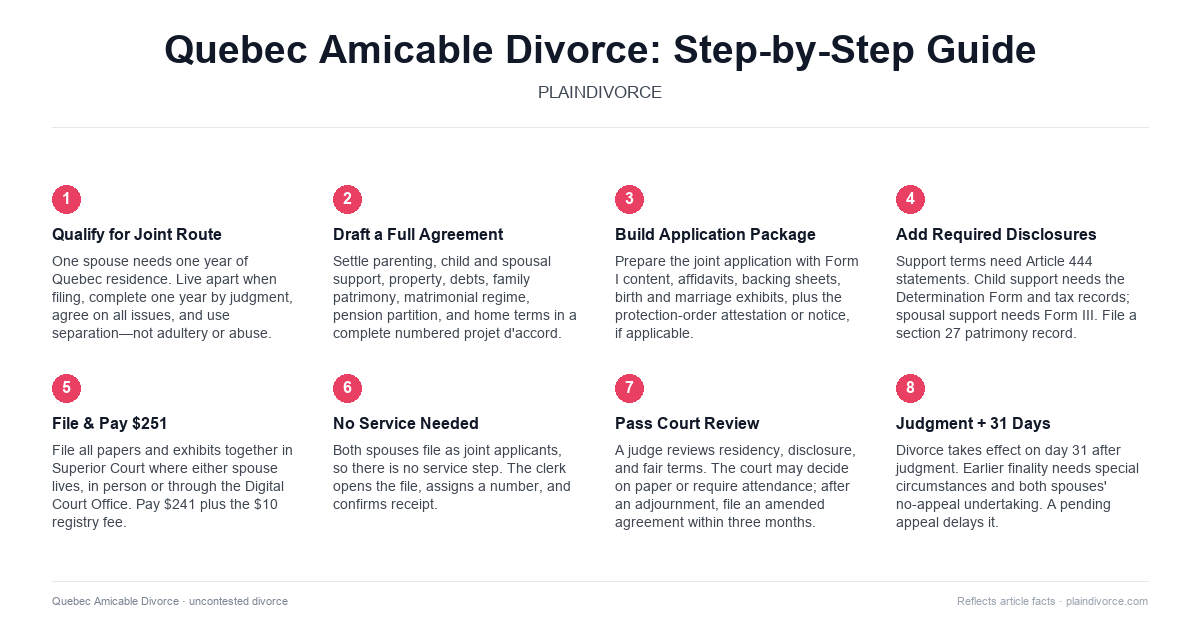
9. Step-by-Step: The Quebec Amicable Divorce Process
Step 1 — Confirm you qualify
- One spouse has been habitually resident in Quebec for the 12 months before filing.
- You are living apart now, and will have been apart at least one year by the time the judgment is rendered.
- You agree on every consequence of the divorce, and the ground is the one-year separation.
Step 2 — Prepare the draft agreement (projet d’accord)
Write a complete, numbered settlement covering parenting time and parental authority, child support (with the calculation), spousal support if any, the family patrimony and matrimonial regime, any compensatory allowance, pension partition, and use or ownership of the home. If you are unsure of the consequences of a term, get legal advice before you sign — the Ministère de la Justice will also pay an accredited family mediator’s fees after you attend a parenting-after-separation information session.
Step 3 — Complete the forms and disclosure
Prepare the joint application (Form I content), the backing sheets, and the civil-status exhibits. Add the protection-order attestation notice if it applies. If the agreement provides for support, add the two Article 444 statements; add the Child Support Determination Form and its tax documents if child support is involved; add Form III if spousal support is involved. Include your section 27 family-patrimony filing. In many districts you also prepare a sworn statement for each spouse.
Step 4 — File in the Superior Court
File at the Superior Court office in the judicial district where you or your spouse lives, in person or through the Digital Court Office of Quebec. Pay the court fee and the $10 federal registry fee. The clerk opens the file, assigns a number, and issues a certificate confirming the application and the applicants’ statement were received. All exhibits must be filed at the same time as the joint application.
Step 5 — Court review and the divorce judgment
A judge reviews the application, the draft agreement, and the disclosure. In districts that accept sworn statements, neither spouse appears and the judgment arrives by mail; in other districts you both attend on a set date. If a clause does not adequately protect a spouse or the children, the court can ask you to amend it and postpone the decision, or refuse to homologate the agreement — and the joint application lapses if you do not present an amended agreement within three months of an adjournment order. Otherwise the court pronounces the divorce and homologates the agreement.
Step 6 — The 31-day wait
Under section 12(1) of the Divorce Act, the divorce takes effect on the 31st day after the judgment is rendered. A court can set an earlier date only if it finds special circumstances and both spouses agree and undertake not to appeal (section 12(2)); a pending appeal pushes the date out (section 12(3)). Neither spouse can remarry until the divorce has taken effect, and you will usually need a certificate of divorce as proof.
10. How Long Does an Uncontested Divorce in Quebec Take?
There is no single number, because the timeline has three moving parts:
- The one-year separation. The judgment cannot issue until you have been apart a full year — often the longest part of the wait.
- Court processing. This varies by judicial district and, heavily, by how complete and consistent your package is. A file missing an Article 444 statement, a tax document, or a family-patrimony filing goes back to you and restarts the clock.
- The 31-day wait after the judgment before the divorce takes effect.
The joint route can shorten some of the delay and legal cost of a contested case, but local practice and the documents your district requires still drive the schedule. Assemble a clean, complete package the first time and you remove the biggest source of delay you actually control.
11. What Does an Uncontested Divorce in Quebec Cost?
For an amicable joint divorce, the mandatory hard cost is small: the court fee to open the file plus a federal registry fee. On Quebec’s tariff of court costs (last updated January 1, 2026), a joint introductory application for divorce, legal separation, or civil union dissolution is $241, versus $362 for a non-joint (sole) application. A federal $10 fee registers the divorce in the Central Registry of Divorce Proceedings. The tariff is re-indexed every January 1, so treat these as a snapshot. If you qualify for legal aid, the judicial fees are covered — file a copy of your eligibility certificate.
| Item | Cost |
|---|---|
| Court fee — joint divorce application | $241 (verify current tariff) |
| Court fee — sole (non-joint) application | $362 (verify current tariff) |
| Federal registry fee (Central Registry of Divorce Proceedings) | $10 |
| Bailiff (huissier) service | Only on a sole application; varies |
| Replacement civil-status certificates (if you need to order them) | Varies by document and registry |
| Commissioner for oaths / notary (for sworn signatures) | Often free at the courthouse; otherwise varies |
| Certified translation (if your district requires it) | Varies |
Court fees and required documents change. Always confirm current amounts on Quebec’s official tariff and with your district’s court office before you file.
12. When a DIY Divorce Is Not Right for You
Handle an amicable divorce yourself only if the agreement is genuinely fair and freely made. Get a lawyer if:
- there is family violence, coercion, intimidation, or a serious power imbalance;
- one spouse does not understand the finances or feels pressured to sign;
- there are complex assets or debts — a business, pensions, stock options, multiple or foreign properties;
- you are unsure how the family patrimony, the matrimonial regime, or a compensatory allowance applies to you; or
- there is any real disagreement about the children or support.
A judge who sees an agreement that shortchanges a spouse or the children will not rubber-stamp it, so an unfair “deal” costs you time as well.
13. Where a Self-Help Divorce Kit Fits In
If your case is truly amicable, a self-help kit earns its place as an organizing tool for a document-heavy process — whether you are assembling the Joint Application for Divorce Quebec courts will accept, drafting a Draft Agreement for Divorce Quebec spouses can sign without a lawyer, or working through the Quebec divorce forms PDF checklist. A good kit:
- walks you through the joint filing pathway and Quebec’s terminology;
- keeps you on top of the real package — application, draft agreement, backing sheets, civil-status exhibits, the protection-order attestation, the Article 444 statements, the Child Support Determination Form or Form III, and the section 27 family-patrimony filing; and
- heads off the errors that get files sent back: missing signatures, inconsistent dates, vague parenting or support terms, and missing disclosure.
Our Quebec uncontested divorce kit is built around the current government models and disclosure rules. It does not replace legal advice, and you are responsible for using the current court forms and confirming current fees and filing procedures with your district.
PlainDivorce is not a law firm and does not provide legal advice. This guide is legal information about the amicable divorce process in Quebec, not a substitute for advice about your situation.
14. FAQ
What is an uncontested or simple divorce in Quebec?
Quebec calls it an amicable divorce. Both spouses file a joint application for divorce together, with a signed draft agreement that settles children, support, and property, and the Superior Court of Quebec pronounces the divorce and homologates the agreement without a contested trial. It is available only when you agree on everything, the ground is the one-year separation, and adultery or abuse is not raised.
What is Form I in Quebec?
Form I is the model the Regulation of the Superior Court of Quebec in family matters sets for the divorce application, which must be supported by an affidavit. In the self-represented joint route you follow the “Joint Application for Divorce” model published in the government’s Joint Application for Divorce on a Draft Agreement brochure, which is Form I adapted for two joint applicants filing together.
Is Form III required for child support in Quebec?
No. Form III (Statement of Income and Expenditures and Balance Sheet) is the sworn financial statement for a spousal-support claim. Child support is documented with the Child Support Determination Form under the Quebec model, each parent’s statement required under article 444 of the Code of Civil Procedure, and supporting tax documents. Use Form III only when your agreement provides spousal support.
Do we need a family patrimony statement if we already agree?
You need one of four things in the court record under section 27 of the Regulation: a declaration that you are not subject to the family-patrimony rules, a renunciation of partition, a declaration that partition is not contested, or the family-patrimony calculation form with a sworn statement. There is no universal “Form IV” patrimony statement — current Form IV is a consent to a psychosocial evaluation.
Where can I get the official Quebec divorce forms (PDF)?
The Ministère de la Justice publishes a free Joint Application for Divorce on a Draft Agreement brochure with the application, draft-agreement outline, backing sheet, sworn statement, and article 444 statement, plus a standalone Child Support Determination Form. Quebec.ca also hosts a separation and divorce forms library. Always work from the version currently linked by Quebec.ca or the Superior Court, since these are updated periodically.
How much does a joint divorce cost to file in Quebec?
On the 2026 tariff, the court fee for a joint divorce application is $241, plus a $10 federal registry fee — about $251 in mandatory court costs before any other expense such as replacement certificates or a translation. A sole application is $362. The tariff is re-indexed every January 1, and legal aid covers the judicial fees if you qualify.
How long after the judgment is the divorce final in Quebec?
The divorce takes effect on the 31st day after the judgment is rendered, under section 12 of the Divorce Act. A court can order an earlier date only in special circumstances, and only if both spouses agree and undertake not to appeal; a pending appeal delays it. Neither spouse can remarry until the divorce has taken effect.
Do we have to go to court for an amicable divorce in Quebec?
Often not. In many judicial districts a judge can grant the divorce on sworn statements — one signed by each spouse before a person authorized to administer oaths — and you receive the judgment by mail without appearing. Other districts require both spouses to attend on a set date. Ask the court office in your district what its practice is before you file.
Sources and local rules can change. Use this guide as a plain-English organizer, then verify the current filing requirements with the official court or government source for your jurisdiction.

About Harry D
Expert contributor at PlainDivorce, helping Canadians and American navigate simple uncontested divorces with clarity and confidence.