Rhode Island Nominal Divorce: A Plain-English Guide to an Uncontested Divorce
A Rhode Island nominal divorce is an uncontested divorce that moves on the Family Court’s fast “nominal track”: you and your spouse settle every issue in writing, one spouse files a Complaint for Divorce, and a judge approves the agreement at a short Nominal Hearing. The judge then signs a decision, and about three months later a separate Final Judgment makes the divorce final. There is no paperwork-only divorce in Rhode Island, and the case does not finalize on its own when the three months pass.
This guide explains, in plain English, how the process works: who qualifies, the residency and witness rules that trip people up, the exact filing package, the FC-5/DR-6 Financial Statement, what changes when you have children, realistic timelines, costs, and where a do-it-yourself (DIY) approach fits. It also flags the situations where handling everything alone is a bad idea.
Red alert (Rhode Island residency witnesses): The Rhode Island Judiciary’s own Nominal Divorce Proceeding sheet tells every filer to bring two witnesses who can testify that you have lived in Rhode Island for the year before you filed. In practice one witness is usually enough if both spouses attend the hearing, and a sworn affidavit from one witness can sometimes stand in for live testimony. Sort this out early — showing up with no residency proof is a common reason hearings get continued for weeks.
TL;DR
A Rhode Island “nominal divorce” is an uncontested divorce on the Family Court’s fast track. You settle everything in writing, one spouse files a Complaint for Divorce, and a judge approves the deal at a short Nominal Hearing. There is no paperwork-only divorce here, and the case does not finalize on its own.
- Residency: the filing spouse must have been a domiciled Rhode Island resident for one year before filing (§ 15-5-12). If your spouse meets it and is served, that satisfies the rule.
- Bring a residency witness. The Judiciary’s own sheet says bring two witnesses to confirm your year of residence. In practice one is often enough when both spouses attend, and a sworn affidavit can sometimes substitute — but showing up with nothing gets your hearing continued. Ask your clerk first.
- You must attend a hearing. The Nominal Hearing is short, but the judge asks set questions about residency, the marriage, the breakdown, and any custody, parenting time, and support terms.
- Two-step ending. The judge signs a Decision Pending Entry of Final Judgment (FC-45) — which says on its face that you are still married. A separate Final Judgment (FC-44) must be presented and entered before the divorce is real.
- The wait: three calendar months after the decision before a Final Judgment can be entered — or only 20 days if your ground is the three-year separation. Present the FC-44 within 180 days after that period, or entry requires a court appearance.
- The filing package: Complaint (FC-56, nominal box checked, notarized) plus the cover sheet (FC-75), the FC-5/DR-6 Financial Statement, the Statement Listing Children (FC-59), your marriage certificate, and the Child Support Guideline Worksheet (FC-78) if you have kids.
- The FC-5/DR-6 is where cases stall. It’s confidential, signed under penalty of perjury, and needs real numbers — income, expenses, assets, debts, health insurance. Treat it like an audit.
- Cost: the filing fee is commonly reported around $160 plus a technology surcharge of up to $25, but the Judiciary doesn’t publish it — confirm with the clerk. Fee waiver available via a Motion to Proceed in Forma Pauperis (filed on paper).
- Realistic timeline: about 63 days from filing to the hearing, then the three months, so most uncontested cases run five to seven months.
- Get a lawyer if there’s abuse or intimidation, hidden or complex finances, a real dispute about the children, immigration or tax exposure, or pressure to “just sign.”
1. What Is a Nominal Divorce in Rhode Island?
A Rhode Island nominal divorce is an uncontested divorce that the Family Court places on its “nominal track.” That is the court’s own language: the Complaint for Divorce (Form FC-56) has a checkbox that reads “I hereby request that this matter be placed on the ‘nominal track’ calendar,” and the Family Court’s e-filing rules list a “Nominal Track Divorce” as a distinct case type. “Nominal divorce” is just the everyday shorthand.
A case belongs on the nominal track when:
- Both spouses agree the marriage is over, usually on the no-fault ground of irreconcilable differences that have caused the marriage to break down irreparably.
- They agree on every issue: dividing property and debt, and — if it applies — custody and a parenting schedule, child support, and any spousal support (alimony).
- One spouse files the Complaint for Divorce and the other cooperates instead of contesting the case.
Rhode Island does not grant an uncontested divorce on paperwork alone. Even a fully agreed nominal case gets a short Nominal Hearing in front of a judge, who confirms residency, the ground for the divorce, and the agreement, then makes findings of fact. That decision starts the roughly three-month clock before the divorce can be made final.
2. Who Qualifies for a Nominal Divorce in Rhode Island?
Before you invest time in paperwork or a DIY kit, confirm three things: you meet the residency rule, you have a valid ground for divorce, and your case is genuinely uncontested.
Residency and domicile
Under Rhode Island General Laws § 15-5-12, the spouse who files (the plaintiff) must have been a domiciled inhabitant of Rhode Island and a resident of the state for one year before filing the complaint. “Domiciled” means Rhode Island is your true, permanent home — not a temporary stay. There are two important wrinkles:
- If the other spouse (the defendant) meets the one-year test and is properly served, the plaintiff’s own residency requirement is treated as satisfied.
- Members of the armed forces and merchant marine keep their earlier Rhode Island domicile during their service and for 30 days afterward.
Corroborating the year of residence. The Rhode Island Judiciary’s Nominal Divorce Proceeding question sheet instructs every filer to bring two witnesses who can testify about your residence for the year before you filed — a friend, relative, neighbor, or coworker with personal knowledge of where you live. Common practice: if both spouses appear, one witness is usually enough; if only the filing spouse appears, expect to need two witnesses, or one witness plus a sworn affidavit from another. Section 15-5-12 also lets the court accept “the ex parte affidavit of one witness” instead of live testimony. Because judges handle this differently, ask the clerk what your assigned courthouse expects before your hearing date.
No-fault grounds: irreconcilable differences or three-year separation
Rhode Island recognizes both fault and no-fault grounds. Nominal cases almost always use one of the two no-fault options:
- Irreconcilable differences — you both agree the marriage has broken down irreparably with no realistic chance of reconciliation (§ 15-5-3.1). This is the standard nominal-divorce ground.
- Living separate and apart for at least three years — whether voluntary or not (§ 15-5-3). This ground has a different final-judgment clock: the Final Judgment can be entered 20 days after the decision, not three months. If you might use it, tell the clerk so your paperwork reflects the shorter timeline.
When a nominal divorce is a good fit
- You meet the residency and grounds requirements.
- Both spouses are ready to end the marriage.
- You can communicate well enough to cooperate and exchange full financial information.
- You have a complete agreement (or can reach one) on property, debts, and support — and, with children, on custody and parenting time.
- Neither spouse is hiding assets or pressuring the other into an unfair deal.
When “uncontested” may not actually work
- There is a history of domestic violence, threats, or coercive control.
- One spouse controls all the money and the other has little information.
- You disagree about custody, relocation, or a child’s safety.
- You own a business, have significant retirement or investment assets, or have complicated tax issues.
- One spouse has immigration concerns tied to the marriage.
In those situations, get Rhode Island-specific legal advice before you sign anything or file a Complaint for Divorce.
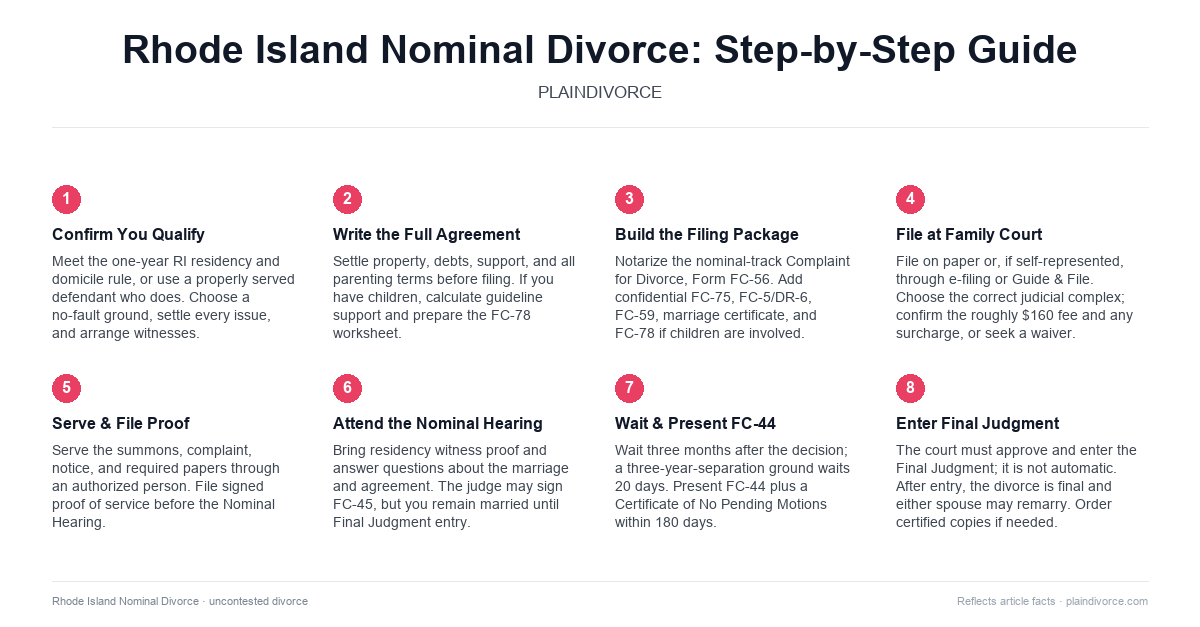
3. Step by Step: Complaint, Nominal Hearing, and Final Judgment
Most Rhode Island nominal divorces follow the same path. Here it is in the Family Court’s own vocabulary so the instructions and forms make sense.
Step 1 – Confirm you qualify
- Confirm the one-year residency/domicile rule for you or your spouse, and line up witnesses for the year of residence.
- Confirm your ground (usually irreconcilable differences).
- Confirm you agree on every issue, or are very close.
Step 2 – Reach a full written agreement
Settle the big decisions before you file. The cleaner your agreement, the smoother the Nominal Hearing.
- Property and debts: house or lease, vehicles, bank accounts, credit cards, loans, retirement and investment accounts.
- Support: child support (calculated on the guideline worksheet) and any spousal support.
- Parenting: legal custody and decision-making, physical placement, and a specific weekday, weekend, holiday, and vacation schedule.
Step 3 – Prepare the nominal-track filing package
One spouse files the Complaint for Divorce (Form FC-56) — nominal-track box checked, signed in front of a notary — together with the required attachments the Family Court lists for a nominal divorce:
- Family Court Cover Sheet (FC-75) — filed as confidential.
- Statement of Assets, Liabilities, Income, and Expenses (FC-5/DR-6 Financial Statement) — confidential (see section 4).
- Statement Listing Children (FC-59) — confidential.
- Marriage certificate (or an affidavit supporting a common-law marriage), plus a certified translation if it is not in English.
- Child Support Guideline Worksheet (FC-78) if you have minor children.
Attorneys must e-file through the Judiciary’s Odyssey system; self-represented filers may e-file (including through the Judiciary’s Guide & File interviews) or file on paper at the clerk’s office. The clerk will reject a package that is missing a required document, a signature, or notarization — being uncontested does not change that. You can read the requirements in the Family Court’s e-filing guidelines for domestic relations cases.
Step 4 – File at the right Family Court location
Rhode Island’s Family Court sits at four judicial complexes: Garrahy (Providence and Bristol counties, Providence), Noel (Kent County, Warwick), Murray (Newport County, Newport), and McGrath (Washington County, Wakefield). You select the correct location on the complaint. When you file, you pay the filing fee (or file a fee-waiver motion), get a case number, and the system assigns your Nominal Hearing date.
Step 5 – Serve your spouse
After the complaint is accepted, the clerk issues a summons with your hearing date on it. Even with a cooperative spouse, the case has to follow proper notice rules. A few specifics:
- The summons, complaint, a Language Assistance Notice, and the other required documents are served together.
- Initiating documents that must be hand-delivered cannot be served electronically; the filing party arranges service through a constable, sheriff, or other authorized person.
- The signed proof of service must be filed with the court before the hearing.
Step 6 – Attend the Nominal Hearing
The Nominal Hearing is short. Using its published question sheet, the judge asks you to confirm your name and address, that you meet the one-year residency rule, your marriage date, what caused the breakdown, that there is no chance of reconciliation, and — if you have children — the custody, visitation, holiday, and child-support arrangements, followed by questions about real estate and retirement accounts. Bring your residency witness(es).
If everything is in order, the judge makes findings of fact and signs a Decision Pending Entry of Final Judgment (Form FC-45). Read what that form says on its face: “This is not a Final Judgment of Divorce. The parties remain legally married until entry by this court of a Final Judgment.” This decision is what people loosely call the “interlocutory” decision, and it starts the Rhode Island divorce waiting period.
Step 7 – Enter the Final Judgment (a separate step)
Under § 15-5-23, no Final Judgment can be entered until three calendar months after the date of the decision. It does not happen automatically:
- Within 180 days after that three-month period, the prevailing party can present a proposed Final Judgment (Form FC-44) to the judge in chambers, with a Certificate of No Pending Motions. The judge approves it and it is entered.
- After the 180 days, a Final Judgment can be entered only in open court, on motion or the written consent of both parties — more steps and more delay.
Miss this step and you stay legally married, even though the hearing already happened. Once the Final Judgment is entered, either spouse may remarry. Order certified copies then for name changes, benefits, refinancing, or a future marriage.
4. The FC-5/DR-6 Financial Statement
The form that stresses Rhode Island filers most is the Statement of Assets, Liabilities, Income, and Expenses — still widely called the DR-6 Financial Statement, and numbered FC-5/DR-6 on the current form. It is the Family Court’s core financial disclosure in a divorce, it is filed as confidential, and it is signed under penalty of perjury with the notary certification the form requires. Follow the instructions printed on the form itself.
Why it matters: the judge uses financial disclosure to check that the deal is fair, especially where there is support, children, or significant property and debt. A missing or sloppy FC-5/DR-6 delays a nominal divorce and can mean a return trip to court.
What to gather:
- Income documentation (recent pay stubs, tax returns, other proof of earnings)
- Monthly expenses (housing, utilities, insurance, transportation, child costs)
- Assets (bank accounts, vehicles, retirement and investment accounts, real estate)
- Debts (credit cards, loans, arrears)
- Health-insurance details, including the cost to cover the children
Practical tip: prepare it like an audit. Use consistent numbers, keep backup documents, and don’t guess when you can verify. If you truly cannot pin down a figure, note how you estimated it.
5. Special Issues When You Have Children
Even in a nominal divorce, the Family Court has to be satisfied that the parenting and support terms are in the children’s best interests. The court also has an independent duty to weigh evidence of past or present domestic violence in any custody or visitation decision and to treat the safety of the child and of a victim parent as the primary concern (§ 15-5-16).
Parenting plan and custody
- Physical placement (where the children primarily live)
- Legal custody and decision-making (school, medical, religion)
- A detailed schedule: weekdays, weekends, holidays, school breaks, vacations
- Communication rules and a way to resolve future disagreements
Child support and the FC-78 worksheet
Rhode Island sets child support with a formula and guidelines adopted by the Family Court (§ 15-5-16.2). The math goes on the Child Support Guideline Worksheet (FC-78), which the form itself says must be filed with a divorce complaint and again with any answer or modification. Even if you agree on a different number, the judge will want to see the guideline calculation and a reason for any deviation — and a deviation needs written findings that the guideline amount would be unfair to the child or a parent.
Every Rhode Island child-support order also has to:
- Address health-care coverage for the children — a parent obtains coverage when it is available at reasonable cost, or pays cash medical support toward the premium.
- Be recorded in the state’s registry of support orders and carry immediate income withholding unless an exception applies.
- Trigger a continuing duty: each parent must tell the Family Court about a change of address, employer, or contact information within 10 days.
6. How Long Does a Nominal Divorce Take in Rhode Island?
Two things drive the timeline: when the Nominal Hearing is scheduled, and the three-month period that runs after it before a Final Judgment can be entered.
| Stage | Typical timing |
|---|---|
| Filing → Nominal Hearing | Auto-scheduled about 63 days after the filing is accepted (the court assigns the next available session if the judge’s calendar is full) |
| Nominal Hearing → eligible for Final Judgment | Three calendar months after the date of the decision (only 20 days if the ground is the three-year separation) |
| Presenting the Final Judgment (FC-44) | Best done within 180 days after the three-month period, in chambers; slower and more formal after that |
A simple way to picture it: Nominal Hearing (decision date) → three months run → party presents FC-44 with a Certificate of No Pending Motions → judge approves and the Final Judgment is entered. Realistically, many uncontested Rhode Island cases finish in roughly five to seven months from filing.
Delays usually come from hard-to-complete service, an incomplete FC-5/DR-6, a missing signature or notarization, no residency witness at the hearing, or forgetting to present the Final Judgment.
7. What Does a Nominal Divorce Cost in Rhode Island?
Court filing fee
The Family Court charges a filing fee when you file the Complaint for Divorce. It is commonly reported at around $160, and a technology surcharge of up to $25 can apply to electronic transactions. The Judiciary does not publish a divorce fee schedule online, so confirm the current total with the Family Court clerk before you file.
Service and other expenses
- Service of process (constable or sheriff)
- Notary fees for the complaint and the FC-5/DR-6
- Copies, postage, travel, and parking
- Certified copies of the Final Judgment
Fee waiver
If you cannot afford the fees, file a Motion to Proceed in Forma Pauperis with a proposed order, an affidavit in support, and supporting financial documentation, at the clerk’s office (this motion is filed on paper, not e-filed). The duty judicial officer decides it; if granted, filing and service costs are waived.
Optional professional help
Some couples stay uncontested but still pay for a mediator to reach agreement, or a lawyer to review the settlement and financial statements before the hearing. A limited-scope review often costs less than the delays it prevents when there are children, support, or significant assets involved.
8. When a DIY Divorce Might Not Be Right for You
A DIY nominal divorce keeps costs down — but only when the case is genuinely safe and fair. Get legal help if any of these apply:
- Domestic violence or intimidation
- Hidden or complex finances (a business, large retirement or investment accounts, complicated debt)
- Real disagreement about the children (custody, relocation, safety)
- Serious immigration or tax issues
- Uneven bargaining power (pressure to “just sign”)
If something feels unsafe, confusing, or one-sided, pause and get Rhode Island-specific advice before filing or signing.
9. Where a Self-Help Divorce Kit Fits Into the Process
If your case is a good fit for a Rhode Island nominal divorce, a self-help kit helps most at the points where DIY cases stall: assembling the FC-5/DR-6 financial disclosure, building a complete filing package, preparing for the Nominal Hearing, bringing a residency witness, and remembering the separate Final Judgment step after the three-month period.
- Explains the workflow: complaint → service → Nominal Hearing → three-month period → Final Judgment.
- Keeps you organized with checklists and deadlines.
- Helps you gather what you need for a Rhode Island Complaint for Divorce, the FC-5/DR-6, and child-related documents.
- Cuts the errors that trigger clerk rejections and continued hearings.
- Gets you to the Nominal Hearing prepared instead of guessing.
PlainDivorce.com kits are for people who want an affordable, agreement-based divorce and are comfortable handling their own paperwork — but want structure instead of piecing it together from scattered sources. Court staff can explain procedure, but they cannot give legal advice or tell you what to write, so always verify current requirements with the Rhode Island Judiciary.
10. Rhode Island Nominal Divorce FAQ
What is a nominal divorce in Rhode Island?
A nominal divorce is Rhode Island’s uncontested divorce. The Family Court places a fully agreed case on its “nominal track,” so it moves faster than a contested case and is resolved at one short Nominal Hearing where the judge confirms residency, the ground for divorce, and your settlement, then signs a decision that starts the waiting period before the Final Judgment.
Do I have to go to a hearing for an uncontested divorce in Rhode Island?
Yes. Rhode Island does not grant a divorce on paperwork alone. The filing spouse must attend a brief Nominal Hearing — often only a few minutes — and answer the judge’s standard questions about residency, the marriage, and the agreement. If you have children, expect questions about custody, the parenting schedule, and child support.
Do I need a witness at the Rhode Island nominal divorce hearing?
Usually. The Rhode Island Judiciary’s Nominal Divorce Proceeding sheet tells filers to bring two witnesses who can confirm you lived in Rhode Island for the year before filing. In practice one witness is often enough when both spouses attend, and under § 15-5-12 a sworn affidavit from one witness can sometimes replace live testimony. Ask your courthouse clerk what that judge expects.
What is the FC-5/DR-6 Financial Statement?
It is the Rhode Island Family Court’s mandatory financial disclosure in a divorce — the Statement of Assets, Liabilities, Income, and Expenses, still commonly called the DR-6. It lists your income, monthly expenses, assets, debts, and health-insurance information, is filed as a confidential document, and is signed under penalty of perjury with the notary certification the form requires.
How long is the divorce waiting period in Rhode Island?
For most nominal divorces, a Final Judgment cannot be entered until three calendar months after the date of the judge’s decision at the Nominal Hearing. If the ground is living separate and apart for three years, the period is only 20 days. Add roughly two months from filing to the hearing, so many uncontested cases take about five to seven months overall.
Is my divorce final when the three months are up?
No. The three-month decision (Form FC-45) states that you remain legally married until a Final Judgment is entered. Someone has to present a proposed Final Judgment (Form FC-44) with a Certificate of No Pending Motions for the judge to approve. Best practice is to do this within 180 days after the three-month period; after that, entry requires a court appearance.
How much does a nominal divorce cost in Rhode Island?
Budget for the Family Court filing fee (commonly reported around $160, plus a technology surcharge of up to $25), service of process, notary fees, and certified copies at the end. Confirm the current filing fee with the clerk. If you cannot afford it, file a Motion to Proceed in Forma Pauperis with a supporting affidavit and financial documentation.
What are the residency requirements for a Rhode Island divorce?
The filing spouse must have been a domiciled inhabitant and resident of Rhode Island for one year before filing (§ 15-5-12). If the other spouse meets that one-year test and is served, the requirement is treated as satisfied. Service members keep their prior Rhode Island domicile during service and for 30 days after.
11. Final Thoughts and Next Steps
Even when both spouses agree, a divorce is a major transition. If you are aiming for a Rhode Island nominal divorce, staying organized and using the court’s own terminology keeps it moving:
- Confirm residency and your ground, and line up your residency witness(es).
- Reach a complete written agreement on money and children.
- File the Complaint for Divorce (FC-56) with the full nominal-track package (FC-75, FC-5/DR-6, FC-59, marriage certificate, and FC-78 if you have children).
- Complete service and file the proof of service before the hearing.
- Attend the Nominal Hearing and get the Decision Pending Entry of Final Judgment (FC-45).
- After three months, present the Final Judgment (FC-44) with a Certificate of No Pending Motions — then order certified copies.
A structured Rhode Island uncontested divorce kit can carry you through each of those steps. And again: PlainDivorce.com is not a law firm and does not give legal advice. This guide is educational only. Confirm current rules, forms, and fees with the Rhode Island Judiciary, and get legal help if anything about your situation feels unsafe, disputed, or unusually complex.
Sources and local rules can change. Use this guide as a plain-English organizer, then verify the current filing requirements with the official court or government source for your jurisdiction.

About Harry D
Expert contributor at PlainDivorce, helping Canadians and American navigate simple uncontested divorces with clarity and confidence.