Uncontested Divorce in Saskatchewan: The Joint Petition (Form 15-100A) and Desk Divorce, Explained
An uncontested divorce in Saskatchewan is a divorce the Court of King’s Bench for Saskatchewan grants on the paperwork alone, with no hearing, because neither spouse is asking a judge to decide a dispute. Cooperative spouses file a Joint Petition (Form 15-100A) together under Rule 15-100 and never have to serve each other. Otherwise, one spouse files a Petition (Form 15-16), serves it, and the case proceeds undefended when the other spouse files no Answer. Either way, the divorce takes effect on the 31st day after the judge signs the judgment.
TL;DR: an uncontested divorce in Saskatchewan at a glance
- Two filing routes. A Joint Petition (Form 15-100A), signed by both spouses as co-petitioners and then sealed by the local registrar (no service, no noting in default), or a sole Petition (Form 15-16) that is served on your spouse and proceeds when no Answer (Form 15-19A) is filed.
- “Form 15-2” is out of date. If you searched for a Joint Petition for Divorce Form 15-2, that number is from the pre-2023 rules. Saskatchewan renumbered its family-law forms; the joint petition today is Form 15-100A.
- The sworn evidence is the Affidavit of Petitioner (or Respondent), Form 15-78. That is the current document behind an “Affidavit of Applicant” search in Saskatchewan.
- The document the judge signs is the Divorce Judgment (Form 15-102), followed by the Certificate of Divorce (Form 15-103) as proof. A search for “Judgment for Divorce Form 15-61” is off: current Form 15-61 is a Joint Request for a Family Law Pre-Trial Conference.
- You must qualify: one year’s ordinary residence in Saskatchewan, and (in most cases) one year of separation before the divorce is granted.
- Parents have extra steps: the Parenting After Separation course, possibly a family dispute resolution certificate, financial disclosure, and a judge who must be satisfied child support is reasonable.
- Cost: $300 to start the divorce, $95 to apply for judgment, $10 for a certified copy of the order (all per the July 2024 Tariff of Costs).
- Forms: the King’s Bench Part 15 forms are published online by Publications Saskatchewan; the court’s guided Self-Help Divorce Kit is provided on request by the Family Law Information Centre.
A note on form numbers: Saskatchewan renumbered Part 15 (Family Law Proceedings) of the King’s Bench Rules effective the October 13, 2023 Gazette amendment. Older guides that reference a “Joint Petition for Divorce (Form 15-2),” a “Petition for Divorce (Form 15-1),” a “Financial Statement (Form 15-26),” or a “Judgment for Divorce (Form 15-61)” are using numbering that is no longer current. This guide uses the forms in force today.
1. What is an uncontested (simple) divorce in Saskatchewan?
Divorce in Canada is governed by the federal Divorce Act, but the paperwork and process in Saskatchewan run through the Court of King’s Bench for Saskatchewan under Part 15 (Family Law Proceedings) of The King’s Bench Rules. People also call this a “simple divorce.”
A divorce is uncontested when the court does not have to resolve a dispute. In practice that means:
- both spouses accept that the marriage has broken down;
- there is no live court fight about parenting, child support, spousal support, or property; and
- either you file together as co-petitioners, or one spouse files and the other does not defend.
Uncontested files are handled under Division 6 of Part 15 (“Resolving Claims Without a Full Trial”). Many are finished without anyone appearing in court: under Rule 15-80 a judge may grant judgment without an appearance, but the same rule lets the judge require an appearance or oral evidence if the file is thin or the arrangements for children look unreasonable. There is no published statistic on how often each happens, so treat “no hearing” as the likely path for a clean file, not a guarantee.
2. Joint Petition (Form 15-100A) vs sole Petition (Form 15-16)
This is where older Saskatchewan guides go wrong. There is no single form used for both sole and joint divorces. The two paths use two different forms:
- Sole route — Petition (Form 15-16), Rule 15-16. One spouse (the petitioner) starts the case. The petition is signed by the petitioner, then signed and sealed by the local registrar, and must be served on the other spouse.
- Joint route — Joint Petition (Form 15-100A), Rule 15-100. Both spouses are “co-petitioners.” The Joint Petition is signed by both, then signed and sealed by the local registrar. Under Rule 15-100(2) it need not be served on either spouse and need not be noted for default. If a dispute later arises, a spouse files a Notice of Withdrawal of Joint Petition (Form 15-100B) with an Answer and Counter-Petition.
You can only use the joint route if “the facts establishing the breakdown of the marriage and the remedy claimed are not in dispute” (Rule 15-100(1)). When co-petitioners later apply for the divorce judgment, Rule 15-100(4)-(5) requires the same materials as a sole uncontested divorce “with any necessary modification,” and each co-petitioner must file their own Affidavit of Petitioner in Form 15-78.
- Why the joint route helps: it removes the need to serve your spouse, so you avoid the cost of a process server or sheriff and the delay of proving service.
- Why accuracy matters: if you have seen “Joint Petition for Divorce Form 15-2” quoted anywhere, that is the pre-October-2023 number. The current joint petition is Form 15-100A.
Get the PlainDivorce Saskatchewan Uncontested Divorce Self-Help Kit
3. Who qualifies for an uncontested divorce in Saskatchewan?
Residency requirement
Under section 3 of the Divorce Act, a Saskatchewan court can hear your divorce if you or your spouse has been ordinarily resident in Saskatchewan for at least one year immediately before the proceeding starts. This federal rule was not affected by the 2023 provincial renumbering.
Grounds and the one-year separation rule
There is only one ground for divorce in Canada: breakdown of the marriage. Under section 8, breakdown is established by one year’s separation, adultery, or cruelty. Almost every uncontested divorce relies on one-year separation because it is the cleanest no-fault path.
- You must be living separate and apart when the proceeding starts, and separate and apart for at least one year immediately before the court determines the divorce. You can file before the year is complete; the divorce simply is not granted until it passes.
- A reconciliation attempt (or attempts) totalling no more than 90 days does not reset the separation clock if getting back together was the main purpose.
- Adultery and cruelty are also grounds, but they usually add evidence and complexity, so most cooperative couples do not use them.
When your case is a good fit
- You meet the one-year Saskatchewan residency rule.
- You can rely on one-year separation.
- You and your spouse agree on parenting, support, and property, or those issues are already settled in writing.
- You can file jointly (best case), or you expect your spouse not to defend.
If there is fear, coercion, a large financial imbalance, or a real parenting dispute, get legal advice before you file.
4. The current Saskatchewan divorce form stack
Generic guides say “file the divorce papers.” In Saskatchewan you save yourself missed-step delays by using the correct, current King’s Bench form numbers. Here is the stack that applies to an uncontested divorce today.
| Form | What it is | When you use it |
|---|---|---|
| Form 15-16 | Petition (sole) | One spouse starts the case; must be served. |
| Form 15-100A | Joint Petition | Both spouses start the case as co-petitioners; no service. |
| Form 15-100B | Notice of Withdrawal of Joint Petition | A co-petitioner pulls out and the matter becomes contested. |
| Form 15-78 | Affidavit of Petitioner (or Respondent) | Your sworn evidence for the desk decision (each co-petitioner files one). |
| Form 15-76A / 15-76B | Application for Judgment (without notice / with notice) | The step that puts the file in front of a judge. |
| Form 15-47 | Financial Statement | Child or spousal support is claimed (unless an exception applies). |
| Form 15-48A / 15-48B | Waiver of Financial Statements / Agreement as to Child Support | Support is agreed, so no full Financial Statement is filed. |
| Form 15-49 | Property Statement | A property claim is made (unless waived). |
| Form 15-50 | Waiver of Property Statements | Both spouses agree on the property remedy and file the waiver. |
| Form 15-102 | Divorce Judgment | The order the judge signs to end the marriage. |
| Form 15-103 | Certificate of Divorce | Official proof of the divorce, requested afterward. |
Two corrections worth flagging. Under the current rules, Form 15-26 is the Application for Variation of a Final Order (used later, to change a final order), not a Financial Statement — the Financial Statement is Form 15-47. And Form 15-61 is now a Joint Request for a Family Law Pre-Trial Conference, not a “Judgment for Divorce.” Use these current numbers to fill in your forms; do not use them to work out what an old form number used to mean.
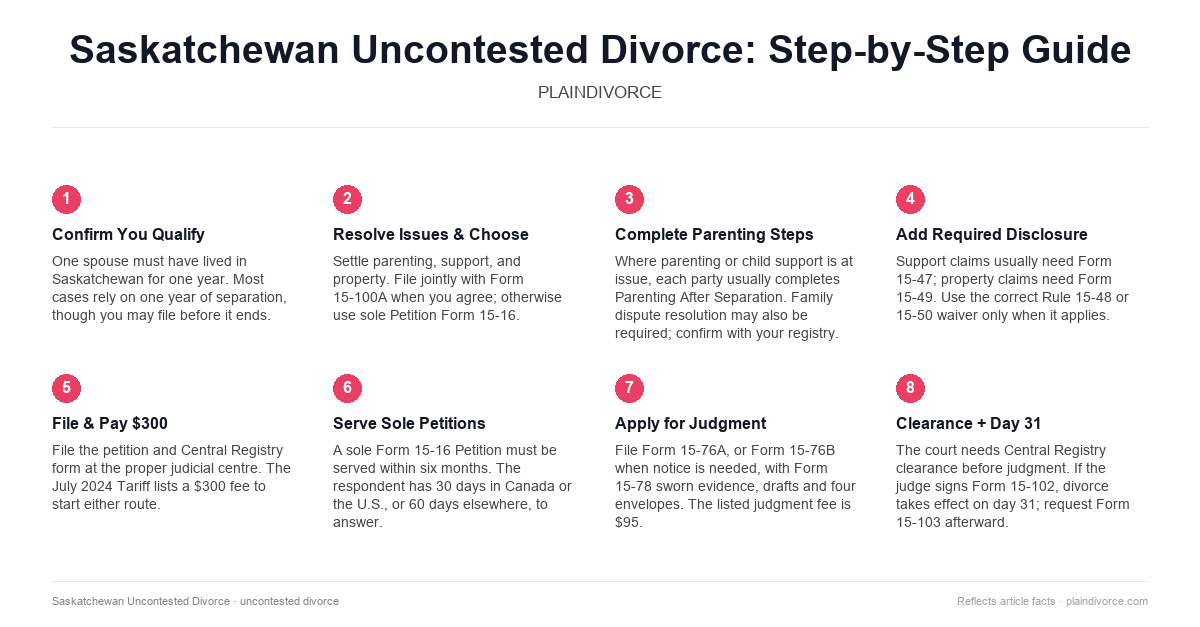
5. Step-by-step: from filing to divorce judgment
This is a practical roadmap for an uncontested divorce in Saskatchewan. Always follow the newest instructions and form versions for your judicial centre.
Step 1: Confirm eligibility
- You or your spouse has lived in Saskatchewan for at least one year.
- You have a ground — almost always one-year separation.
- The divorce itself is not opposed, and you can gather acceptable proof of marriage (a certificate of marriage or certificate of registration of marriage).
Step 2: Settle children, support, and property
Even in an uncontested file, the court still checks that the arrangements are reasonable — especially for children and child support. Put your agreement in writing before you file. Where there are children of the marriage, section 11 of the Divorce Act requires the judge to be satisfied that reasonable child-support arrangements have been made under the Federal Child Support Guidelines, and to stay the divorce until they are.
Step 3: Choose your route and complete the petition
- Best case: complete the Joint Petition (Form 15-100A) together and file it as co-petitioners under Rule 15-100 (no service).
- If you must file alone: complete the Petition (Form 15-16) as the sole petitioner. The petition asks you to confirm one of: a certificate of marriage is filed, an undertaking to file one is given, or it is impossible or impractical to obtain one and you are asking the court to dispense with it.
Step 4: Financial and property disclosure (or a waiver)
- Support claimed: file a Financial Statement (Form 15-47) — unless a Rule 15-48 exception applies. No Financial Statement is needed if the only claim is child support in the Guidelines table amount (Rule 15-48(3)); if child support is agreed, you file an Agreement as to Child Support (Form 15-48B) with the required tax returns and notices of assessment (Rule 15-48(2)); if spousal support is agreed, you file a Waiver of Financial Statements (Form 15-48A) (Rule 15-48(1)).
- Property claimed: file a Property Statement (Form 15-49) — unless both spouses have agreed on the remedy and filed a Waiver of Property Statements (Form 15-50) (Rule 15-50). Simply “agreeing to waive” is not enough; the signed Form 15-50 must be on file.
Step 5: Parenting After Separation and family dispute resolution
If your case involves child support or parenting, each party generally must complete the Parenting After Separation (PAS) course and file a Certificate of Attendance before taking any further step (Rule 15-15). Separately, when required under The King’s Bench Act and its regulations, the parties must complete a family dispute resolution step at the close of pleadings and file a participation or exemption certificate (Rule 15-14). See sections 8 and 9 for detail — both are hard stops, and PAS is not the only one.
Step 6: Prepare the sworn evidence (Form 15-78)
In an uncontested proceeding, Rule 15-77 requires the evidence to be given by affidavit rather than live testimony. The form is the Affidavit of Petitioner (or Respondent), Form 15-78. For an uncontested divorce, Rule 15-82 says your Form 15-78 must set out:
- the grounds and evidence supporting the claim, and confirmation that the facts in the petition are still true;
- proof of the marriage, if no certificate has been filed;
- evidence that there is no possibility of reconciliation and no collusion;
- the arrangements for the support of any children of the marriage, plus the required income and financial information;
- on the separation ground, evidence that you lived separate and apart for at least one year before the divorce is determined and were separate and apart when the proceeding began.
If you have searched for “Affidavit of Applicant Saskatchewan,” Form 15-78 is the current document that name points to. Confirm the current template with the Court of King’s Bench or the Family Law Information Centre before you swear it.
Step 7: File with the Court of King’s Bench
File your package at the appropriate judicial centre, pay the filing fee (see section 11), and receive your court file number and sealed copies. A sole Petition (Form 15-16) must be served within 6 months of being issued unless the court orders otherwise; a Joint Petition (Form 15-100A) does not need to be served.
Step 8: Service and response deadlines (sole route only)
If you filed a sole Petition, you serve your spouse under the rules and file proof of service. Your spouse then has:
- 30 days (served in Canada or the United States) or 60 days (served elsewhere) to serve and file an Answer (Form 15-19A) or an Answer and Counter-Petition (Form 15-20);
- an extra 10 days if they first file a Notice of Intent to Answer (Form 15-19B).
A spouse who does not oppose the divorce but wants to be kept informed can file a Demand for Notice (Form 15-21); you must then serve them notice of later steps, and your application for judgment must be made with notice (Form 15-76B). Only after the response time has passed, with proof of service on file, can you move to judgment. A joint filing skips this step entirely.
Step 9: Application for judgment (Form 15-76A or 15-76B)
This is the step that moves your file onto a judge’s desk. The application is made without notice in Form 15-76A in the ordinary case, or with notice in Form 15-76B if your spouse filed a Demand for Notice or the court orders it. Under Rule 15-78 you file with it:
- evidence that the respondent received the petition (sole route);
- your Affidavit of Petitioner (Form 15-78) — one from each co-petitioner on the joint route;
- a draft Divorce Judgment (Form 15-102), and a separate draft child support order if support is sought;
- a draft Certificate of Divorce (Form 15-103), completed as far as possible;
- 4 envelopes, about 4 inches by 9 inches — two addressed to the respondent and two to the petitioner — so the court can mail the signed judgment back. (On the joint route this requirement applies “with necessary modification,” so confirm the exact envelope treatment with your registry.)
Step 10: Central Registry clearance, judgment, and the 31-day wait
Two separate things happen at the end:
- Before judgment: under Rule 15-99 the court will not grant the divorce until written clearance from the federal Central Registry of Divorce Proceedings confirms no other divorce proceeding is pending. Your filing includes the Central Registry form.
- After judgment: the judge signs the Divorce Judgment (Form 15-102). Under section 12 of the Divorce Act the divorce takes effect on the 31st day after the judgment is rendered. It can take effect earlier only in special circumstances where both spouses undertake not to appeal; a pending appeal pushes the date back.
Once the divorce is effective, you can request a Certificate of Divorce (Form 15-103) as official proof for remarriage or administration.
6. The “desk divorce”: how sworn evidence avoids a hearing
“Desk divorce” describes how most clean uncontested files finish: a judge decides on a complete paper record under the “Resolving Claims Without a Full Trial” rules. The Affidavit of Petitioner (Form 15-78) is the heart of that record because it supplies sworn evidence without anyone testifying. Rule 15-79 lets the court order oral evidence at a hearing, and Rule 15-80 lets the judge require an appearance, so a “desk” outcome depends on your paperwork being complete and consistent — it is the norm for a tidy file, not an entitlement.
7. Special issues when you have children
Parenting arrangements
Your documents should state plainly where the children live, the parenting-time schedule, and how major decisions are made. Vague parenting terms are the most common reason an uncontested file gets sent back or set down for an appearance.
Child support and financial disclosure
If child or spousal support is in play, expect to disclose income. The Financial Statement (Form 15-47) is the Saskatchewan form. You can skip a full Form 15-47 only under a Rule 15-48 exception — a Guidelines table-amount-only child-support claim (Rule 15-48(3)), an Agreement as to Child Support (Form 15-48B) with the required tax documents, or a Waiver of Financial Statements (Form 15-48A) for agreed spousal support. Even with an agreement, where there are children the judge must still see enough income information to check the numbers against the Guidelines (Rule 15-101).
Property claims and disclosure
If your petition includes a property claim, you generally also file a Property Statement (Form 15-49). It is not required only where both spouses have agreed on the remedy and filed a Waiver of Property Statements (Form 15-50) under Rule 15-50.
8. Parenting After Separation: the certificate you cannot skip
Under Rule 15-15, each party to a family law proceeding involving child support or parenting must attend a parenting education program and, before taking any further step in the case, file a Certificate of Attendance confirming they attended within the previous two years. The Parenting After Separation (PAS) program details:
- Free, delivered online, available in French, and takes about three to four hours.
- You register through a free Saskatchewan Account, then link the “Parenting After Separation” service card to reach the e-learning platform.
- On the sole route, the petitioner completes PAS and files their certificate first; the served petition notifies the respondent, who must then complete PAS and file their own certificate before taking any further step.
- Exemptions: you file a certificate proving you completed PAS or an equivalent course within the last two years; the court grants an exemption order; or both parties certify in writing that they have a full written agreement settling every issue about decision-making responsibility, parenting time, and child support.
- A companion course, Parenting After Separation for Families in High Conflict (PASHC), is not mandatory but can be ordered by the court.
Questions go to the Family Law Information Centre: 306-787-5837 or toll-free 1-888-218-2822 (Regina), or 1-877-964-5501 (Saskatoon). Confirm which certificates your judicial centre needs before you submit your final package.
9. Family dispute resolution: the step people miss
PAS is not the only process prerequisite. Under Rule 15-14, when required by The King’s Bench Act and its regulations, at the close of pleadings the parties must take part in family dispute resolution and file either a signed certificate of participation or an exemption certificate signed by an authorized person. If a party does not comply and gets no exemption or order, they are barred from taking any further step or filing any further application, and the court can strike their documents or order costs.
A joint (Form 15-100A) file usually has no contested “close of pleadings,” so how this step applies to co-petitioners can differ. Confirm with your registry whether a participation or exemption certificate is needed for your file.
10. How long does an uncontested divorce take in Saskatchewan?
There are three time components:
- One year of separation before the divorce can be granted on that ground (you may file before it is complete).
- Court processing time after you apply for judgment. This depends on your judicial centre and whether your documents are complete; the court does not publish a province-wide estimate, so ask your registry.
- The federal 31-day waiting period after judgment before the divorce takes effect.
A complete joint file — both Form 15-78 affidavits, PAS certificates where required, clear child-support terms, the right envelopes — gives the registry nothing to send back, which is the main thing within your control.
11. What does an uncontested divorce cost in Saskatchewan?
Costs are a mix of fixed court fees and practical paperwork costs. The court fees below are from the Tariff of Costs (July 2024); always confirm the current amounts with your registry before filing.
| Item | Fee |
|---|---|
| Start a divorce (commencement of a petition for divorce) — sole or joint | $300 |
| File an application for judgment in an uncontested family law proceeding | $95 |
| Certified copy of your divorce order | $10 per copy |
| File search, if you cannot give a file number or year and staff must search 5+ years of files | $20 |
| Serving a sole petition (process server or sheriff) | varies |
| Swearing affidavits (if no free commissioner is available) | varies |
Note that there is no discounted joint or uncontested rate — starting any petition for divorce is $300. For a certified copy, send the request and the $10 fee to the Local Registrar’s office where the divorce was granted, with the file number or the year the action started; the court’s Common Questions page confirms the $20 search fee only applies when staff must look through more than five years of files.
Cost-saving tip: filing the Joint Petition (Form 15-100A) removes the need to serve your spouse, so you avoid process-server or sheriff fees — one of the more common DIY expenses.
12. When a DIY divorce might not be right for you
Get legal advice before proceeding if:
- there is family violence, coercion, or fear;
- there is a serious parenting dispute or a child-safety concern;
- one spouse controls the finances, or disclosure is incomplete;
- you have complex property (a business, a farm, pensions, multiple properties);
- there are immigration, tax, or benefit complications.
13. Where a self-help divorce kit fits in
If you have searched for “Saskatchewan divorce forms pdf,” here is the accurate picture. The individual King’s Bench Part 15 forms — including the Joint Petition (Form 15-100A), the Affidavit of Petitioner (Form 15-78), the Divorce Judgment (Form 15-102), and the Certificate of Divorce (Form 15-103) — are published online by Publications Saskatchewan. Separately, the Court of King’s Bench offers an assembled Self-Help Divorce Kit (step-by-step instructions plus one complete set of forms) that you request from the Family Law Information Centre (306-787-5837, toll-free 1-888-218-2822). The court’s kit is not a substitute for legal advice.
If your case is genuinely uncontested, the PlainDivorce Saskatchewan uncontested divorce kit helps you stay organised alongside the court’s materials, especially on the Saskatchewan-specific steps that trip DIY filers up. It:
- explains when to use the Joint Petition (Form 15-100A) and when a sole Petition (Form 15-16) is unavoidable;
- walks through the Affidavit of Petitioner (Form 15-78) and what Rule 15-82 says it must contain;
- flags when Form 15-47, Form 15-48A/15-48B, Form 15-49, and Form 15-50 apply;
- highlights the hard stops — PAS certificates, family dispute resolution, the four return envelopes, Central Registry clearance.
Download the PlainDivorce Saskatchewan Uncontested Divorce Kit
Reminder: PlainDivorce provides legal information and tools, not legal advice. You are responsible for verifying the current forms, rules, and fees with official Saskatchewan sources.
14. FAQ
What is an uncontested (simple) divorce in Saskatchewan?
It is a divorce that is not opposed and where the court does not have to resolve a dispute about parenting, support, or property. In Saskatchewan, most uncontested files are decided on the paper record — a “desk divorce” — under the Court of King’s Bench’s Division 6 rules, provided the forms and the sworn Affidavit of Petitioner (Form 15-78) are complete. A judge can still require an appearance if the file is unclear.
Is “Form 15-2” still the joint petition form in Saskatchewan?
No. A Joint Petition for Divorce Form 15-2 comes from the pre-October-2023 King’s Bench Rules. Saskatchewan renumbered its family-law forms effective the October 13, 2023 Gazette amendment. Today the joint petition is Form 15-100A, filed by both spouses as co-petitioners under Rule 15-100, and it does not need to be served or noted for default.
What forms do I need for an uncontested divorce in Saskatchewan?
The core set: a Joint Petition (Form 15-100A) or sole Petition (Form 15-16); an Affidavit of Petitioner (Form 15-78) from each petitioner; an Application for Judgment (Form 15-76A or 15-76B); a draft Divorce Judgment (Form 15-102) and draft Certificate of Divorce (Form 15-103); plus a Financial Statement (Form 15-47) or a waiver (Form 15-48A/15-48B) if support is claimed, and a Property Statement (Form 15-49) or waiver (Form 15-50) if property is claimed. You also file the federal Central Registry of Divorce Proceedings form and, where applicable, PAS certificates.
Where can I get Saskatchewan divorce forms as a PDF?
The King’s Bench Part 15 forms are published online by Publications Saskatchewan, so the individual PDFs do exist. For a guided package, the Court of King’s Bench also provides an assembled Self-Help Divorce Kit — instructions plus one full set of forms — on request from the Family Law Information Centre at 306-787-5837 or toll-free 1-888-218-2822. Ask for the kit for your judicial centre.
Is the “Affidavit of Applicant” still used in Saskatchewan?
“Affidavit of Applicant” is an informal name people still search for. Under the current King’s Bench Rules, the sworn-evidence document for an uncontested divorce is the Affidavit of Petitioner (or Respondent), Form 15-78 (Rule 15-78, with the extra content in Rule 15-82). The purpose is the same — sworn evidence that supports a decision without a hearing. Confirm the current template with the Court of King’s Bench or the Family Law Information Centre before you swear it.
Is “Judgment for Divorce (Form 15-61)” the right form?
No. A search for Judgment for Divorce Form 15-61 points to outdated numbering. Under the current rules, the divorce judgment is Form 15-102 and the proof-of-divorce document is the Certificate of Divorce (Form 15-103). Current Form 15-61 is a Joint Request for a Family Law Pre-Trial Conference — a different document that has nothing to do with an uncontested divorce.
How much does an uncontested divorce cost in Saskatchewan?
Per the July 2024 Tariff of Costs, it costs $300 to start a petition for divorce (there is no cheaper joint or uncontested rate), $95 to file the application for judgment in an uncontested proceeding, and $10 for a certified copy of the divorce order. Add practical costs like swearing affidavits and, on the sole route, serving your spouse. Filing jointly avoids the service cost.
Do I have to go to court for an uncontested divorce in Saskatchewan?
Usually not. Under Rule 15-80 a judge may grant the divorce judgment without any party appearing, based on the affidavit record. The same rule lets the judge require an appearance or oral evidence if something is missing or unclear, so a no-appearance outcome depends on a complete, consistent file.
Is the Parenting After Separation course required in Saskatchewan?
Yes, in most cases where child support or parenting is at issue. Under Rule 15-15, each party must attend the course and file a Certificate of Attendance (confirming attendance within the last two years) before taking any further step, unless the court exempts them or both parties certify a full written agreement on decision-making responsibility, parenting time, and child support. The course is free, online, about three to four hours, and available in French.
Do I need to provide envelopes with my application?
Yes. Rule 15-78 requires four envelopes, approximately 4 by 9 inches — two addressed to the respondent and two to the petitioner — filed with the application for judgment so the court can mail the signed judgment and returned documents back. The rule does not say the envelopes must be stamped. On the joint route the requirement applies “with necessary modification,” so confirm with your registry.
15. Final thoughts and next steps
For a Saskatchewan guide that is genuinely local and current, the entities that matter are:
- Court of King’s Bench for Saskatchewan — the court that grants the divorce.
- Joint Petition (Form 15-100A) under Rule 15-100 — the co-petitioner route that skips service.
- Petition (Form 15-16) — the sole route, which must be served.
- Affidavit of Petitioner (Form 15-78) — the sworn evidence behind a desk decision.
- Application for Judgment (Form 15-76A / 15-76B) — the trigger for the judge’s review.
- Financial Statement (Form 15-47) and Property Statement (Form 15-49) — disclosure, with waivers in Form 15-48A/15-48B and Form 15-50.
- Divorce Judgment (Form 15-102) and Certificate of Divorce (Form 15-103) — the final documents.
- Parenting After Separation certificate and, where required, a family dispute resolution certificate.
To move forward: confirm eligibility, choose the joint route if you can, gather acceptable proof of marriage, complete PAS and any family dispute resolution step, prepare clean Form 15-78 affidavits, and file using the current forms and instructions for your judicial centre. If anything feels unsafe, unfair, or financially complex, get legal advice before you sign or file.
Start with the PlainDivorce Saskatchewan Uncontested Divorce Kit
Sources and local rules can change. Use this guide as a plain-English organizer, then verify the current filing requirements with the official court or government source for your jurisdiction.
About Harry D
Expert contributor at PlainDivorce, helping Canadians and American navigate simple uncontested divorces with clarity and confidence.