Uncontested Divorce in South Carolina: A Plain-English Guide to the One-Year Separation Process
An uncontested divorce in South Carolina is a case both spouses agree on, filed on the no-fault ground of one year of continuous separation — you and your spouse have lived in separate homes, without cohabitation, for a full year, and you have a written agreement covering property, debt, and (if you have them) children. One spouse files a Complaint for Divorce in Family Court, serves the other, and a judge approves the agreement at a short final hearing. There is no paperwork-only divorce in South Carolina: a hearing is always required, and you must bring a corroborating witness who can confirm the year apart.
This guide explains, in plain English, how the process works: the residency and separation rules that decide whether you can file, the exact filing package, how service and scheduling actually happen, the Financial Declaration (SCCA 430), what changes when you have children, realistic timelines and costs, and where a do-it-yourself approach or a self-help divorce kit fits. It also flags the situations where handling everything alone is a bad idea.
Red alert (the two things that stall South Carolina filers): the 365-day separation must be complete before you file — living in separate bedrooms under one roof does not count — and you must line up a corroborating witness for the final hearing. Sort both out early.
TL;DR
An uncontested divorce in South Carolina is filed on the no-fault ground of one year of continuous separation. One spouse files, serves the other, and a judge approves your written agreement at a final hearing. There is no paperwork-only divorce here — a hearing is always required, and you must bring a witness.
- The 365 days must be complete BEFORE you file. “Separate and apart” means separate dwellings — different addresses, not separate bedrooms. You can’t file early and let the clock run. Resuming cohabitation generally restarts it.
- You need a corroborating witness. South Carolina won’t grant a divorce on the spouses’ testimony alone. Line up someone with first-hand knowledge of the year apart — plus a backup — who can appear in person and testify under oath.
- Residency: the filing spouse needs one year in South Carolina — or just three months if both spouses are residents (§ 20-3-30).
- The five-form filing package: Coversheet (SCCA 467), Certificate of Exemption (SCRFCFORM02), Summons, Complaint, and the Financial Declaration (SCCA 430). Filing fee is $150, cash/cashier’s check/money order only.
- You can’t hand the papers to your spouse yourself (Rule 4 bars a party from serving) — but you can mail them certified, restricted delivery, return receipt requested.
- Filing doesn’t get you a court date. Wait 35 days after service, then you file the Request for Hearing. Then mail the Notice of Hearing to your spouse at least 10 days before the date and file the affidavit proving it.
- Don’t sign the SCCA 430 until you’re in front of a notary — it’s sworn. Attach a recent pay stub. Sloppy financials are a routine reason hearings get continued.
- With kids: your agreement must meet the Child Support Guidelines minimums, and you need a guideline worksheet plus the UCCJEA disclosure. Agreeing on a number doesn’t remove the judge’s duty to review it.
- No post-filing waiting period on this ground — the § 20-3-80 delays don’t apply. Once the year is done, the court phase is roughly two to four months depending on your county.
- You’re divorced when the judge signs the Final Order, the Clerk files it, and you get a clocked copy — not at the end of the hearing.
1. What an Uncontested Divorce in South Carolina Actually Is
South Carolina has no separate “uncontested divorce” statute. When people say uncontested or “simple” divorce here, they mean a case granted on the no-fault ground in S.C. Code § 20-3-10 — one year of continuous separation without cohabitation — where the spouses are not asking a judge to decide any disputes. South Carolina also recognizes four fault grounds (adultery, desertion for a year, physical cruelty, and habitual drunkenness or narcotic drug use), but the one-year separation ground is the one most agreed cases use.
In practice, an uncontested divorce in South Carolina usually means all of the following are true:
- You and your spouse both want the marriage to end.
- You can prove the ground: a full, continuous year living separate and apart without cohabitation.
- You have a written marital settlement agreement covering property and debts and, if you have children, custody, parenting time, and child support.
- One spouse files a Complaint for Divorce, the other cooperates (signs an Acceptance of Service or files an Answer that agrees with every paragraph), and a judge approves the case at a final hearing.
The South Carolina Judicial Branch publishes a Self-Represented Litigant Simple Divorce Packet for people filing without a lawyer. It is written for a narrow situation: the one-year-separation ground, with no marital property or debt (or a written agreement dividing it), and either no children and none expected, or minor children with a written agreement on custody, visitation, and child support that meets the South Carolina Child Support Guidelines minimums. If you are outside those lines — separated under a year, or still arguing about any issue — the packet itself tells you to hire an attorney.
2. Who Qualifies: Residency and the One-Year Separation Ground
Residency
Before you can file, S.C. Code § 20-3-30 requires one of these to be true:
- The plaintiff (the filing spouse) has resided in South Carolina for at least one year before the action is commenced; or
- The plaintiff lives out of state, but the resident defendant has lived in South Carolina for at least one year; or
- Both spouses are South Carolina residents, in which case the plaintiff need only have resided in the state for three months.
Active-duty service members get a break: continuous physical presence in South Carolina under military orders counts as residence even without an intent to stay permanently. If your living situation is unusual — a recent move, a deployment, spouses in different states — confirm which rule fits your facts before filing.
The one-year continuous separation ground
The South Carolina divorce one year separation rule is straightforward on paper: you and your spouse must have lived separate and apart without cohabitation for one continuous year. The year has to be complete before you file — you cannot file early and let the clock run during the case. If you resume living together in a way that counts as cohabitation, the year generally starts over.
Two features of this ground help agreed cases move quickly. Under § 20-3-80, the two-month and three-month post-filing waiting periods that apply to other grounds do not apply here — the hearing can be held and the decree issued once the responsive pleadings are filed or the defendant is in default. And the usual defenses of recrimination and res judicata do not bar a one-year-separation divorce.
3. What “Separate and Apart” Really Means (the 365-Day Reality)
This is the number-one hurdle in South Carolina family law. The statutory ground is one year living separate and apart without cohabitation, and the Judicial Branch’s simple-divorce packet spells out what that looks like in practice: separate dwellings. Different addresses. Not separate bedrooms in the same house, not roommates splitting a lease, and not “we still share the house to save money but the marriage is over.”
Practical takeaway: if you are still under the same roof, you are almost certainly not yet eligible for a one-year-separation divorce, no matter how emotionally separated you feel. The clock starts the day someone moves out.
Whether a particular arrangement counts can be a genuine legal question — for example, a brief overnight stay to care for a sick child, or a few nights back in the house during a move. An article cannot resolve that for your facts. If you are unsure whether your year “counts,” that is a strong reason to get a short consultation before you file, because a judge who is not satisfied on this point can deny the divorce at the hearing.
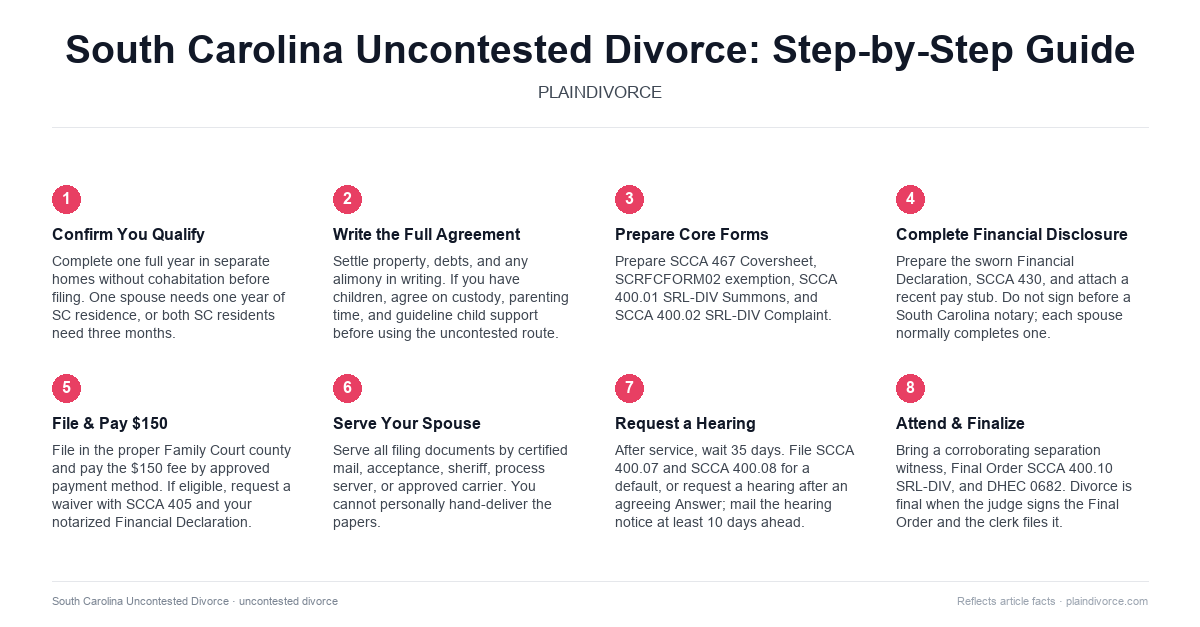
4. Step by Step: Complaint, Service, Scheduling, Hearing, Final Order
Every case is different, but a South Carolina uncontested divorce on the one-year-separation ground generally follows this path.
Step 1 — Confirm eligibility
- Residency: confirm you meet the one-year or three-month rule from Section 2.
- Separation: confirm a full, continuous year in separate dwellings without cohabitation.
- Agreement: confirm you agree on property, debt, and — if you have children — custody, parenting time, and guideline child support.
Step 2 — Put the agreement in writing
A clear marital settlement agreement is what makes an uncontested case uncontested. It should address:
- Property division (home, vehicles, bank and retirement accounts)
- Debt division (credit cards, loans)
- Spousal support (alimony), if any — including a clear waiver if there is none
- Custody, parenting time, and child support if you have children
Step 3 — Prepare the filing package
Using the Judicial Branch’s simple-divorce packet, the first five forms to complete and file are:
- Family Court Coversheet (SCCA 467, revised 11/2024) — required for docketing; it must be filled out completely, signed, and dated, and a copy is served with the summons and complaint.
- Certificate of Exemption (SCRFCFORM02) — most agreed filers check “An agreement has been reached among all parties on every issue” to be exempt from mediation.
- Summons for Divorce (SCCA 400.01 SRL-DIV)
- Complaint for Divorce (SCCA 400.02 SRL-DIV) — states residency, the date you separated, and what you are asking the court to approve.
- Financial Declaration (SCCA 430, revised 11/2024) — see Section 7.
Step 4 — File in the right county
File with the Clerk of Court, Family Court Division. Venue is set by § 20-3-60, and the packet frames the choices this way: file where your spouse lives; where you and your spouse last lived together as spouses; or, if your spouse is not a South Carolina resident, where you live. If you are the non-resident, the action must be filed where your spouse lives. Pay the $150 filing fee by cash, cashier’s check, or money order (no personal checks), or file a Motion and Affidavit to Proceed In Forma Pauperis (SCCA 405) with your notarized Financial Declaration attached to ask the court to waive it.
Step 5 — Serve your spouse
Your spouse must get official notice (service of process) of the coversheet, Certificate of Exemption, summons, complaint, and Financial Declaration. The packet allows five methods:
- Certified mail, restricted delivery, return receipt requested (the packet’s default). If anyone other than your spouse signs the green card, you must re-send.
- Acceptance of Service — your spouse signs the form and you file it.
- The county sheriff’s office where your spouse lives or works.
- A private process server.
- An IRS-approved commercial delivery service (for example, UPS or FedEx), with the delivery record attached to an affidavit.
One nuance the older version of this guide got wrong: you cannot personally hand the papers to your spouse, because under Rule 4 of the South Carolina Rules of Civil Procedure the person who physically serves process may not be a party to the case. But you, the plaintiff, can mail the documents by certified mail or send them by an approved commercial carrier yourself.
Step 6 — Wait 35 days, then request a hearing
Count 35 days from the day after your spouse was served. Then:
- No Answer filed: complete the notarized Affidavit of Default for Divorce (SCCA 400.07 SRL-DIV) and the Request for Hearing (SCCA 400.08 SRL-DIV), and file them with the return receipt.
- Answer agrees with every paragraph: just file the Request for Hearing.
- Answer disputes any paragraph: the case is contested — the packet route no longer fits and you should consult an attorney.
Step 7 — Notice of Hearing and the 10-day rule
The Clerk mails you a Notice of Hearing with your date. You must send a copy to your spouse or their attorney at least 10 days before the hearing by certified mail, return receipt requested, and then file the notarized Affidavit of Service by Mailing (Notice of Hearing) (SCCA 400.09 SRL-DIV). If the envelope comes back undelivered, bring it to the hearing — you only have to prove it was mailed.
Step 8 — Final hearing and Final Order
Before the hearing, prepare the Final Order of Divorce (SCCA 400.10 SRL-DIV) and the Report of Divorce or Annulment of Marriage (DHEC 0682), and confirm your witness. Arrive at least 30 minutes early with copies of everything. You testify first (the packet includes a sample script), then call your witness. The judge confirms residency, the year of separation, that reconciliation efforts failed, and that your agreement is voluntary and fair, then signs the Final Order and, often, an SCRCP Form 4F judgment. You are not divorced until the judge signs the Final Order and the Clerk files it — you are divorced when you receive a clocked copy. The Clerk then reports the divorce to the state Division of Vital Statistics within 30 days.
5. How You Actually Get a Court Date
Filing does not put you on the calendar. In a packet divorce, you trigger scheduling by filing the Request for Hearing (SCCA 400.08 SRL-DIV) — after the 35-day window closes with a default, or as soon as an agreeing Answer is filed. The Clerk then sets a date and mails the Notice of Hearing, and you handle the 10-day certified-mail notice to your spouse described above.
Mediation and the Certificate of Exemption
Family Court actions are subject to mediation under the Supreme Court’s Alternative Dispute Resolution Rules, but a fully settled case is normally exempt. The Certificate of Exemption (SCRFCFORM02) in the packet lets you certify that “an agreement has been reached among all parties on every issue.” File it with your coversheet. Some counties and judges handle scheduling and exemptions slightly differently, so follow the instructions from the specific Clerk of Court where you file.
6. Corroborating Witness: SC Divorce Requirements
South Carolina will not grant a divorce on the uncorroborated testimony of the spouses alone — a rule the courts use to prevent collusion. In an uncontested one-year-separation case, that means a corroborating witness. The Judicial Branch’s packet tells the plaintiff directly: “ask someone who has personal knowledge that you have lived separate and apart from your spouse for one (1) year to testify under oath in Court on the day of your hearing,” and to line up more than one person in case someone cannot make it. The Final Order form itself records the evidence given by the plaintiff and the plaintiff’s witness.
Who can be your witness
- Anyone other than you or your spouse — a friend, neighbor, relative, or coworker.
- Someone with first-hand knowledge of where each of you has lived during the separation year, not just someone repeating what you told them.
- Someone willing and able to appear in person at the hearing and answer the judge’s questions under oath.
Practical tip: ask a primary witness and a backup, confirm the hearing date with both, and walk them through the handful of questions (name, how they know you, where you and your spouse have each lived this past year, whether they are aware of any reconciliation). The packet’s sample witness script is a good starting point.
7. The Financial Declaration (SCCA 430): South Carolina Instructions
The Financial Declaration is South Carolina’s standard Family Court financial-disclosure form. The current version is SCCA 430 (revised 11/2024). It lists each party’s gross monthly income, payroll deductions, monthly expenses, debts, and assets.
When it is required
Family Court Rule 20 requires a current Financial Declaration whenever “the financial condition of a party is relevant or is an issue” — it must be filed and served by the first hearing or within 45 days of service of the complaint, whichever comes first, and willful non-compliance can bring sanctions. Rule 20 is not automatically universal, but the point is academic for packet filers: the Judicial Branch’s simple-divorce packet lists SCCA 430 among the first five forms you file, so plan on completing one (and expect your spouse to as well) in any agreed case with income, support, or assets and debts to address.
How to complete it
- Do not sign until you are in front of a South Carolina notary — the form is sworn, and the notary must witness your signature.
- Attach a recent pay stub. The form’s instructions tell you how to convert weekly, biweekly, or semi-monthly pay to a monthly figure.
- If your total assets are under $300,000, complete the main pages, sign, and have it notarized. If they are over $300,000, itemize using the additional sections.
- Gather supporting documents before you start: pay stubs, recent tax returns, health-insurance and childcare costs, and account and debt statements.
Why it matters: incomplete or inconsistent financial declarations are a routine reason a judge continues a hearing or asks for corrections, which can add weeks.
8. Special Issues When You Have Children
Minor children do not block a one-year-separation divorce, but the court must independently find that your custody and support arrangements serve the children’s best interests — your agreement is a proposal, not the final word. The packet may be used with children only if you have a written agreement on custody, visitation, and child support that meets the South Carolina Child Support Guidelines minimums.
Custody, parenting time, and the UCCJEA affidavit
Your agreement should set out physical custody (where the children primarily live), legal custody (how major decisions are made), a concrete weekday/weekend/holiday/vacation schedule, and how you will communicate and resolve disputes.
South Carolina’s version of the Uniform Child Custody Jurisdiction and Enforcement Act (S.C. Code § 63-15-346) adds a disclosure step: in your first pleading, or a sworn affidavit attached to it, each party must state the child’s present address, every place the child has lived in the last five years and who the child lived with, and whether that party has taken part in or knows of any other custody case or any person claiming custody or visitation rights. A court can pause the case until this information is provided.
Child support
South Carolina uses guideline-based child support, and the guideline figure is a rebuttable presumption (§ 63-17-470). You will need a current guideline worksheet showing the numbers behind your agreement. A judge can approve a different amount, but only with specific written findings that state what the guidelines would have required and why the order varies — and agreeing on a number does not remove the court’s duty to review it.
- Health care: the order must address the children’s medical needs through health-insurance coverage and/or cash medical support.
- Income withholding: under § 63-17-1420, a new or modified support order is subject to immediate income withholding unless the court finds good cause or you reach a written alternative arrangement.
- Where payments go: when withholding is in effect, support is paid through the State Disbursement Unit (§ 63-17-1430), not directly between parents.
9. How Long a South Carolina Uncontested Divorce Takes
Think of the timeline in two parts.
| Phase | What has to happen | Typical time |
|---|---|---|
| Before you can file | A full, continuous year in separate dwellings without cohabitation | At least 12 months |
| Filing to service | Prepare and file the package; serve your spouse; wait out the 35-day response window | About 5–8 weeks |
| Request for Hearing to final hearing | Clerk sets a date; you give 10-day notice; you attend with your witness | Varies by county calendar |
| Hearing to final | Judge signs the Final Order; Clerk files it and you get a clocked copy | Same day to a few weeks |
The separation year dominates everything. Once it is complete, there is no statutory post-filing waiting period on this ground — the remaining time is driven by how fast service goes and how busy your county’s Family Court calendar is. Rather than guess at a total, plan the separation year deliberately and treat the court phase as roughly two to four months on top, subject to your county.
10. What It Costs
- Court filing fee: $150 for a divorce, annulment, or separate support and maintenance action — see the South Carolina Judicial Branch’s Family Court fee schedule. Pay by cash, cashier’s check, or money order.
- Fee waiver: if you cannot afford the fee, file the Motion and Affidavit to Proceed In Forma Pauperis (SCCA 405) with your notarized Financial Declaration; a judge decides.
- Service costs: certified mail is inexpensive; a sheriff or private process server charges a fee that varies by county and provider.
- Motion fees: certain motions carry an added fee (often $25) under the Judicial Branch’s motion-fee list — it applies to specific listed motions, not every filing. A well-organized uncontested case usually files none.
- Notary and certified copies: small per-document charges for the sworn forms and for certified copies of the Final Order at the end.
- Optional: a limited-scope attorney review of your agreement and forms, or mediation if one issue needs a nudge.
11. When a DIY Divorce Might Not Be Right for You
Doing it yourself can save money, but it is not for everyone. Talk to a South Carolina family-law attorney — or South Carolina Legal Services, if you qualify — if any of these apply:
- Domestic violence, intimidation, stalking, or fear
- A business, significant retirement or pension interests, real estate beyond the family home, or unusual debt
- Any real disagreement about custody, relocation, or a child’s safety
- Immigration, disability, military pension, or tax complications
- You feel pressured to sign an agreement you do not think is fair
- You are unsure your year of separation actually “counts”
12. Where a Self-Help Divorce Kit Fits
South Carolina publishes self-help resources, but many people still stall on the sequence: the Financial Declaration, the 35-day window, triggering the hearing, the 10-day notice, and preparing for the final hearing with a corroborating witness. A private self-help kit is not legal advice and does not replace the official forms. It can help you:
- Understand the process end to end, including the 365-day requirement, and work from a plain-English South Carolina Complaint for Divorce template built for the one-year-separation ground.
- Stay organized with checklists and deadlines so you do not stall after service.
- Prepare your testimony and your witness for the final hearing.
- Avoid the small mistakes — an unsigned coversheet, a Financial Declaration signed before seeing the notary, a missed 10-day notice — that cause delays and rejected filings.
Download Our South Carolina Uncontested Divorce Self-Help Kit
13. Frequently Asked Questions
Can I get a divorce in South Carolina if we still live in the same house?
Not on the one-year-separation ground. That ground requires a full, continuous year living separate and apart without cohabitation, and the Judicial Branch’s simple-divorce packet describes that as living in separate dwellings — different addresses, not separate bedrooms. The year starts the day one spouse moves out and must be complete before you file.
What is a corroborating witness, and do I really need one?
Yes, plan on one. South Carolina will not grant a divorce on the spouses’ uncorroborated testimony alone. The packet tells the filing spouse to bring someone with personal knowledge that the two of you have lived apart for a year to testify under oath at the final hearing. It can be a friend, neighbor, relative, or coworker — anyone other than you or your spouse — and you should line up a backup.
What is the Financial Declaration, and does it have to be notarized?
The Financial Declaration (SCCA 430, revised 11/2024) is South Carolina’s Family Court financial-disclosure form — income, expenses, assets, and debts. It is sworn before a South Carolina notary: do not sign it until you are in front of the notary. Attach a recent pay stub. The Judicial Branch’s simple-divorce packet lists it among the first five forms you file, and each spouse completes their own.
Do I have to go to court for an uncontested divorce in South Carolina?
Yes. South Carolina does not grant divorces on paperwork alone. There is always a final hearing, and the filing spouse must attend, testify, and present the corroborating witness. If you have children, expect questions about custody, the parenting schedule, and guideline child support.
Can I serve the divorce papers on my spouse myself?
You cannot personally hand the papers to your spouse — under Rule 4 of the South Carolina Rules of Civil Procedure, the person who physically serves process may not be a party. But you may serve by certified mail, restricted delivery, return receipt requested, or by an IRS-approved commercial carrier, or have your spouse sign an Acceptance of Service, or use the sheriff or a private process server.
How much does an uncontested divorce in South Carolina cost?
The Family Court filing fee is $150 for a divorce action. On top of that, budget for service (certified mail is cheap; a sheriff or process server charges a fee), notary charges, and certified copies of the Final Order. If you cannot afford the filing fee, file a Motion to Proceed In Forma Pauperis with your notarized Financial Declaration and a judge will decide.
Is there a waiting period after I file?
Not on the one-year-separation ground. The two-month and three-month post-filing delays in S.C. Code § 20-3-80 do not apply here — the hearing can be held and the decree issued once the responsive pleadings are filed or your spouse is in default. In practice, the packet’s 35-day response window and your county’s hearing calendar set the pace.
When is my South Carolina divorce final?
When the judge signs the Final Order of Divorce and the Clerk of Court files it. You are officially divorced when you receive a clocked (date-stamped) copy from the Clerk. The Clerk then reports the divorce to the South Carolina Division of Vital Statistics within 30 days.
14. Final Thoughts and Next Steps
For an uncontested divorce in South Carolina, three things make or break the case:
- A complete year in separate dwellings — different addresses, not different rooms — before you file.
- A corroborating witness with first-hand knowledge of that year, ready to testify in person.
- The right sequence: file the five-form package, serve correctly, wait 35 days, file the Request for Hearing, give the 10-day notice, and bring the Final Order and DHEC 0682 to the hearing.
From there it is clean paperwork and calendar management. Get the Financial Declaration notarized correctly, keep copies of everything, and confirm each step with the Clerk of Court in your county. If anything about your safety, your finances, or your children feels complicated, a short consultation with a South Carolina family-law attorney early on can save months later.
PlainDivorce.com is not a law firm and does not provide legal advice. This guide is for educational purposes only. Court rules, forms, and fees change and vary by county, so always verify current requirements with the South Carolina Judicial Branch and your Family Court clerk before filing.
Sources and local rules can change. Use this guide as a plain-English organizer, then verify the current filing requirements with the official court or government source for your jurisdiction.

About Harry D
Expert contributor at PlainDivorce, helping Canadians and American navigate simple uncontested divorces with clarity and confidence.