Uncontested Divorce in South Dakota: The 2026 Stipulated Divorce Guide
An uncontested divorce in South Dakota is one where you and your spouse agree on every issue — property, debt, support, and any parenting terms — and put that agreement in a signed Stipulation and Settlement Agreement. You file a summons and complaint in circuit court, complete service, wait out the mandatory 60-day period, file your stipulation and the joint jurisdiction statement, and ask a judge to sign the Judgment and Decree of Divorce, often without a hearing.
This guide walks through how the South Dakota Unified Judicial System (UJS) actually handles a cooperative case as a stipulated divorce: who qualifies, the South Dakota stipulated divorce forms by name and number, how service and Admission of Service work, the SD divorce 60 day waiting period, how children and child support are handled, realistic timing and cost, and where a self-help kit fits if you decide to do it yourself.
TL;DR
South Dakota calls an uncontested divorce a stipulated divorce. You file a summons and complaint, serve your spouse, wait out the mandatory 60 days, file a signed Stipulation and Settlement Agreement plus a joint jurisdiction statement, and a judge signs the decree — often with no hearing and no court appearance.
- Residency is easy here: the filing spouse just has to be a South Dakota resident (or stationed here) when the case starts. No durational requirement — no minimum months, and no separation period before filing.
- The 60 days runs from completed SERVICE, not filing (SDCL 25-4-34), and the day of service doesn’t count — so day 61 at the earliest. It’s a floor, not a countdown: nothing happens automatically.
- A restraining order binds you both on service (SDCL 25-4-33.1). Don’t transfer or encumber marital property, cancel or change insurance, or take the kids out of state without written consent or a court order.
- Regular or certified mail alone is NOT proper service. The cooperative route is a signed Admission of Service (UJS-315 or UJS-317) — and if your spouse doesn’t return it within 20 days without good cause, the court can make them pay for personal service.
- Two packets, two form sets: without children (UJS-309/310, stipulation UJS-324, decree UJS-326A) or with children (UJS-311/312, stipulation UJS-325, decree UJS-326B). Both need the Case Filing Statement (UJS-232) — and a blank one served on your spouse — plus each spouse’s Financial Statement (UJS-023).
- The joint jurisdiction statement (UJS-319A/319B) is what lets the case finish on the papers. Both spouses sign it, and it’s filed after the stipulation.
- With kids: both parents must finish a court-approved parenting course within 60 days of service and file UJS-364 — no decree until they do. Initial and sign every page of UJS-325, attach the child-support calculation, and file the confidential UJS/DSS Form 089.
- No presumption of joint physical custody in South Dakota, and the judge reviews your parenting plan and support figures independently.
- Cost: a $97 filing fee statewide (same either packet), waivable with UJS-022. Add the parenting-course fee per parent and certified copies.
- Get a lawyer if there’s abuse, hidden assets, a farm, ranch, or business, significant retirement to divide, immigration exposure, or pressure to “just sign.”
1. What a stipulated (uncontested) divorce means in South Dakota
South Dakota has no separate “simple divorce” track and no formal “uncontested” case type. What people mean by an uncontested divorce in South Dakota is a case the courts and the UJS forms call a stipulated divorce: both spouses reach a full written agreement and present it to the circuit court, so the judge can grant the divorce on the paperwork instead of holding a trial.
The heart of it is the Stipulation and Settlement Agreement. That document tells the court the spouses have settled everything and asks the judge to sign the Judgment and Decree of Divorce on those terms. A typical stipulation covers:
- How property, accounts, and debts are divided
- Whether either spouse pays spousal support (alimony), and for how long
- If there are minor children: legal custody, physical custody, and parenting time
- Child support, health insurance, uncovered medical costs, and child-care expenses
When both spouses sign the stipulation and the joint jurisdiction statement, an irreconcilable-differences case can usually be decided without either spouse appearing in person — though the Clerk of Court or the judge can still set a short hearing depending on the county and the facts. A contested divorce, by contrast, is one where the spouses cannot agree on custody, support, or property and need the judge to decide; those cases are slower, more stressful, and more expensive.
2. Who qualifies: residency, venue, grounds, and agreement
Residency
Under SDCL 25-4-30, the spouse who files (the plaintiff) must be a South Dakota resident when the action is commenced, or be a member of the armed forces stationed in South Dakota. There is no durational residency requirement — no fixed number of months in the state before you can file. You must be a bona-fide resident, not just passing through, but the current forms require only that you be a resident at the start; you do not have to keep that residence until the decree is signed.
Venue (which county)
Per SDCL 25-4-30.1, you can start the case in the circuit court for the county where either spouse resides. The defendant has the right to move the place of trial to the county where the defendant lives, which rarely matters in a cooperative case.
Grounds
South Dakota keeps both fault grounds (such as adultery, extreme cruelty, willful desertion, willful neglect, habitual intemperance, and felony conviction) and the no-fault ground of irreconcilable differences — substantial reasons the marriage cannot be saved. Almost every stipulated divorce uses irreconcilable differences.
Two rules matter for a cooperative case. Under SDCL 25-4-17.2, the court cannot grant an irreconcilable-differences divorce without the consent of both spouses once the defendant has made a general appearance — which is exactly what a signed stipulation and joint jurisdiction statement provide. And if the judge sees a reasonable possibility of reconciliation, the court may pause the case for up to 30 days.
Genuine agreement
A stipulated divorce works when both spouses:
- Agree the marriage should end
- Will cooperate on paperwork, signatures, and deadlines
- Can sign a complete Stipulation and Settlement Agreement covering property, debt, support, and any parenting terms
- Will be transparent about income, assets, and debts — each files a Financial Statement (UJS-023)
Even in a fully stipulated case with children, the judge independently reviews the parenting plan and child support for the children’s best interests and does not rubber-stamp every term.
3. South Dakota stipulated divorce forms, by name and number
South Dakota uses UJS form numbers, and the packet you need depends on whether you have minor children. The plaintiff’s checklists (Form UJS-307A without children and UJS-307B with children) were revised 05/2026 and list the forms in order. Here are the South Dakota stipulated divorce forms you will actually touch.
Forms common to both packets
- Case Filing Statement (UJS-232) — the cover sheet that opens the case, with both spouses’ demographic and Social Security information. A blank UJS-232 must also be served on the defendant.
- Financial Statement (UJS-023) — each spouse files one; it uses a penalty-of-perjury declaration rather than notarization.
- Motion, Affidavit and Order to Waive Filing and/or Service Fees (UJS-022) — file this instead of the filing fee if you cannot afford it.
- Notice and Admission of Service — UJS-315 (without children) or UJS-317 (with children), used when the defendant will accept service voluntarily.
- Statement of Plaintiff and Defendant as to Jurisdiction and Grounds for Divorce — UJS-319A (without children) or UJS-319B (with children). Both spouses sign and file this after the stipulation; it is how a stipulated case reaches a decree without a personal appearance.
- Notice of Entry and Statement of Mailing — completed after the judge signs the decree (the clerk prepares one or both in some counties).
Without minor children
- Summons (UJS-309) and Complaint for Divorce (UJS-310)
- Stipulation and Settlement Agreement without Minor Children (UJS-324)
- Judgment and Decree of Divorce without Minor Children (UJS-326A)
With minor children
- Summons (UJS-311) and Complaint for Divorce (UJS-312), with the South Dakota Parenting Guidelines (UJS-302) attached to the complaint
- Statement on Court-Approved Parenting Course (UJS-364) — filed to certify completion (or to request a waiver or delay)
- Stipulation and Settlement Agreement for Divorce with Minor Children (UJS-325, Rev. 05/2026) — both parties initial and sign every page, and the child-support calculation is attached
- Child Support Order Filing Data Form (UJS/DSS Form 089) — a confidential form filed with the clerk for every new or modified support order
- Judgment and Decree of Divorce with Minor Children (UJS-326B)
Practical tip: if you see references online to a “Confidential Information Form” with a form number from another state, stop and confirm you are reading South Dakota materials. The South Dakota intake cover sheet is the Case Filing Statement (UJS-232). For a guided way to assemble these documents, South Dakota’s courts offer an online interview called Guide & File; a self-help divorce kit is another way to keep the packet organized.
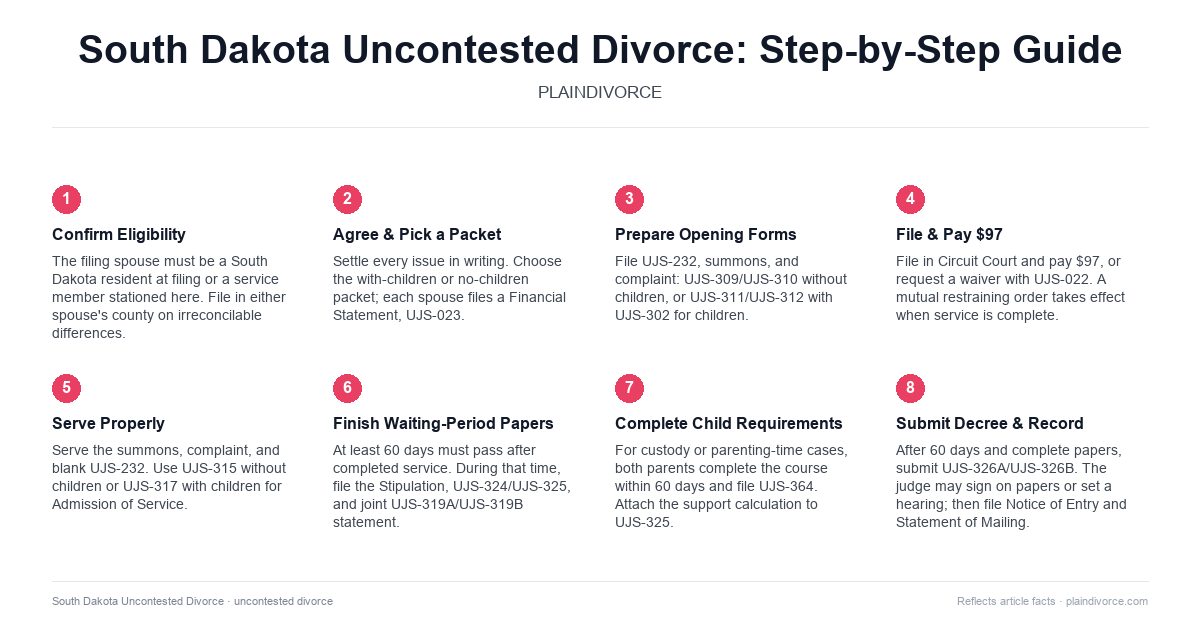
4. Step-by-step: how the process runs
Every case is different, but most South Dakota stipulated divorces follow this path. Always follow the current UJS instructions and your local court’s rules.
Step 1 — Confirm eligibility and agreement
- Is the filing spouse a South Dakota resident (or stationed here)?
- Are you proceeding on irreconcilable differences?
- Can you sign a complete Stipulation and Settlement Agreement? Decide now whether the with-children or without-children packet applies.
Step 2 — File the opening papers
The plaintiff files with the Clerk of Court: the Case Filing Statement (UJS-232), the summons, and the complaint — UJS-309/UJS-310 without children, or UJS-311/UJS-312 with the Parenting Guidelines (UJS-302) attached for cases with children — plus the $97 filing fee (or UJS-022 to ask the court to waive it).
Step 3 — Serve your spouse and file proof
The defendant must be formally served with the summons, the complaint, and a blank UJS-232. In a cooperative case that usually means a signed Admission of Service (see the next section). Regular or certified mail alone is not proper service. Proof of service — a sheriff’s return, a process server’s certificate, or the completed Notice and Admission of Service — must be filed with the Clerk of Court, because that filing sets the clock for both the answer deadline and the 60-day period.
Step 4 — Use the waiting period to finish the paperwork
During the 60 days, cooperative spouses complete and file: each spouse’s Financial Statement (UJS-023); the Stipulation and Settlement Agreement (UJS-324 or UJS-325, with the child-support calculation attached for a children’s case); and, after the stipulation is filed, the joint Statement as to Jurisdiction and Grounds (UJS-319A or UJS-319B) signed by both spouses. Parents also complete the parenting course and file the Statement on Court-Approved Parenting Course (UJS-364).
Step 5 — Submit the decree and finalize
Once the 60 days have elapsed and the file is complete, you submit the proposed Judgment and Decree of Divorce (UJS-326A or UJS-326B). Ask the Clerk of Court whether the judge will sign on the papers or set a brief hearing. For a children’s case, the Child Support Order Filing Data Form (UJS/DSS Form 089) is filed with the clerk. After the judge signs, complete and file the Notice of Entry and Statement of Mailing, and mail the other spouse a certified copy of the signed decree with the notice. Then request certified copies for name changes, banks, and benefits.
If your spouse is served and never answers: after the 60-day period you can pursue a default judgment using the UJS-321 series, the Statement of Military Status (UJS-306), and the default decree (UJS-322A or UJS-322B).
5. Service and Admission of Service in a South Dakota divorce
Service is the step most self-filers get wrong. You cannot simply hand or mail the papers and move on.
Admission of Service (the cooperative route)
Using the Notice and Admission of Service (UJS-315 without children, UJS-317 with children), the plaintiff mails the defendant the summons, complaint, blank UJS-232, and the notice and admission form. The defendant fills in where the papers were received, signs and dates the admission, and returns the original. If the defendant does not sign and return it within 20 days of the mailing date without good cause, the court can order the defendant to pay the cost of personal service. The signed admission is then filed with the Clerk of Court as the proof of service.
Personal service (the fallback)
If your spouse will not cooperate, a sheriff or a licensed process server personally delivers the papers and files a return of service. Sheriff’s fees vary by county.
The 30-day answer deadline
After service, the defendant has 30 days to file and serve an Answer (the day of service is not counted). In a stipulated case the defendant often does not file a formal Answer and instead signs the stipulation and the joint jurisdiction statement, which counts as a general appearance and consent. If the defendant neither answers nor signs, the plaintiff can move for default after the 60-day period.
6. The SD divorce 60 day waiting period
The SD divorce 60 day waiting period comes from SDCL 25-4-34: a divorce action “shall not be heard, tried, or determined by the court until at least sixty days have elapsed from the completed service of the plaintiff’s summons and complaint.” The day of service is not counted, so the court can act on roughly day 61 at the earliest.
Two things to understand about it:
- It is a floor, not a countdown to an automatic decree. Nothing is granted at day 60. The judge (or clerk, per county practice) still has to act, and your stipulation, financial statements, jurisdiction statement, and (for parents) parenting-course certificate all have to be on file.
- It runs from completed service, not from the filing date. Delays in getting your spouse served push the whole timeline back.
Use the 60 days well: finalize the stipulation, sign the financial statements, complete the parenting course if you have children, and prepare the proposed decree so the case is ready to submit the moment the period ends.
7. The automatic restraining order that starts on service
This surprises many people: under SDCL 25-4-33.1, a mutual temporary restraining order is printed on the summons and becomes a court order against both spouses once service is complete. Until the case ends or the court says otherwise, neither spouse may:
- Transfer, encumber, conceal, or dispose of marital property — except in the usual course of business, for the necessities of life, or by written consent or court order
- Molest or disturb the peace of the other spouse
- Remove the minor children from South Dakota without written consent or a court order
- Cancel or change insurance coverage, except to add or increase benefits
Plan around this. If you need to sell a vehicle, refinance, or reallocate accounts before the decree, put it in the stipulation or get written consent.
8. Children: parenting course, custody, and child support
The parenting course is mandatory
Under SDCL 25-4A-32, the parties to any action involving child custody or parenting time must complete a court-approved parenting course within 60 days of service. A final decree cannot be granted until both parents complete it and certify completion (file UJS-364), unless the judge waives or delays the requirement for good cause. “Good cause” expressly includes a default by one parent, or a showing that the parents took a court-approved course or its equivalent within the past five years — but those are examples the judge weighs, not automatic exemptions. Each parent pays for and completes the course separately.
Custody and the parenting plan
The court decides custody on the child’s best interests, and there is no presumption of joint physical custody in South Dakota (SDCL 25-4A-26). A strong stipulated parenting plan spells out:
- Legal custody (decision-making for school, health, and religion) and physical custody
- A week-to-week schedule, holidays, school breaks, and summers
- Transportation and exchange logistics, and how disputes get resolved
The South Dakota Parenting Guidelines (UJS-302) attach to the complaint and apply by default unless your plan says otherwise.
Child support
Child support runs on the statewide schedule in SDCL 25-7-6.2. The obligation is set from the parents’ combined monthly net incomes and divided between them in proportion to their incomes; a low-income obligor gets a self-support reserve. Any deviation from the guideline amount requires specific written findings (SDCL 25-7-6.10). The South Dakota Department of Social Services publishes an online Child Support Obligation Calculator for estimates.
Your support order will also:
- Include immediate income withholding unless the court finds good cause or approves a written alternative (SDCL 25-7A-23)
- Address medical support — health insurance and how uncovered medical costs are split
- Route payments through the DSS Division of Child Support, the state’s central case registry and payment center, unless the Division says otherwise
Attach the completed child-support calculation to UJS-325 and file the confidential UJS/DSS Form 089 with the clerk.
9. How long a stipulated divorce takes
There is no guaranteed timeline. What the rules fix is the minimum:
- No pre-filing separation period — you can file as soon as you meet residency.
- 30 days for the defendant to answer after service.
- At least 60 days from completed service before the court can determine the case.
- For parents, the parenting course within 60 days of service, and certificates on file before the decree.
Beyond the statutory minimum, timing depends on how fast your spouse is served, how quickly you finish the stipulation and financial statements, whether the parenting-course certificates get filed, whether the judge wants a hearing, and the court’s calendar. Ask your Clerk of Court what a cooperative case is currently running in your county.
10. What it costs
| Cost | What to expect |
|---|---|
| Filing fee | $97 (same for with- and without-children packets); file UJS-022 to request a waiver |
| Service | Minimal if your spouse signs an Admission of Service; sheriff or process-server fees for personal service (varies by county) |
| Parenting course | Each parent pays the provider’s fee (cases with children) |
| Certified copies | Clerk of Court fee for certified copies of the decree; South Dakota Department of Health charges about $15 for a certified divorce record |
| Optional help | Self-help kit, mediator, or a limited-scope attorney consultation |
Fees change and vary by county. Confirm the current filing fee with your Clerk of Court, and ask about fee-waiver eligibility if money is tight. For certified copies of the divorce record, see the South Dakota Department of Health Vital Records page.
11. When DIY is not the right call
A stipulated divorce assumes real agreement and full financial honesty. Talk to a South Dakota lawyer before you sign anything if:
- There is domestic violence, intimidation, or a serious safety concern
- You suspect hidden income, assets, or debts
- You have a farm, ranch, closely held business, or multiple properties to divide
- There are significant retirement accounts or pensions (dividing them usually needs a separate court order)
- One spouse is not a U.S. citizen and the timing or terms could affect immigration status
- You disagree about where the children will live, or either spouse feels pressured to “just sign”
Even one limited-scope consultation can flag a problem before it is locked into a decree.
12. Where a self-help divorce kit fits
If your case is a genuine fit for a South Dakota stipulated divorce, a self-help kit adds structure. It does not replace legal advice, but it helps you:
- Follow the roadmap from filing through service, the 60-day period, and the decree
- Work from checklists so you do not miss a signature, a required attachment like the child-support calculation, or the blank UJS-232 that has to be served
- Draft clear settlement terms — often starting from a Stipulation and Settlement Agreement SD template — so your stipulation is complete and consistent with your other forms
- Stay on top of the parenting-course deadline and certificate filing (cases with children)
Even with a kit, you can consult a lawyer at any stage — before filing, after drafting your stipulation, or if the case stops being cooperative.
13. Frequently asked questions
What is a stipulated divorce in South Dakota?
It is South Dakota’s version of an uncontested divorce. Both spouses reach a full written agreement in a Stipulation and Settlement Agreement (UJS-324 without children, UJS-325 with children), both sign a joint Statement as to Jurisdiction and Grounds, and the judge can grant the Judgment and Decree of Divorce on the paperwork — often with no hearing.
What are the South Dakota stipulated divorce forms?
The core set is the Case Filing Statement (UJS-232), a summons and complaint (UJS-309/UJS-310 without children or UJS-311/UJS-312 with children), each spouse’s Financial Statement (UJS-023), the Stipulation and Settlement Agreement (UJS-324 or UJS-325), the joint Statement as to Jurisdiction and Grounds (UJS-319A or UJS-319B), and the Judgment and Decree of Divorce (UJS-326A or UJS-326B). Children’s cases add the Parenting Guidelines (UJS-302), UJS-364, and the confidential UJS/DSS Form 089.
How does Admission of Service work in a South Dakota divorce?
The plaintiff mails the summons, complaint, blank UJS-232, and the Notice and Admission of Service (UJS-315 or UJS-317). The defendant signs and dates the admission and returns the original. If it is not returned within 20 days of mailing without good cause, the court can make the defendant pay for personal service. The signed admission is filed as the proof of service. Regular or certified mail alone is not proper service.
How long is the SD divorce 60 day waiting period?
By law (SDCL 25-4-34), the court cannot hear, try, or determine a divorce until at least 60 days have passed from completed service of the summons and complaint; the day of service is not counted, so the earliest a decree can be signed is about day 61. It is a minimum, not an automatic countdown — your full stipulation, financial statements, jurisdiction statement, and any parenting-course certificates still have to be on file.
Is there a residency requirement for a South Dakota divorce?
The filing spouse must be a South Dakota resident when the action begins, or a service member stationed in the state (SDCL 25-4-30). There is no durational requirement — no minimum number of months — and you do not have to keep that residence until the decree is signed. You must be a genuine resident, not just visiting.
Do we both have to take a parenting class?
Yes, if your case involves child custody or parenting time. SDCL 25-4A-32 requires both parents to complete a court-approved parenting course within 60 days of service, and the final decree cannot be granted until both certify completion (UJS-364) unless the judge waives or delays it for good cause. A course taken within the past five years is an example of good cause the judge may accept, not an automatic waiver.
How much does an uncontested divorce in South Dakota cost?
The statewide filing fee is $97, and you can ask the court to waive it with UJS-022. Add minimal service cost if your spouse signs an Admission of Service (more for a sheriff or process server), each parent’s parenting-course fee in a children’s case, and certified-copy fees. Confirm the current amounts with your Clerk of Court.
Can we finish the divorce without going to court?
Often, yes. When both spouses sign the stipulation and the joint Statement as to Jurisdiction and Grounds, an irreconcilable-differences case can usually be decided on the papers. But the Clerk of Court or the judge can still require a short hearing depending on the county and the facts, so ask the clerk before you assume no appearance is needed.
14. Next steps
A clean uncontested divorce in South Dakota comes down to a complete Stipulation and Settlement Agreement, proper service, and respecting the 60-day period. To move forward:
- Confirm residency and choose the with-children or without-children packet
- Prepare the Case Filing Statement (UJS-232), summons, and complaint, and pay the $97 fee or file UJS-022
- Serve your spouse properly — usually by Admission of Service — and file the proof of service
- During the 60 days, finish the Financial Statements (UJS-023), the Stipulation (UJS-324 or UJS-325), and the parenting course if you have children
- File the joint Statement as to Jurisdiction and Grounds (UJS-319A or UJS-319B), submit the decree, then file the Notice of Entry and Statement of Mailing
If you want the forms organized with checklists and a settlement-agreement template, the South Dakota uncontested divorce kit is built for exactly this process.
Remember: PlainDivorce is not a law firm and this guide is not legal advice. South Dakota laws, forms, and fees change. Before you rely on any detail here, check the current UJS forms and instructions and the statutes cited above, and get legal advice if your finances or parenting situation are complex.
Sources and local rules can change. Use this guide as a plain-English organizer, then verify the current filing requirements with the official court or government source for your jurisdiction.

About Harry D
Expert contributor at PlainDivorce, helping Canadians and American navigate simple uncontested divorces with clarity and confidence.