Uncontested Divorce in Tennessee: The 2026 Guide to the Agreed Divorce
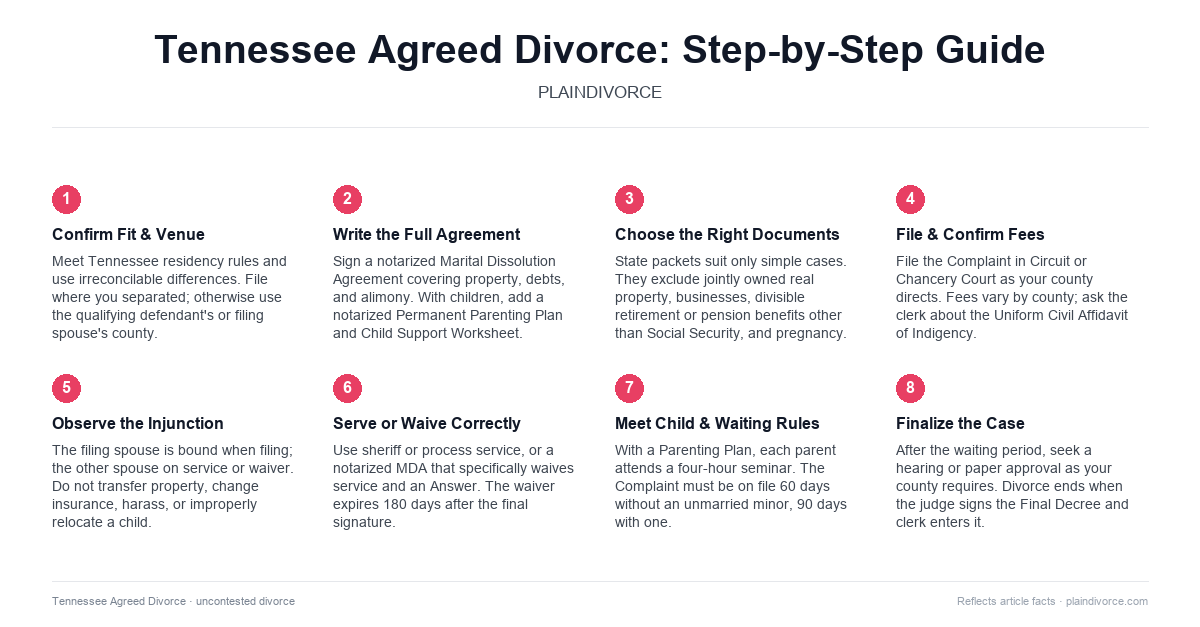
An uncontested divorce in Tennessee is called an Agreed Divorce. Both spouses ask for the divorce on the no-fault ground of irreconcilable differences, sign a complete written settlement, and let the court approve it. The judge cannot finalize until the case has been on file at least 60 days (no minor child) or 90 days (a minor child), and the written agreement must adequately provide for the children and fairly divide property.
This guide walks through how the Agreed Divorce works in plain English: who qualifies, the Tennessee Agreed Divorce forms you file, the statutory injunction that starts the moment you file, the parent education seminar, the 60- and 90-day waiting periods, current filing costs by county, and where a do-it-yourself kit fits. It is written for cooperative couples who can sign the paperwork and agree on parenting, support, and property so the case moves without a fight.
TL;DR
Tennessee calls an uncontested divorce an Agreed Divorce. Both spouses file on the no-fault ground of irreconcilable differences, sign a notarized Marital Dissolution Agreement, wait out the statutory period, and the judge approves it — sometimes without anyone appearing in court.
- The waiting period is the headline: the complaint must be on file at least 60 days with no unmarried child under 18, or 90 days if there is one. The clock runs from the original filing date — an amended complaint doesn’t restart or shorten it.
- Residency: if the grounds arose while you lived in Tennessee, that’s enough — no months test. Otherwise either spouse needs six months here before filing (§ 36-4-104).
- The statewide packets are narrow. You cannot use them if you jointly own real property, either spouse owns a business or has retirement or pension benefits to divide, or a spouse is pregnant. Your case can still be uncontested — you just need fuller documents.
- Agreement isn’t enough by itself. Under § 36-4-103 the judge must find your written agreement makes adequate provision for the children and an equitable settlement of property. Thin or lopsided drafts get sent back.
- A mutual injunction starts on filing (§ 36-4-106): no moving or borrowing against marital property, no changing insurance, no harassment, no relocating a child out of state or more than 50 miles away.
- The MDA can replace service — but the waiver is only good for 180 days from the last signature. Miss that window and you re-sign.
- With kids: a Permanent Parenting Plan on the official form is mandatory in every decree, child support runs on the Income Shares guidelines with a worksheet attached, income withholding is the default, and both parents must complete a four-hour parent education seminar (§ 36-6-408).
- Cost: county-set filing fees, which rose statewide January 1, 2026. Nashville runs about $234.50 without minor children and $309.50 with. Can’t pay up front? Ask the clerk about the Uniform Civil Affidavit of Indigency.
- After the decree, either spouse has 30 days to appeal — so hold off on remarrying or transferring major property during that window.
- Get a lawyer if there’s abuse or coercion, hidden assets, a business or pension, or real disagreement about parenting or support. Limited-scope MDA review is a common middle option.
1. What Is an Agreed (Uncontested) Divorce in Tennessee?
In Tennessee, the term used on court resources and form packets is Agreed Divorce. People also say “uncontested” or “simple” divorce, but Agreed Divorce is the Tennessee-specific label. It is almost always filed on the no-fault ground of irreconcilable differences under Tennessee Code § 36-4-101.
An Agreed Divorce means both spouses:
- Want the divorce;
- Agree on the ground (irreconcilable differences); and
- Have a complete written agreement on property and debts and, if there are children, on parenting time, decision-making, and child support.
Agreement alone does not end the marriage. Under Tennessee Code § 36-4-103, before a judge can grant an irreconcilable-differences divorce, the court must affirmatively find that your written agreement makes adequate and sufficient provision for the custody and support of any children and for an equitable settlement of property. If the agreement is thin or unfair, the judge continues the case until you fix it. One practical benefit: filing a properly executed Marital Dissolution Agreement (and a parenting plan, if you have minor children) removes any requirement that you attend mediation, unless the court later rejects one of those documents.
Tennessee also publishes court-approved, plain-language Agreed Divorce form packets — one for couples without minor children and one with minor children. Those packets are only for genuinely simple cases and carry strict eligibility limits (see section 2.4).
2. Do You Qualify? Residency, Grounds, and a Truly Agreed Case
Qualifying for an uncontested divorce in Tennessee comes down to three questions: can you file here, do you have a ground, and is the case genuinely agreed?
2.1 Tennessee residency rules
Under Tennessee Code § 36-4-104:
- If the acts that are the basis for divorce happened while the filing spouse was a bona fide Tennessee resident, that is enough — there is no separate months-of-residence test.
- Otherwise, the plaintiff or the defendant must have resided in Tennessee for the six months immediately before the complaint is filed.
- A service member (or the spouse of one) who has lived in Tennessee for at least one year is presumed to be a resident, and that presumption can be overcome only by clear and convincing evidence of a domicile elsewhere.
2.2 Grounds for divorce in Tennessee
Tennessee has both fault and no-fault grounds. Agreed cases use one of two:
- Irreconcilable differences (§ 36-4-101(a)(14)) — you both agree the marriage cannot be repaired. This is the standard route for an Agreed Divorce and the only one that pairs with the statewide packets.
- Two-year separation (§ 36-4-101(a)(15)) — for a continuous period of two or more years, both spouses have lived in separate residences, have not cohabited, and there are no minor children of the parties. This is a narrower ground and rarely needed when both spouses will simply sign.
Fault grounds (adultery, cruelty, and others) remain available but add conflict, proof, and cost, so cooperative couples almost always choose irreconcilable differences.
2.3 What makes a case genuinely “agreed”
Your case is a strong candidate if:
- Both spouses want to end the marriage and will sign the paperwork;
- You agree on property and debt division, on whether alimony will be paid (and if so, how much and for how long), and — if you have children — on a parenting schedule and a child-support figure the court can approve; and
- No one is being pressured, threatened, or coerced.
2.4 The statewide Agreed Divorce packets have strict limits
The Tennessee Supreme Court’s Agreed Divorce packets are not available just because a case is uncontested. According to the current instruction packets, you cannot use them if any of the following is true:
- You and your spouse jointly own real property (a house, land, or a mobile home permanently attached to land);
- Either spouse owns a business;
- Either spouse has retirement or pension benefits to divide (other than Social Security);
- Either spouse is pregnant;
- You do not agree on every issue, or one spouse will not sign.
The with-children packet adds more limits: you cannot use it if a child born during the marriage has a different biological father and was not adopted by both spouses, or if a non-parent holds a court order for custody or visitation. For packet purposes, a “minor child” includes a child who is under 18, still in high school, or disabled.
If you own a home, have a business or retirement accounts, or have complex finances, your divorce can still be uncontested — you just need fuller documents than the statewide packet and may want a lawyer to review the agreement. A well-built Tennessee uncontested divorce kit is designed for exactly that middle ground.
2.5 When an Agreed Divorce may not work
- There has been domestic violence, coercion, or stalking;
- One spouse is hiding money or property;
- You strongly disagree about parenting or support;
- There are serious immigration, tax, disability-benefit, or pension issues; or
- One spouse will not cooperate or sign.
In these situations, talk to a Tennessee family-law attorney or legal aid office, even if you still hope to settle peacefully.
3. The Tennessee Agreed Divorce Forms
Exactly which documents you use depends on whether you qualify for the statewide packet and which county you file in. Form numbers differ between the no-children and with-children packets and change between revisions, so focus on the documents by name. A typical agreed case involves:
- Complaint (Request) for Divorce — starts the case; in the packet it is signed and notarized.
- Spouses’ / Both Parties’ Personal Information — a confidential sheet with identifying details, kept out of the public file.
- Statutory injunction (the packet calls it the “Court Order for Divorcing Spouses”) — the mutual restraining order required by Tennessee Code § 36-4-106; its terms attach to the summons and complaint.
- Health Insurance Notice for Divorcing Spouses — filed with the clerk and mailed to your spouse by certified mail.
- Marital Dissolution Agreement (MDA) — your written settlement of property, debt, and alimony; signed and notarized by both spouses. A Marital Dissolution Agreement TN template is the backbone of every agreed case.
- Permanent Parenting Plan and Child Support Worksheet — required if you have minor children; both spouses sign and notarize the plan, and the worksheet is attached as an exhibit. Tennessee publishes an official Permanent Parenting Plan form and the court expects that format.
- Final Decree (Final Divorce Order) — the order the judge signs to end the marriage.
- Certificate of Divorce — a vital-records form you get from the clerk and complete before the hearing.
- Motion or notice to set the uncontested hearing — used in many counties to get a hearing date after the waiting period.
- Title IV-D information form and an optional Wage Assignment Order — in child-support cases.
Agreed Divorce document map
Names, not numbers — the statewide packet renumbers forms between the with-children and no-children versions.
| Document | When you need it | Signing |
|---|---|---|
| Complaint / Request for Divorce | Every case | Notarized |
| Spouses’ Personal Information | Every case (confidential) | Signed |
| Statutory injunction / Court Order for Divorcing Spouses | Every case | Signed |
| Health Insurance Notice | Every case (file + certified mail) | Signed |
| Marital Dissolution Agreement | Every case | Notarized, both spouses |
| Permanent Parenting Plan + Child Support Worksheet | Minor children | Notarized, both spouses |
| Certificate of Divorce | Every case (from the clerk) | Completed before hearing |
| Final Decree / Final Divorce Order | Every case | Signed by both; judge signs last |
Missing signatures, missing notarization, and incomplete parenting or support paperwork are the usual reasons an agreed case stalls.
4. Step-by-Step: How the Agreed Divorce Process Works
Counties differ in their local habits, but most agreed cases follow the same path.
Step 1 — Confirm you qualify
Check residency (section 2.1), pick your ground (irreconcilable differences), confirm the case is fully agreed, and decide whether you meet the statewide packet limits or need fuller documents.
Step 2 — Put the whole agreement in writing
Reach agreement on property and debts, on alimony, and — if you have children — on parenting time, decision-making, and child support. The written settlement is your Marital Dissolution Agreement. With minor children you also complete a Permanent Parenting Plan and a Child Support Worksheet. The judge must be able to see that the agreement is complete and legally acceptable, so vague or one-sided drafts get sent back.
Step 3 — File in the correct county
Divorce is heard in Circuit Court or Chancery Court, depending on the county; ask the clerk which court hears divorces where you live. Venue is set by Tennessee Code § 36-4-105. You file in:
- the county where the spouses resided when they separated; or
- the county where the defendant resides, if the defendant is a Tennessee resident; or
- if the defendant is a nonresident or incarcerated, the county where the filing spouse resides.
Do not file in more than one court. The clerk opens the case, assigns a docket number, and collects the filing fee (see section 7).
Step 4 — The statutory injunction takes effect
Under § 36-4-106, a mutual temporary injunction applies automatically. It restrains both spouses from:
- transferring, borrowing against, hiding, or dissipating marital property outside the ordinary course;
- cancelling, changing, or letting lapse insurance covering a spouse or child;
- harassing, threatening, or making disparaging remarks about the other spouse; and
- relocating a child out of state or more than 50 miles from the marital home, or destroying electronically stored evidence.
The injunction’s terms are attached to the summons and complaint and served with them. It binds the filing spouse when the complaint is filed and the other spouse upon service (or upon accepting or waiving service), and it lasts until the final decree, a dismissal, or a further court order.
Step 5 — Handle service (or waive it correctly)
The court must be satisfied the other spouse had proper notice. In an irreconcilable-differences case, formal service can be replaced only by a written, notarized Marital Dissolution Agreement that refers specifically to the pending divorce (or states the spouse’s awareness that a Tennessee action will be filed) and waives service and the filing of an answer. That waiver is good for 180 days from the date the last spouse signs; the packet instructions add that your final hearing must fall within that window, or you re-sign the MDA. If you do not use that route, you serve the complaint the normal way — by the sheriff or a private process server, for an added fee.
Step 6 — Attend the parent education seminar (if you have children)
This is a statewide requirement, not a county option. Under Tennessee Code § 36-6-408, in any case where a Permanent Parenting Plan is or will be entered, each parent must attend a parent educational seminar of at least four hours, as soon as possible after the complaint is filed. A court can waive attendance only on motion for good cause, and it cannot deny the divorce solely because a parent did not attend. Ask the clerk which providers your court accepts and what they charge.
Step 7 — Complete the statutory waiting period (60 or 90 days)
Under § 36-4-103(c), an irreconcilable-differences complaint must have been on file before it can be heard:
- At least 60 days if the spouses have no unmarried child under 18; and
- At least 90 days if the spouses have an unmarried child under 18. This is the TN divorce waiting period with a child.
Tennessee’s minimum waiting period
The clock runs from the date the original complaint is filed — not from a later amended complaint. Even a perfect, fully agreed file cannot be finalized sooner.
No unmarried child under 18
60 days minimum on file before the hearing.
Unmarried child under 18
90 days minimum on file before the hearing.
After the minimum passes, timing still depends on county scheduling and whether the judge or clerk needs corrections.
Step 8 — The hearing (or a decision on the papers)
Section 36-4-103 lets an irreconcilable-differences complaint be “taken as confessed” and a decree entered without corroborating proof or testimony; the petitioner is not required to testify to the facts constituting irreconcilable differences. In practice, many Tennessee counties still set a short uncontested-docket hearing where the filing spouse confirms the marriage is over and the agreement is fair. Ask your clerk whether your court requires an appearance or will approve the file on the papers. You do not need witnesses.
Step 9 — Get the Final Decree and certified copies
Once the judge signs the Final Decree of Divorce and it is entered by the clerk, your marriage is legally ended. Each spouse then has 30 days to appeal, so avoid remarrying or transferring major property during that window. Order certified copies of the decree; you may need them to change your name (the decree can restore a prior name if you ask), update beneficiaries and benefits, or prove the divorce if you remarry.
5. Extra Rules When You Have Children
When there are minor children, Tennessee courts look harder at the paperwork — even in an Agreed Divorce — because the arrangements must serve the best interests of the child.
5.1 The Permanent Parenting Plan is mandatory
Every final divorce decree involving a minor child must incorporate a Permanent Parenting Plan. Using the official Permanent Parenting Plan form Tennessee publishes, the plan sets out the residential schedule (weekdays, weekends, holidays, vacations), how major decisions (education, health care, religion, extracurriculars) are made, how parents share information, how disputes are resolved, and how child support is paid. A vague or incomplete plan gets sent back for revision even when both parents agree.
5.2 Child support runs on the Income Shares guidelines
Tennessee uses an Income Shares model. The state child-support guidelines (last amended effective October 1, 2021) base support on both parents’ combined adjusted gross income, the number of children, the parenting-time split, and certain add-ons such as health-insurance premiums and work-related child care. The guideline figure is a rebuttable presumption: a judge can approve a different number only with written findings that the presumptive amount is unjust or inappropriate and that the deviation serves the child’s best interest. The Tennessee Department of Human Services publishes the official worksheet and an online calculator; the completed worksheet is attached to your parenting plan as an exhibit.
5.3 Immediate income assignment
Under Tennessee Code § 36-5-501, a child-support order ordinarily must order immediate income assignment — support is withheld from the paying parent’s wages. Parents can agree to a different arrangement, but that agreement has to be in writing, reviewed by the court, and entered in the record. A private handshake about how support gets paid will not control.
5.4 Parent education seminar
As covered in Step 6, both parents must complete the four-hour parent educational seminar under § 36-6-408 unless the court waives it for good cause.
6. How Long Does an Uncontested Divorce Take in Tennessee?
Think of the timeline in three parts:
- Preparation — how long it takes you to reach a full agreement and complete the forms;
- Statutory minimum — at least 60 days (no unmarried child under 18) or 90 days (an unmarried child under 18) on file before the case can be heard; and
- Court scheduling and review — how quickly your court sets a hearing or processes the agreed file, and whether corrections are needed.
The 60- and 90-day figures are the only firm numbers. Total time beyond that varies by county caseload and by how clean your paperwork is the first time, and Tennessee does not publish statewide processing data. A complete, consistent file with correct notarization and a workable parenting plan is the single biggest thing you control.
7. What Does an Agreed Divorce Cost?
7.1 Court filing fees
Filing fees are set county by county (a statutory base fee plus local litigation taxes and any service fee), and Tennessee court fees rose statewide on January 1, 2026. Confirm the current amount with your Circuit or Chancery Court clerk before you file. Published 2026 examples:
- Davidson County (Nashville), effective January 1, 2026: divorce without minor children $234.50 (no service fee) or $286.50 with sheriff service; divorce with minor children $309.50 or $361.50 with sheriff service (Davidson County Circuit Court Clerk fee schedule).
- Shelby County (Memphis): reported around $306.50 without children and $381.50 with children in 2026.
- Knox County (Knoxville): reported around $276 in 2026.
7.2 Other common costs
- Service of process — sheriff or private process server fees if you do not use the notarized-MDA waiver;
- Parent education seminar — a provider fee for each parent in cases with children;
- Notary fees — the MDA and, with children, the parenting plan must be notarized;
- Certified copies of the Final Decree.
7.3 If you cannot afford the filing fee
Tennessee’s Uniform Civil Affidavit of Indigency (Tennessee Supreme Court Rule 29) lets an eligible person file without paying court costs up front. It is not an automatic waiver — the court can still assess costs against a party at the end of the case — but it removes the upfront barrier. Ask the clerk for the affidavit.
8. When a DIY Divorce Might Not Be Right for You
A cheap divorce is not always a good divorce. Get legal help right away if:
- Your spouse has been abusive, threatening, or controlling, or you are afraid to disagree;
- You believe assets or income are being hidden;
- You own a business or multiple properties, or need to divide retirement or pension accounts;
- You do not fully understand the paperwork because of a language or literacy barrier; or
- There are serious immigration, tax, disability, or pension issues tied to the divorce.
Some Tennessee attorneys offer limited-scope help — for example, reviewing only your Marital Dissolution Agreement — so you can keep the rest of the case DIY.
9. Where a Self-Help Divorce Kit Fits In
A well-built self-help kit helps cooperative spouses complete an uncontested divorce in Tennessee without hiring a lawyer for everything — mainly by keeping the case organized and heading off the mistakes that get filings rejected:
- Understanding the paperwork — plain-English guidance and a Marital Dissolution Agreement TN template, plus help with the Permanent Parenting Plan and Child Support Worksheet;
- Staying organized — step-by-step checklists, notarization reminders, and the 60/90-day and 180-day deadlines tracked for you;
- Avoiding common mistakes — missing signatures, an incomplete parenting plan, or a child-support figure with no worksheet behind it;
- Saving money — far cheaper than full representation for a simple agreed case.
The PlainDivorce Tennessee kit is built for self-represented spouses who want to move through the Agreed Divorce step by step, with language that matches Tennessee terminology and court expectations.
Download Our Tennessee Agreed Divorce Self-Help KitEven with a kit, you are still representing yourself. A good kit gives you structure and confidence; it is not a substitute for independent legal advice when your situation calls for it.
10. Frequently Asked Questions
What is an Agreed Divorce in Tennessee?
It is Tennessee’s uncontested divorce: both spouses ask for the divorce on the ground of irreconcilable differences and sign a complete written settlement — a Marital Dissolution Agreement covering property, debt, and alimony, plus a Permanent Parenting Plan and Child Support Worksheet if there are minor children. The court still reviews everything and must find the agreement adequately provides for the children and fairly divides property before a judge signs the Final Decree.
How long does an uncontested divorce take in Tennessee?
The complaint must be on file at least 60 days before it can be heard if you have no unmarried child under 18, and at least 90 days if you do. That clock runs from the original filing date. Actual completion is usually longer because it also depends on how fast you finish the paperwork and how quickly your county sets a hearing or reviews the agreed file.
What is the TN divorce waiting period with a child?
Ninety days. Under Tennessee Code § 36-4-103, an irreconcilable-differences complaint must be on file at least 90 days before a hearing when the spouses have an unmarried child under 18. Without a minor child, the minimum is 60 days. A later amended complaint does not restart or shorten the period — it is measured from the original filing.
Do you have to go to court for an Agreed Divorce in Tennessee?
Not always. The statute allows an irreconcilable-differences case to be taken as confessed and a decree entered without testimony, and the filing spouse is not required to testify to the grounds. But many counties still schedule a brief uncontested-docket hearing where the filing spouse confirms the marriage is over and the agreement is fair. Ask your clerk whether your court requires an appearance or will approve the file on the papers.
What is the Marital Dissolution Agreement?
The Marital Dissolution Agreement (MDA) is your written contract dividing property and debt and setting any alimony. Both spouses sign it before a notary. A notarized MDA that refers to the pending divorce can also waive formal service of process and the filing of an answer — but only for 180 days from the last signature, so your hearing has to happen within that window.
Is the Permanent Parenting Plan required?
Yes. Every final divorce decree involving a minor child must incorporate a Permanent Parenting Plan on the official Tennessee form. It sets the residential schedule, decision-making authority, information sharing, dispute resolution, and how child support is paid, with the Child Support Worksheet attached as an exhibit. Both parents must also complete a four-hour parent education seminar.
How much does an uncontested divorce cost in Tennessee?
The main cost is the county filing fee, which rose statewide on January 1, 2026 and varies by county. As of January 2026, Davidson County (Nashville) lists roughly $234.50 without minor children and $309.50 with minor children (more if the sheriff serves your spouse). Add notary fees, a parent-seminar fee per parent in cases with children, and certified-copy fees. If you cannot pay up front, ask the clerk about the Uniform Civil Affidavit of Indigency.
Can you use the state packet if you own a house or a retirement account?
No. Tennessee’s statewide Agreed Divorce packets exclude couples who jointly own real property or a business or who have retirement or pension benefits to divide (other than Social Security), and cases where a spouse is pregnant. Your divorce can still be uncontested — you just need fuller documents than the packet, and often a lawyer’s review of the agreement or a self-help kit built for those issues.
11. Final Thoughts and Next Steps
An Agreed Divorce keeps a Tennessee case narrow and predictable, but local scheduling and the court’s required review still control when it finishes. Break it into steps:
- Confirm you can file in Tennessee and pick the right county under § 36-4-105;
- Put the entire agreement in writing — a notarized Marital Dissolution Agreement, plus a Permanent Parenting Plan and Child Support Worksheet if you have minor children;
- File in Circuit or Chancery Court, handle service (or the notarized-MDA waiver), and note that the statutory injunction is now in force;
- Complete the parent education seminar and the 60- or 90-day waiting period, then get your hearing date or on-the-papers approval.
Important reminder: This guide is legal information only. PlainDivorce.com is not a law firm, and nothing here is legal advice for your situation. Tennessee statutes, court rules, forms, and fees change over time — the fees above are dated examples, not a promise. Before you file, confirm the current rules with the Tennessee court where you will file, or speak with a Tennessee family-law attorney or legal aid office.
Sources and local rules can change. Use this guide as a plain-English organizer, then verify the current filing requirements with the official court or government source for your jurisdiction.

About Harry D
Expert contributor at PlainDivorce, helping Canadians and American navigate simple uncontested divorces with clarity and confidence.