Uncontested Divorce in Texas: How the Agreed Divorce Works, Step by Step
An uncontested divorce in Texas is handled by the courts as an Agreed Divorce: you and your spouse agree on every issue — property, debt, spousal support, and anything involving children — and you both sign the paperwork, so the judge only reviews and approves what you have already settled. In almost every case you must wait at least 60 days from the filing date before a judge can finalize it.
This guide walks through how an uncontested divorce in Texas works in plain English: who can file, which statewide form set matches your situation, the Texas Agreed Divorce forms you prepare, the step-by-step court process, the 60-day waiting period, what changes when you have children, realistic timing and cost, and where a do-it-yourself (DIY) approach fits.
TL;DR
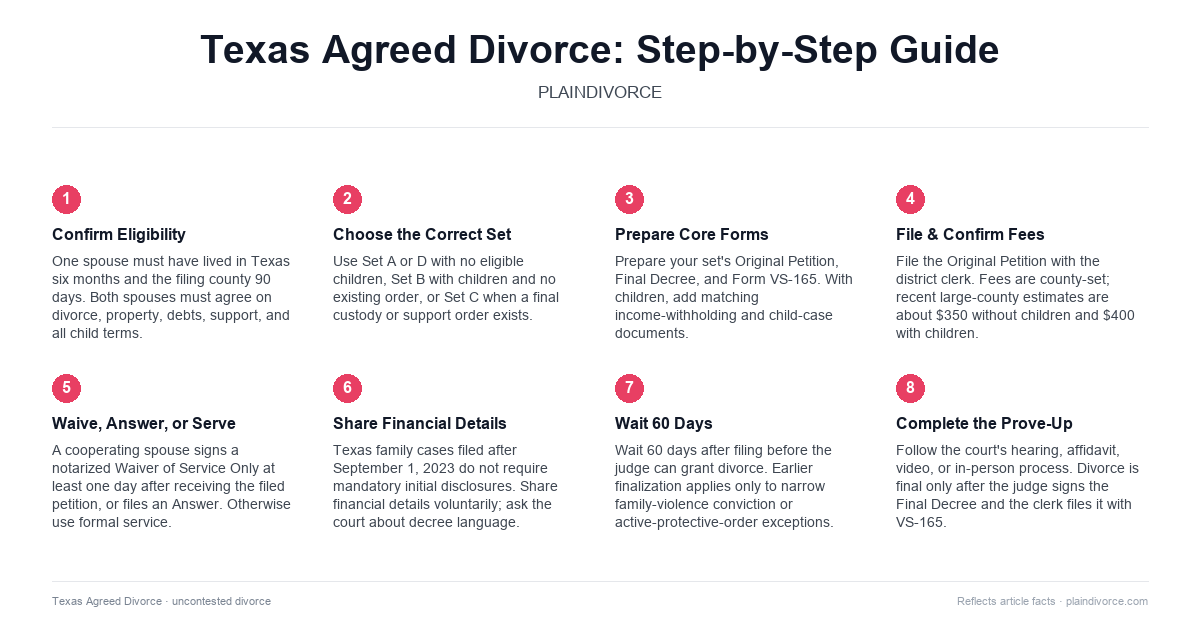
Texas calls an uncontested divorce an Agreed Divorce: you and your spouse settle every issue, both sign the Final Decree of Divorce, and the judge reviews and approves what you already worked out. No trial, and often only one spouse appears.
- Residency: one spouse must have been a Texas domiciliary for six months and a resident of the filing county for 90 days. Either spouse counts, and military time outside Texas still counts toward both.
- The 60-day wait is mandatory. A judge cannot grant the divorce before the 60th day after filing (§ 6.702). The only exceptions are a family-violence conviction or an active protective order against the respondent.
- Pick the right form set first — this is where DIY filings go wrong. Set A (no minor children), Set D (no children, same-sex marriage), Set B (minor children, no existing order), Set C (minor children, order already exists).
- The waiver timing trap: a Waiver of Service Only must be signed at least one day AFTER the petition is filed, in front of a notary, after your spouse has the clerk-stamped copy. Sign it too early and it’s invalid — the judge can refuse to grant the divorce. Filing an Answer instead also avoids formal service.
- Don’t forget VS-165 (the “Austin form”) — every divorce needs it, printed front and back on one sheet.
- Mandatory initial disclosures no longer apply to family-law cases filed after September 1, 2023. Financial info is exchanged only through formal discovery, so a waiver clause is optional now, not required.
- With kids: the decree needs conservatorship, possession and access, guideline child support (a presumption you must justify departing from), medical and dental support, and income withholding by default. Watch the UCCJEA home-state rule and the Medicaid/TANF notice to the Attorney General.
- Cost: county-set filing fees, recently around $350 without children and $400 with, in the large counties. Can’t pay? File a Statement of Inability to Afford Payment of Court Costs (form CB-CFFW-100) under Rule 145.
- You’re divorced when the judge signs the decree and the signed decree is filed with the clerk. Then: no marrying a new partner until the 31st day after the decree, and a 30-day appeal window.
- Get a lawyer if there’s family violence, hidden finances, a business or retirement needing a QDRO, a pregnancy, or an unresolved paternity question.
1. What is an Agreed (uncontested) divorce in Texas?
In everyday speech, an “uncontested” or “simple” divorce means you and your spouse agree on everything and just want the judge to sign off. Texas paperwork uses a more specific label: a divorce is agreed when the spouses agree on all issues in the case and both sign the forms needed to finish it.
A Texas case is treated as agreed when all of the following are true:
- You both agree the marriage should end.
- You both agree on how to divide property and debts.
- You both agree on whether either spouse will pay spousal support, and on what terms.
- If you have children, you agree on conservatorship (Texas’s word for legal custody), possession and access (the parenting schedule), and child support.
- You are both willing to sign the Final Decree of Divorce and the other paperwork that closes the case.
Two related situations are not the same as an agreed divorce. A contested divorce is one where you disagree about children, support, or property and ask the judge to decide; those cases take longer and cost more. A default divorce is one where you file, properly serve your spouse, and your spouse never files an answer — the court can still grant it, but it runs on a different procedural track and is not “agreed.”
2. Who qualifies for an Agreed Divorce in Texas?
Before the forms, check two things: that Texas is the right place to file, and that your situation is genuinely cooperative enough for an agreed case.
2.1 Residency requirement
Under Texas Family Code Chapter 6, a divorce suit cannot be maintained in Texas unless, at the time the suit is filed, either the petitioner or the respondent has been:
- a domiciliary of Texas for the preceding six-month period, and
- a resident of the county where you file for the preceding 90-day period.
Only one spouse has to meet both parts, and it does not matter which spouse files. Texas also has a specific rule for service members and other Texans stationed elsewhere: time spent outside Texas or the county while serving in the U.S. armed forces or another branch of government service (or accompanying a spouse who is) still counts toward Texas domicile and county residence. If that applies to you, read the residency instructions in the current TexasLawHelp petition carefully.
2.2 Grounds: the no-fault option (insupportability)
Texas allows both fault and no-fault grounds. Almost every agreed case uses the no-fault ground of insupportability. Family Code § 6.001 lets a court grant a divorce “without regard to fault” when the marriage “has become insupportable because of discord or conflict of personalities that destroys the legitimate ends of the marital relationship and prevents any reasonable expectation of reconciliation.”
Fault grounds (cruelty, adultery, abandonment, felony conviction, and others) still exist and are not automatically off the table in an agreed case, but pleading fault tends to raise conflict and is far more common in contested divorces.
2.3 When your case fits the agreed path
An Agreed Divorce is a good fit when:
- You both agree the marriage is over.
- You can communicate without threats, coercion, or fear.
- You both have full information about income, accounts, property, and debts.
- You can write down a clear split of property and debts.
- If you have children, you can agree on conservatorship, a possession schedule, and child support that follows the state guidelines.
- Neither spouse is hiding assets or pushing the other to sign something they do not understand.
2.4 When an agreed approach may not be safe or realistic
Even if you meet the residency rule, get legal help before filing an agreed case if:
- There has been family violence, or you are afraid of your spouse.
- One spouse is using money, threats, or intimidation to control the outcome.
- You have complex finances — a business, significant retirement accounts (a QDRO is often needed to divide a 401(k) or pension), or multiple properties.
- A spouse is pregnant now, a child was born to someone else during the marriage, or paternity of a child is unresolved. Texas courts generally will not finish a divorce while a spouse is pregnant until the child is born and parentage is addressed.
- There is already a court order about custody or child support for your kids, or a parent plans to move away with them.
- Bankruptcy, immigration, or a serious tax issue is tied to the divorce.
In those situations, talk to a Texas family lawyer or a legal aid clinic even if you still hope to settle everything out of court.
3. Texas Agreed Divorce forms: which form set fits you
There is no single “uncontested divorce” packet in Texas. The statewide self-help forms are organized into sets, and using the wrong one is a common reason paperwork gets bounced. Match your situation to a set first, then gather that set’s Texas Agreed Divorce forms.
| Your situation | Form set | Core forms in that set |
|---|---|---|
| No children together under 18 or still in high school; opposite-sex marriage | Set A | Original Petition for Divorce (FM-DivA-100), Final Decree of Divorce (FM-DivA-201), Sample Testimony (FM-DivA-700-Test) |
| No children together under 18 or still in high school; same-sex marriage | Set D | Original Petition for Divorce (FM-DivD-100), Final Decree of Divorce (FM-DivD-201), Sample Testimony |
| Children under 18 (or still in high school) and no existing custody/support order | Set B | Original Petition (FM-DivB-100), Respondent’s Original Answer (FM-DivB-102), Waiver of Service Only (FM-DivB-103), Final Decree of Divorce (FM-DivB-201), Income Withholding for Support (FM-IW-200) |
| Children and a final custody/support order already exists that you are not changing | Set C | Set C divorce forms (the Set B petition itself says not to use it when an order already exists) |
Across every set, three documents do most of the work:
- Original Petition for Divorce — the first document filed, which starts the case. If you are working from an Original Petition for Divorce Texas template, make sure it is the current version for your set and that the residency, grounds, and children sections match your facts.
- Waiver of Service Only or Respondent’s Original Answer — either one lets a cooperating spouse join the case without being formally served. More on the difference in Step 4.
- Final Decree of Divorce — the order that spells out every agreement (property, debts, support, and children). Follow the Final Decree of Divorce Texas instructions in your form set closely; the decree has to dispose of all property and debts and, if you have kids, include the custody, possession, and support terms.
Every divorce also requires Form VS-165, “Information on Suit Affecting the Family Relationship” — often called the “Austin form” because it feeds the state’s vital-statistics records. Complete it, print it on a single sheet front and back, and file it the way your form set and district clerk direct.
You can download the current statewide forms for every set from the official TexasLawHelp self-help forms library. A structured Texas uncontested divorce kit bundles the right forms for your situation with plain-English instructions so you are not guessing which set applies.
4. Step-by-step: the Agreed Divorce process
Local practice varies, but most agreed cases follow the same path. Here is the roadmap, with the Texas-specific traps that most often derail a DIY filing.
Step 1 — Confirm you qualify and the case is truly agreed
- Residency: six months in Texas and 90 days in the county for at least one spouse.
- Ground: most agreed cases plead insupportability (no-fault).
- Agreement: you have, or can reach, a full agreement on children, support, property, and debts — and you have picked the correct form set.
Step 2 — Write down every agreement
The judge expects your Final Decree of Divorce to state clearly what you agreed to. Cover at least:
- Children: conservatorship, a possession and access schedule (regular weeks, holidays, summer, transportation).
- Child support: the guideline amount (or an explained reason to differ), plus medical and dental support and how uninsured expenses are split.
- Spousal support / maintenance: whether any is paid, how much, and for how long.
- Property and debts: the house, vehicles, bank and retirement accounts, credit cards, and loans — each item assigned to one spouse.
Step 3 — Prepare your form set (including VS-165)
Fill out the petition, the decree, and the supporting forms for your set. Prepare VS-165 now so it is ready to file with your final paperwork. Because counties differ, call or check the website of the district clerk where you will file and ask about: the filing method (most Texas courts require e-filing for represented parties and allow it for self-represented filers), any local standing orders that take effect automatically when you file, required attachments, and how that court sets an uncontested final hearing.
Step 4 — File with the district clerk, then handle “service” the agreed way
File the Original Petition for Divorce with the district clerk (or county clerk, in counties where a county court at law hears family cases) in your county. The clerk assigns a cause number and a court. You pay the filing fee unless you file an approved fee-waiver statement (see Section 7).
Your spouse then joins the case in one of two ways:
- Waiver of Service Only — your spouse gives up formal service (delivery by a constable, sheriff, or private process server) but keeps the right to notice of, and participation in, later steps.
- Respondent’s Original Answer — your spouse files an answer. Filing an answer also removes the need for formal service and keeps the respondent fully in the case.
The waiver timing trap. If you use the Waiver of Service Only Texas divorce form, your spouse must:
- receive and read the filed petition (the copy with the clerk’s stamp) first;
- sign it at least one day after the petition is filed — never before, and not the same day;
- sign it in front of a notary, and include a mailing address; and
- file the original signed waiver with the clerk.
Sign the waiver too early and it is invalid — a judge can refuse to grant the divorce at the final hearing, and the waiver has to be redone. If your spouse will not sign a waiver or file an answer, you must arrange formal service; you generally cannot hand your spouse the papers yourself.
Step 5 — Understand today’s disclosure rules
You may have read that Texas requires “mandatory initial disclosures” (former Rule 194.2) on a deadline in every case. That no longer applies to family-law cases. All Texas family-law cases filed after September 1, 2023 are not required to exchange those disclosures. If either spouse wants financial information, they use the discovery process in Family Code Chapter 301. In a cooperative agreed case, you have usually already shared everything voluntarily, so a “mutual waiver of disclosures” clause is optional, not a universal requirement. Still, ask your court whether it expects any disclosure language in the decree.
Step 6 — Wait out the 60-day period
Under Family Code § 6.702, a court may not grant a divorce before the 60th day after the date the suit was filed. To count it: leave out the filing day, count 60 calendar days, and if day 60 lands on a weekend or holiday, the earliest available date moves to the next business day. The statute has only two narrow exceptions:
- the respondent has been finally convicted of, or received deferred adjudication for, an offense involving family violence against the petitioner or a member of the petitioner’s household; or
- the petitioner has an active protective order under Title 4, or an active magistrate’s order for emergency protection, based on the respondent’s family violence.
Everyone else waits the full 60 days. Finishing on day 61 exactly is possible in a smooth case, but the court’s calendar — not the statute — usually sets the real hearing date.
Step 7 — Finish at the final (prove-up) hearing
Many Texas courts wrap up an agreed case with a short prove-up hearing: the petitioner appears, answers a few questions under oath about residency and the grounds, and asks the judge to sign the decree. Some courts allow this by written affidavit or by video, and some require an in-person appearance — confirm your court’s procedure in advance, because there is no single statewide rule. The Sample Testimony form in your set is a checklist to prepare from; your answers must match your own facts.
In an agreed case, both spouses normally sign the completed Final Decree of Divorce before the hearing. When the judge approves everything, the judge signs the decree. Then file the signed decree (and any related signed orders, plus VS-165) with the clerk — in Texas, your divorce is not final until the signed decree is filed. Afterward, order certified copies from the clerk for changing your name, retitling property, and updating benefits.
5. Extra requirements when you have children
When minor children are involved, the judge must find that the orders are in the best interest of the children, even in a fully agreed case. Expect the decree to spell out:
- Conservatorship — who makes legal decisions, and whether it is joint managing, sole managing, or possessory.
- Possession and access — the parenting schedule, including holidays and summers, and where the children primarily live.
- Child support — amount, start date, and payment method. Under Family Code Chapter 154, the guideline amount is presumed to be reasonable and in the child’s best interest; if your agreement differs, the court needs a reason and must make specific findings.
- Medical and dental support — who carries insurance for the children and how uninsured costs are divided.
- Income withholding — Texas orders child support to be paid by withholding from the paying parent’s wages by default (an Income Withholding for Support order), routed through the state disbursement unit, unless the court approves an exception.
Two screening points people miss:
- Which state decides custody. A Texas court can make an initial custody order only if the child has lived in Texas for about the last six months (or since birth), or Texas is the child’s home state and the child has been gone less than six months. This is separate from the spouses’ divorce residency.
- Medicaid or TANF notice. If a child has ever received Medicaid or TANF, you must deliver a file-stamped copy of the petition to the Texas Attorney General’s Child Support Division and keep proof.
6. How long does an uncontested divorce in Texas take?
The floor is set by statute; the ceiling is set by paperwork and your court’s calendar.
- Earliest possible: about 60 days from the filing date, because of the mandatory waiting period.
- Realistic: often a few months, driven by how fast you complete and sign the forms and how quickly your court can set the final hearing.
The usual delays are avoidable: a waiver signed too early, a missing signature on the decree, a decree that does not dispose of every asset and debt, a forgotten VS-165, or simply waiting for a hearing slot. There is no reliable statewide “average” — ask your district clerk what an uncontested final setting currently looks like in that court.
7. What does an Agreed Divorce cost?
The main costs are:
- Court filing fee paid to the district clerk. Each county sets its own schedule; in recent years the large counties have charged roughly $350 for a case without children and around $400 with children, but you should pull the current fee list from your own district clerk before you file.
- Service costs — only if your spouse will not sign a Waiver of Service Only or file an answer and must be formally served.
- Notary and certified-copy fees — a few dollars per notarized signature and per certified copy of the final decree.
- Optional help — a limited-scope attorney consultation, document review, mediation, or a structured DIY kit.
If you cannot afford the fees, file a “Statement of Inability to Afford Payment of Court Costs or an Appeal Bond” (TexasLawHelp form CB-CFFW-100) with your other papers, under Texas Rule of Civil Procedure 145. You can file and have your spouse served while it is pending. The clerk or your spouse can contest it, and a judge then decides after a hearing whether you must pay.
8. When a DIY divorce is not right for you
A DIY Agreed Divorce is not the best fit when there are safety risks or genuinely complex legal or financial issues. Get advice first if:
- there has been domestic or family violence, or you feel unsafe;
- you do not have a full picture of the finances;
- there are complex assets — a business, several properties, or large retirement accounts needing a QDRO;
- a spouse is pregnant, or paternity of a child is disputed or unestablished;
- immigration, tax, or bankruptcy questions are tangled up in the divorce; or
- you feel pressured to sign anything you do not understand.
Even in an agreed case, a one-time consultation can flag long-term consequences — tax basis on the house, survivor benefits on a pension, how support interacts with benefits — before you sign the decree.
9. Where a self-help divorce kit fits in
If your case really is agreed, a self-help kit keeps you organized and helps you avoid the mistakes that stall DIY filings — choosing the wrong form set, mishandling the Waiver of Service Only timing, leaving assets out of the Final Decree of Divorce, skipping VS-165, or showing up unprepared for the prove-up. It does not replace legal advice, but for a straightforward uncontested divorce in Texas it can save you weeks of trial and error.
Download Our Texas Agreed Divorce Self-Help Kit10. Frequently asked questions
What is an Agreed Divorce in Texas?
An Agreed Divorce is an uncontested divorce where you and your spouse agree on every issue — property, debts, spousal support, and any children — and both sign the Final Decree of Divorce and the other required forms. The judge reviews the paperwork and, after the 60-day waiting period, signs the decree. If you disagree on anything and need the judge to decide, the case is contested instead.
Which Texas Agreed Divorce forms do I need?
It depends on your situation. Use Set A (or Set D for a same-sex marriage) if you have no children together under 18 or in high school. Use Set B if you have minor children and no existing custody or support order. Use Set C if a final custody or support order already exists. Every set centers on an Original Petition for Divorce, a Waiver of Service Only or Answer, a Final Decree of Divorce, and Form VS-165.
What is the Waiver of Service Only in a Texas divorce?
It is a form your spouse signs to give up formal service of process while staying in the case with full notice of later steps. Your spouse must first receive the filed (clerk-stamped) petition, sign the waiver in front of a notary at least one day after the petition is filed, include a mailing address, and file the original with the clerk. Signing it before the petition is filed makes it invalid. A spouse who files an Answer instead also avoids formal service.
How long is the waiting period for divorce in Texas?
Family Code § 6.702 bars a judge from granting a divorce before the 60th day after the suit is filed. Count from the day after filing; if day 60 falls on a weekend or holiday, the next business day is the earliest date. The only exceptions are a respondent’s family-violence conviction or deferred adjudication against the petitioner or a household member, or an active protective order against the respondent. Court scheduling often pushes the actual date past day 60.
Do I still have to exchange “initial disclosures” in an agreed divorce?
Not automatically. Texas family-law cases filed after September 1, 2023 are not subject to the old mandatory Rule 194.2 initial disclosures. Financial information is exchanged only if a spouse uses formal discovery under Family Code Chapter 301. In a cooperative agreed case you have usually shared everything already, so a written waiver clause is optional — but ask your court whether it wants disclosure language in the decree.
What is a prove-up hearing, and do I have to attend?
A prove-up is a brief final hearing where the petitioner testifies under oath that the residency and no-fault grounds are met and asks the judge to sign the decree. Some Texas courts allow prove-up by affidavit or video; others require an in-person appearance. There is no statewide rule, so confirm your court’s procedure. In an agreed case both spouses normally sign the decree beforehand, and usually only the petitioner appears.
What does it cost, and what if I can’t afford the fee?
The district clerk’s filing fee is the main cost. Counties set their own schedules — recently roughly $350 without children and about $400 with children in the large counties — plus any service, notary, and certified-copy costs. If you cannot pay, file a “Statement of Inability to Afford Payment of Court Costs or an Appeal Bond” (form CB-CFFW-100) under Rule 145 with your other papers; the clerk or your spouse may contest it and a judge decides.
When is my Texas divorce actually final?
When the judge signs the Final Decree of Divorce and the signed decree is filed with the clerk. Order certified copies for your records. Note two follow-on rules: neither spouse may marry a new partner before the 31st day after the divorce is decreed (you can remarry each other any time, and a court can waive the 31-day wait for good cause), and the decree can generally be appealed for 30 days after it is signed.
11. Final thoughts and next steps
When both spouses cooperate and sign everything, an uncontested divorce in Texas is usually the calmest and least expensive route. Keep the reality checks in view: pick the right form set for your situation, respect the 60-day waiting period, get the Waiver of Service Only timing right (never sign before filing), complete VS-165, and file the signed Final Decree of Divorce with the clerk so it actually takes effect. If you have children, build the decree around guideline child support, medical and dental support, income withholding, and the UCCJEA home-state rule.
Remember: PlainDivorce.com is not a law firm, and this guide is information only. If you are unsure of your rights, worried about safety, or dealing with complex finances, a pregnancy, or an unresolved paternity question, talk to a Texas family lawyer or a legal aid organization before you file. When your case is a clean fit, the Texas uncontested divorce kit gives you the right forms and step-by-step instructions to do it yourself with confidence.
Sources and local rules can change. Use this guide as a plain-English organizer, then verify the current filing requirements with the official court or government source for your jurisdiction.

About Harry D
Expert contributor at PlainDivorce, helping Canadians and American navigate simple uncontested divorces with clarity and confidence.