Uncontested Divorce in Utah: A Plain-English Guide to Stipulated Divorce, MyPaperwork, and the 30-Day Wait
An uncontested divorce in Utah is one where both spouses agree the marriage is over and agree on every issue — property, debts, and, if you have kids, custody, parent-time, and child support. Utah courts handle that kind of case as a stipulated divorce: you sign a written agreement (a “stipulation”), file it with your other paperwork, wait out a 30-day period, and ask a judge to sign the decree, usually without a hearing.
This guide walks through how a stipulated, uncontested divorce in Utah works in 2026: who qualifies, how you now prepare the forms (Utah retired its old OCAP system and replaced it with MyPaperwork), the step-by-step process, the 30-day statutory waiting period and when a waiver is even possible, what it costs, the extra requirements when children are involved, and where a self-help kit fits if you are looking for Utah stipulated divorce forms in PDF and an OCAP divorce alternative you can work through offline.
TL;DR
Utah handles an uncontested divorce as a stipulated divorce: you sign a written settlement, file it with your petition, wait out 30 days, and ask a judge to sign the decree — usually with no hearing. Two things changed recently that older guides get wrong: OCAP is gone (replaced by MyPaperwork), and the divorce statutes moved from Title 30 to Title 81 in September 2024.
- Residency: one spouse must have lived in the filing county for 90 days (or be stationed there on military orders 90+ days, or both spouses consent to jurisdiction). With kids, the child generally needs 6 months in Utah.
- The 30-day wait is the floor. A court can’t enter a decree until 30 days after filing (§ 81-4-402). A waiver requires extraordinary circumstances and is rare — plan around the full 30 days.
- MyPaperwork prepares your forms, it does not file them. It generates completed PDFs; you download, sign, and submit them yourself by email, mail, or in person.
- The Vital Statistics certificate goes in WITH the Petition — not at the end. This is one of the most common filing mistakes. Also due at intake: the Notice of Disclosure Requirements and, with kids, the Non-Public Information form and Notice of Education Requirements.
- A Rule 109 injunction fires the moment you file. It binds you immediately and your spouse only once they get a copy — so deliver it. No moving property, changing insurance, or harassing the other spouse.
- You can’t serve the papers yourself. An Acceptance of Service (notarized) is the easy route. Service must be completed within 120 days of filing; the Answer deadline is 21 days (in Utah) or 30 days (outside).
- With kids, do the courses FIRST. Both parents must complete two separate courses — Mandatory Parenting (up to $35) and Divorce Orientation (up to $30, or $15 live within 30 days). Petitioner: 60 days from filing. Respondent: 30 days from service. No decree until both certificates are filed. Leaving these to the end is the top self-inflicted delay.
- Financial Declarations are required — with pay stubs, two years of tax returns, and three months of account statements. Not just a promise to be honest.
- Cost: the filing fee rose to $350 effective May 6, 2026, plus an $8 Vital Statistics charge (about $358), plus a separate MyPaperwork document fee. Fee waivers available.
- No mediation in a fully stipulated case — that requirement only kicks in when contested issues remain after a response is filed.
1. What Is an Uncontested (Stipulated) Divorce in Utah?
Utah does not use an official case label called “simple divorce.” When people say simple or uncontested divorce, they mean a case where both spouses agree the marriage should end and agree on how to divide everything. In Utah court language, that agreed case is a stipulated divorce: you give the court a signed stipulation (your written settlement) and ask the judge to finalize the divorce on the paperwork.
A stipulated divorce generally looks like this:
- Both spouses agree the marriage should end (almost always on the no-fault ground of irreconcilable differences).
- Both spouses agree on the major issues: property and debt division, alimony (if any), and — if there are minor children — legal custody, physical custody, parent-time, and child support.
- You file a Petition for Divorce to open the case, give the other spouse legal notice, sign a Stipulation, and submit final-order paperwork — Findings of Fact and Conclusions of Law followed by a Decree of Divorce.
By contrast, a contested divorce is one where at least one issue is disputed — custody, parent-time, child support, alimony, property, or debt. Contested cases add deadlines, mandatory mediation, hearings, and cost. A stipulated case that stays truly agreed can skip most of that, though a judge still reviews the terms (especially anything involving children) before signing.
2. Who Qualifies: Residency, Grounds, and Agreement
To file a stipulated, uncontested divorce in Utah, focus on three things: residency, grounds, and a genuine agreement. Utah’s divorce statutes are in Title 81, Chapter 4 of the Utah Code (they moved there from Title 30 on September 1, 2024, so older articles and forms that cite “30-3” are out of date).
Residency requirements
Under Utah Code § 81-4-402, you can file for divorce if any one of these is true:
- You or your spouse has been an actual and bona fide resident of the Utah county where you file for at least 90 days (about 3 months) right before filing; or
- You are a member of the U.S. armed forces stationed in Utah under military orders for at least 90 days before filing; or
- Neither of those applies, but both spouses consent to a Utah court having personal jurisdiction to decide the divorce.
If minor children are involved and Utah will decide custody or parent-time, the child usually must have lived in Utah with a parent for at least 6 months before filing. That is a rule of thumb, not an absolute — the interstate custody rules (the UCCJEA) have exceptions for newborns, recent moves, and existing out-of-state orders. If your child recently moved, lives in another state, or is already covered by another state’s order, get the current jurisdiction analysis from a Utah lawyer before you file.
Grounds for divorce in Utah
Utah recognizes both fault and no-fault grounds. Nearly every stipulated divorce uses the no-fault ground in Utah Code § 81-4-405: irreconcilable differences of the marriage — meaning the relationship has broken down and cannot be repaired. Fault grounds (adultery, cruelty, felony conviction, habitual drunkenness, desertion, and others) exist, but pleading fault tends to make a case adversarial and slower, which defeats the point of an agreed filing.
When a stipulated divorce is a good fit
- You both agree on the big issues (children, support, property, debt), or you are close and willing to keep negotiating in good faith.
- You can exchange complete financial information — Utah requires a formal Financial Declaration, not just a promise to be honest.
- Neither spouse is pressuring the other to sign unfair terms.
- You are both safe enough to communicate and negotiate directly.
When an uncontested filing may not work
- Domestic violence, threats, intimidation, stalking, or any safety concern.
- Hidden assets, refusal to share financial records, or a major power imbalance.
- Complex finances — a business, significant retirement accounts, real estate in multiple states, or unusual tax issues.
- Real disputes about custody, relocation, or a child’s safety.
In those situations, pause and get legal advice before filing anything, even if you still hope to settle later.
3. How You Prepare the Forms Now (MyPaperwork Replaced OCAP)
If you have read an older Utah divorce guide, you have seen the “OCAP vs. PDF forms” choice. That framing is out of date. Utah Courts has announced that, after nearly 25 years, the Online Court Assistance Program (OCAP) is being retired and replaced by MyPaperwork. Divorce is already handled in the new system.
What MyPaperwork is
MyPaperwork is Utah’s free, guided online interview. You answer step-by-step questions and it generates your completed court forms — the Petition for Divorce, the child support worksheet, the Findings, the Decree, and the case-specific extras. It follows the correct Petition for Divorce Utah instructions so the grounds, residency, and requested relief are stated in the format the court expects.
Two things to understand about MyPaperwork:
- It does not file your case for you. MyPaperwork creates the papers; you download them and file them yourself — by email, by mail, or in person at the courthouse. There is no “click to file a divorce” button.
- It may not produce every paper you need. The exact set of documents depends mostly on whether you have minor children. Utah Courts publishes a “Checklist for Divorce (With Children)” and a “Checklist for Divorce (Without Children)” that control what a complete packet looks like.
Is there a separate “PDF forms” track?
Not as a parallel official system. Utah Courts directs self-represented filers to MyPaperwork for divorce preparation. The forms MyPaperwork generates are downloadable PDFs, so if you are searching for Utah stipulated divorce forms in PDF, that is where the official documents come from — you just print, sign, and file them on your own schedule. The individual blank forms also exist on the Utah Courts site, but there is no state-supplied “just the PDFs” divorce packet that replaces the guided interview.
Where a paid self-help kit comes in is organization and plain-English explanation: a good kit walks you through the vocabulary, gives you a checklist so nothing is missing, and helps you keep the case on the agreed track whether you generate your documents through MyPaperwork or fill out the forms by hand. More on that in section 9.
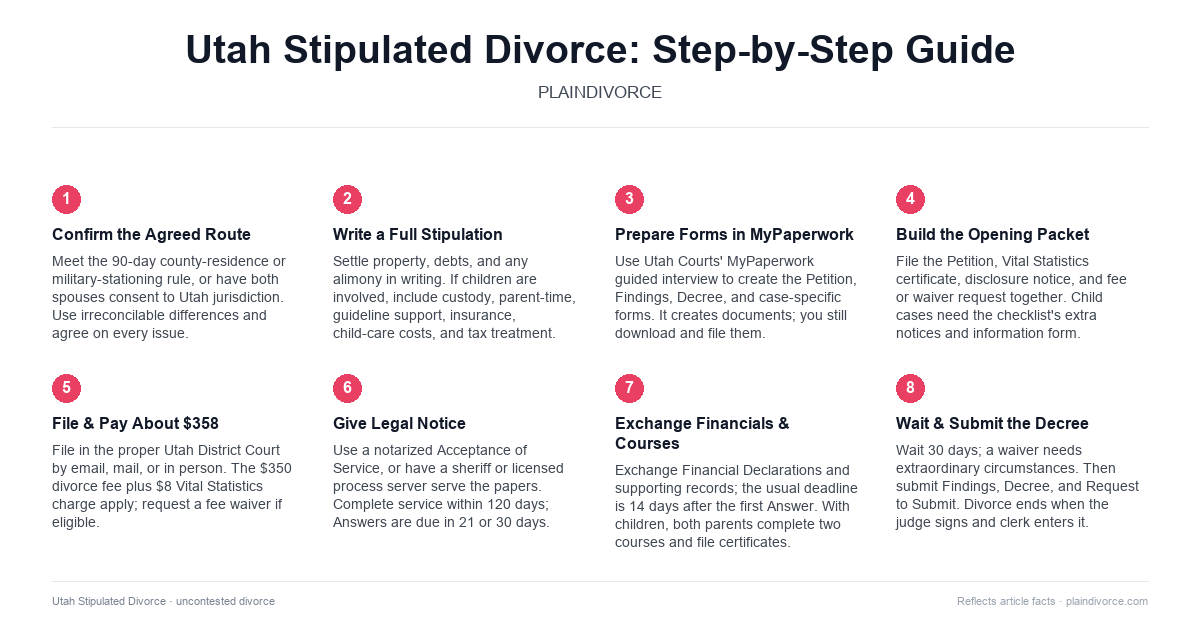
4. Step-by-Step: The Utah Uncontested Divorce Process
Step 1 – Confirm eligibility and gather your information
- Confirm the 90-day county residency (or a military-orders or consent pathway), and child residency if custody will be decided.
- Confirm you are filing no-fault on irreconcilable differences in a genuinely agreed case.
- Pull together income records, account statements, tax returns, and a full list of property and debts — you will need them for the Financial Declaration and, if you have kids, the child support worksheet.
Step 2 – Reach a full agreement (the stipulation)
In a stipulated divorce, the agreement is the engine of the case. A complete stipulation typically covers:
- Division of property and debts (who keeps what, who pays what, and any equalizing payment).
- Alimony — amount and duration, or a clear statement that neither party will pay it.
- If you have children: legal custody, physical custody, a specific parent-time schedule (including holidays), child support, health and dental insurance, how uninsured medical and work-related child-care costs are split, and which parent claims the tax exemption.
Your final Findings and Decree must match the stipulation word for word on the substance. If they say something different, the court can reject the paperwork and send you back to fix it.
Step 3 – Prepare the filing packet
Do not assume the four “core” documents (Petition, Stipulation, Findings, Decree) are the whole list. Utah’s checklists require several intake documents at the initial filing:
- Petition for Divorce — opens the case and states grounds, residency, and what you are asking the court to order.
- Certificate of Divorce, Dissolution of Marriage, or Annulment — the Utah Department of Health and Human Services “Vital Statistics” form. It must be filed with the Petition, not saved for the end. This is a common thing filers get wrong.
- Notice of Disclosure Requirements in Domestic Relations Cases.
- The filing fee, or a fee waiver application (Motion and Order to Waive Fees) if you qualify.
- If you have minor children, also: a Notice of Education Requirements, a Non-Public Information form (parent and child identifiers), a Notice to the Department of Human Services if either spouse receives state cash assistance, and a parenting plan if you are asking for joint custody (it is folded into the Decree, not filed as a separate attachment).
You will also need, before the judge signs: proof of how the other spouse was notified, a Declaration of Jurisdiction and Grounds for Divorce (or sworn testimony at a brief hearing), and, in a child case, the two course-completion certificates and child support income verification. The two checklists are the authoritative list — work from the one that matches your situation.
Step 4 – File in the right Utah District Court
File with the Utah District Court in the county where you meet residency (commonly the county where you or your spouse lives). You can file in person, by mail, or by email, depending on the court. Pay the filing fee or submit your fee waiver request at the same time.
The moment you file, an automatic domestic relations injunction under Utah Rule of Civil Procedure 109 takes effect. It binds you as soon as you file, and it binds your spouse only once they receive a copy — so you must deliver a copy of the injunction to your spouse along with the other papers. In plain terms, while the case is open, neither spouse may:
- Harass, intimidate, or disturb the peace of the other spouse (including electronically), or commit any domestic violence or abuse.
- Cancel or change health, auto, home, or life insurance without the other’s written consent or a court order.
- Transfer, hide, or dispose of property (beyond ordinary living expenses and normal business) when property division is at issue.
- Take a child on non-routine travel without consent or notice, or demean the other parent in front of the children.
Step 5 – Give the other spouse legal notice
Utah requires formal notice to your spouse, and you cannot serve the papers yourself. In an uncontested case, the simplest route is an Acceptance of Service: your spouse signs (in front of a notary) to acknowledge they received the Petition and related documents. That is cheaper and faster than hiring a process server. If your spouse will not sign, you serve a Summons through a sheriff or licensed process server and file a Return/Proof of Service.
You must complete service and file the proof within 120 days of filing the case. Once your spouse is served or signs an acceptance, their deadline to file an Answer is:
- 21 days if served inside Utah.
- 30 days if served outside Utah.
The day of service counts as day zero, and if the deadline lands on a weekend or court holiday it rolls to the next open day. In a fully stipulated case, the other spouse often does not file a separate Answer at all — the signed stipulation and acceptance move the case forward.
Step 6 – Exchange financial disclosures
Utah divorce parties owe each other initial disclosures and a completed Financial Declaration with supporting attachments — recent pay stubs, two years of tax returns with W-2s, three months of financial-account statements, and documents backing property values and debts. The normal deadline is within 14 days after the first Answer is filed. In a stipulated case with no Answer, you should still exchange Financial Declarations (and can agree in writing on timing) so both spouses are signing the settlement with the same numbers in front of them.
Step 7 – Wait out the 30-day period
Utah Code § 81-4-402(3) says the court may not enter a decree of divorce until 30 days after the day the petition is filed, unless the judge finds extraordinary circumstances. The court can still issue interim orders during that window. See section 6 for how the Utah divorce 30-day waiting period waiver works — short version: it is rare.
Step 8 – Submit final papers and get the decree signed
After the 30 days (and, in a child case, after both parents finish the mandatory courses), you submit the Findings of Fact and Conclusions of Law, the Decree of Divorce, and any remaining checklist items, then file a Request to Submit for Decision so the judge or commissioner knows the case is ready. If the papers are complete and consistent with the stipulation, the judge signs — usually with no hearing in an uncontested case.
You are not divorced until a judge signs the Decree and the clerk enters it. The signed, entered decree is your proof the marriage has ended. Order a certified copy or two for changing your name, updating benefits, and retitling accounts. Note: neither spouse may marry someone else until the decree is final.
5. Extra Requirements When You Have Children
You can still do a stipulated, uncontested divorce in Utah with children — you just have to complete the additional steps built in to protect the children’s best interests, and the judge will look harder at the terms.
Two mandatory courses
In any divorce involving minor children, both parents must complete two separate courses, each with its own certificate:
- The Mandatory Parenting course (also called Divorce Education for Parents) — capped at $35 per person.
- The Divorce Orientation course — capped at $30 per person, but $15 if you take a live in-person session within 30 days (petitioner: 30 days of filing; respondent: 30 days of service). Filers who cannot afford the fee can attend free with an indigency affidavit.
The statutory deadlines: the petitioner must finish both within 60 days of filing, and the respondent within 30 days of being served. A judge can waive the requirement if attendance is not necessary, appropriate, feasible, or in the parties’ best interests — but absent a waiver, the court will not sign a final decree until both parents file both certificates. Do the courses early; leaving them to the end is the most common self-inflicted delay in a child case.
Child support
Utah uses an Income Shares model: a guideline table sets the total support figure based on both parents’ gross incomes and the number of overnights, and the parents split it in proportion to income. Even in an agreed case, a child support order has to include guideline-based support (or a legally supported reason to deviate), plus provisions for:
- Medical and dental insurance, with the children’s share of the premium split equally.
- Work-related child-care costs, also split equally.
- Which parent claims the tax exemption.
- Income withholding (the default), and a notice about Office of Recovery Services enforcement.
Each parent has to verify current income (pay stubs, employer statement, or recent tax return), file an Income Verification and Statement of Compliance with Child Support Guidelines, and attach a completed Child Support Worksheet. MyPaperwork runs the calculation and produces the worksheet as part of your divorce papers; you can also use the Utah Courts online child support calculator to check the number.
Custody and parent-time
Your paperwork needs to spell out legal custody, physical custody, and a specific parent-time schedule with holiday and vacation provisions. If you are asking for joint legal custody, Utah requires a parenting plan, which is written into the Decree. Vague or incomplete custody terms are a leading reason a judge sends an otherwise-agreed packet back.
6. How Long Does a Utah Uncontested Divorce Take?
The one firm number is the 30-day statutory waiting period: a Utah court cannot sign your decree until at least 30 days after the petition is filed. Beyond that floor, the timeline depends on how fast you complete correct paperwork, whether you have children (the courses add time), and how busy your court is. Fully agreed, paperwork-complete cases are often finalized not long after the 30 days; cases with missing forms, incomplete child requirements, or terms that do not match the stipulation take longer because the court returns them for correction. If a case stops being agreed and becomes contested, plan on a much longer process with mediation and hearings.
| Milestone | Timing |
|---|---|
| Earliest a decree can be signed | 30 days after filing (waiver only in extraordinary circumstances) |
| Service of the petition | Must be completed within 120 days of filing |
| Answer deadline (if filed) | 21 days (served in Utah) / 30 days (served outside Utah) |
| Financial disclosures | Normally within 14 days after the first Answer |
| Parent courses (child cases) | Petitioner: within 60 days of filing. Respondent: within 30 days of service |
The 30-day waiting period waiver
A Utah divorce 30-day waiting period waiver is possible only if the judge finds extraordinary circumstances, and it is not granted automatically. You file a Motion to Waive the Divorce Waiting Period, serve it on the other party (who has 14 days to object), and file a Request to Submit for Decision so a judge rules on it. Most uncontested filers should simply plan around the 30-day minimum rather than count on a waiver. See the Utah Courts page on the divorce waiting period for the current procedure.
7. What Does a Utah Uncontested Divorce Cost?
Even a do-it-yourself stipulated divorce has costs. The main ones:
| Item | Typical amount (2026) |
|---|---|
| District Court filing fee (divorce) | $350, effective May 6, 2026 (Utah Code § 78A-2-301) |
| Vital Statistics charge on the cover sheet | $8 (Utah Code § 26B-8-128) — so the filing line is about $358 |
| Fee for documents prepared through MyPaperwork | A separate court-set fee applies; confirm the current amount on the Utah Courts fee schedule |
| Mandatory Parenting course (parents) | Up to $35 per person |
| Divorce Orientation course (parents) | Up to $30 per person ($15 for a live session taken within 30 days) |
| Service by process server (if no Acceptance of Service) | Varies — roughly $40–$100+ |
| Certified copies of the Decree | Small per-copy fee at the clerk’s office |
If your income is low, you can apply for a fee waiver using the current Utah Courts Motion and Order to Waive Fees. Always confirm live amounts on the Utah Courts filing and other fees page before you file — the divorce fee went up in May 2026 and court fee schedules are being updated.
8. When a DIY Divorce Is Not the Right Call
A DIY Utah divorce can work well when the case is genuinely simple and genuinely agreed. Get at least a short consultation with a Utah family lawyer or a legal clinic if:
- There is domestic violence, coercion, stalking, or a safety risk.
- You suspect hidden income or assets, or serious financial dishonesty.
- You have complex finances — a business, a pension or large retirement accounts, stock compensation, or unusual debt.
- A retirement account has to be divided by a Qualified Domestic Relations Order (QDRO).
- You are unsure about immigration status or major tax consequences.
- You cannot actually agree on custody, parent-time, or the child support basics.
This guide can explain the Utah process, but it cannot tell you whether a particular deal is fair to you or what you personally should agree to. That is what a consultation is for.
9. Where a Self-Help Kit Fits (An Offline OCAP Alternative)
If the state’s guided interview feels rigid or stressful, or you simply want to work through everything on paper, at your own pace, before anything is filed, a structured self-help kit can be an OCAP divorce alternative in Utah — not a replacement for the court’s forms, but a way to stay organized around them.
A well-built Utah kit supports a stipulated divorce by:
- Explaining the terminology in plain English — Petition, Stipulation, Findings of Fact and Conclusions of Law, Decree, Acceptance of Service, domestic relations injunction.
- Giving you a checklist that mirrors the court’s own, so you do not forget the intake pieces filers routinely miss — the Vital Statistics certificate at initial filing, the Notice of Disclosure Requirements, the Non-Public Information form, the course certificates.
- Helping you exchange a complete Financial Declaration and, if you have kids, gather what the child support worksheet needs.
- Keeping you focused on the agreed path rather than drifting into contested territory.
Because the exact form set depends on your facts (mostly whether you have children), no private kit can promise it contains every document your specific case needs — always cross-check against the current Utah Courts “Checklist for Divorce” for your situation before you file.
Get the Utah Uncontested Divorce Self-Help Kit
10. Frequently Asked Questions
What is an uncontested (stipulated) divorce in Utah?
It is a divorce where both spouses agree the marriage is over and agree on every issue — property, debts, and any custody, parent-time, and child support. Utah handles it as a stipulated divorce: you sign a written settlement (the stipulation), file it with your petition and the other required forms, wait out the 30-day period, and ask a judge to sign the decree, usually without a hearing.
Do I still use OCAP to file for divorce in Utah?
No. Utah Courts has retired OCAP and replaced it with MyPaperwork, the free guided interview that now prepares divorce documents. MyPaperwork creates your forms as downloadable PDFs; it does not file the case — you submit the papers yourself by email, mail, or in person. There is no separate state “PDF packet” track that replaces the interview.
Where do I get Utah stipulated divorce forms in PDF?
The official forms come from Utah Courts — either as the completed PDFs that MyPaperwork generates from your answers, or as individual blank forms on the Utah Courts website. A paid self-help kit does not give you different court forms; it gives you plain-English instructions and a checklist to work through those forms offline and keep your case on the agreed track.
What are the two required courses for parents?
Divorces with minor children require both a Mandatory Parenting course (up to $35 per person) and a Divorce Orientation course (up to $30, or $15 for a live session taken within 30 days). They are separate courses with separate certificates. The petitioner must finish within 60 days of filing and the respondent within 30 days of service. A judge will not sign the final decree until both parents file both certificates or the requirement is waived.
How fast can a Utah uncontested divorce be finalized?
A Utah court cannot sign the decree until at least 30 days after the petition is filed. After that, timing depends on how quickly you file complete, consistent paperwork, whether you have children (the parent courses add time), and your court’s workload. Paperwork-complete, fully agreed cases are often finalized shortly after the 30 days; missing forms or terms that do not match the stipulation cause the court to send the packet back.
Can I get the 30-day waiting period waived?
Only sometimes. A Utah divorce 30-day waiting period waiver requires a judge to find extraordinary circumstances, and it is never automatic. You file a Motion to Waive the Divorce Waiting Period, serve it on the other party, and file a Request to Submit for Decision. Most uncontested filers should plan around the full 30 days.
Is there a form that reports my divorce to vital records?
Yes — the Utah Department of Health and Human Services Certificate of Divorce, Dissolution of Marriage, or Annulment (the “Vital Statistics” sheet). It is an initial-filing document: Utah Courts says it must be filed with the Petition for Divorce, not saved for the end of the case.
Do we have to go to mediation?
Only if contested issues remain after a response is filed. Utah requires at least one mediation session when there is still something to fight about — a fully stipulated divorce, where everything is already agreed and signed, does not trigger the mediation requirement.
11. Final Thoughts and Next Steps
A Utah stipulated divorce can be one of the calmer, lower-cost ways to end a marriage when both spouses are organized, honest about finances, and focused on workable terms. The process rewards preparation: complete paperwork, numbers both spouses have actually seen, and — in a child case — the courses done early.
- Confirm the 90-day county residency (and child residency, if custody is at issue).
- Reach a full agreement and write it into a clear stipulation.
- Prepare your forms through MyPaperwork or work through them with a self-help kit — and check the current Utah Courts checklist for your situation.
- File the Petition with the Vital Statistics certificate, arrange service (Acceptance of Service is easiest), and deliver the Rule 109 injunction.
- Exchange Financial Declarations, plan around the 30-day wait, and, if you have children, complete both parent courses right away.
Reminder: PlainDivorce.com is not a law firm and cannot give legal advice. This guide explains the Utah uncontested (stipulated) process so you can make informed decisions; for advice about your specific facts, talk to a qualified Utah family-law attorney or a legal clinic.
Sources and local rules can change. Use this guide as a plain-English organizer, then verify the current filing requirements with the official court or government source for your jurisdiction.

About Harry D
Expert contributor at PlainDivorce, helping Canadians and American navigate simple uncontested divorces with clarity and confidence.