Uncontested Divorce in Vermont: A Plain-English Guide to Stipulated Divorce and the Decree Nisi
An uncontested divorce in Vermont is one where both spouses agree the marriage is over and agree on every issue — parenting, child support, spousal maintenance, and how to divide property and debts. Vermont courts handle that kind of case as a stipulated divorce: you file your written settlement (a “Final Stipulation”) along with the complaint in the Superior Court, Family Division, pay a reduced filing fee, and ask a judge to approve the paperwork — often with a short hearing, and sometimes with no hearing at all.
This guide explains how a stipulated, uncontested divorce in Vermont works in 2026: who qualifies (including Vermont’s six-month separation rule and the one-year residency rule), how the reduced fee works, exactly which forms you file with and without children, the step-by-step process, and the state’s signature quirk — the Decree Nisi and the 90-day wait before your divorce is truly final. It also covers what changes when you have kids, and where a self-help kit fits if you want to know how to file for divorce in Vermont without a lawyer.
TL;DR
Vermont handles an uncontested divorce as a stipulated divorce: you file your signed settlement together with the complaint in the Superior Court, Family Division. Two Vermont quirks drive everything — a big filing-fee discount for filing agreed from day one, and the Decree Nisi, which means your divorce is not actually final the day the judge grants it.
- File agreed and save $205. A complaint filed with a stipulation costs $90 (resident) or $180 (nonresident). Filed without one, it’s $295 — and you can’t get the discount by agreeing later. Finish the Final Stipulation before you file.
- The Decree Nisi: the judge’s order starts as provisional and becomes absolute after 90 days (15 V.S.A. § 554) unless the court sets an earlier date. You cannot remarry until it’s absolute. You can request a waiver in the stipulation — but finalizing sooner can end a spouse’s health insurance and change your tax filing status.
- Two residency tests: six months in Vermont to file, and one year before the final hearing to get the decree.
- The ground is six months living separate and apart. You can file before the six months are up, but no final hearing until they’re complete. Same-house separation can count if you’re genuinely not living as a couple.
- The forms trip people up. Every case needs the Information Sheet (400-00800), Complaint (400-00836), Statement of Confidential Information (400-00849), the Health Department Record of Divorce, Acceptance of Service (400-00844), and the Final Stipulation (400-00878).
- With kids, add: the parenting agreement (400-00825), a guideline-backed Child Support Order (400-00802), and both financial affidavits (400-00813A and 400-00813B) from each parent — four forms total. Filing only one per parent is the classic mistake.
- Parents must take COPE — a 4-hour UVM Extension seminar, about $80 each (reduced to ~$30 or $15 for hardship). No final hearing gets scheduled until both parents finish, so register immediately.
- The six-month scheduling rule: with minor children, the court usually won’t set a final hearing until six months after the case starts. For parents, this — not the Nisi period — is normally the real pacing factor.
- Skipping the hearing is limited. The waiver form (400-00841) is unavailable if an abuse-prevention order is in effect, and if you have children it’s attorneys only — self-represented parents can’t use it.
- Get a lawyer if there’s abuse or coercion, a real dispute about the children, hidden finances, or a business, pension, or QDRO involved.
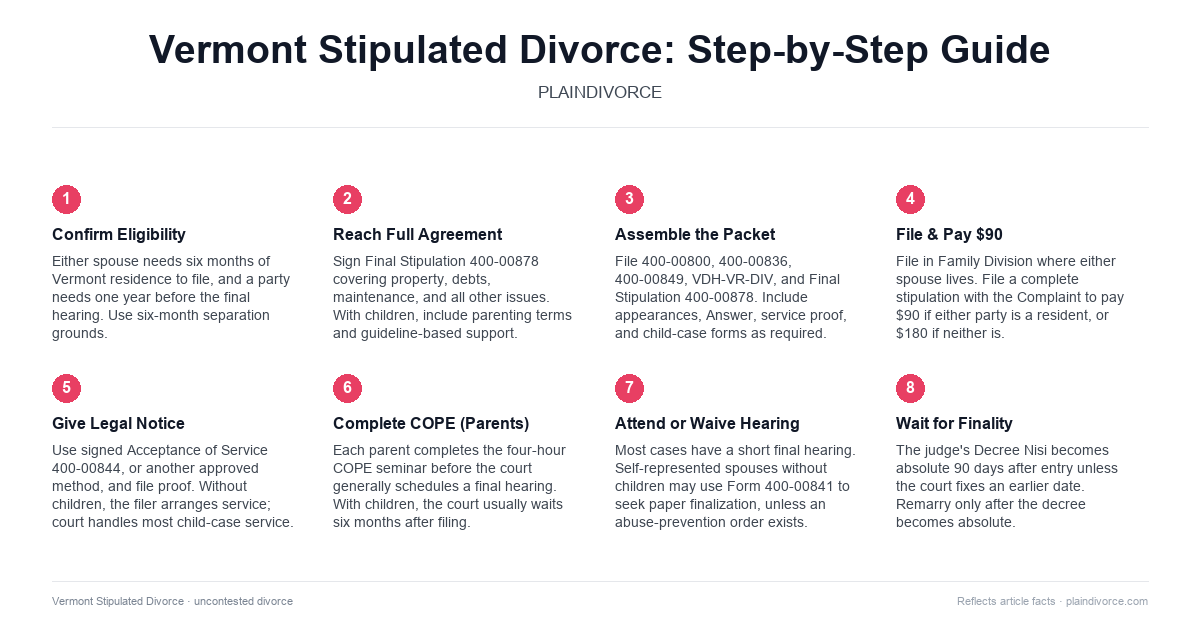
1. What Is an Uncontested (Stipulated) Divorce in Vermont?
In everyday speech people say “uncontested divorce” or “simple divorce.” Vermont’s Family Division calls the agreed version a stipulated divorce — a case where you file a signed written agreement resolving everything, so there is nothing for the court to decide except whether to approve it.
An uncontested divorce in Vermont generally looks like this:
- Both spouses agree the marriage should end (almost always on the no-fault ground of living separate and apart for six consecutive months).
- Both spouses agree on the major issues: parenting and child support if you have children, spousal maintenance if any, and division of property and debts.
- You put the agreement into a Final Stipulation (property, debts, and maintenance) and, if you have children, an Agreement on Parental Rights & Responsibilities plus a Child Support Order.
- You file in the Superior Court, Family Division and ask the court to approve the paperwork.
A judge still reviews the agreement — more closely if there are children — but a genuinely agreed case skips most of what makes divorce slow and expensive: no discovery fights, fewer hearings, and far lower cost. By contrast, a contested divorce is one where you disagree about something (parenting, support, property, or whether to divorce at all), which brings conferences, motions, evidence, and usually lawyers.
2. Who Qualifies: Residency, Grounds, and Agreement
To file a stipulated, uncontested divorce in Vermont, focus on three things: residency, grounds (the Vermont divorce separation period of 6 months), and a genuine agreement.
Residency: six months to file, one year to finish
Vermont has two separate residency tests, set by 15 V.S.A. § 592:
- To file: either you or your spouse must have “resided within the State for a period of six months or more.”
- To get the decree: a divorce may not be granted unless the plaintiff or the defendant “has resided in the State one year next preceding the date of final hearing.” A temporary absence for illness, work, or military service does not break the year if Vermont stayed your home.
There is one narrow exception in § 592(b) for people who married or entered a civil union in Vermont but live elsewhere: nonresidents can file in the county where the marriage certificate was filed if all of these are true — no minor children were born or adopted during the marriage, neither spouse’s home state will recognize the Vermont marriage for divorce purposes, and the spouses file a joint stipulation, entered into freely, that resolves every issue. In those cases the court waives the final hearing unless the paperwork is incomplete or a term needs clarifying.
Grounds: living separate and apart for six months
Nearly every uncontested Vermont case uses the no-fault ground in 15 V.S.A. § 551(7): the spouses have “lived apart… for six consecutive months and the court finds that the resumption of marital relations is not reasonably probable.” You can file the complaint before the six months are up, but the court cannot hold the final hearing until the full six months have passed.
“Separate and apart” does not always mean two addresses. The Judiciary’s practical standard is that spouses can be separate and apart in the same home if they are not living as a couple — sleeping in separate rooms and keeping separate households. A judge can then find the requirement met, but it is fact-specific, so be ready to explain your living arrangement at the hearing.
When a stipulated divorce is a good fit
- You both want the divorce and will cooperate on the paperwork.
- You can agree on parenting, child support, and (if needed) maintenance.
- You can agree on dividing property and debts, including any retirement accounts.
- Neither spouse is hiding money or information.
- There is no domestic violence or coercion that makes it unsafe to negotiate.
If there are real disputes about the children, incomplete financial information, intimidation or abuse, or complex assets (a business, multiple properties, large pensions, cross-border issues), a stipulated divorce may not be the right tool — get at least a one-time consultation with a Vermont family lawyer or legal-aid office first.
3. The Biggest Vermont Cost Tip: File as Stipulated From Day One
Here is the Vermont-specific money detail many people miss. Under 32 V.S.A. § 1431, the divorce filing fee depends on whether you file your complete written agreement with the complaint:
| How you file | Filing fee |
|---|---|
| Complaint for divorce, no stipulation | $295 |
| Complaint filed with a stipulation for a final order — one or both parties are Vermont residents | $90 |
| Complaint filed with a stipulation for a final order — neither party is a Vermont resident | $180 |
The catch: the reduced fee applies only when you file the stipulation for a final order together with the complaint. If you file a plain complaint first and “agree later,” you pay the full $295. And if the court finds your stipulation unacceptable, or the case later becomes contested, you must pay the difference before a final order can issue. So if you are truly agreed, finish the Final Stipulation before you file and ask the clerk to process the case in the stipulated category. Always confirm the current amount on the Vermont Judiciary fees page.
4. The Forms You File (With and Without Children)
The single biggest cause of DIY delay in Vermont is filing the complaint but missing the intake and disclosure forms. The required set is different depending on whether you have minor children together. Use the Vermont Judiciary’s official divorce forms list to confirm current versions; the stipulation for divorce Vermont form most people mean is the Final Stipulation (400-00878).
Every stipulated case
- Information Sheet (400-00800) — the cover/data form.
- Complaint for Divorce (400-00836, “with children” or “without children” version).
- Statement of Confidential Information (400-00849) — Social Security numbers and other private identifiers, filed separately from the public record.
- Record of Divorce or Annulment for the Vermont Department of Health (VDH-VR-DIV) — the vital-records form; file it with your complaint.
- Notice of Appearance for each self-represented party (400-00831) and the defendant’s Answer (400-00837).
- Acceptance of Service (400-00844), signed by the defendant, or proof of another approved service method.
- Final Stipulation — Property, Debts and Spousal Support (400-00878), signed by both spouses.
If you have no minor children, you generally do not have to file financial affidavits — but both spouses must certify that they shared financial information with each other before signing the agreement.
Additional forms when you have minor children
- Agreement on Parental Rights & Responsibilities, Parent Child Contact and Provisions Relating to Children (400-00825).
- Child Support Order (400-00802), backed by a completed Vermont child-support guideline worksheet or calculator result.
- Financial Affidavit (400-00813A, income and expenses) and Financial Affidavit — Property & Assets (400-00813B), from each parent — four forms in total.
Practical tip: in a child case, file both financial affidavits for each spouse. A common mistake is completing one form and omitting the other, which sends the packet back.
5. Step-by-Step: The Vermont Stipulated Divorce Process
Step 1 – Reach a complete written agreement
Your case is “uncontested” because you file an agreement. A complete Final Stipulation covers property division (home, vehicles, bank accounts, retirement, personal property), debt division (mortgage, credit cards, loans, taxes), and spousal maintenance (amount and duration, or a clear statement that neither party pays it). If you have children, the parenting agreement and child support terms come with it. Unclear, incomplete, or inconsistent terms are the leading reason a judge delays approval.
Step 2 – Assemble the filing packet
Use the checklist in section 4 for your situation. Filing the complaint without the Information Sheet, the Statement of Confidential Information, the Health Department record, or (in a child case) the parenting agreement, child support order, and all four financial affidavits is the classic DIY stumble.
Step 3 – File in the right county
Under 15 V.S.A. § 593, you file in the Family Division for the county where you or your spouse lives. If neither of you lives in Vermont (the § 592(b) situation), you file in the county where the marriage certificate was filed. Pay the filing fee (see section 3) or submit an Application to Waive Filing Fees & Service Costs (600-00228). You get a docket number and instructions on what comes next.
Step 4 – Give the other spouse legal notice
Vermont requires proof that the other spouse got formal notice, and how service works depends on children:
- No minor children: the filing party arranges service.
- Minor children: the court handles service in most cases, and the filer pays the service cost unless the court granted a fee waiver.
In a truly stipulated case the simplest route is for your spouse to sign the Acceptance of Service (400-00844). If they will not sign, you use another approved method and file the proof.
Step 5 – Parents: complete the COPE course
If you have minor children together, both parents must attend a 4-hour parenting seminar, “Helping Children Cope With Separation and Divorce” (COPE), run by University of Vermont Extension for the Family Division. Do it early — the court generally will not schedule a final hearing until both parents have completed it. See section 7 for cost and details.
Step 6 – Final hearing (or a waiver in limited cases)
Most stipulated divorces include a short uncontested final hearing where the judge confirms residency, the six-month separation, that the marriage has broken down with no reasonable prospect of reconciliation, and that both spouses understand and voluntarily agree to the stipulation. The judge often signs the order at the hearing.
Waiving the hearing: the Stipulation and Motion to Waive Final Hearing (400-00841) lets some cases finish “on the papers.” Two hard limits: it is not available if an abuse-prevention order is in effect between the parties, and if the parties have children the form is for attorneys only — self-represented parents cannot use it, though self-represented spouses without children can. Nonresident § 592(b) filings are the other route to a no-hearing decree.
Step 7 – Decree Nisi, then the 90-day wait
When the judge grants the divorce, the order is a Decree Nisi. It becomes absolute after the Nisi period — see section 6. The Vermont path at a glance: File → Serve or accept service → (parents: COPE) → Court review, hearing or waiver → Decree Nisi → Nisi period → decree becomes absolute.
6. The Decree Nisi and the 90-Day Nisi Period (Vermont Decree Nisi Explained)
This is the number-one Vermont-specific concept that trips up DIY filers, so here is the Vermont Decree Nisi explained in plain English: in most cases your divorce is not fully final the day the judge grants it.
Under 15 V.S.A. § 554, a divorce decree “in the first instance shall be a decree nisi and shall become absolute at the expiration of 90 days” from when it is entered — unless the court that grants the divorce fixes an earlier date. (If a spouse dies during the Nisi period, the decree is treated as absolute immediately before the death.)
- Decree Nisi entered: the court has granted the divorce, but it is not yet absolute.
- Nisi period: the built-in wait — 90 days from entry unless the court set a shorter time.
- Decree becomes absolute: on the expiration of that 90 days (or the earlier date the court fixed). Only then can either spouse remarry.
Can you shorten or waive it? Yes, sometimes. The court has discretion under § 554 to set an earlier absolute date, and the current Final Stipulation (400-00878) lets the parties request waiver of all or part of the Nisi period in the agreement itself. Court approval is still required. Think carefully before asking: ending the marriage sooner can change health-insurance eligibility (a spouse often loses coverage once the divorce is absolute) and your income-tax filing status for the year. If you need an exact “absolute” date for remarriage or benefits planning, check the entry date on your decree and confirm the timeline with the court clerk.
7. Extra Requirements When You Have Children
You can still do a stipulated, uncontested divorce in Vermont with children — you just complete extra steps built in to protect the kids, and the judge looks harder at the terms.
The COPE parenting seminar
Both parents must attend “Helping Children Cope With Separation and Divorce” (COPE), a 4-hour course administered by University of Vermont Extension for the Superior Court, Family Division. The standard fee is roughly $80, with sliding-scale reductions (about $30 or $15) for parents who show financial hardship. Register at uvm.edu/extension/cope. Confirm the current fee when you register. The court generally will not schedule a final divorce hearing until both parents have completed COPE, so do it as soon as the case is filed.
The six-month scheduling rule
When the parties have minor children, the court usually will not schedule a final divorce hearing until six months after the case starts. A judge may allow an earlier hearing in some situations — for example, when the parents have followed a stable and effective parenting agreement for at least six months. For parents, this scheduling rule (which runs alongside the six-month separation requirement) is normally the real pacing factor, more than the Nisi period.
Parenting and child support terms
Your Agreement on Parental Rights & Responsibilities (400-00825) should clearly address:
- Legal rights and responsibilities (decision-making) — sole or shared.
- Parent-child contact: the regular schedule plus holidays and vacations.
- Transportation and communication between households.
- Child support and which parent provides health insurance.
Child support is not a number you simply pick. Vermont uses statewide guidelines, and your proposed Child Support Order (400-00802) must be supported by a completed guideline worksheet or the court’s online calculator, using the income and expense figures from your financial affidavits. A judge can reject an agreed amount that departs from the guidelines without a valid, documented reason.
8. How Long Does a Vermont Uncontested Divorce Take?
Even a cooperative Vermont divorce has several “time gates.” The ones that actually control your timeline:
| Time gate | What it means |
|---|---|
| Separation period | No final hearing until you have lived separate and apart for six consecutive months (you can file earlier). |
| Residency to finish | A party must have lived in Vermont for the year before the final hearing. |
| Six-month scheduling rule (children) | With minor children, the court usually will not set a final hearing until six months after filing; earlier only in limited cases. |
| COPE (children) | Both parents must finish the seminar before a final hearing is scheduled. |
| Decree Nisi period | 90 days from entry of the decree before it becomes absolute, unless the court fixes an earlier date. |
| Court scheduling & paperwork | Complete, consistent filings move faster; missing forms get sent back. |
If you file a complete packet with no surprises, a case without children is often paced by the six-month separation requirement and then the 90-day Nisi period. A case with children is usually paced by the six-month scheduling rule plus COPE, and then the Nisi period. Vermont does not publish a guaranteed “X to Y weeks” range, so plan around the gates above rather than a promised finish date.
9. What Does a Vermont Uncontested Divorce Cost?
| Item | Typical amount (2026) |
|---|---|
| Filing fee — complaint with a stipulation, resident party | $90 (32 V.S.A. § 1431) |
| Filing fee — complaint with a stipulation, no resident party | $180 |
| Filing fee — complaint without a stipulation | $295 |
| Service cost | Varies; in child cases the court arranges service and bills the filer unless waived |
| COPE seminar (parents) | About $80 per parent; roughly $30 or $15 with a hardship reduction |
| Other | Copies, postage, notary, travel, optional mediation |
If you cannot afford the court costs, file the Application to Waive Filing Fees & Service Costs (600-00228). A waiver is not automatic — the court reviews your finances and can, for example, waive the filing fee but still require you to pay part of the service cost. Confirm current amounts on the Vermont Judiciary fees page before you file.
10. When DIY Is Not the Right Call (and Where a Kit Fits)
A DIY Vermont stipulated divorce works well when the case is genuinely simple and both spouses are honest and cooperative. Get legal advice first if there is domestic violence or coercion, a serious dispute about the children, hidden or complicated finances (a business, multiple properties, large retirement accounts, a pension that needs a QDRO, cross-border issues), or if you are unsure about the tax or immigration consequences of a term you are being asked to sign.
Where a self-help kit helps most is organization and plain-English explanation around Vermont’s unusual timeline. A good kit can:
- Explain the vocabulary — Complaint for Divorce, Final Stipulation, Decree Nisi, “becomes absolute,” Acceptance of Service — in everyday language.
- Give you a checklist that mirrors the court’s own, so you do not miss the Information Sheet, the Statement of Confidential Information, the Health Department record, or (in a child case) all four financial affidavits.
- Keep you organized from filing through the hearing and the Nisi period.
Because the exact form set depends on your facts — mainly whether you have minor children — always cross-check against the Vermont Judiciary’s current divorce forms list before you file.
Get the Vermont Uncontested Divorce Self-Help Kit
11. Frequently Asked Questions
What is a Decree Nisi in a Vermont divorce?
A Decree Nisi is a provisional divorce decree. Under 15 V.S.A. § 554, a Vermont divorce decree starts as a decree nisi and “becomes absolute at the expiration of 90 days” from entry, unless the court fixes an earlier date. Until the decree is absolute, you are not free to remarry. If a spouse dies during the Nisi period, the decree is treated as absolute immediately before the death.
What is the Vermont divorce separation period of 6 months?
The usual no-fault ground is that the spouses have lived separate and apart for six consecutive months and there is no reasonable prospect of resuming the marriage. You can file the complaint before the six months are complete, but the court cannot hold the final hearing until the full six months have passed. Spouses can sometimes be “separate and apart” in the same home if they are not living as a couple.
What are the Vermont residency requirements for divorce?
Two tests. To file, either spouse must have lived in Vermont for at least six months. To grant the divorce, a party must have lived in Vermont for the one year immediately before the final hearing. A narrow exception lets nonresidents who married in Vermont file here if there are no minor children, neither home state will dissolve the marriage, and the spouses file a complete joint stipulation.
How much does it cost to file for divorce in Vermont without a lawyer?
If you file your complete agreement with the complaint, the fee is $90 when one or both spouses are Vermont residents, or $180 when neither is. A complaint filed without a stipulation costs $295. If your income is low, you can apply to waive filing and service costs using Form 600-00228, though the court can grant a partial waiver. Parents also pay for the COPE seminar (about $80 each, reduced for hardship).
Which forms do I file for a stipulated divorce in Vermont?
Every case: the Information Sheet (400-00800), Complaint for Divorce (400-00836), Statement of Confidential Information (400-00849), the Department of Health Record of Divorce (VDH-VR-DIV), Notices of Appearance and the Answer, an Acceptance of Service (400-00844), and the Final Stipulation (400-00878). With minor children, add the parenting agreement (400-00825), a Child Support Order (400-00802) with a guideline worksheet, and Financial Affidavits 400-00813A and 400-00813B from each parent. Confirm current versions on the Vermont Judiciary forms list.
Can I skip the final hearing?
Sometimes. Spouses without minor children can ask the court to finalize on the papers using the Stipulation and Motion to Waive Final Hearing (400-00841). That form is not available if an abuse-prevention order is in effect between the parties, and if the parties have children it is for attorneys only. Nonresident spouses who married in Vermont and qualify under 15 V.S.A. § 592(b) also get a hearing waiver by default.
Can I waive the Nisi period?
You can ask. The court has discretion under 15 V.S.A. § 554 to set an earlier absolute date, and the current Final Stipulation (400-00878) lets the parties request waiver of all or part of the Nisi period in their agreement. The judge still has to approve it. Weigh the trade-offs first: finalizing sooner can end a spouse’s health-insurance coverage and change your tax filing status for the year.
Do we have to take a parenting class?
If you have minor children together, yes — both parents must complete the 4-hour COPE seminar (“Helping Children Cope With Separation and Divorce”), run by UVM Extension for the Family Division. The court generally will not schedule your final hearing until both parents have finished it, so register early. Fees run about $80, with reductions to roughly $30 or $15 for financial hardship.
12. Final Thoughts and Next Steps
A Vermont stipulated divorce is one of the calmer, lower-cost ways to end a marriage when both spouses are organized, honest about finances, and focused on workable terms. The process rewards preparation.
- Confirm the residency tests (six months to file, one year before the final hearing) and the six-month separation requirement.
- Finish a clear Final Stipulation — and, if you have kids, the parenting agreement and a guideline-based child support order — before you file, so you get the $90 (or $180) fee.
- File the complete packet for your situation, including the Information Sheet, Statement of Confidential Information, and Health Department record.
- Parents: register for COPE right away, and plan around the six-month scheduling rule.
- Plan around the Decree Nisi → 90-day Nisi period → decree becomes absolute structure, and think hard before waiving the Nisi period.
- If anything feels unsafe, unclear, or unfair, pause and get legal advice before signing.
Reminder: PlainDivorce.com is not a law firm and cannot give legal advice. This guide explains the Vermont uncontested (stipulated) process so you can make informed decisions; for advice about your specific facts, talk to a qualified Vermont family-law attorney or a legal-aid office. Confirm every form, fee, and deadline with the Vermont Judiciary before you file.
Sources and local rules can change. Use this guide as a plain-English organizer, then verify the current filing requirements with the official court or government source for your jurisdiction.

About Harry D
Expert contributor at PlainDivorce, helping Canadians and American navigate simple uncontested divorces with clarity and confidence.