Uncontested Divorce in the U.S. Virgin Islands: A Plain-English Guide (6-Week Residency Rule)
To get an uncontested divorce in the U.S. Virgin Islands, the spouse who files must be a Virgin Islands resident who has lived in the territory continuously for at least six weeks before filing, and you start the case by filing a complaint in the Family Division of the Superior Court of the Virgin Islands (St. Thomas/St. John or St. Croix). The court can then grant a Decree of Divorce once it is satisfied the marriage has broken down and there is no reasonable chance of saving it.
If you and your spouse mostly agree about ending the marriage, an uncontested case is usually calmer and cheaper than a contested fight. This guide covers the USVI divorce residency requirements (the 6 weeks rule), the grounds the court actually applies, what “the Complaint for Divorce” really is in the USVI, where you file, the step-by-step flow, the current court fees, and the paperwork self-represented filers most often get wrong.
TL;DR
An uncontested divorce in the U.S. Virgin Islands runs through the Family Division of the Superior Court and moves on the “Family Track 1 (Summary)” calendar. The headline rule is the six-week residency requirement — the shortest in any U.S. jurisdiction — but it applies to the filing spouse only, and “continuous” means literally continuous.
- Six weeks, and the FILING spouse must meet it (16 V.I.C. § 106). It is not enough that your spouse lives here. Six weeks of qualifying residence is presumptive proof of domicile and gives the court jurisdiction regardless of where you married.
- A trip off-island can reset the clock. “Continuously and uninterruptedly” is literal — track your dates and be conservative about when you file. Residency proof is the single most scrutinized issue in a USVI filing.
- There is no statewide “Complaint for Divorce” form. You draft the complaint yourself to plead the § 106 residency dates and the § 104 grounds. Don’t go looking for a fill-in-the-blank divorce form — it doesn’t exist.
- The Case Information and Litigant Data Form is mandatory at filing — and it’s the most common omission. An uncured deficiency can eventually mean dismissal for failure to prosecute.
- Agreement alone isn’t enough. Under § 104 the judge must be independently satisfied the marriage has broken down with no reasonable likelihood of preservation. Fault is never weighed.
- A cooperative spouse still needs formal service or a signed waiver. The court rules specifically bar the usual “they clearly received it” shortcut in divorce actions. You have 120 days to serve; response is 21 days in-territory, 30 days outside.
- Child support isn’t “whatever you agree.” Under § 345 the guidelines carry a rebuttable presumption even for support set by agreement or consent — a different amount requires a specific written finding.
- Property is equitable, not 50/50 (§ 109), with specific carve-outs for gifts, inheritance, and pre-marital exchanges.
- Cost: $75 to file, $50 for service of summons, $10 for the decree, $3 per page for certified copies. Fee waivers available.
- Pick the right district: St. Thomas/St. John or St. Croix. Filing in the wrong office is avoidable delay.
1. What an Uncontested (Simple) Divorce Means in the USVI
In the U.S. Virgin Islands, divorce is governed by Virgin Islands law (Title 16 of the Virgin Islands Code), not federal law, and cases are handled by the Family Division of the Superior Court of the Virgin Islands. One spouse (the plaintiff) starts the case by filing a complaint that asks the court to dissolve the marriage.
An uncontested divorce in the U.S. Virgin Islands is one where you and your spouse agree on every issue that matters, or there is nothing significant to decide. On the court’s own case-management scale, uncontested divorce is a “Family Track 1 (Summary)” matter, which is why it can move more quickly than a contested case that needs hearings and a trial.
Contested vs. uncontested
- Contested: you disagree about custody, child support, spousal support, or dividing property and debt. Expect mediation, hearings, evidence, and possibly a trial.
- Uncontested: you agree on all major issues (often written into a Marital Settlement Agreement), and you are asking the judge to approve those terms and enter a final decree.
An uncontested divorce is still a real court case with formal documents, deadlines, and rules. Agreement makes it smoother; it does not make the paperwork optional.
2. USVI Divorce Residency Requirements: The 6-Week Rule and How You Prove It
The defining USVI-specific rule is the six-week residency requirement in 16 V.I.C. § 106. Read it closely, because the details trip people up:
- The plaintiff (the spouse who files) must be an inhabitant of the Virgin Islands who is domiciled there when the action begins.
- That same spouse must have resided in the Virgin Islands continuously and uninterruptedly for at least six weeks immediately before filing.
- Six weeks of qualifying residence is presumptive proof of domicile, and that residence gives the court jurisdiction regardless of where you married or where the marriage broke down.
It is not enough that your spouse lives in the USVI. The person who files has to meet the rule. If neither of you qualifies yet, the spouse who plans to file needs to build the six weeks first. A service-member exception applies: someone who was a Virgin Islands resident when they entered the U.S. Armed Forces or the Merchant Marine is treated as continuing to reside here while serving.
“Continuously and uninterruptedly” is literal. A trip off-island during the six weeks can reset the clock, so track your dates carefully and be conservative about when you file.
How residency is documented. Because six weeks of residence is presumptive proof of domicile, self-represented filers commonly attach a sworn statement about their arrival date and continuous presence — you will sometimes hear this called an “Affidavit of Plaintiff” in the Virgin Islands. There is no statewide court form with that title, so the wording is up to you (or your kit), and under the court rules a dated declaration signed “under penalty of perjury” is generally acceptable in place of a notarized affidavit unless a specific requirement says otherwise. Keep back-up proof — lease, utility bills, local ID, employment records — in case the court asks.
Residency timeline (plain text)
- Move-in date: the filing spouse starts tracking continuous, uninterrupted presence in the USVI.
- + 6 continuous weeks (42 days): once clearly met, the residency element for filing is satisfied and stands as presumptive proof of domicile.
- Earliest practical filing date: after the full six-week period, with no gaps. If your dates are close or your proof is unusual, confirm with the Family Division clerk first.
3. The Legal Grounds the Court Applies
The Virgin Islands is a no-fault jurisdiction. Under 16 V.I.C. § 104, a court may dissolve a marriage only when it is “satisfied from the evidence” that the marriage has broken down “to the extent that the legitimate objects of matrimony have been destroyed and there remains no reasonable likelihood that the marriage can be preserved.” That is the only ground, and marital fault (an affair, who left, who was difficult) is not weighed.
The practical takeaway: agreeing with your spouse and meeting the six-week rule are necessary but not sufficient. Your complaint still has to state facts that show the marriage is over, and the judge still has to be satisfied of that before signing a decree.
4. Where You File: St. Thomas/St. John vs. St. Croix
Divorce is a Family Division matter of the Superior Court of the Virgin Islands. The Family Division runs two separate offices:
- Family Division — St. Thomas/St. John
- Family Division — St. Croix
Which office your case belongs in depends on the district you are connected to. Before you file, confirm the correct office with the Superior Court Family Division. Filing in the wrong place causes avoidable delay.
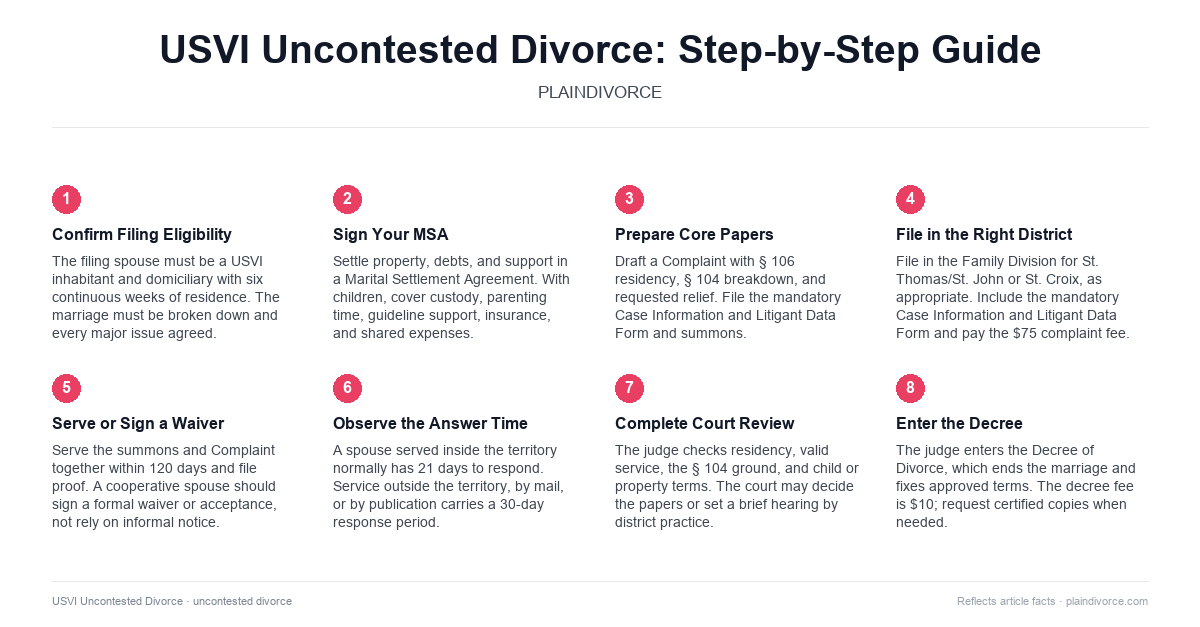
5. Step-by-Step: Complaint, Filing, Service, Decree
Every case is different, but most uncontested USVI divorces follow this flow.
Step 1 – Confirm you qualify
- The filing spouse meets the six-week continuous residency requirement and is domiciled in the USVI.
- The marriage has genuinely broken down under the § 104 standard.
- The case is truly uncontested — full cooperation, nothing hidden, no live disputes about children or property.
Step 2 – Put your agreement in writing
If you have assets, debts, or children, prepare a written Marital Settlement Agreement (MSA) covering:
- Division of property and debt
- Spousal support (maintenance), if any
- For children: legal and physical custody, a parenting-time schedule, child support, health insurance, and how expenses are shared
An MSA tells the court what you want approved, but it does not override the court’s own authority — the judge still reviews property terms against Virgin Islands equitable-distribution law and child support against the guidelines (see sections 7 and 8).
Step 3 – Prepare the complaint and opening documents
A civil action in the Superior Court is commenced by filing a complaint with the clerk. The Virgin Islands does not publish a statewide, divorce-specific “Complaint for Divorce” form — the court’s general civil complaint form is what exists, and your complaint is drafted to fit a divorce. However you title it, the complaint must plead:
- the residency and domicile facts under § 106 (dates matter);
- the § 104 grounds — that the marriage has broken down with no reasonable likelihood of preservation;
- the relief you want — the divorce itself, plus any custody, support, and property terms.
You also prepare a summons for your spouse (a separate summons for each defendant) and, in practice, a short sworn or penalty-of-perjury statement supporting the residency dates.
Verification and notarization. Under the Virgin Islands court rules, a pleading generally does not have to be verified or notarized unless a specific rule or statute requires it, and a dated declaration “under penalty of perjury” is usually accepted in place of a notarized oath. The court may still ask for verification or additional proof, especially on residency, so confirm the current expectation with the Family Division clerk before you file.
DIY opening package (high level)
Names and details vary by district and change over time. Confirm the current list with the Family Division clerk.
- Divorce complaint (pleading § 106 residency and § 104 grounds)
- Case Information and Litigant Data Form (mandatory at filing)
- Summons for your spouse (one per defendant)
- Sworn or penalty-of-perjury statement supporting residency dates
- Marital Settlement Agreement, if you are asking the court to approve terms
- Proposed Decree of Divorce, if your judge requests one
- A certified copy of your marriage certificate, and birth certificates for any minor children
Step 4 – File with the Family Division (include the cover sheet)
File your complaint and supporting documents with the Family Division in the correct district and pay the filing fee (see section 9). The court rules require the plaintiff to file a completed Case Information and Litigant Data Form together with the complaint. If it is missing or incomplete, the court’s process is to flag the deficiency and give you a chance to cure it; an uncured deficiency can lead to a deficiency notice and, eventually, dismissal for failure to prosecute. It is not an instant rejection, but it is not something to skip.
Step 5 – Serve your spouse (even if cooperative)
- The summons and complaint are served together, and you generally have 120 days from filing to complete service. If you miss that window without good cause, the court can dismiss the case without prejudice or set a firm deadline.
- Proof of service is filed with the court unless service is formally waived.
- A spouse served inside the Virgin Islands normally has 21 days to respond. Personal service outside the territory, or service by publication or mail, carries a 30-day response period.
- For divorce actions, the court rules specifically do not allow the usual “they clearly received it” shortcut. A cooperative spouse should sign a formal waiver or acceptance of service rather than relying on having informally received the papers.
In an uncontested case, you want your spouse’s response (or signed waiver) to stay consistent with the agreed terms and not raise anything new.
Step 6 – Court review and the Decree of Divorce
Once the court is satisfied that (1) residency and jurisdiction are proven, (2) service was done correctly, (3) the § 104 grounds are met, and (4) the arrangements for any children are appropriate, the judge can enter a Decree of Divorce. Because uncontested divorce is a summary-track matter, some judges decide it on the papers while others set a brief hearing where the plaintiff confirms the facts — ask the Family Division what to expect in your district. The Decree of Divorce is the order that legally ends the marriage and fixes the approved terms.
6. Key Documents (and What DIY Filers Miss)
USVI uncontested cases go smoother when the opening package is complete and internally consistent. The pieces that matter most:
- The divorce complaint — there is no separate statewide “Complaint for Divorce” form; you draft the complaint to plead § 106 residency and § 104 grounds.
- Case Information and Litigant Data Form — mandatory at filing; this is the single most common omission.
- Residency statement (“Affidavit of Plaintiff”) — a sworn or penalty-of-perjury statement of your move-in date and continuous presence. No official form name; the substance is what counts.
- Summons and proof of service — or a signed waiver/acceptance of service from your spouse.
- Marital Settlement Agreement — if you are resolving property, debt, support, or parenting terms.
- Proposed Decree of Divorce — often submitted for the judge’s signature, depending on local practice.
- Marriage certificate and children’s birth certificates — bring certified copies.
On “vital records” forms: earlier versions of DIY guidance mention a required “Certificate of Dissolution” or vital-statistics form before the decree. We could not confirm any current, official USVI divorce vital-statistics form or a timing requirement tied to it. If a clerk in your district asks for something specific, follow that instruction — but do not assume it applies territory-wide.
Tip: residency proof is the most scrutinized issue in a USVI filing. If your dates do not line up, a required signature is missing, or the residency statement is vague, expect the court to hold the case until it is fixed.
7. Dividing Property and Debt
Under 16 V.I.C. § 109, the Decree of Divorce can award the parties their marital property under equitable-distribution principles — a fair division, not automatically a 50/50 split. The statute defines marital property as property either spouse acquired after the marriage, with specific exclusions, including:
- property received by gift, bequest, devise, or descent (inheritance);
- property acquired in exchange for property owned before the marriage;
- property acquired after a decree of legal separation;
- a judgment awarded to one spouse against the other;
- property excluded by a valid written agreement between the spouses;
- income from excluded property, when it is not attributable to a spouse’s personal effort.
A clear Marital Settlement Agreement helps the court approve your terms quickly, but it works with the statute, not around it. If your split departs sharply from what equitable distribution would produce, be ready to explain why.
8. Children: Custody and Child Support
When minor children are involved, the court’s focus is the best interests of the child, and the judge can require changes even in an uncontested case if custody or support terms are unclear or inappropriate. Your agreement should address:
- Legal custody — who makes major decisions (education, health, religion)
- Physical custody — where the child primarily lives
- Parenting time — a workable schedule, including holidays and travel between islands or to the mainland
- Child support — calculated under the Virgin Islands guidelines
- Health-care coverage and expenses — who provides insurance and how uncovered costs are split
Child support is not just “whatever you agree.” Under 16 V.I.C. § 345, the child-support guidelines carry a rebuttable presumption that applies even when support is set by agreement, stipulation, or consent. To order an amount that differs from the guideline figure, the court must make a specific written finding that the guideline amount would be unjust or inappropriate. Every covered support order must also address the child’s health-care coverage when it is available at reasonable cost.
If there is a documented history of family violence or serious ongoing conflict, that weighs heavily in custody and parenting-time decisions and can lead to supervised or limited contact. Get legal advice in that situation, even if you hoped to keep the divorce uncontested. See our family law guides for more on custody and safety planning.
9. How Long It Takes and What It Costs
There is no official published timeline for a USVI uncontested divorce. Think in stages:
- Residency stage: the filing spouse must complete six continuous weeks before filing.
- Service and response stage: up to 120 days to serve, then a 21-day (in-territory) or 30-day (out-of-territory) response window — shorter if your spouse signs a waiver promptly.
- Court-review stage: the judge reviews residency, service, grounds, and any child or property terms before entering the decree.
Current Superior Court fees
| Item | Fee |
|---|---|
| Divorce Complaint (filing) | $75.00 |
| Service of Summons | $50.00 |
| Divorce Decree | $10.00 |
| Certified copy of any record | $3.00 per page |
| Court notary signature | $5.00 |
Verify these amounts on the Superior Court fee schedule before you file. If your income is limited, ask the Family Division about a fee waiver (in forma pauperis) request. Budget separately for a private process server if your spouse will not sign a waiver, an outside notary if one is needed, and certified copies of the final decree.
10. When DIY Fits, and Where a Self-Help Kit Helps
A DIY uncontested divorce can work well when the marriage is short or simple, both spouses cooperate, and there are no serious disputes. Get a lawyer — at least for a limited-scope review — if there is abuse, hidden or complex assets, a business, a pension, significant debt, immigration or tax exposure, or any real disagreement about the children.
Where a self-help kit earns its keep is structure and consistency: a complaint that actually pleads the § 106 residency dates and § 104 grounds, a clean residency statement, the mandatory Case Information and Litigant Data Form, a proper summons or signed waiver, and a Marital Settlement Agreement that matches your decree. Our Virgin Islands uncontested divorce kit walks you through each piece in order.
Download Our Virgin Islands Uncontested Divorce Self-Help Kit11. Frequently Asked Questions
What are the USVI divorce residency requirements?
Under 16 V.I.C. § 106, the spouse who files must be an inhabitant of the Virgin Islands, domiciled there when the case begins, and must have lived in the territory continuously and uninterruptedly for at least six weeks immediately before filing. Six weeks of residence is presumptive proof of domicile. It is not enough that the non-filing spouse lives in the USVI, and a trip off-island can break the six-week continuity.
Is there a “Complaint for Divorce” form for the USVI?
The Virgin Islands does not publish a statewide, divorce-specific complaint form. A civil action starts by filing a complaint with the Superior Court clerk, and for a divorce that complaint is drafted to plead the § 106 residency facts, the § 104 grounds (the marriage has broken down with no reasonable likelihood of preservation), and the relief you want. Confirm any district-specific formatting with the Family Division.
What is the Affidavit of Plaintiff in a Virgin Islands divorce?
It is the sworn statement self-represented filers commonly use to document their move-in date and continuous presence for the six-week residency rule. There is no official statewide form with that title, so wording varies. Under the Virgin Islands court rules, a dated declaration signed “under penalty of perjury” is generally accepted in place of a notarized affidavit unless a specific requirement calls for a notary.
Do I have to go to court for a USVI uncontested divorce?
Uncontested divorce is a “Family Track 1 (Summary)” matter in the Superior Court. Depending on the judge and district, it may be decided on the papers or with a short hearing where the plaintiff confirms the facts in the complaint. Ask the Family Division office in your district what to expect before you file, so you can plan for an appearance if one is required.
How much does it cost to file for divorce in the U.S. Virgin Islands?
The Superior Court fee schedule lists $75 to file a divorce complaint, $50 for service of summons, $10 for the divorce decree, $3 per page for a certified copy of a record, and $5 for a court notary signature. Private process servers and outside notaries charge separate, variable fees. A fee waiver may be available if your income is limited. Confirm current amounts with the court.
How long does an uncontested divorce take in the Virgin Islands?
There is no official timeline. You must complete the six-week residency before filing. After filing, you have up to 120 days to serve your spouse, who then has 21 days to respond (30 days if served outside the territory) unless they sign a waiver sooner. The court then reviews residency, service, grounds, and any child or property terms before entering the decree. Plan for several months, longer if paperwork needs correction.
How is child support decided in a USVI divorce?
Under 16 V.I.C. § 345, the Virgin Islands child-support guidelines apply with a rebuttable presumption, even to support set by agreement or consent. A court that orders a different amount must make a specific written finding that the guideline figure would be unjust or inappropriate. Every covered support order must also provide for the child’s health-care coverage when it is available at reasonable cost.
Where do I file for divorce in the Virgin Islands?
In the Family Division of the Superior Court of the Virgin Islands, which has separate offices for the District of St. Thomas/St. John and the District of St. Croix. Confirm which office your case belongs in with the Family Division before filing, because filing in the wrong district causes delay.
Final Thoughts and Next Steps
- Confirm the filing spouse meets the six-week continuous residency rule and can prove the dates.
- Make sure your complaint pleads both the § 106 residency facts and the § 104 grounds.
- Choose the right Family Division office: St. Thomas/St. John or St. Croix.
- Put your agreement in writing (an MSA) if you have property, debt, or children, and check child support against the guidelines.
- File the Case Information and Litigant Data Form with the complaint, and use a signed waiver or acceptance of service if your spouse cooperates.
- If anything feels unsafe or complicated, get a short consultation with a local attorney.
PlainDivorce is not a law firm and cannot give legal advice, but we help self-represented people make uncontested divorces clearer and better organized. Always verify current rules with the Family Division of the Superior Court of the Virgin Islands before filing. For related reading, see our family law guides and the USVI uncontested divorce kit.
Sources: 16 V.I.C. § 104 (grounds), § 106 (residence), § 109 (final orders and marital property), and § 345 (child-support guidelines), via the Virgin Islands Code; the Superior Court of the Virgin Islands Family Division; and the Superior Court fee schedule. Last reviewed September 2026.
Sources and local rules can change. Use this guide as a plain-English organizer, then verify the current filing requirements with the official court or government source for your jurisdiction.

About Harry D
Expert contributor at PlainDivorce, helping Canadians and American navigate simple uncontested divorces with clarity and confidence.