Uncontested Divorce in Virginia: A Plain-English Guide to the PSA, Affidavit Method, and Ore Tenus Hearing
An uncontested divorce in Virginia is a no-fault case where both spouses agree the marriage is over and have settled property, debt, support, and any parenting issues in writing. You file a Bill of Complaint for Divorce in Circuit Court after the required separation period—six months if you have a signed separation agreement and no minor children, otherwise one year—and in most cases you can finish on the paperwork alone, without a courtroom appearance.
The single biggest question DIY filers ask is whether they have to show up in court. Often the answer is no. Virginia lets you finalize an uncontested no-fault case by sworn written testimony—commonly called a Virginia divorce by affidavit (or by deposition). The alternative is a short in-person ore tenus hearing, where the judge hears a few minutes of oral testimony. Which one applies depends on your facts and on your local Circuit Court’s practice.
This guide walks through how to file for divorce in VA without a lawyer when the case is genuinely uncontested: who qualifies, the Virginia divorce separation requirements (the 6 months vs. 1 year rule), the difference between the affidavit method and an ore tenus hearing, the paperwork that trips people up (including the VS-4 form and the confidential CC-1426 addendum), realistic costs, and where a self-help kit fits.
TL;DR
An uncontested divorce in Virginia is a no-fault case built on a signed Property Settlement Agreement, filed in Circuit Court after the required separation. The good news most people are looking for: you often don’t have to appear in court — Virginia lets you finalize on sworn written testimony.
- The 6-month vs. 1-year rule is the big one. Six months applies only when you have a signed PSA and no minor children shared with your spouse. Miss either piece — a minor child, or no signed agreement — and you’re on the full year.
- Residency: one spouse must have been a bona fide Virginia resident and domiciliary for six months before filing.
- No hearing required, often. Under § 20-106 you can finalize by affidavit or deposition when you’ve settled everything in writing, no issues but the grounds remain, or a personally served spouse defaulted. The affidavit has statutory required contents — residency, separation date and continuity, military status, minor children, pregnancy.
- You do NOT need a corroborating witness for a no-fault divorce — § 20-99(1) exempts the separation ground. Some courts still ask by local habit, so check yours; don’t treat it as a legal must.
- Privacy rule with teeth: § 20-121.03 keeps Social Security numbers and account identifiers out of your complaint, PSA, and orders. They go in the sealed CC-1426 addendum. Clerks reject filings that don’t comply.
- Don’t forget the VS-4. The Report of Divorce or Annulment is required for every Virginia divorce, and a missing or wrong one can hold up entry of your decree.
- A waiver of service has conditions. For a no-fault case, your spouse’s CC-1406 waiver only works if the complaint is attached and your spouse also signs the proposed Final Decree.
- With kids: you’re automatically on the one-year track, and guideline child support is a rebuttable presumption — a deviation needs written findings. The parent-education class is mandatory only if custody, visitation, or support is contested.
- Cost: roughly $86–$95 to file, about $12 for sheriff service (skipped if your spouse signs the waiver), plus notary and certified copies. Fee waivers available.
- Local practice matters more here than in most states. There’s no statewide divorce packet, and courts differ on the CC-1416 cover sheet and on whether they finalize on the papers or set an ore tenus hearing. Call your clerk before you build the paperwork.
1. What Is an Uncontested (No-Fault) Divorce in Virginia?
In Virginia, most “simple” divorces are uncontested and based on no-fault separation under Virginia Code § 20-91(A)(9). In practical terms, an uncontested divorce in Virginia means:
- You and your spouse both accept that the marriage should end;
- You have lived separate and apart without cohabitation, without interruption, for the required time; and
- You have resolved property, debt, spousal support, and (if you have children) custody and child support—almost always in a written contract.
The case is filed in a Virginia Circuit Court, which has exclusive jurisdiction over divorce under § 20-96. The opening document is the Bill of Complaint for Divorce—Virginia’s traditional name for what other states call a petition or complaint. It must be signed and verified (sworn), and it states your residency, the date you separated, the no-fault ground, and whether you want the court to affirm, ratify, and incorporate your agreement into the decree.
The engine of most uncontested cases is a written Property Settlement Agreement (PSA), sometimes called a marital settlement or separation agreement. This is where you spell out every agreed term: how property and debts are divided, whether spousal support is paid or waived, and—if applicable—custody, the parenting schedule, child support, health insurance, and shared expenses. Many DIY filers start from a Property Settlement Agreement Virginia template and adapt it to their situation.
Practical note: Virginia has no single statewide fill-in-the-blank “divorce packet” that works in every Circuit Court. Some courts publish local instructions or sample forms, and local practice varies on details like cover sheets, scheduling, and whether the judge wants a hearing. Careful drafting and a quick call to your clerk’s office go a long way.
2. Who Qualifies? Residency and Separation Rules (6 Months vs. 1 Year)
Two requirements decide whether you can file: residency and separation.
2.1 Virginia residency
Under § 20-97, at least one spouse must have been an actual bona fide resident and domiciliary of Virginia for at least six months immediately before the suit is filed. “Domiciliary” means Virginia is your true, fixed home—not just where you happen to be staying. The statute has special rules for active-duty servicemembers stationed in Virginia and for military or federal civilian employees deployed overseas who lived in Virginia for the six months before deployment.
2.2 Separation: the Virginia divorce separation requirements (6 months vs. 1 year)
Virginia’s no-fault ground has two timelines. Which one applies turns on whether you have a signed separation agreement and whether you have minor children.
- Six-month route (the shorter option). Available only when both of these are true:
Then you may finalize after six months of continuous separation without cohabitation.
- You have entered into a signed separation agreement (PSA), and
- You have no minor children “born of the parties, born of either party and adopted by the other, or adopted by both parties” (the statute’s exact wording—so a minor child either spouse shares with the other counts).
- One-year route (the default). If you have a qualifying minor child, or you do not have a signed agreement, you must live separate and apart without cohabitation, without interruption, for a full year before the divorce can be decreed.
What “separate and apart without cohabitation” means: more than “we don’t get along.” Courts look at the separation date, at least one spouse’s intent to end the marriage, and whether you resumed living as a married couple. You can be separated under one roof in Virginia, but it is harder to prove—you generally need to show separate bedrooms, separate finances and chores, and no marital relations. If your separation story is complicated (moving out and back, a brief reconciliation, staying under one roof), get legal advice before you file, because a broken separation can reset the clock.
3. The 6-Month vs. 1-Year Trap (Quick Decision Guide)
People plan their move-out date around the wrong timeline all the time. Run through this before you count on six months:
| Your situation | Separation you must complete |
|---|---|
| No minor children shared with your spouse and a signed PSA | 6 months |
| You have a minor child together (including a child of one spouse adopted by the other) | 1 year |
| No signed separation agreement yet | 1 year |
| Adult children only, signed PSA, no minor children | 6 months |
Bottom line: the six-month timeline is available only when it is “no minor children and signed agreement.” Miss either piece and you are on the one-year track.
4. The Two Ways to Finalize: Virginia Divorce by Affidavit vs. Ore Tenus Hearing
This is the make-or-break topic for DIY filers. In an uncontested no-fault case you finalize either on written testimony or at a brief hearing.
Option A: Finalize without going to court (the affidavit / deposition method)
Under § 20-106, you may take your evidence by deposition or affidavit without leave of court in a § 20-91(A)(9) no-fault case—but only when at least one of these is true:
- You and your spouse have resolved all issues in a written settlement agreement;
- There are no issues other than the grounds for the court to decide; or
- Your spouse was personally served and did not file a responsive pleading or appear.
The affidavit itself has required contents set by statute. It must be on the affiant’s personal knowledge, contain only facts admissible in court, and address: each party’s age and competency; the other spouse’s military or Servicemembers Civil Relief Act status and any incarceration; Virginia residency and domicile; the date you separated and that the separation was continuous with intent to end the marriage; whether there are minor children; and whether the wife is pregnant. A corroborating witness is not required for a no-fault divorce (see the next section), and a verified complaint does not substitute for the affidavit.
When it is allowed and the paperwork is complete, the judge reviews the written record, signs the Final Decree of Divorce, and you never set foot in the courtroom. People search this as “no court hearing divorce Virginia.”
Do you need a corroborating witness?
Not for a no-fault divorce. § 20-99(1) says that except for divorces on the § 20-91(A)(9) separation ground, no divorce may be granted “on the uncorroborated testimony of the parties.” That carve-out means a neutral witness who confirms your separation is not a statewide requirement when you divorce on no-fault grounds. Some Circuit Courts still ask for corroboration by local habit, and if you proceed by deposition it is common (and easy) to include a short second deposition from a friend or relative. But do not treat a witness as a legal must—check what your specific court expects.
Option B: Finalize at a short hearing (the ore tenus hearing)
“Ore tenus” is Latin for “by word of mouth.” An ore tenus hearing in an uncontested Virginia divorce is brief—often ten minutes or less. The plaintiff answers basic questions about residency, the marriage, the separation date, and the no-fault ground. If a corroborating witness attends, they confirm a fact or two. If children are involved, the judge may ask a few questions to be satisfied the arrangements are reasonable. Then the judge signs the Final Decree.
Local practice note: some Circuit Courts finalize uncontested cases on the papers whenever the file is complete; others prefer or routinely schedule an ore tenus hearing. Even where you submit an affidavit, § 20-106(A) lets the judge require some or all of the testimony to be given orally in open court if something needs clarifying. Ask your clerk which route your court uses before you build your paperwork.
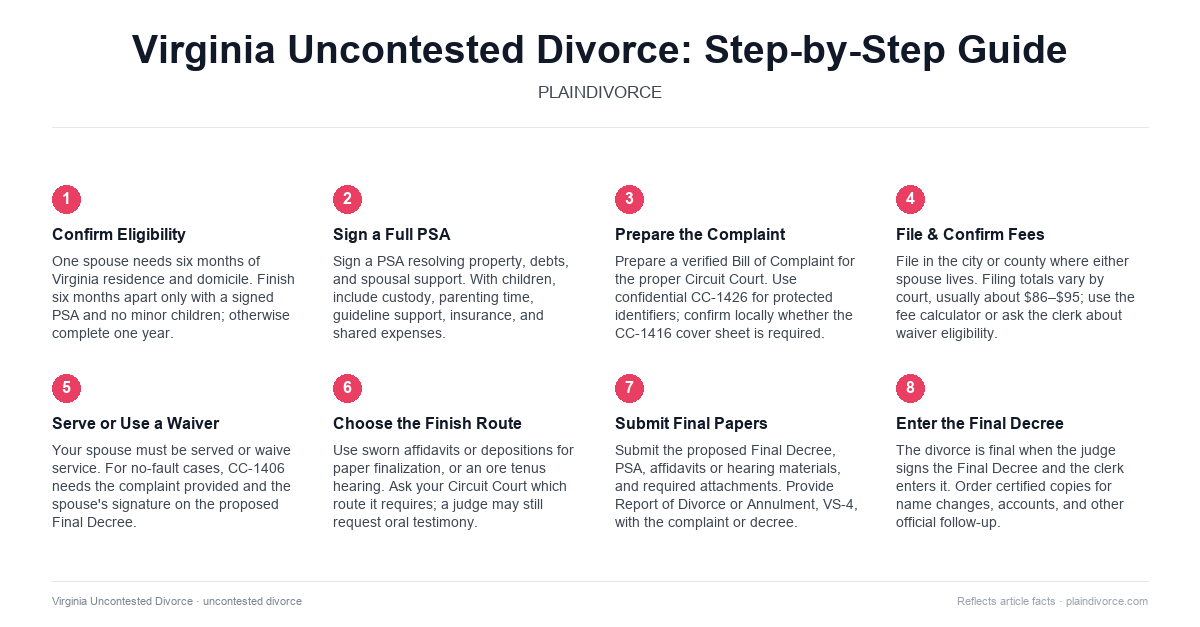
5. Step-by-Step Process (Bill of Complaint to Final Decree)
Here is the typical flow for a Virginia uncontested no-fault divorce. Details vary by locality, but the sequence is consistent. Follow your Circuit Court’s Bill of Complaint for Divorce Virginia instructions where they exist.
Step 1: Confirm eligibility
- At least one spouse has been a Virginia resident and domiciliary for six months.
- Separation completed: six months (signed PSA and no minor children shared with your spouse) or one year (minor child, or no agreement).
- The case is genuinely uncontested—no live dispute over money, property, or children.
Step 2: Sign your Property Settlement Agreement (PSA)
Your PSA should clearly resolve:
- Division of real estate, vehicles, bank and retirement accounts, and personal property;
- Responsibility for each debt;
- Spousal support—an amount and duration, or a clear mutual waiver;
- If you have children: legal and physical custody, the parenting schedule, child support, health insurance, and how uncovered medical and child-care costs are shared.
Both signatures should be notarized. If you are relying on the six-month timeline, a signed PSA is essentially required—it is what unlocks that shorter route.
Step 3: Prepare and file your Bill of Complaint
File in the Circuit Court for the city or county where you or your spouse resides (venue rules apply). Your verified Bill of Complaint for Divorce must state residency and domicile, the separation date, the no-fault ground, and your request that the court incorporate the PSA. Two intake items come up often:
- Cover Sheet for Filing Civil Actions (Form CC-1416) — a statewide form used to open and categorize a civil case. Whether your Circuit Court requires it with a divorce filing is a local question; Virginia’s own fee tool tells filers to call the court and ask. Confirm it with your clerk.
- Addendum for Protected Identifying Information – Confidential (Form CC-1426) — the sealed addendum for information that cannot go in the public file (more on this in Section 6).
Privacy rule (statewide, not a preference): under § 20-121.03, you must keep Social Security numbers—yours, your spouse’s, and any child’s—and identifying account numbers for specific assets, debts, accounts, or credit cards out of the complaint, the PSA, and every order. When that information still has to be provided, it goes in the CC-1426 addendum. A clerk can reject a filing that does not comply.
Step 4: Give your spouse notice (or use a signed waiver)
Even in an uncontested case, your spouse must be served or must waive service. Under § 20-99.1:1, a cooperative spouse can:
- Accept service before a notary or other officer authorized to administer oaths;
- Sign a notarized writing waiving service (this can be done before a clerk or deputy clerk of any Circuit Court); or
- Simply file an answer.
For a no-fault case, a pre- or post-filing waiver only works if a copy of the complaint is attached to (or otherwise provided with) the waiver and the proposed Final Decree is signed by your spouse. The common form is the Acceptance/Waiver of Service of Process and Waiver of Future Service of Process and Notice (Form CC-1406). If your spouse will not cooperate, the sheriff or a private process server delivers the papers.
Step 5: Choose your finish line—affidavit or ore tenus
- By written testimony: submit the statutory affidavit(s) or depositions plus your proposed Final Decree of Divorce and attachments (the PSA, and often a spousal-support/child-support addendum).
- By ore tenus hearing: schedule the brief hearing, appear with a witness if your court wants one, and hand up the proposed Final Decree.
Step 6: Submit the Final Decree and the VS-4
If the record is complete, the judge signs the Final Decree of Divorce. Virginia law also requires a Report of Divorce or Annulment on state form VS-4. Under § 32.1-268, the petitioner or their attorney furnishes the report’s information with the complaint or when filing the decree; the clerk then certifies it and forwards it to the State Registrar on or before the tenth of the following month. Once the clerk enters the Final Decree, your divorce is final, and you can order certified copies for name changes, financial accounts, and other official needs.
6. Key Forms and Filing Items (CC-1416, CC-1426, CC-1406, VS-4)
Virginia divorce paperwork varies by Circuit Court, but these names come up in almost every uncontested case:
| Item | What it does |
|---|---|
| Bill of Complaint for Divorce | Verified pleading that opens the case in Circuit Court; states residency, separation date, and the no-fault ground. |
| Property Settlement Agreement (PSA) | The signed, notarized contract resolving property, debt, support, and parenting terms. Unlocks the 6-month route. |
| Form CC-1416 – Cover Sheet for Filing Civil Actions | Statewide civil intake cover sheet. Required with a divorce filing only if your Circuit Court says so—call and confirm. |
| Form CC-1426 – Addendum for Protected Identifying Information (Confidential) | Sealed addendum for SSNs and account identifiers that § 20-121.03 keeps out of the public file. |
| Form CC-1406 – Acceptance/Waiver of Service… | How a cooperative spouse accepts service and waives future notice, avoiding sheriff service. |
| Affidavit(s) / depositions | Sworn testimony under § 20-106 with statutory required contents; the basis for finalizing without a hearing. |
| Final Decree of Divorce | The order the judge signs to end the marriage and incorporate the PSA. |
| Form VS-4 – Report of Divorce or Annulment | State vital-records report required for every Virginia divorce; furnished with the complaint or the decree. |
Why the VS-4 matters: it is not the document that divorces you—the Final Decree does that—but it is the document that reports your divorce to the Virginia Department of Health’s Division of Vital Records. Under 12VAC5-550-140, its contents are prescribed by regulation. If it is missing or filled out incorrectly, some clerks will hold entry of your decree until it is fixed.
Name restoration: if you changed your name when you married, you can ask the court to restore your former or maiden name. Under § 20-121.4, the court does this by a separate order, on your motion—often entered alongside the Final Decree. The $20 statutory name-change fee is not charged when the change is incident to a divorce, though some courts add a small fee (around $26) to record and index the separate order. A standalone adult name change unrelated to divorce uses Virginia’s separate Circuit Court name-change procedure.
7. Special Issues When You Have Children
You can have an uncontested divorce in Virginia with minor children, but two things change: you are on the one-year separation track, and the judge will look harder at your arrangements.
- Custody and parenting time. Legal custody (decision-making) and physical custody, plus a specific, workable schedule—including holidays.
- Child support. Under § 20-108.2, the guideline amount is a rebuttable presumption—it is treated as correct unless the court makes written findings that applying it would be unjust or inappropriate. Even in an agreed case, be ready to show the guideline calculation and justify any deviation.
- Health care and child care. The cost of the child’s health, dental, and vision coverage and work-related child-care costs are added to the basic support obligation and split between the parents.
Parent education seminar. Under § 16.1-278.15, the four-hour parent-education class is mandatory only when custody, visitation, or support is contested (attend within the 12 months before your court date or within 45 days after). In a truly uncontested case, the court can order it only if it finds good cause. The fee is based on ability to pay and cannot exceed $50. Some Circuit Courts still encourage the class for every divorcing parent—check your court’s website.
8. How Long Does an Uncontested Divorce Take in Virginia?
Timing has two parts:
- The separation period you must finish before the divorce can be decreed: six months or one year.
- Court processing after you file. There is no statewide processing clock. As a rough, locality-dependent estimate, a clean uncontested case that finalizes on affidavit often takes a few weeks to a few months, depending on service, the clerk’s backlog, and whether the judge wants an ore tenus hearing.
You can cut delay by keeping the separation date identical across every document, getting notarizations right the first time, resolving the CC-1426 privacy addendum up front, and confirming with the clerk whether your court finalizes on the papers or by hearing.
9. What Does an Uncontested Divorce Cost?
The filing fee is set by statute plus local assessments. Virginia’s Office of the Executive Secretary fee schedule shows a divorce filing “basic cost” of about $89; reported locality totals run roughly $86–$95. Because the amount depends on your court and case details, use the Virginia Circuit Court civil filing fee calculator or call your clerk. If you cannot afford the fee, ask about a civil filing fee waiver (in forma pauperis).
Other likely costs:
- Service of process: about $12 for sheriff service in Virginia (§ 17.1-272); a private process server costs more. You avoid this if your spouse signs the CC-1406 waiver.
- Notary fees for the PSA, affidavits, and the waiver.
- Certified copies of the Final Decree.
- Optional help: mediation, or a limited-scope attorney review of your PSA.
There is no official statewide cost study, but an uncontested no-fault divorce is generally far cheaper than a contested case, where attorney fees alone can reach five figures.
10. When a DIY Divorce Might Not Be Right for You
DIY works when the case is calm and the money is simple. Talk to a lawyer—even once—if:
- There is domestic violence, threats, stalking, or coercion.
- One spouse is hiding assets or income, or refuses basic financial disclosure.
- There is a business, multiple properties, significant retirement or pension assets (which may need a QDRO), or heavy debt.
- There are immigration, military pension, tax, or bankruptcy complications.
- You feel pressured to sign a PSA you do not fully understand.
A single consultation is cheap next to fixing a bad decree later.
11. Where a Self-Help Divorce Kit Fits
If your case is truly uncontested, a self-help kit helps most with organization and the Virginia-specific moving parts:
- Getting the 6-month vs. 1-year question right, and understanding exactly what a signed PSA changes.
- Building a complete Property Settlement Agreement, often starting from a Property Settlement Agreement Virginia template and adapting it.
- Assembling a clean filing package—and knowing to confirm CC-1416 locally and to move SSNs and account numbers into the CC-1426 addendum.
- Understanding the statutory affidavit contents under § 20-106 so a “no court hearing” finish is realistic in your court.
- Not forgetting small-but-mandatory items like the VS-4 form.
For related reading, see our guide to what belongs in a Property Settlement Agreement and our overview of uncontested vs. contested divorce.
Download Our Virginia Uncontested Divorce Self-Help Kit12. Virginia Uncontested Divorce FAQs
What is an uncontested or simple divorce in Virginia?
It is a no-fault divorce where both spouses agree the marriage is over and have no unresolved disputes about property, debt, support, or children. It runs on the required separation period under Virginia Code § 20-91(A)(9) plus, in most cases, a signed Property Settlement Agreement that the Final Decree incorporates.
Can we finalize a Virginia divorce without going to court?
Often, yes. Section 20-106 lets you finalize a no-fault case on sworn affidavits or depositions—without a hearing—when you have settled all issues in writing, no issues besides the grounds remain, or a personally served spouse defaulted. The affidavit must contain statutory facts about residency, separation, military status, and children. The judge can still require a short ore tenus hearing, and some courts prefer one, so confirm with your Circuit Court.
Do we need a corroborating witness for a no-fault divorce in Virginia?
Not as a statewide rule. Section 20-99(1) exempts no-fault separation divorces from the requirement that testimony be corroborated. A neutral witness is therefore not legally required. Some Circuit Courts still ask for corroboration by local practice, and if you proceed by deposition it is common to add a brief witness deposition, so check what your court expects before you file.
How long must we be separated to divorce in Virginia?
Six months if you have a signed separation agreement and no minor children born of or adopted by both or either spouse. Otherwise one year of living separate and apart without cohabitation and without interruption. If you have a minor child together, or no signed agreement, plan on the full year.
What is a Property Settlement Agreement (PSA)?
A PSA is a signed, notarized contract between the spouses that resolves property division, debts, spousal support, and any parenting and child-support terms. A signed PSA is what allows a no-fault filing after six months of separation when there are no minor children, and the court typically incorporates it into the Final Decree.
Do we have to serve divorce papers if we agree?
Your spouse must be served or must waive service. Under § 20-99.1:1 a cooperative spouse can accept service before a notary, sign a notarized waiver, or file an answer. For a no-fault case, a waiver counts only if the complaint is attached or provided and your spouse also signs the proposed Final Decree. The usual form is CC-1406. If your spouse will not cooperate, the sheriff or a process server serves the papers.
What is the VS-4 form?
The VS-4 is Virginia’s Report of Divorce or Annulment, a vital-records form required for every divorce. Under § 32.1-268 the petitioner or attorney provides its information with the complaint or when filing the decree, and the clerk certifies it and sends it to the State Registrar. It does not grant the divorce, but a missing or incorrect VS-4 can delay entry of your Final Decree.
How much does a simple divorce cost in Virginia?
The Circuit Court filing fee is roughly $86–$95 depending on the court (the statewide schedule shows about $89). Sheriff service is about $12 if needed, and you may also pay for notarization and certified copies. Use Virginia’s online civil filing fee calculator or call your clerk for the exact figure, and ask about a fee waiver if cost is a barrier.
What paperwork do people most often forget in Virginia?
The three usual misses are: moving Social Security numbers and account numbers into the confidential CC-1426 addendum as § 20-121.03 requires; the VS-4 vital-records report; and checking whether the local court wants the CC-1416 cover sheet with a divorce filing. Getting the separation date consistent across every document is the other common fix.
13. Final Thoughts and Next Steps
For a clean uncontested divorce in Virginia, focus on three pillars:
- Eligibility: six months’ Virginia residency and the correct separation timeline (six months or one year).
- Agreement: a complete, signed Property Settlement Agreement covering property, debt, support, and any parenting and child-support terms.
- Finalization: know whether your Circuit Court will accept a Virginia divorce by affidavit or expects an ore tenus hearing, and build your affidavit to the § 20-106 checklist.
PlainDivorce provides educational resources and DIY tools for uncontested cases. We are not a law firm and cannot give legal advice. Before you file, and again before you submit your final paperwork, verify the current requirements and fees with your local Virginia Circuit Court or the Virginia Judicial System’s fee resources.
Sources and local rules can change. Use this guide as a plain-English organizer, then verify the current filing requirements with the official court or government source for your jurisdiction.

About Harry D
Expert contributor at PlainDivorce, helping Canadians and American navigate simple uncontested divorces with clarity and confidence.