Uncontested Divorce in West Virginia: A Plain-English 2026 Guide
An uncontested divorce in West Virginia is one where you and your spouse agree on every issue—property, debts, and any parenting and support terms—so the family court only has to review your paperwork, not settle a fight. You file a verified Petition for Divorce with the Circuit Clerk, use one of two no-fault grounds, exchange financial disclosures, and attend a short review hearing. The single detail that trips up most do-it-yourself filers: the faster ground, irreconcilable differences, only works if your spouse files an answer that admits it. Without that admission, the case moves to the one-year separation ground.
This guide walks through the grounds, the residency and venue rules, the exact statewide forms, the step-by-step process, the extra requirements when you have minor children, and realistic timing and cost—all checked against the West Virginia Code and the Rules of Practice and Procedure for Family Court as of 2026.
TL;DR
An uncontested divorce in West Virginia is an agreed case — you file a verified Petition with the Circuit Clerk, use a no-fault ground, exchange financial disclosures, and attend a short review hearing. There’s no cooling-off period, but there’s one requirement that quietly derails DIY filers.
- Irreconcilable differences requires your spouse’s ADMISSION. Under §48-5-201, the court can only grant on this ground if an answer is filed admitting it — a statutory condition, not a judge’s preference. A signed settlement agreement does not substitute. No admission means you fall back to the one-year separation ground.
- “One year apart” is stricter than it sounds: separate places of abode, no cohabitation, no interruption, for a full year (§48-5-202).
- Residency depends on where you married. Married in West Virginia? One spouse just has to be a bona fide resident when you file — no minimum. Married elsewhere? One spouse needs a full uninterrupted year here first.
- Four forms go in with the Petition: the Petition (SCA-FC-101), Civil Case Information Statement (SCA-FC-103), Vital Statistics form (SCA-FC-104), and Financial Statement (SCA-FC-106).
- Agreement doesn’t bind the judge. The court “may approve, modify or reject” your agreement and enter its own orders. A specific, clean agreement is what keeps it intact.
- The summons must be served within 20 days of filing (Family Court Rule 9). A signed Acceptance of Service avoids the cost — but doesn’t excuse your spouse from answering and disclosing.
- With kids or spousal support, three hard stops: the BCSE application (FDVCSAP) from each party (the most-missed item), parent education for both parents at $25 each with a filed certificate, and the Rule 13 attachments — three pay stubs, two years of returns and W-2s, plus receipts for extraordinary expenses. Medical support is mandatory, not optional.
- Expect a hearing. Family courts generally hold a final review, and Rule 55 requires one for any agreement with child support in it.
- Cost: $135 to file — the same in all 55 counties — waivable with a Financial Affidavit. Plus service, $25 per parent for the class, and certified copies.
- Name restoration is free and automatic on request — no separate petition needed (§48-5-613).
1. What Counts as an Uncontested Divorce in West Virginia?
West Virginia has no separate legal track called “simple divorce” or “summary divorce.” People use those words to describe an uncontested (or agreed) divorce: both spouses want the marriage to end and neither is asking the judge to resolve a dispute.
In practice, an uncontested West Virginia case has three ingredients:
- A no-fault ground the family court can actually grant on your facts.
- A written agreement covering property, debt, and—if you have children—a parenting plan and child support.
- A complete filing package with the statewide forms and financial disclosures the court requires even when nobody is fighting.
One more point that surprises people: agreement does not force the outcome. Under W. Va. Code §48-5-201, the court “may approve, modify or reject any agreement of the parties” and enter its own orders on support, custody, child support, visitation, and property. A clean, specific agreement is what keeps the judge from needing to change anything.
Almost every divorce in West Virginia is a family court case that you file with the Office of the Circuit Clerk. A circuit court can hear the divorce only in a narrow situation—no parenting plan or custody/decision-making issue, no child support, and both spouses file a written property settlement agreement at the time of filing (W. Va. Code §51-2A-2).
2. Irreconcilable Differences vs. One-Year Separation: The WV Requirements
West Virginia recognizes several fault grounds, but uncontested filers use one of two no-fault paths. The choice is not just wording—it decides whether your case can move now or has to wait.
2.1 Irreconcilable differences (needs your spouse’s admission)
This is the core of the irreconcilable differences divorce WV requirements: under §48-5-201, the court may grant a divorce on this ground only if the petition alleges irreconcilable differences and an answer is filed admitting that allegation. It is a statutory condition, not a local judge’s preference. The upside: this ground needs no corroborating witness, and it is the only ground where the court can act on the spouses’ own testimony without outside proof.
So the plan only works if your spouse will sign and file a verified Answer to Divorce Petition (form SCA-FC-108) that admits irreconcilable differences. A signed settlement agreement helps cooperation but does not substitute for that admission in the case record.
2.2 One-year voluntary separation (the fallback)
If your spouse will not file the admission, the usual fallback is the no-fault ground in §48-5-202. It is not simply “a year apart.” The parties must have lived in separate places of abode, without any cohabitation, and without interruption, for one year. The separation can result from one spouse’s voluntary act or from mutual consent. A bonus of this ground: the other side cannot raise affirmative defenses like condonation or recrimination against it (§48-5-403).
Quick logic check:
- Will your spouse file a verified Answer admitting irreconcilable differences? You can proceed on that ground now.
- No admission coming? You need a full year of qualifying separation and then file on the one-year ground.
3. Residency, Venue, and Whether Your Case Fits
3.1 Residency: the actual rule
West Virginia’s residency test (§48-5-105) depends on where you married:
- Married in West Virginia: one spouse must be an actual bona fide resident of the state when the action is filed—no minimum length of time.
- Married elsewhere: one spouse must be an actual bona fide resident and that residency must have continued uninterrupted for the one year immediately before filing.
3.2 Venue: which county
Under §48-5-106, if your spouse lives in West Virginia, file in the county where you last lived together or the county where your spouse resides. If your spouse lives out of state, file where you last lived together or the county where you reside.
3.3 Signs your case is a good fit for “uncontested”
- You both want the marriage to end.
- You can agree on how to split property and debts.
- If you have children, you can agree on a parenting plan, decision-making, and child support.
- Your spouse will participate in the ground you rely on—critically, filing the admission for irreconcilable differences.
3.4 When uncontested is not safe or practical
A DIY divorce is a poor fit when there is domestic violence, coercion, stalking, serious intimidation, hidden or complex assets (a business, pension, or retirement account), or real conflict over the children. West Virginia law lets the family court enter protective and injunctive orders as part of a divorce (§48-5-509); if any of that is in play, get legal advice, even limited-scope advice, first.
4. The West Virginia Divorce Forms You File
West Virginia uses standardized statewide SCA-FC forms issued by the Supreme Court of Appeals. Every petitioner files this core set with the Petition, in every divorce:
| Form | What it is | Who files / when |
|---|---|---|
| SCA-FC-101 — Petition for Divorce | The verified pleading that starts the case and states your ground | Petitioner, at filing |
| SCA-FC-103 — Petitioner’s Civil Case Information Statement (Domestic Relations) | The intake cover sheet the Circuit Clerk uses to open and categorize the case | Petitioner, at filing |
| SCA-FC-104 — Information Requested by the Division of Vital Statistics | State recordkeeping form for the divorce | Petitioner, at filing |
| SCA-FC-106 — Financial Statement | Required in all divorce cases; served on the other spouse | Both parties |
| SCA-FC-105 — Acceptance of Service | Sworn, notarized acknowledgment a cooperative respondent can sign instead of being formally served | Respondent, optional |
| SCA-FC-108 — Answer to Divorce Petition | Respondent’s verified response; must include a case information statement (SCA-FC-114) and a financial statement | Respondent |
If your case involves minor children or a request for spousal support, add:
- BCSE Application and Income Withholding Form (FDVCSAP) — the Bureau for Child Support Enforcement application. The statewide petitioner instructions require it in cases with minor children and/or spousal support, and each party files one.
- Proposed parenting plan — due before the first hearing.
- Parent Education Notice — served on a respondent who is a parent of the children.
- Financial attachments — under Family Court Rule 13 each party must file their three most recent pay stubs, complete tax returns and W-2s for the prior two years, a current business/self-employment financial statement where applicable, and receipts for any listed extraordinary medical, child-care, or special-needs expenses.
Form titles and revision dates change—always download the current versions from the West Virginia Judiciary’s official family court forms list rather than reusing an old packet.
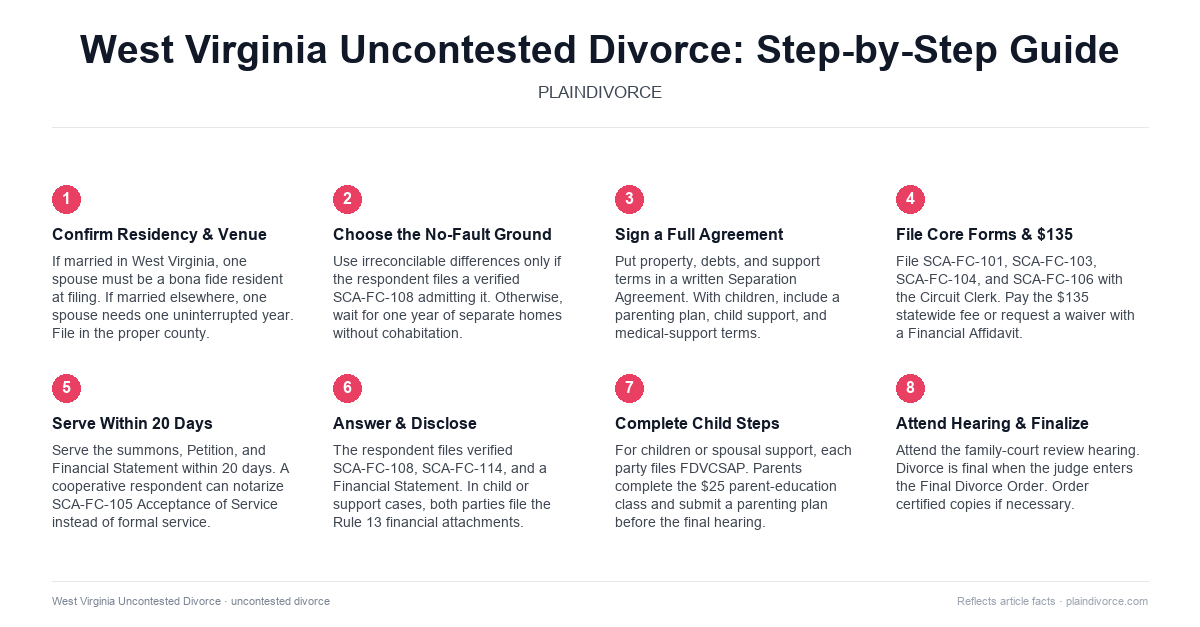
5. Step-by-Step: The West Virginia Divorce Process
Step 1: Pick your no-fault ground before you file
- Irreconcilable differences: only if your spouse will file a verified Answer admitting it.
- One-year separation: when the admission is not available and you have a full year of qualifying separation.
Step 2: Put your agreement in writing
A written Separation Agreement (also called a property settlement agreement) is the backbone of an uncontested file. Many people start from a West Virginia Separation Agreement template and adapt it to their facts. It usually covers:
- Real and personal property and debts—who keeps what, who pays what
- Spousal support, or a clear waiver
- For children: parenting schedule, decision-making, child support, and medical support
Family Court Rule 55 says agreements must be in writing, signed by all parties, and incorporated into an order—and the court holds a hearing to review any agreement with child-support provisions.
Step 3: File the Petition and the core package
File the Petition for Divorce plus the Civil Case Information Statement, Vital Statistics form, and Financial Statement with the Circuit Clerk in the correct county, and pay the filing fee. When the Petition is filed, the court’s clock starts.
Step 4: Serve the summons (or use Acceptance of Service)
Under Family Court Rule 9, the Circuit Clerk issues a summons to be served within 20 days of filing. The respondent is served with the Petition and the petitioner’s Financial Statement (plus a Parent Education Notice if the respondent is a parent of the minor children). A cooperative respondent can instead sign a notarized Acceptance of Service (SCA-FC-105)—but that does not remove the respondent’s own duty to answer and file disclosures.
Step 5: The Answer stage (where irreconcilable differences succeeds or fails)
The respondent files a verified Answer to Divorce Petition (SCA-FC-108) within the time set by Rule 12 of the Rules of Civil Procedure, including a completed case information statement (SCA-FC-114) and a financial statement—plus the FDVCSAP in child or support cases. If you are relying on irreconcilable differences, this is the step that must contain the admission. No admission in the record means the case has to proceed on the one-year separation ground instead.
Step 6: Financial disclosure and scheduling
The court enters a scheduling order. In cases with minor children or spousal support, both parties file the Rule 13 financial attachments by the scheduling date or at least five days before any hearing.
Step 7: Review hearing
West Virginia family courts generally hold a final hearing to confirm jurisdiction and the ground and to review your agreement. How it is scheduled and conducted depends on the assigned court’s order; when the paperwork is complete and the agreement is clear, the hearing is usually straightforward.
Step 8: Final Divorce Order (and name restoration)
If the judge is satisfied, the court enters a Final Divorce Order. On request, the court restores a spouse’s former name without a separate petition and issues a one-page certificate of divorce reflecting the change (§48-5-613). Order certified copies from the clerk for name changes, benefits, and financial paperwork.
6. Extra Requirements When You Have Minor Children
Uncontested divorces with children are common in West Virginia, but the requirements are stricter and the court will not simply rubber-stamp your deal.
Hard stop #1: BCSE application (FDVCSAP)
In cases involving minor children and/or spousal support, the statewide instructions require the BCSE Application and Income Withholding Form (FDVCSAP), and each party files one. It registers the support side of the case with the Bureau for Child Support Enforcement.
Hard stop #2: Parent education class
Under Family Court Rule 37 and W. Va. Code §48-9-104, both parents must complete parent education and file a certificate of completion. A waiver requires the court to put specific reasons on the record. Completion is required before any mediation or, if none is ordered, before the final hearing—and a late class can halt the case. The class is $25, waivable for a qualifying fee waiver.
Hard stop #3: Financial disclosure and attachments
Beyond the Financial Statement (SCA-FC-106) required in every divorce, a case with minor children or a spousal-support request means each party must file the Rule 13 attachments: three recent pay stubs, two years of complete tax returns and W-2s, a business/self-employment statement where applicable, and receipts for extraordinary medical, child-care, or special-needs costs.
Parenting plan, child support, and medical support
- Parenting plan: a workable schedule, holidays, transportation, and decision-making, filed before the first hearing.
- Child support: calculated under the West Virginia child support guidelines; the court can accept an agreed number that fits the guidelines or a justified deviation.
- Medical support: when the action involves minor children, §48-5-603(c) requires the court to order medical support—it is not just an optional agreement term.
7. How Long Does an Uncontested Divorce Take in West Virginia?
There is no statutory cooling-off period for an uncontested West Virginia divorce, and irreconcilable differences avoids the one-year separation element. But “no waiting period” is not the same as “fast.” Timing is driven by:
- The 20-day window to serve the summons and how quickly the respondent files the Answer
- Whether the verified admission is ready to file (the most common avoidable delay)
- How fast both parties complete the required disclosures
- Your county’s family court calendar and scheduling order
A cooperative no-children case often finishes in a couple of months; cases with children take longer because of the parenting plan, parent education, and support review.
8. What Does an Uncontested Divorce Cost?
- Filing fee: $135 statewide for divorce, annulment, or separate maintenance—the same in all 55 counties—subject to an approved fee waiver (you file a Financial Affidavit to ask).
- Service: varies by method. If your spouse signs an Acceptance of Service, you avoid this. Otherwise sheriff or certified-mail service carries a fee—confirm the current amount with your Circuit Clerk rather than relying on an estimate.
- Parent education: $25 per parent when minor children are involved, waivable for a qualifying fee waiver.
- Notary and certified copies: for verified signatures and copies of your Final Divorce Order.
- Optional help: mediation or a limited-scope attorney review of your agreement.
9. When a DIY Divorce Is Not the Right Call
Skip the DIY route and get legal advice if there is domestic violence, threats, stalking, or coercion; suspected hidden assets; complex property such as a business, pension, or retirement account; or serious conflict about the children. West Virginia also lets a court reduce or end spousal support later if the recipient enters a de facto marriage (§48-5-707), so support waivers and terms deserve care.
10. Where a Self-Help Divorce Kit Fits Into the Process
West Virginia publishes official statewide forms, but people get stuck on sequence, the required supporting documents, and the ground strategy—irreconcilable differences versus one-year separation. A structured self-help kit helps you:
- Understand the process in plain English and avoid common missteps
- Use checklists so items like the Civil Case Information Statement, Vital Statistics form (SCA-FC-104), and Financial Statement (SCA-FC-106) are not missed
- Flag the children/support hard stops—BCSE application (FDVCSAP), parenting plan, parent education, and Rule 13 attachments
- Keep dates, service steps, and hearing readiness consistent across the file
11. West Virginia Uncontested Divorce FAQ
What is an uncontested divorce in West Virginia?
It is a divorce where you and your spouse agree on property, debts, and any parenting and support terms, so the family court reviews your paperwork instead of deciding a dispute. You still file a verified Petition for Divorce, use a no-fault ground, exchange financial disclosures, and usually attend a review hearing. West Virginia has no separate “simple divorce” track—“uncontested” just describes an agreed case.
Does West Virginia require an admission for an irreconcilable differences divorce?
Yes. Under W. Va. Code §48-5-201, the court may grant a divorce on irreconcilable differences only if the petition alleges the ground and an answer is filed admitting it. That admission—typically a verified Answer to Divorce Petition (SCA-FC-108)—is a statutory requirement. If your spouse will not file it, the case proceeds on the one-year voluntary separation ground instead. This ground needs no corroborating witness.
How long do you have to live in West Virginia before filing for divorce?
It depends on where you married. If the marriage took place in West Virginia, one spouse only needs to be an actual bona fide resident when you file—no minimum length. If you married elsewhere, one spouse must have been a West Virginia resident continuously for the full year before filing (W. Va. Code §48-5-105).
What forms do I file with a West Virginia Petition for Divorce?
Every petitioner files four documents together: the Petition for Divorce (SCA-FC-101), the Petitioner’s Civil Case Information Statement for domestic relations (SCA-FC-103), the Vital Statistics form (SCA-FC-104), and the Financial Statement (SCA-FC-106). Cases with minor children or spousal support add the BCSE application (FDVCSAP), a proposed parenting plan, a Parent Education Notice, and the Rule 13 financial attachments.
Is a West Virginia Separation Agreement the same as the divorce?
No. A Separation Agreement (or property settlement agreement) is the written contract settling property, debt, support, and—if applicable—parenting. It is filed with the case and incorporated into the Final Divorce Order, but it does not end the marriage by itself and does not bind the judge. Under §48-5-201 the court may approve, modify, or reject it. Many filers adapt a West Virginia Separation Agreement template to their facts.
What is the BCSE application and who needs it?
The BCSE Application and Income Withholding Form (FDVCSAP) registers the support side of your case with the West Virginia Bureau for Child Support Enforcement. The statewide petitioner instructions require it in cases involving minor children and/or a spousal-support request, and each party files one. It is one of the most commonly missed items in a DIY filing with children.
Do I have to go to a hearing for a West Virginia divorce?
Generally yes. West Virginia family courts typically hold a final hearing to confirm jurisdiction and the ground and to review your agreement, and Family Court Rule 55 requires a hearing to review any agreement with child-support provisions. How the hearing is scheduled and run depends on the assigned court’s order; a complete file and a clear agreement usually make it short.
How much does an uncontested divorce cost in West Virginia?
The statewide filing fee is $135, the same in every county, and you can ask for a waiver with a Financial Affidavit. On top of that, budget for service (avoided if your spouse signs an Acceptance of Service), $25 per parent for the parent education class when children are involved, and notary and certified-copy fees. Confirm current service costs with your Circuit Clerk.
12. Final Thoughts and Next Steps
A smooth uncontested divorce in West Virginia comes down to keeping three things aligned:
- Ground strategy: irreconcilable differences needs a verified Answer admitting it; otherwise plan for the one-year voluntary separation ground—separate abodes, no cohabitation, no interruption.
- Agreement: put your terms in clear writing so the court can enter a clean Final Divorce Order.
- Complete filing package: the four core forms with the Petition, the 20-day summons, and—if children or support are involved—the BCSE application, parenting plan, parent education, and Rule 13 attachments.
The West Virginia uncontested divorce kit organizes those steps and checklists so nothing gets missed.
Remember: PlainDivorce is not a law firm and nothing here is legal advice. Before you file, confirm the current rules, forms, and fees with the West Virginia Judiciary, the Rules of Practice and Procedure for Family Court, or your local Circuit Clerk’s Office.
Sources and local rules can change. Use this guide as a plain-English organizer, then verify the current filing requirements with the official court or government source for your jurisdiction.

About Harry D
Expert contributor at PlainDivorce, helping Canadians and American navigate simple uncontested divorces with clarity and confidence.