Uncontested Divorce in Wisconsin: A Plain-English 2026 Guide
An uncontested divorce in Wisconsin is one where you and your spouse agree on everything—property, debts, and any custody, placement, and support terms—so the court reviews your paperwork instead of deciding a fight. You confirm residency, file on the no-fault ground that the marriage is irretrievably broken, wait out a mandatory 120-day period, exchange financial disclosures, and attend a short final hearing. The cleanest path for cooperating spouses is a joint petition, which skips formal service of process entirely.
This guide covers the residency rule, the 120-day wait and the automatic restraints that come with it, the exact statewide forms (including the ones most do-it-yourself filers miss), the step-by-step process, the extra requirements when you have minor children, and realistic timing and cost—all checked against the Wisconsin Statutes and the Wisconsin Court System’s current forms and fee schedule as of 2026.
TL;DR
An uncontested divorce in Wisconsin means you agree on everything and the court reviews your paperwork instead of deciding a fight. It’s no-fault, and the cleanest route for cooperating spouses is a joint petition — both sign, both waive service, no summons to serve at all. But there’s a hard 120-day minimum you cannot waive.
- Residency is two tests: 6 months in Wisconsin and 30 days in the filing county (§ 767.301). File where you live now, not where you married.
- The 120 days runs from service (sole filing) or from filing the joint petition — and it’s a statutory floor. Only a health, safety, or emergency finding gets you an earlier hearing. Agreement doesn’t waive it.
- Automatic restraints kick in the moment you file (§ 767.117). No transferring or disposing of property outside the ordinary course, no harassment, and with kids: no moving more than 100 driving miles from the other parent, no taking a child out of state for over 90 days. Violations are contempt.
- GF-179 is mandatory — the Confidential Petition Addendum, filed with every petition. Leaving it out is a top reason self-filed cases get rejected at intake.
- Form numbers end in “V.” Old guides drop it. Joint petition is FA-4110V (with children) or FA-4111V (without); the Financial Disclosure Statement is FA-4139V, due within 90 days and kept current through the hearing.
- Your agreement doesn’t bind the judge. Under § 767.34, a stipulation is only effective if the court approves and adopts it into the judgment.
- With kids: child support follows the percentage standard (roughly 17% / 25% / 29% / 31% / 34%), and a deviation requires findings on the record. Support is generally paid through the state with automatic income withholding, plus annual fees of $65 (payer) and $35 (recipient) — no informal Venmo arrangements.
- Cost: $184.50 to file with no support request, $194.50 with one, plus $35 per party for eFiling. Waiver available with form CV-410A.
- You cannot remarry for 6 months after the judgment — anywhere in the world — and a marriage before then is void (§ 765.03(2)).
- Get a lawyer if there’s abuse or coercion, hidden assets, a business or retirement account needing a QDRO, or real disagreement about the children.
1. What Counts as an Uncontested Divorce in Wisconsin?
Wisconsin law has no separate track called “simple divorce” or “summary divorce.” Courts describe a case as contested or uncontested, and as with or without minor children. An uncontested divorce in Wisconsin simply means both spouses agree the marriage is over and neither is asking a judge to resolve a dispute.
In practice, an uncontested Wisconsin case has three parts:
- Both spouses agree the marriage is irretrievably broken (Wis. Stat. § 767.315).
- A full written agreement covering property and debts, spousal maintenance, and—if there are children—legal custody, physical placement, and child support.
- A complete filing package with the statewide forms and financial disclosures the court requires even when nobody is fighting.
One point that surprises people: your agreement does not force the result. Under Wis. Stat. § 767.34, the parties may stipulate to property division, maintenance, support, custody, and placement only subject to the approval of the court, and the stipulation is not binding until the judge adopts it into the judgment. A clear, specific agreement is what keeps the court from changing anything.
Every Wisconsin divorce is filed with the Clerk of Circuit Court in the county where you file, and the case is heard in circuit court (the family court branch).
2. Who Qualifies: Residency, No-Fault Grounds, and Fit
Residency: the actual rule
Under Wis. Stat. § 767.301, a divorce action cannot begin unless, immediately before filing:
- At least one spouse has been a bona fide resident of Wisconsin for 6 months, and
- At least one spouse has been a bona fide resident of the filing county for 30 days.
You file in the county where you live now, not the county where you married. If you do not meet both tests yet, you generally have to wait until you do. (A legal separation, by contrast, needs only 30 days of state residency—but that is a different case and does not end the marriage.)
Grounds: no-fault only
Wisconsin is a no-fault state. Nobody has to prove wrongdoing. The only ground is that the marriage is irretrievably broken, meaning there is no reasonable prospect of reconciliation. The court makes that finding after a hearing if:
- Both spouses state under oath (by testimony or affidavit) that the marriage is irretrievably broken, or
- One spouse so states and either the parties have lived apart for 12 months or the court finds no reasonable prospect of reconciliation. If only one spouse alleges the breakdown and you have not lived apart a year, the court can continue the matter 30 to 60 days and may suggest counseling (§ 767.315).
In a cooperative uncontested case both spouses simply confirm the marriage is broken, and this step is quick.
When an uncontested divorce is a good fit
- You both want the marriage to end and will sign paperwork.
- You can reach a complete agreement on property, debts, support, and (if applicable) custody, placement, and child support.
- You are both honest about finances and willing to exchange full disclosure.
- If one spouse files alone, the other will cooperate with service—for example, by signing an Admission of Service (form FA-4119V).
When it is not safe or practical
Skip the DIY route if there is domestic abuse, coercion or intimidation, hidden or complex assets (a business, pension, or retirement account), or real disagreement about children or money. In those situations, legal help—even limited-scope help—is safer than relying on forms.
3. The Wisconsin Divorce 120-Day Waiting Period and Automatic Restraints
The 120-day rule
The Wisconsin divorce 120 day waiting period is a hard statutory minimum. Under Wis. Stat. § 767.335, the court may not bring the case to a final hearing or trial until 120 days after the later of:
- the summons and petition are served on your spouse (sole filing), or
- the joint petition is filed (joint case).
The only exception: the court can order an immediate hearing to protect the health or safety of a party or child, or for other emergency reasons consistent with the statute. Absent an emergency, 120 days is the floor—you cannot waive it by agreement.
Timeline: Day 0 (serve, or file the joint petition) → 120-day waiting period → earliest date the court can grant the divorce at a final hearing.
Automatic restraints the moment you file
Many filers do not realize that Wis. Stat. § 767.117 imposes automatic restraints on both spouses—on the petitioner (or joint petitioners) when the petition is filed, and on the respondent when the petition is served—that last until the case is dismissed or a final judgment is entered. While the case is pending, neither spouse may:
- harass, intimidate, physically abuse, or restrain the personal liberty of the other spouse or a minor child;
- encumber, conceal, damage, destroy, transfer, or dispose of property owned by either or both spouses, except for the ordinary course of business, the necessities of life, or reasonable attorney fees;
- establish a residence with a minor child more than 100 driving miles from the other parent, remove a minor child from Wisconsin for more than 90 consecutive days, or conceal a minor child from the other parent.
Violating these provisions can be treated as contempt of court. Read them before you move money, sell property, or travel with the kids.
4. The Wisconsin Divorce Forms You File
Wisconsin uses standardized statewide forms with an “FA-” prefix and a “V” suffix (for example, FA-4110V). Older guides and templates often drop the “V”—always match the current number on the Wisconsin Court System’s forms list. Titles and revision dates change, so download fresh copies rather than reusing an old packet.
Starting forms
| Form | What it is | When |
|---|---|---|
| FA-4110V / FA-4111V — Joint Petition for Divorce/Legal Separation (with / without minor children) | Starts a joint case; both spouses sign, consent to jurisdiction, and waive service of summons | Joint filers, at filing |
| FA-4104V / FA-4105V — Summons (with / without minor children) | Notice that opens a sole-filed case | Sole filer, at filing |
| FA-4108V / FA-4109V — Petition for Divorce/Legal Separation (with / without minor children) | The pleading a sole filer uses instead of the joint petition | Sole filer, at filing |
| GF-179 — Confidential Petition Addendum | Mandatory. Holds identifying information (dates of birth, etc.); filed confidentially with the petition or joint petition | Every case, at filing |
| FA-4119V — Admission of Service | Signed, cooperative alternative to sheriff or process-server service in a sole-filed case | Respondent, optional |
The Joint Petition for Divorce in Wisconsin is usually the cleanest route for an uncontested case: because both spouses sign it and waive service, there is no summons to serve and no proof of service to file.
Disclosure and agreement forms
- FA-4139V — Financial Disclosure Statement. Required in every divorce. Follow the Financial Disclosure Statement Wisconsin instructions on the form: Wis. Stat. § 767.127 requires full disclosure of all assets and debts from each party, permits individual or joint disclosure, and sets the filing deadline at no later than 90 days after service or the joint filing (or a date the court orders), with a duty to keep it updated through the hearing. Deliberately hiding assets is perjury and can trigger a constructive trust.
- FA-4150V / FA-4151V — Marital Settlement Agreement (with / without minor children). This is where your deal on property, debts, maintenance, and (if applicable) custody, placement, and support is written down. If you start from a Marital Settlement Agreement WI template, make every term match your Financial Disclosure Statement and the petition—inconsistencies are a top cause of delay.
Final-hearing forms
Before the final hearing you also prepare:
- FA-4160VA / FA-4161VA — Findings of Fact, Conclusions of Law, and Judgment of Divorce (with / without minor children). This is the statewide judgment document the court signs—not simply a page titled “Judgment of Divorce.”
- Vital Statistics form — obtained from the Clerk of Circuit Court; it feeds the state’s divorce record.
- Any local forms your county requires (cover sheets, proposed orders, hearing request slips).
Most filers are directed to Wisconsin’s Circuit Court eFiling system. You can use the court system’s self-help resources and interactive form tools to assemble the packet, then confirm local steps with your county clerk.
5. Step-by-Step: The Uncontested Divorce Process
Counties schedule hearings differently, but the structure is the same statewide.
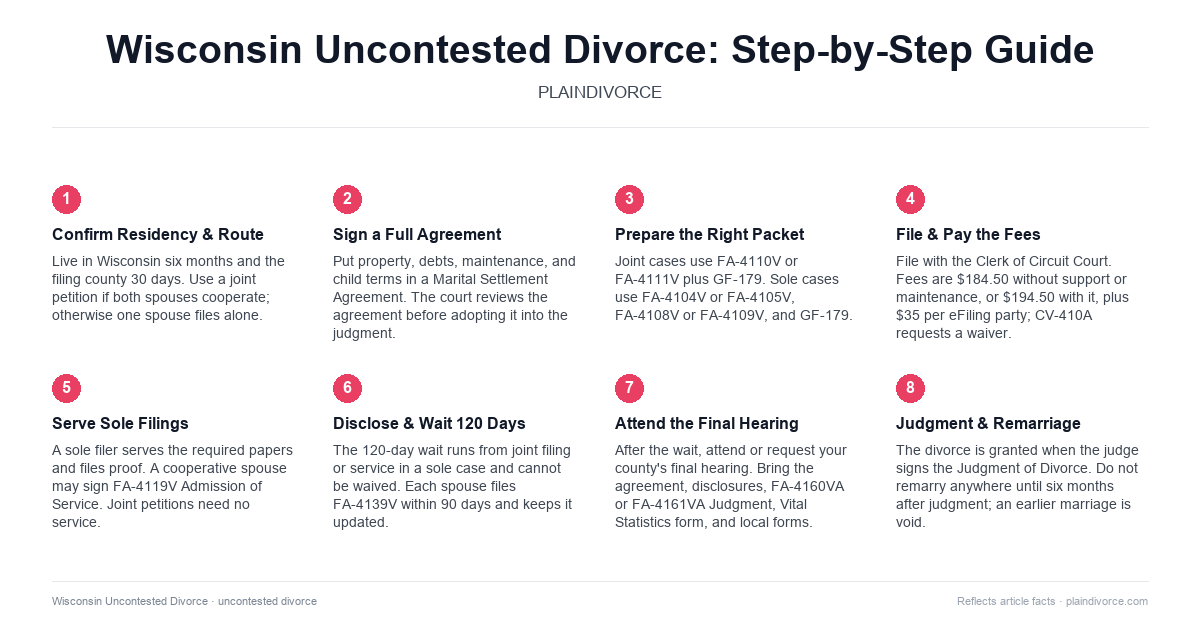
Step 1 — Confirm you qualify and choose joint vs. sole filing
- Check residency: 6 months in Wisconsin, 30 days in the county.
- Confirm both spouses will state the marriage is irretrievably broken.
- Decide whether to file a joint petition (FA-4110V / FA-4111V) or have one spouse file alone with a summons and petition.
Step 2 — Reach a complete agreement and put it in writing
Your Marital Settlement Agreement should cover property and debts (who keeps what, who pays what), spousal maintenance (an amount or a clear waiver), and, if you have children, legal custody, physical placement, child support, health insurance, and how you split uncovered medical and other expenses.
Step 3 — Prepare the filing package
For a joint case: the joint petition (FA-4110V / FA-4111V) and the Confidential Petition Addendum (GF-179). For a sole case: the summons (FA-4104V / FA-4105V), the petition (FA-4108V / FA-4109V), and GF-179. Both tracks also need the Financial Disclosure Statement (FA-4139V) and, in child cases, a proposed parenting plan if custody or placement is disputed.
Step 4 — File with the Clerk of Circuit Court and pay the fee
File in the correct county and pay the commencement fee (see Section 8). Most family filers use eFiling; some situations still allow paper. Filing the petition—or serving it—starts both the 120-day clock and the automatic restraints under § 767.117.
Step 5 — Serve your spouse (sole filings only)
If you filed alone, your spouse must receive the summons, petition, Confidential Petition Addendum, and—in child cases—the proposed parenting-plan materials, and proof of service must be filed. Cooperative spouses can sign an Admission of Service (FA-4119V) instead of being formally served. If you filed a joint petition, no service is required.
Step 6 — Complete the 120-day waiting period and disclosures
Use the wait productively: finish and exchange the Financial Disclosure Statement (due within 90 days), finalize the Marital Settlement Agreement, and complete any county parenting program. Keep every number consistent across the documents.
Step 7 — Final hearing and Judgment of Divorce
After the waiting period, the court sets a final hearing (some counties schedule it automatically; in others you request it). Bring the Marital Settlement Agreement, the Financial Disclosure Statements, the Findings of Fact/Conclusions of Law/Judgment of Divorce (FA-4160VA / FA-4161VA), the Vital Statistics form, and any local forms. If the paperwork is complete and the agreement is fair, the judge grants the divorce and signs the judgment. Order certified copies from the clerk for name changes, benefits, and financial paperwork.
Remember the 6-month remarriage bar: under Wis. Stat. § 765.03(2), a party to a Wisconsin divorce may not remarry anywhere until 6 months after the judgment, and a marriage before then is void.
6. Special Issues When You Have Minor Children
Even an uncontested case is more detailed with minor children, because the court must independently protect the child’s best interests. It will not simply rubber-stamp your deal.
Custody and placement
Wisconsin law presumes joint legal custody (shared major decision-making) is in the child’s best interest. Physical placement is the schedule—where the child actually is. If either parent is proposed for less than 25% placement, the order must give specific reasons. Your agreement needs a workable plan for the schedule, holidays, transportation, and communication.
Child support and the percentage standard
Child support is set by the percentage standard the Department of Children and Families publishes, applied to the payer’s gross income (Wis. Stat. § 767.511): roughly 17% for one child, 25% for two, 29% for three, 31% for four, and 34% for five or more, with adjustments for shared placement, split placement, low or high income, and serial-family payers.
The court must use the standard unless it finds, by the greater weight of the credible evidence, that it is unfair to the child or a party. A parties’ preference is not enough: to deviate, the court has to state on the record the guideline amount, the deviation, the reasons it is unfair, and the basis for the new figure. Agreements that track the guideline are approved far more smoothly.
How support gets paid
Support orders come with mechanics people rarely expect. Under Wis. Stat. § 767.57 and § 767.75, child support, maintenance, or family support generally must be paid to the state (the Department of Children and Families or its designee), the order operates as an assignment of income (automatic income withholding), and there are annual fees—$65 for the paying party and $35 for a party receiving child or family support—withheld from income or deducted from the payment. Build these into your budgeting; do not assume you can just Venmo each other.
Parenting programs and mediation
If custody or placement is disputed, the court orders mediation, and each parent gives a proposed parenting plan (FA-4147V) to the mediator at least 10 days before the first session; if mediation does not resolve it, a proposed parenting plan is filed within 60 days. Many counties also run a short parent-education program. Note the limit in Wis. Stat. § 767.401: such a class may not exceed 4 hours, the parties pay any cost, and the court may not require the class as a condition of granting the final judgment. Check your county’s family-court page so a scheduling quirk does not stall you.
7. How Long Does an Uncontested Divorce Take in Wisconsin?
The minimum is 120 days because of the statutory waiting period, measured from service or from filing the joint petition. There is no statewide official estimate for the typical total; realistically, a cooperative no-children case is often ready for a final hearing shortly after the 120 days expire, while cases with children run longer because of parenting programs, the parenting plan, and support review. Actual timing depends on your county’s calendar.
Common avoidable delays:
- Incomplete or inconsistent Financial Disclosure Statements
- Missing signatures or a missing GF-179
- Service problems in sole-filed cases
- A child-support number that does not match the guideline without a stated reason
- Local scheduling backlogs
8. What Does an Uncontested Divorce Cost?
Court filing fees (statewide)
Wisconsin publishes one consolidated circuit-court fee schedule. As of the chart updated July 13, 2026, commencing a divorce, legal separation, or annulment costs:
- $184.50 when no support or maintenance is requested
- $194.50 when support or maintenance is requested
- plus $35 per party, per case for electronically filed cases (waived for a granted fee-waiver petition and for government units)
Confirm the current figures on the Wisconsin Court System’s official fee schedule at wicourts.gov before you file.
Other typical costs
- Service fees (sheriff or private process server) in a sole-filed case—avoided if your spouse signs an Admission of Service or you file jointly
- Certified copies of the Judgment of Divorce
- Notary and mailing where applicable
- Annual support fees of $65 (payer) and $35 (recipient) if there is a support order
- Optional help: mediation or a limited-scope attorney review of your agreement
Fee waivers
If you cannot afford the fees, file form CV-410A, Petition for Waiver of Fees and Costs — Declaration of Indigency, with your case. Approval is not automatic; the court reviews your financial information and decides.
9. When a DIY Divorce Is Not the Right Call
A DIY uncontested divorce saves money and stress, but it is not for everyone. Get legal advice—even limited-scope advice—if there is domestic abuse, coercion, or intimidation; suspected hidden assets; complex property such as a business, pension, or retirement account that needs a QDRO; or serious disagreement about parenting or support. Spending a few hundred dollars on advice up front is cheaper than paying a lawyer later to fix a signed judgment.
10. Where a Self-Help Divorce Kit Fits Into the Process
Wisconsin publishes official statewide forms, but people get stuck on sequence, the required supporting documents, and keeping the numbers consistent. A structured Wisconsin self-help kit helps you:
- Understand joint petition vs. sole filing and the service implications
- Track disclosure deadlines—the Financial Disclosure Statement (FA-4139V) within 90 days and updated to the hearing
- Use checklists so items like the Confidential Petition Addendum (GF-179), the Vital Statistics form, and the Findings/Conclusions/Judgment forms are not missed
- Keep your Marital Settlement Agreement, petition, and disclosures aligned so the final hearing is short
11. Wisconsin Uncontested Divorce FAQ
What is a Joint Petition for divorce in Wisconsin?
A joint petition (form FA-4110V with minor children, or FA-4111V without) is a single document both spouses sign to start the divorce together. In it, both parties consent to the court’s jurisdiction and waive service of a summons, so there is no formal service of process and no proof of service to file. It is generally the cleanest path for a cooperative uncontested divorce in Wisconsin.
How long is the divorce waiting period in Wisconsin?
Wisconsin requires a mandatory 120-day waiting period. The court cannot hold a final hearing until 120 days after the joint petition is filed, or 120 days after the summons and petition are served in a sole-filed case (Wis. Stat. § 767.335). The court can order an earlier hearing only for health, safety, or other emergency reasons. You cannot waive the wait by agreement.
What is the Financial Disclosure Statement, and does each spouse file one?
The Financial Disclosure Statement (FA-4139V) is a sworn listing of each party’s assets, debts, income, and expenses, required in every Wisconsin divorce. Wis. Stat. § 767.127 requires full disclosure from each party but allows the spouses to file individually or jointly. It must be filed within 90 days of service or the joint filing (or a date the court sets) and kept updated through the hearing. Deliberately hiding assets is perjury.
Do we have to go to court for an uncontested divorce in Wisconsin?
Usually yes. The Wisconsin Court System’s basic guide tells filers to attend a final hearing after the 120-day wait so the court can confirm residency and the ground and review the Marital Settlement Agreement. Some counties handle simple stipulated cases with a very brief or limited appearance, and state law allows a divorce to be granted on affidavits in specified circumstances—so check your county’s current practice.
What is the GF-179 form and is it required?
GF-179 is the Confidential Petition Addendum. It is mandatory and is filed with the petition or joint petition in every case. It collects identifying information (such as dates of birth) that is kept out of the public court file. Leaving it out is one of the most common reasons a self-filed Wisconsin divorce gets rejected at intake.
How much does an uncontested divorce cost in Wisconsin?
The statewide commencement fee is $184.50 with no support or maintenance request, or $194.50 with one, plus $35 per party for eFiling (as of the July 13, 2026 fee chart). Add service fees for a sole-filed case, certified copies, and, if there is a support order, annual fees of $65 for the payer and $35 for the recipient. Low-income filers can request a waiver with form CV-410A.
Can we remarry right after the divorce is granted?
No. Under Wis. Stat. § 765.03(2), a person who was a party to a Wisconsin divorce may not remarry anywhere in the world until 6 months after the judgment is granted, and a marriage entered before then is void. If remarriage timing matters, confirm how the rule applies to your dates before making plans.
Can the court change what we agreed to?
Yes. Under Wis. Stat. § 767.34 the court may approve, modify, or reject your stipulation, and it must independently review child support against the percentage standard and confirm any custody and placement terms serve the child’s best interest. A clear agreement that tracks the guidelines is what keeps the judge from adjusting anything.
12. Final Thoughts and Next Steps
Court forms and deadlines feel overwhelming during a major life change—that is normal. A smooth uncontested divorce in Wisconsin comes down to a few things done in order:
- Confirm eligibility: 6 months in the state, 30 days in the county, and both spouses ready to say the marriage is irretrievably broken.
- Choose the cleanest path: a joint petition when you can, so there is no service step.
- File a complete package: petition (or joint petition), GF-179, Financial Disclosure Statement, and—before the final hearing—the Marital Settlement Agreement, the Findings/Conclusions/Judgment forms, and the Vital Statistics form.
- Plan around the 120-day wait and the automatic § 767.117 restraints, and keep every dollar figure consistent across the paperwork.
The Wisconsin uncontested divorce kit organizes those steps with checklists so nothing gets missed.
Remember: PlainDivorce is not a law firm and nothing here is legal advice. Before you file, verify the current rules, forms, and fees with the Wisconsin Court System and your county Clerk of Circuit Court, or talk to a licensed Wisconsin attorney—especially if your situation involves safety concerns, complex finances, or any disagreement.
Sources and local rules can change. Use this guide as a plain-English organizer, then verify the current filing requirements with the official court or government source for your jurisdiction.

About Harry D
Expert contributor at PlainDivorce, helping Canadians and American navigate simple uncontested divorces with clarity and confidence.