Uncontested Divorce in Wyoming: A Plain-English Step-by-Step Guide
An uncontested divorce in Wyoming is one where you and your spouse agree the marriage is over and agree on every issue — property, debts, support, and any parenting arrangements — so a district court judge can approve your written Decree of Divorce without a trial. Wyoming law sets a hard floor of 20 days from the day the Complaint for Divorce is filed before any decree can be entered (W.S. § 20-2-108), but a real case also has to clear service, a response period, and the court’s own schedule.
This guide walks through who qualifies under W.S. § 20-2-107, which Wyoming divorce forms (the free PDF packets published by the Wyoming Judicial Branch) you actually fill out, how the process runs from filing to final decree, how long it takes, what it costs, and where a do-it-yourself approach fits. It uses the Wyoming terms you’ll see in the packets — Complaint for Divorce, Acknowledgement and Acceptance of Service, Initial Disclosures, Confidential Financial Affidavit, Affidavit for Divorce Without Appearance of Parties, and Decree of Divorce — so you can recognize them.
TL;DR
An uncontested divorce in Wyoming is an ordinary district court divorce where the second spouse doesn’t fight. You file a Complaint for Divorce on the no-fault ground of irreconcilable differences, and in most agreed cases the judge signs your Decree of Divorce without a hearing. Wyoming’s waiting period is the shortest in the country — but it’s a floor, not a timeline.
- Just 20 days minimum from the filing date before a decree can be entered (W.S. § 20-2-108). No separation period, no cooling-off, and no waiting period to remarry afterward.
- Residency is only 60 days for either spouse — or, if you married in Wyoming, continuous residence since the wedding (W.S. § 20-2-107).
- Three clocks run at once: service within 90 days of filing, your spouse’s response period of 20 days (served in Wyoming) or 30 days (out of state), and the 20-day decree floor.
- Pick the right packet. The Judicial Branch’s free PDFs split by children: Packet 1 (plaintiff, with minor children) or Packet 3 (plaintiff, no minor children). Fee-waiver forms are in Packet 10.
- Financial disclosure differs by packet. No children: Initial Disclosures, sent to your spouse and not filed with the court. With children: both parties file a Confidential Financial Affidavit with pay stubs and two years of tax returns, plus the child support computation.
- The Acknowledgement and Acceptance of Service saves the service fee — your spouse signs before a notary confirming they got the Complaint and the Summons.
- The Affidavit for Divorce Without Appearance is a statewide form, not a local favor. It’s what lets the judge sign on the papers — though a brief hearing can still be set.
- With kids: guideline support is presumptively correct, and “we both agree to less” isn’t enough — a deviation needs written findings in the decree. If a child gets public benefits, the court cannot go below the calculated amount. An Order for Income Withholding is mandatory, and payments must route through the clerk or the State Disbursement Unit — money handed directly to the other parent may be treated as a gift.
- Cost: a $160 filing fee, roughly $35–$50 for service (often $0 with the acknowledgement), notary fees, and $25 per Vital Records copy. Waiver available via the Affidavit of Indigency.
- You’re divorced only when the signed decree is filed with the Clerk of District Court — make sure your copy is file-stamped.
- Get a lawyer if there’s abuse or pressure, hidden finances, a ranch, farm, or business, a parenting dispute — or if either spouse is pregnant, since the court may not finalize until after the birth.
1. What Is an Uncontested Divorce in Wyoming?
Wyoming has no separate “simple divorce” statute. An uncontested divorce in Wyoming is just an ordinary district court divorce in which the second spouse does not fight. In practice that means:
- One spouse (the Plaintiff) files a Complaint for Divorce in the District Court, stating there are irreconcilable differences in the marital relationship (the no-fault ground under W.S. § 20-2-104).
- The other spouse (the Defendant) either signs an Acknowledgement and Acceptance of Service and files a short Answer agreeing to the divorce, or simply does not respond, which lets the Plaintiff finish the case by default.
- Both spouses sign a proposed Decree of Divorce that spells out how property, debts, support, and any parenting issues are handled.
- The judge reviews the paperwork and, in most agreed cases, signs the decree without a hearing after the parties file an Affidavit for Divorce Without Appearance of Parties.
You do not have to prove cheating, cruelty, or any other “bad act.” Stating that the marriage has broken down and cannot be repaired is enough.
Uncontested vs. contested
- In a contested divorce, the spouses disagree on one or more issues. The court may hold multiple hearings, issue temporary orders, order mediation, and set a trial.
- In an uncontested divorce, the court’s job is mainly to confirm it has jurisdiction (residency is met and Wyoming can decide any child issues), that your agreement follows the law — especially on children and child support — and that the required forms are complete.
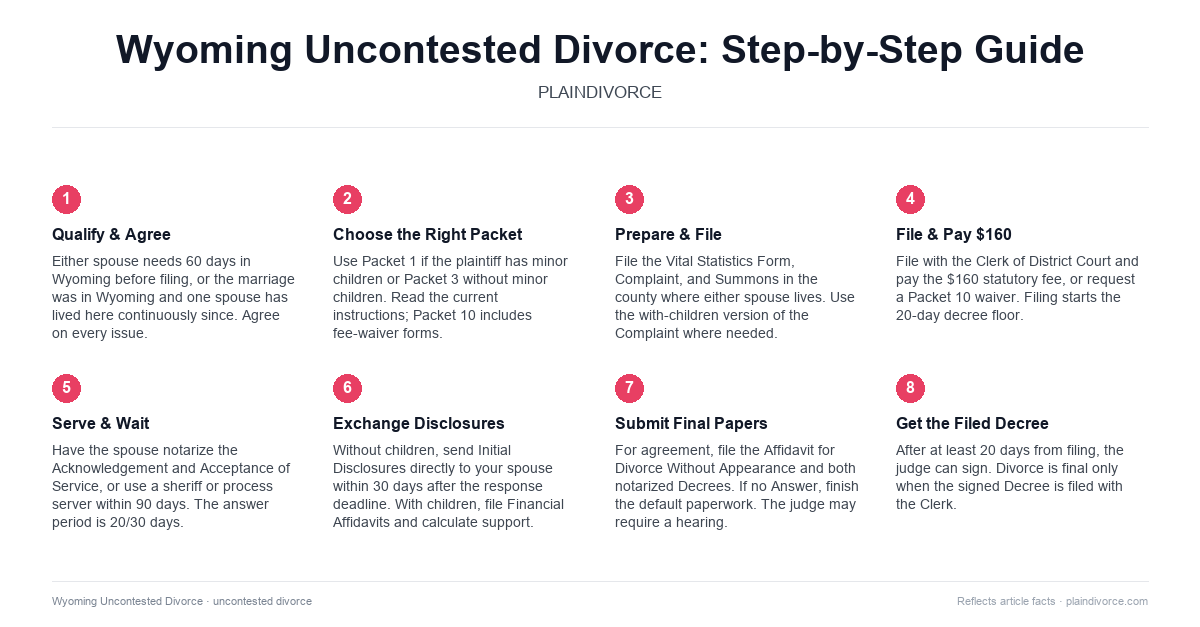
Process snapshot: File the Complaint for Divorce and Summons → serve your spouse or have them sign the Acknowledgement and Acceptance of Service (within 90 days of filing) → wait out the answer period (20 days if served in Wyoming, 30 days if served out of state) → exchange financial disclosure → file the Affidavit for Divorce Without Appearance and signed Decree (or complete a default) → judge signs the Decree, which becomes final when it is filed with the clerk — no sooner than 20 days after filing.
2. Who Qualifies for an Uncontested Divorce in Wyoming?
Two questions sit under “do I qualify”: can you file for divorce in Wyoming at all, and is your case a realistic fit to stay uncontested from start to finish?
Wyoming residency requirement (W.S. § 20-2-107)
Under W.S. § 20-2-107, no divorce can be granted unless:
- Either you or your spouse has lived in Wyoming for at least 60 days immediately before the Complaint for Divorce is filed, or
- The marriage took place in Wyoming and one of you has lived here continuously from the date of the marriage until you file.
You file in the District Court for the county where you or your spouse lives (W.S. § 20-2-104).
Grounds: irreconcilable differences (W.S. § 20-2-104)
Nearly every uncontested Wyoming divorce uses the no-fault ground of irreconcilable differences: the marriage has broken down, you cannot get along, and there is no realistic way to fix it. Wyoming has no separation period or “cooling-off” residency beyond the 60-day rule, and there is no statutory waiting period to remarry once the decree is final.
What makes a case a good fit to stay uncontested
- Both spouses agree the marriage should end and are willing to sign court forms.
- You have no minor children, or a workable, child-focused plan for custody, parenting time, and support that both of you accept.
- You both understand the household finances — income, debts, the home, vehicles, retirement accounts.
- You can reach a clear agreement on who keeps which assets and debts, whether anyone pays alimony, and how parenting responsibilities are divided.
When uncontested may not work
- There is domestic violence, coercion, or intimidation, or you feel pressured to sign.
- One spouse is hiding or controlling information about money or property.
- You disagree about where the children live or how much time they spend with each parent.
- There are complex assets: a family business, a farm or ranch, multiple properties, pensions, or stock options.
- There are immigration, tax, military, or disability-benefit questions tied to the timing or terms of the divorce.
- Either spouse is pregnant — the Complaint asks about this, and the court may not finalize the divorce until after the birth so custody and support for the child can be addressed.
In any of those situations, talk to a Wyoming family-law attorney or a legal-aid office before relying on a purely DIY approach.
3. Which Wyoming Divorce Forms You’ll Use (PDF Packets)
People searching for “Wyoming divorce forms pdf” are looking for the Wyoming Judicial Branch’s free self-help packets. As of 2025 the Judicial Branch publishes these as numbered packets, and the forms differ depending on whether you have minor children. The two plaintiff packets are Packet 1 — Divorce with Minor Children (Plaintiff) and Packet 3 — Divorce with No Minor Children (Plaintiff); matching defendant packets exist as well. Fee-waiver forms live in Packet 10 — Miscellaneous Forms.
Always check the packet date against the Judicial Branch’s official self-help forms list, or ask your clerk, before you rely on a form you downloaded earlier.
Divorce with no minor children (Packet 3)
| Stage | Key forms |
|---|---|
| Filing | Vital Statistics Form; Complaint for Divorce; Summons |
| Notice to your spouse | Acknowledgement and Acceptance of Service (or sheriff/process-server service) |
| Financial disclosure | Initial Disclosures — exchanged directly with your spouse, not filed with the court |
| Finishing (agreement) | Affidavit for Divorce Without Appearance of Parties; Decree of Divorce |
| Finishing (default) | Application for Entry of Default; Affidavit in Support of Default; Entry of Default; then the Affidavit for Divorce Without Appearance and Decree |
Note: the no-children packet has no “Confidential Financial Affidavit.” Its financial disclosure is the Initial Disclosures form, which you send to your spouse (not the clerk) within 30 days after the deadline for their response.
Divorce with minor children (Packet 1)
| Stage | Key forms |
|---|---|
| Filing | Vital Statistics Form; Complaint for Divorce with Children; Summons; Confidential Statement of Parties for Child Support Order |
| Notice to your spouse | Acknowledgement and Acceptance of Service (or sheriff/process-server service) |
| Financial disclosure | Initial Disclosures; Confidential Financial Affidavit from both parties (with pay stubs and tax returns attached), or an Affidavit of Imputed Income if the other parent does not file one; Child Support Computation Form & Net Income Calculation |
| Finishing | Affidavit for Divorce Without Appearance of Parties; Decree of Divorce with Children; Order for Income Withholding (required whenever child support is ordered) |
Because a self-help kit organizes these Complaint for Divorce instructions and gives you sample wording, it can help you match the right packet to your situation and keep the forms consistent with each other. See our Wyoming uncontested divorce kit for a walkthrough.
4. Step-by-Step: The Uncontested Divorce Process
Exact steps vary by county, and the official packet instructions should be your primary checklist. Here is the typical flow.
Step 1 – Confirm you qualify
- Residency (W.S. § 20-2-107): 60 days in Wyoming for either spouse, or the “married in Wyoming plus continuous residence” alternative.
- Child jurisdiction: if you have children, Wyoming can decide custody only if the children have lived here for about six months (or since birth, if a child is under six months old), or the court has emergency jurisdiction. The Complaint for Divorce with Children has specific boxes for these facts.
- Grounds: you are comfortable stating there are irreconcilable differences.
- Safety and fairness: it is safe to negotiate directly, and you understand your finances well enough to make decisions.
Step 2 – Reach agreement on children, support, and property
Before you fill out forms, work out the substance with your spouse:
- Children: where they live most of the time, the parenting-time schedule (including holidays and school breaks), and how major education, medical, and religious decisions are made.
- Child support: run the numbers using the Wyoming presumptive guidelines in W.S. § 20-2-304 so you know the expected amount before you agree to anything.
- Medical support: which parent carries health insurance for the children, and how uncovered medical, dental, and vision costs are split (a medical-support provision is required in every child-support order).
- Property and debts: the house, land or ranch, vehicles, loans, credit cards, and retirement accounts.
- Alimony: whether either spouse pays spousal support, how much, and for how long.
Most couples write these decisions into a settlement agreement, which is then reflected in the proposed Decree of Divorce.
Step 3 – Prepare and file the Complaint for Divorce (W.S. § 20-2-108)
- Choose the correct packet (with or without minor children), read the instructions, and complete the Vital Statistics Form, Complaint for Divorce, Summons, and — if you have children — the Confidential Statement of Parties for Child Support Order.
- File with the Clerk of District Court in the right county and pay the filing fee (or file a fee-waiver request from Packet 10).
- Get file-stamped copies for your records. The filing date starts the 20-day clock under W.S. § 20-2-108 — no decree can be entered sooner — and it also starts the 90-day window to serve your spouse.
Step 4 – Give your spouse legal notice
Your spouse must be formally notified. In a cooperative case the simplest method is the Acknowledgement and Acceptance of Service: your spouse signs it in front of a notary, confirming they received the Complaint and the Summons. You then file the signed acknowledgement together with the original Summons as proof of service. This avoids sheriff or process-server fees.
If your spouse will not sign, the Summons and Complaint must be served by the sheriff or a private process server. If you cannot locate your spouse, the packets and Packet 10 explain service by publication. Service must be completed within 90 days of filing or the court may dismiss the case.
After service, your spouse has 20 days to respond if served in Wyoming or 30 days if served outside Wyoming. You must let that period pass before moving the case forward.
Step 5 – Exchange financial disclosure
- No minor children: complete the Initial Disclosures form and send it directly to your spouse (not the clerk) within 30 days after their response deadline.
- Minor children: on the agreed path, both parties file a Confidential Financial Affidavit with the court, attaching pay stubs and the last two years of tax returns, plus the Child Support Computation Form. If your spouse will not file their affidavit, you file an Affidavit of Imputed Income showing what they earn.
Step 6 – Finish on the papers (or attend a short hearing)
The Affidavit for Divorce Without Appearance of Parties is a current statewide packet form — not a county-by-county favor. It gives the judge the sworn evidence needed to sign your Decree without a hearing. It is available:
- Agreement path: your spouse filed an Answer, you agree on everything, and both of you have signed and notarized the Decree of Divorce; or
- Default path: your spouse did not file an Answer, and you have completed the Application for Entry of Default, Affidavit in Support of Default, and Entry of Default.
Even then, a judge may still set a brief hearing and ask straightforward questions about residency, irreconcilable differences, and your agreement. Your clerk or the packet instructions will tell you what your court expects.
Step 7 – Get the signed, filed Decree of Divorce
Once at least 20 days have passed since filing and everything is in order, the judge signs the Decree of Divorce. Your divorce is final only when the signed decree is filed with the Clerk of District Court — make sure your copy is file-stamped. After that:
- Request certified copies of the decree from the clerk and store them safely. If you asked to restore a prior name, that is ordered in the decree.
- For proof of divorce for federal or other purposes, you can order a divorce record from Wyoming Vital Records Services (currently $25 per copy) once the court reports the decree.
5. Children: Custody, Parenting Plans, and Child Support
Divorce with children adds layers even when everything is agreed. A Wyoming judge must apply the best interests of the child standard and is not required to approve a plan that appears to harm the children — so be realistic and child-focused.
Parenting plan and decision-making
Courts look for a clear plan covering where the children live, a parenting-time schedule (including holidays and vacations), and how major education, medical, and religious decisions are made or shared. The court may require parents to attend a parenting class to reduce the impact of the divorce on the children; if that applies, the class provider gives you a certificate to file.
Child support: the presumptive guidelines (W.S. § 20-2-304)
Wyoming child support is calculated from both parents’ net incomes using the tables in W.S. § 20-2-304. That figure is presumptively correct. Key rules an uncontested couple often gets wrong:
- Deviations are limited. The court can order a different amount only if it makes a specific written finding in the decree that the presumptive amount would be unjust or inappropriate in your case and that the deviation is in the children’s best interests. “We both agree to less” is not enough on its own.
- Public benefits block a low agreement. If Title 19 / Kid Care, SNAP, POWER, or similar assistance is being paid for a child, the court cannot approve support below the calculated amount.
- Income withholding is mandatory. In every case where child support is ordered, the court is required by law to enter an Order for Income Withholding.
- Pay through the clerk or the State Disbursement Unit. The decree routes payments through the Clerk of District Court or the Wyoming State Disbursement Unit. Money handed directly to the other parent may be treated as a gift and not credited as support.
6. How Long Does an Uncontested Divorce Take in Wyoming? (W.S. § 20-2-108)
The statutory 20-day minimum
Under W.S. § 20-2-108, “a divorce decree shall not be entered less than twenty (20) days from the date the complaint is filed.” That is a floor, not a typical timeline.
What actually drives the timeline
- Service: completed within 90 days of filing (often much sooner if your spouse signs the Acknowledgement and Acceptance of Service).
- Response period: 20 days (served in Wyoming) or 30 days (served out of state) must pass before you file for a decision.
- Disclosure: Initial Disclosures are due within 30 days after the response deadline; child cases add financial affidavits and the support calculation.
- The court’s docket: the judge reviews the file (or schedules a short hearing) on its own schedule.
As a practical estimate — not a court guarantee — a clean, fully cooperative case often runs from about a month to a few months from filing to final decree. Child-related issues, missing paperwork, or a busy court can push it longer.
7. What Does an Uncontested Divorce Cost in Wyoming?
| Cost | Typical amount |
|---|---|
| District Court filing fee (paid by the plaintiff) | $160 statutory original civil filing fee (W.S. § 5-3-206); confirm the current figure and payment methods with your clerk |
| Sheriff or process-server service | ~$35–$50 per person (set by county); often $0 if your spouse signs the Acknowledgement and Acceptance of Service |
| Notary fees | A few dollars per signature (the acknowledgement, affidavits, and decree must be notarized) |
| Parenting class (if ordered) | Varies by provider |
| Certified copies / Vital Records divorce record | Clerk copy fees; $25 per copy from Wyoming Vital Records |
| Optional limited-scope attorney review | Varies; often a flat fee to review your agreement before filing |
If you cannot afford the court costs, ask the District Court to waive the filing fee using the Affidavit of Indigency and Request for Waiver of Fees in Packet 10. The judge decides based on your finances. A genuinely uncontested, DIY divorce is far cheaper than a contested case with lawyers on both sides — but only when your situation is truly a fit for the DIY route.
8. When a DIY Divorce Might Not Be Right for You
Handling your own paperwork can save real money, but it is not always wise. Get individual legal advice from a Wyoming attorney or a legal-aid program if:
- There has been domestic violence, threats, or serious emotional abuse.
- You feel pressured to sign documents you do not fully understand.
- One spouse controls all the money and the other does not know the full financial picture.
- There are complicated assets — a family farm or ranch, business interests, stock options, multiple properties, or significant retirement accounts.
- One spouse has serious health, disability, military, or immigration issues affected by the divorce.
- You disagree about custody, parenting time, or relocation with the children.
- The proposed agreement looks extremely one-sided and you are not sure what the alternatives are.
9. Where a Self-Help Divorce Kit Fits In
A self-help divorce kit for Wyoming is not a substitute for a lawyer, but if your case is genuinely uncontested and you are comfortable handling it, a well-built kit helps you:
- Understand the whole process step by step, in plain English.
- See how the pieces fit — Complaint for Divorce, Acknowledgement and Acceptance of Service, Initial Disclosures or Confidential Financial Affidavit, child support calculation, Decree of Divorce, and the Affidavit for Divorce Without Appearance.
- Avoid the form mistakes that cause rejections and delays.
- Stay organized with checklists, a timeline, and sample wording you customize to your own facts.
A kit fits in the middle of the process: after you have decided an uncontested approach is right, before you start filling in complex forms, and while you are making sure nothing falls through the cracks. Some people still have an attorney review the final agreement; others rely on the official packets plus a kit for structure.
Download Our Wyoming Uncontested Divorce Self-Help Kit
Using a kit is optional and does not replace legal advice. It is simply one more tool for organized, detail-oriented people moving through an uncontested Wyoming divorce. You may also want our family-law guides for related topics like parenting plans and property division.
10. Wyoming Uncontested Divorce FAQ
How long does a divorce take in Wyoming?
Wyoming law sets a minimum of 20 days from the date the Complaint for Divorce is filed before a judge can enter a decree (W.S. § 20-2-108). That is only a floor. A real case also has to clear service (within 90 days of filing), the spouse’s 20-day response period (30 days if served out of state), financial disclosure, and the court’s schedule, so most uncontested cases take from about a month to a few months.
What is the residency requirement for a Wyoming divorce?
Under W.S. § 20-2-107, either spouse must have lived in Wyoming for at least 60 days immediately before the Complaint for Divorce is filed. There is an alternative: if the marriage took place in Wyoming and one spouse has lived here continuously from the marriage until filing, that also satisfies the requirement. You file in the District Court for the county where either spouse lives.
Do I need a Confidential Financial Affidavit in Wyoming?
It depends on the packet. Divorce cases with minor children require both parties to file a Confidential Financial Affidavit with the court, attaching pay stubs and tax returns; if the other parent will not file one, you file an Affidavit of Imputed Income instead. Divorce cases with no minor children use a different form, the Initial Disclosures, which you exchange directly with your spouse rather than filing it with the clerk.
Can I get a Wyoming divorce without going to court?
Often, yes. Wyoming’s statewide packets include an Affidavit for Divorce Without Appearance of Parties. When your case is fully uncontested — both spouses have signed and notarized the Decree of Divorce — or you have completed the default paperwork, you file that affidavit to give the judge the sworn evidence to sign the decree without a hearing. A judge can still require a brief hearing in some situations.
Where do I get Wyoming divorce forms in PDF?
The Wyoming Judicial Branch publishes free self-help divorce packets as fillable PDFs. Use Packet 1 if you are the plaintiff and have minor children, or Packet 3 if you are the plaintiff with no minor children; matching defendant packets exist. Fee-waiver forms are in Packet 10. Check the packet date against the Judicial Branch’s official forms list, or ask your Clerk of District Court, before relying on any form.
How much does it cost to file for divorce in Wyoming?
The statutory original civil filing fee is $160, paid by the plaintiff (W.S. § 5-3-206). Add roughly $35–$50 for sheriff service if your spouse does not sign the Acknowledgement and Acceptance of Service, small notary fees, and any parenting-class or certified-copy costs. If you cannot afford the fee, request a waiver using the Affidavit of Indigency in Packet 10.
When is my Wyoming divorce actually final?
Your divorce is final when the judge signs the Decree of Divorce and the signed decree is filed with the Clerk of District Court. Make sure your copy is file-stamped. This cannot happen sooner than 20 days after the Complaint for Divorce was filed. Order certified copies from the clerk, and a divorce record from Wyoming Vital Records if you need separate proof.
11. Final Thoughts and Next Steps
To move forward with an uncontested divorce in Wyoming:
- Confirm you meet the W.S. § 20-2-107 residency rule and, if you have children, that Wyoming can decide custody.
- Have a calm conversation (when it is safe) about parenting, property and debts, and whether either of you expects alimony.
- Identify the correct packet — Packet 1 (with children) or Packet 3 (no children) — and read its instructions.
- Decide whether to complete the packets alone, add the structure of a Wyoming-specific self-help kit, and/or pay a lawyer for a limited review.
Remember: PlainDivorce.com is not a law firm and cannot give legal advice. This guide is general legal information based on public Wyoming sources as of September 2026. Courts, forms, and fees change, and different judges and counties have different expectations. If you are ever in doubt about your rights, your safety, or whether your agreement is fair, contact a Wyoming family-law attorney or legal-aid service. A short conversation now can prevent a lot of confusion later.
Sources and local rules can change. Use this guide as a plain-English organizer, then verify the current filing requirements with the official court or government source for your jurisdiction.

About Harry D
Expert contributor at PlainDivorce, helping Canadians and American navigate simple uncontested divorces with clarity and confidence.