Uncontested Divorce in Yukon: Form 91A, the Requisition Route, and a Divorce Order Without a Hearing
An uncontested divorce in Yukon is a divorce the Supreme Court of Yukon can grant on the paperwork alone, because neither spouse is asking a judge to settle a fight over children, support, or property. You start it by filing a Statement of Claim (Family Law – Divorce), Form 91A; a third party serves it on your spouse; and once the response time passes with nothing filed – or your spouse signs on to a consent order – you apply for judgment “by requisition.” A judge then reviews sworn affidavits in chambers and signs the Divorce Order without anyone attending court. The divorce is final on the 31st day after that.
TL;DR: an uncontested divorce in Yukon at a glance
- One starting form. Every Yukon divorce is commenced by a Statement of Claim (Family Law – Divorce), Form 91A under Rule 63 – not a “petition,” not a “Family Law Form 1.”
- “Joint Statement of Claim for Divorce Yukon” is a myth. Yukon has no form that lets spouses file a divorce jointly and skip service. One spouse is the plaintiff, and a third party must serve the Statement of Claim even when both spouses fully agree.
- There is no “Affidavit of Applicant” in Yukon. The sworn document that confirms your case is uncontested is the Affidavit for Divorce Order, Form 97 (or Form 97B for a divorce only).
- No hearing in most cases. You apply for judgment by filing a Requisition for Divorce Order, Form 97A with a draft Divorce Order (Form 100 or Form 100B, or Form 100A on consent); a judge can grant it “without the attendance of the lawyer or the applicant.”
- Supreme Court of Yukon divorce fees: $140 to file the Statement of Claim, $30 to file the Requisition, about $50 for Sheriff’s service, plus notarization and certified-copy costs. Confirm current amounts with the registry.
- All official Yukon divorce forms are free to download in PDF and Word from the Supreme Court of Yukon’s “Rules and Forms” page on yukoncourts.ca.
- The Divorce Order normally takes effect on the 31st day after it is granted; after that you can file for your Certificate of Divorce, Form 101.
1. What is an uncontested divorce in Yukon?
In Canada, divorce is governed by the federal Divorce Act, but the procedure and forms are local. In Yukon, every divorce is filed in the Supreme Court of Yukon in Whitehorse – the only court that can grant a divorce in the territory – and the procedure is set out in Rule 63 of the Rules of Court.
Rule 63 uses the term “uncontested divorce proceeding.” It means a family law proceeding in which a claim for divorce is made and either no statement of defence has been filed, a defence or counterclaim opposing the divorce has been withdrawn or struck out, or the parties have filed a signed statement that every claim except the divorce itself has been settled. In practice, a Yukon divorce stays uncontested one of two ways:
- Consent divorce: you and your spouse agree on everything. One spouse (the “plaintiff”) files the Statement of Claim (Family Law – Divorce), Form 91A, it is served, and both spouses sign on for a Divorce Order (Consent), Form 100A.
- Sole filing that goes unopposed: one spouse files Form 91A and serves it, and the other spouse files no Appearance, Statement of Defence, or Counterclaim within the response period – so the case proceeds as an uncontested divorce proceeding.
In both situations, Rule 63 lets the evidence be presented by affidavit, and the judge may grant the order “without the attendance of the lawyer or the applicant.” Most uncontested Yukon divorces are decided on the paper file rather than at a hearing – which matters in a territory where getting to Whitehorse can be expensive. Agreeing is not the whole job, though: the court still needs the correct current forms, properly sworn evidence, proof that reasonable child-support arrangements are in place, and a judge’s decision.
Download our Yukon Uncontested Divorce Self-Help Kit
2. Yukon’s court terminology (and the “Joint Statement of Claim” myth)
Generic “divorce guide” content borrows terms from other provinces and assumes they apply across Canada. They don’t. Using the wrong words is one of the fastest ways to have a document rejected by the registry. Here is the vocabulary that actually appears in Supreme Court of Yukon Rule 63 and the official forms:
- Statement of Claim (Family Law – Divorce), Form 91A: the document that starts every Yukon divorce (Rule 63(3) and 63(8)(a)). It names one spouse as plaintiff and the other as defendant.
- Uncontested divorce proceeding: Rule 63’s own term for a divorce case where no one is actively opposing the divorce claim.
- Affidavit for Divorce Order, Form 97 (or Form 97B if you are seeking a divorce only): the sworn statement confirming the action is uncontested and giving the judge the evidence. Not an “Affidavit of Applicant.”
- Requisition for Divorce Order, Form 97A: the document that formally asks the court to decide the case on the paperwork – what Rule 63 calls “applying for judgment by requisition.”
- Divorce Order: the judge’s decision granting the divorce. The base order is Form 100 – and its own wording covers both a divorce after a trial and one “coming before me as an uncontested divorce proceeding without a hearing.” Form 100A is the version used on consent; Form 100B is the version used for an uncontested proceeding. Yukon does not use the term “Divorce Judgment.”
- Certificate of Divorce, Form 101: requested after the divorce takes effect; your formal proof of divorce.
- Family Law Case Conference: required in nearly every family law proceeding within 60 days of service of the Statement of Claim, unless a practice direction exempts your matter.
Is there a Joint Statement of Claim for divorce in Yukon?
No. Some provinces (Ontario, for example) let both spouses file together as co-applicants on a joint form, which skips service because there is no opposing party. Yukon’s Rule 63 has no such shortcut. The only pleading that opens a Yukon divorce file is the Statement of Claim (Family Law – Divorce), Form 91A, which is built around a plaintiff and a defendant. And Rule 63(25) requires that a statement of claim in a family law proceeding “must be served by someone other than the plaintiff or defendant” – with no exception for cooperative or agreed cases.
So even when both spouses fully agree the marriage is over, one of you is the plaintiff, and the Statement of Claim still has to be served by a third party (not by either spouse). What cooperation actually buys you is speed afterward: an unopposed or consent case moves straight to a Divorce Order (Consent) or an uncontested Divorce Order without a hearing, instead of a contested trial. Treat “Joint Statement of Claim” or “desk divorce” as informal shorthand, not Yukon court terms.
There is no “Affidavit of Applicant” form in Yukon
People searching for an Affidavit of Applicant for a YT divorce are usually looking for the document that swears the case is uncontested and lays out the evidence for the judge. In Yukon, that document is the Affidavit for Divorce Order, Form 97 (or Form 97B for a divorce with no other claims). No form on the Supreme Court of Yukon’s list is titled “Affidavit of Applicant” – if a template or checklist uses that label, check it against the current Form 97/97B before relying on it.
3. Who qualifies for an uncontested divorce in Yukon?
Before you invest time in forms, confirm two basics: jurisdiction (residency) and grounds.
Residency: the one-year rule
To get divorced in Yukon, at least one spouse must have been ordinarily resident in Yukon for at least one full year immediately before the divorce case is started (Divorce Act, section 3). This is jurisdictional: if neither spouse meets it, the Supreme Court of Yukon cannot grant the divorce, and your Affidavit for Divorce Order has to state the residence facts.
Grounds and the one-year separation clock
Canada has one ground for divorce: breakdown of the marriage. You prove it one of three ways – one year of separation, adultery, or physical or mental cruelty (Divorce Act, section 8). Almost every uncontested case uses the one-year separation basis, because it needs no proof of fault.
- You can file before the year is up, but a judge cannot grant the divorce until you have been separated for one full year.
- A reconciliation attempt totalling up to 90 days does not reset the clock (section 8(3)). Longer than that, and the year usually starts over.
- You can be “separated” under the same roof if you have stopped living as a couple – be ready to explain the arrangement in your affidavit.
When it fits – and when it doesn’t
An uncontested divorce in Yukon is a good fit when at least one spouse meets the one-year residency rule, you can rely on one year of separation, you both agree the marriage is over, children/support/property are resolved or agreed, and you can stay organized with deadlines and notarization.
It is not the right route if there is family violence, coercion, or safety concern; a serious dispute about parenting, relocation, or support; complex finances (a business, several properties, pensions, hidden assets); or an immigration or cross-border issue tied to the divorce. If any of these apply, get legal advice even if you still hope to keep things amicable.
4. The Yukon divorce forms (Form 91A to Form 101)
These form numbers come from Rule 63 and Rule 63A. Every one is published free of charge, in PDF and Word, on the Supreme Court of Yukon’s official “Rules and Forms” page on yukoncourts.ca – that is the set people mean when they search for Yukon divorce forms PDF. Download the current version each time you file; older copies saved from a previous case or a third-party site may be out of date.
| Form | Name | When you use it |
|---|---|---|
| Form 91A | Statement of Claim (Family Law – Divorce) | Starts every Yukon divorce proceeding. |
| Form 7 | Affidavit of Service | Sworn by the third party who serves the Statement of Claim; must state how they identified the person served. |
| Form 9 / 92 / 93 | Appearance / Statement of Defence / Counterclaim | Filed by a spouse who opposes or responds. None of these appears in a truly uncontested file. |
| Form 94 / 94A | Financial Statement (Detailed / Simplified) | Financial disclosure when support or property is in issue (see section 6). |
| Form 95 | Notice to File a Financial Statement | Served with the pleading when one party is entitled to the other’s disclosure. |
| Form 96 | Agreement as to Annual Income and Amount of Child Support | Filed when the parents agree on the payor’s income and the support amount. |
| Form 97A | Requisition for Divorce Order | Asks the court to decide the case by requisition, without a hearing. |
| Form 97 / 97B | Affidavit for Divorce Order (/ Divorce Only) | The sworn evidence that the action is uncontested. This is the “Affidavit of Applicant” people look for. |
| Form 98 | Child Support Affidavit | Filed with the requisition when child support is part of the order. |
| Form 100 / 100A / 100B | Divorce Order / (Consent) / (Uncontested) | The draft order you file with the requisition. Form 100 is the base order; 100A on consent; 100B for an uncontested proceeding. |
| Form 101 | Certificate of Divorce | Filed after the divorce takes effect, as proof the marriage has ended. |
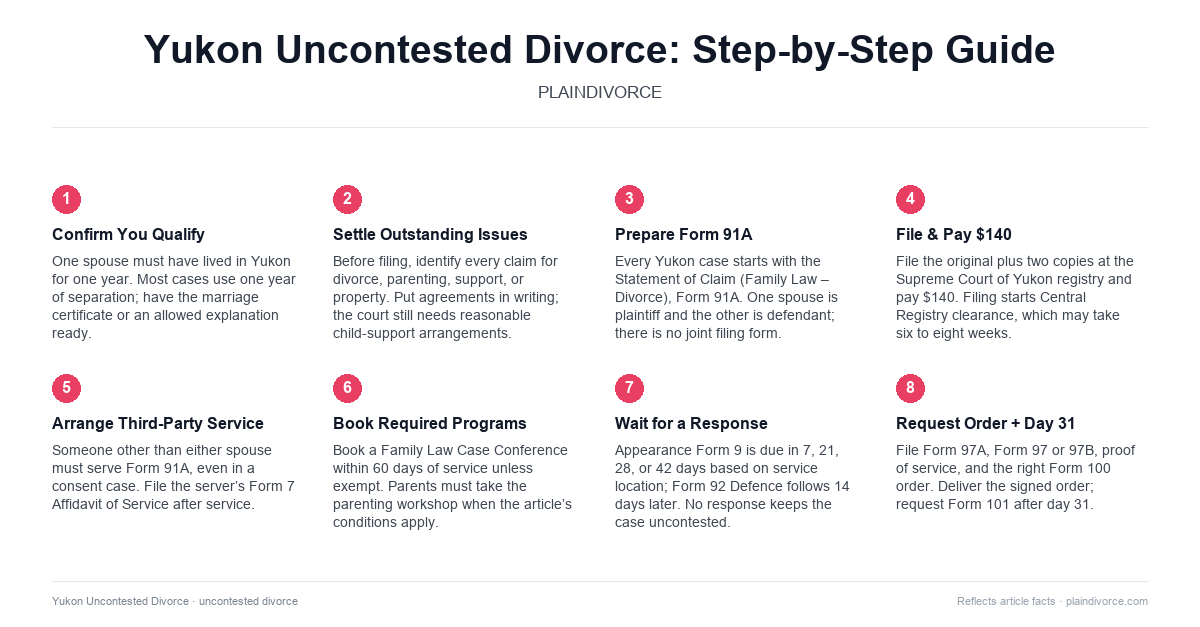
5. Step by step: the Yukon uncontested divorce process
This roadmap follows Rule 63 and the Yukon government’s own Applying for a Divorce self-help guide. Your exact steps vary with whether you have children and whether support or property is in issue.
- Confirm you qualify. Check the one-year Yukon residency rule and a ground for divorce (usually one-year separation). Locate your marriage certificate or registration; under Rule 63(18) it must be filed before the divorce pleading is issued unless the pleading states it is impossible to obtain, or that it will be filed before the application for the Divorce Order.
- Settle children, support, and property first (if you can). Form 91A asks you to identify every claim for relief you are seeking – divorce, parenting order, child support, spousal support, division of assets. Put any agreement in writing before you file.
- Prepare the Statement of Claim (Family Law – Divorce), Form 91A. This is the document that opens your case (Rule 63(8)(a)). It includes a summary of relief, particulars of both spouses, the marriage details, the grounds, and any parenting/support/property claims. Instructions are built into the form – don’t delete them, and don’t renumber paragraphs you remove.
- File with the Supreme Court of Yukon. File the original plus two copies of each document at the Court Registry in the Law Courts building, 2134 Second Avenue, Whitehorse, and pay the $140 filing fee. The clerk opens a file, assigns an S.C. number, and stamps your documents. Filing also starts the federal Central Registry of Divorce Proceedings clearance – and under Rule 63(37) a divorce cannot be pronounced until the court is satisfied no earlier divorce proceeding is pending anywhere in Canada. The self-help guide suggests allowing six to eight weeks for that confirmation, and following up yourself.
- Serve your spouse. Under Rule 63(25) the Statement of Claim must be served by someone other than you or your spouse, whether or not your spouse is on board. Options: the Sheriff’s Office (for a fee), a private process server, or – if your spouse is willing – service arranged through the Family Law Information Centre. The server completes an Affidavit of Service, Form 7, which must state how they identified the person served (Rule 63(26)); you then file it. The self-help guide suggests attaching the front page of each served document as an exhibit to Form 7.
- Book the Family Law Case Conference. Rule 63(13) requires it within 60 days of service unless a practice direction exempts your matter. Contact the Trial Coordinator to schedule it; from outside Whitehorse you can usually attend by phone or video. Missing this deadline can get your case adjourned or struck off the list.
- Take the parenting course, if it applies to you. If you are a parent and either spouse’s pleading claims custody, access, or child support, both parents must complete the For the Sake of the Children workshop – within six months of filing (for the spouse who started the case) or six months of service (for the spouse served). See section 6.
- Wait out the response period. The Statement of Claim sets the deadlines: an Appearance (Form 9) is due in 7 days if your spouse is served in Yukon, 21 days elsewhere in Canada, 28 days in the United States, or 42 days anywhere else; a Statement of Defence (Form 92) follows 14 days after that. If nothing is filed, the case proceeds as an uncontested divorce proceeding. If your spouse will sign, prepare documents for a Divorce Order on consent instead.
- Apply for judgment by requisition. Under Rule 63(31) you file: a Requisition for Divorce Order (Form 97A); a draft Divorce Order (Form 100 or Form 100B for an uncontested proceeding, Form 100A on consent); proof of service; and, where appropriate, an Affidavit for Divorce Order (Form 97 or 97B) confirming the action is uncontested, plus a Child Support Affidavit (Form 98) and any Form 59 affidavit. Because the evidence is on affidavit, the judge can grant the order “without the attendance of the lawyer or the applicant” – but the court can also ask for more evidence or require an appearance.
- Get the Divorce Order, deliver it, and request your Certificate. If the judge is satisfied, the court grants the Divorce Order. Under Rule 63(41), unless the court orders otherwise, you must then deliver a true copy to your spouse at their address for delivery, or mail it to their last known address by ordinary mail. The divorce takes effect on the 31st day after the order (Divorce Act, section 12); an earlier date is possible only where special circumstances apply and both spouses agree and undertake not to appeal, and a pending appeal delays it. Once it takes effect, file a Certificate of Divorce (Form 101) as your formal proof – often needed for remarriage or updating records.
6. If you have children: the parenting course, support, and disclosure
Even in an uncontested file, unclear child support or vague parenting details will slow you down – and one requirement is a hard bar on the divorce itself.
- Parenting course (mandatory, and broader than many guides say). Under Practice Direction FAMILY-2 (in force since March 18, 2025), the For the Sake of the Children workshop is mandatory for every parent who is a party to a divorce proceeding, or to any proceeding where custody, access, or child support is claimed – not only when you ask for a parenting order. It is offered online by the Family Law Information Centre in Whitehorse. Take it within six months of filing (the parent who starts the case) or within six months of being served (the parent served). The only exemptions: the parents have filed a written agreement settling all issues between them, or all the children are 16 or older. There is no distance exemption. File your Certificate of Completion once you have taken it.
- Child support is a precondition of the divorce. Under section 11(1)(b) of the Divorce Act, the judge must be satisfied that reasonable arrangements have been made for the support of the children of the marriage, having regard to the Federal Child Support Guidelines. If they are not satisfied, they must stay (pause) the divorce until proper arrangements are made.
- Agreeing on the number: Form 96. If you agree on the payor’s annual income and the support amount, you can file an Agreement as to Annual Income and Amount of Child Support (Form 96) instead of exchanging full financial statements (Rule 63A(10)). Form 96 still records the payor’s income, the Guideline table amount, the agreed monthly amount, and – if it differs from the table – the reasons; it needs both parties’ signatures; and it must have the payor’s most recent tax return and notice of assessment attached, or an affidavit explaining why they are not available and showing the agreed amount is reasonable. A below-table amount can still be revisited by the court.
- Financial disclosure: Rule 63A. A parent applying for child support completes a Financial Statement (Family Law – Simplified), Form 94A, with income documents; each parent the Guidelines require to give income information serves Form 94A too. A Financial Statement (Family Law – Detailed), Form 94, is required in specific situations – shared or split parenting, special or extraordinary expenses, undue hardship, a spousal or parental support claim, or a division of assets. When one party is entitled to the other’s disclosure, a Notice to File a Financial Statement, Form 95, goes out with the pleading, and the statements are due within 30 days (Canada or the US) or 60 days (elsewhere).
7. How long does an uncontested divorce take in Yukon?
There are usually four moving parts:
- One-year separation: for most uncontested divorces this is the longest stretch, and it has to be complete before the Divorce Order is granted.
- Central Registry confirmation: the self-help guide suggests allowing six to eight weeks after filing for the clearance that confirms no other divorce proceeding is pending on your marriage.
- Service, the response period, and the Family Law Case Conference: depends on how quickly you can arrange service and on the registry’s and Trial Coordinator’s schedules.
- The 31-day wait: the divorce normally takes effect on the 31st day after the Divorce Order, and that is when you can request the Certificate of Divorce.
According to the Yukon government’s self-help guide, an uncontested divorce where the other spouse is served promptly and paperwork is filed at each step without delay can become final in roughly four to six months (measured from filing, assuming the one-year separation is already met). Contested cases take considerably longer.
8. Supreme Court of Yukon divorce fees: what does it cost?
Court fees are set by Appendix C to the Rules of Court and can change by regulation, so confirm the current schedule with the registry (867-667-5937) before you budget. The amounts that matter for an uncontested divorce:
| Item | Fee |
|---|---|
| Filing the Statement of Claim – commencing the proceeding (Schedule 1, item 1) | $140 |
| Filing an application or requisition, such as the Requisition for Divorce Order (Schedule 1, item 6) | $30 |
| Sheriff’s service – receiving, filing, serving one person, returning proof (Schedule 2, item 1); plus $10 per extra party at the same address, $15 elsewhere, and mileage beyond 16 km | $50 |
| Certified copy of a court document (Schedule 1, item 18): up to 10 pages, then $3 per additional page | $15 |
| Filing the Certificate of Divorce (Form 101) | A fee applies; the schedule does not publish the amount – confirm with the registry |
| Filing a Statement of Defence with a counterclaim – only if the case stops being uncontested (Schedule 1, item 2) | $100 |
On top of court fees, budget for notarization (a notary public, lawyer, justice of the peace, or commissioner for oaths must witness your affidavits and any financial statement – the Family Law Information Centre can often do this at no charge), a private process server if you don’t use the Sheriff, and a certified marriage certificate from the province or territory where you married.
If cost is a barrier: under Appendix C, Schedule 1, S1, if the court finds on a summary application that a person is indigent, it may order that no fee is payable to commence, defend, or continue the proceeding. Ask the registry how to apply.
One realistic note: because Yukon requires third-party service on every Statement of Claim – even fully agreed divorces – you should budget for a service fee no matter how amicable the split is. The real saving comes from keeping the file clean so you avoid refiling.
9. When a DIY divorce might not be right for you
Handling your own uncontested divorce is usually a poor idea if there is family violence, coercion, threats, or stalking; you suspect hidden assets or income; you don’t understand your rights around property, pensions, or spousal support; there are serious disputes about the children or safety; or your situation involves immigration or complex cross-border issues.
A “cheap divorce” can become very expensive later if you sign an unfair agreement or give up a right you didn’t know you had. Even a single consultation with a Yukon family lawyer can help you understand the risks before you file.
Download our Yukon Uncontested Divorce Self-Help Kit
10. Where a self-help divorce kit fits into the process
Many self-represented spouses aren’t unsure about the decision to divorce – they’re unsure about the sequence: “What do I file first? What is Form 91A? Who serves it? When do I file the Affidavit for Divorce Order? What is a Requisition?” A Yukon-focused self-help kit helps by:
- explaining the real Yukon vocabulary – Form 91A, Affidavit for Divorce Order, Requisition for Divorce Order, Divorce Order (Form 100/100A/100B);
- walking through the uncontested pathway, including the Family Law Case Conference deadline and the FAMILY-2 parenting course that many DIY filers miss;
- giving you checklists so you don’t miss signatures, notarization, exhibits, service, the CRDP clearance, or the post-order delivery step; and
- keeping you organized – useful if you are outside Whitehorse and want fewer trips.
- Start the case: Statement of Claim (Family Law – Divorce), Form 91A
- File & fee: original plus two copies at the Supreme Court of Yukon registry + $140
- Serve your spouse: third-party service + file the Affidavit of Service (Form 7)
- Book it: Family Law Case Conference within 60 days of service
- Parenting course: For the Sake of the Children (if custody, access, or child support is claimed)
- Sworn evidence: Affidavit for Divorce Order (Form 97/97B), plus Form 98 if child support is in the order
- Ask for the decision: Requisition for Divorce Order (Form 97A) with a draft Divorce Order (Form 100/100A/100B)
- Final order: Divorce Order granted → deliver a copy to your spouse (Rule 63(41))
- After it takes effect: 31-day wait → file the Certificate of Divorce (Form 101)
PlainDivorce kits are designed for uncontested, self-represented cases. They are not legal advice, and you are still responsible for confirming the latest Yukon forms, fees, and requirements before filing.
11. Frequently asked questions
Is there a Joint Statement of Claim for divorce in Yukon?
No. Yukon’s only divorce-initiating pleading is the Statement of Claim (Family Law – Divorce), Form 91A, built around a plaintiff and a defendant. Yukon has no joint application that skips service the way Ontario’s does. Under Rule 63(25), a third party must serve the Statement of Claim in every case, contested or not – so even when both spouses agree, one is the plaintiff and someone other than the spouses does the serving.
Is there an “Affidavit of Applicant” form for a Yukon divorce?
No – that label doesn’t match any Supreme Court of Yukon form. The document you swear and file to confirm your case is uncontested is the Affidavit for Divorce Order, Form 97 (or Form 97B if you are seeking a divorce only). Download the current version from the court’s Rules and Forms page rather than relying on a form name from another province.
Where can I download Yukon divorce forms as a PDF?
All official Yukon Supreme Court divorce forms – Form 91A, Form 97/97A/97B, Form 100/100A/100B, Form 101, and the rest – are free to download in PDF and Word from the Supreme Court of Yukon’s “Rules and Forms” page on yukoncourts.ca. Use the current version each time; copies saved from an earlier case or a third-party site can be outdated.
How much are Supreme Court of Yukon divorce fees?
Appendix C to the Rules of Court sets $140 to file the Statement of Claim and $30 to file the Requisition for Divorce Order. Add about $50 for Sheriff’s service (plus mileage outside a 16 km radius), notarization, a certified marriage certificate, and $15 for a certified copy of a court document. The Certificate of Divorce has its own filing fee – confirm the amount with the registry. If the court finds you indigent, it can order that no fee is payable.
Do I have to go to court for an uncontested divorce in Yukon?
Usually not. Rule 63 lets uncontested and consent divorces be decided on sworn affidavits, and the court can grant the order “without the attendance of the lawyer or the applicant.” A hearing becomes likely only if the judge wants further evidence, or if the case stops being uncontested. A complete, consistent Requisition package is what keeps you on the paperwork track.
How long does it take to get a Divorce Order in Yukon?
If you rely on one-year separation, the order can’t be granted until that year is complete. From filing, the Yukon self-help guide says an uncontested case with prompt service and complete paperwork commonly takes another four to six months, including the Central Registry clearance. The divorce is then final on the 31st day after the Divorce Order.
Do I need a lawyer for an uncontested divorce in Yukon?
No, you can represent yourself. The Family Law Information Centre can help you complete Supreme Court forms, though staff cannot give legal advice or tell you what to write. Whether self-representation is wise depends on how comfortable you are with paperwork and deadlines, and on whether anything in your case is disputed, unsafe, or financially complex.
What is the difference between a Divorce Order and a Certificate of Divorce?
The Divorce Order (Form 100, 100A, or 100B) is the judge’s decision granting the divorce. It doesn’t take effect immediately – there is normally a 31-day wait first, and the court can set an earlier date only where special circumstances apply and both spouses agree not to appeal. The Certificate of Divorce (Form 101), requested after the order takes effect, is your official proof the marriage has ended, and is usually what you need to remarry.
What happens if my spouse doesn’t respond after being served?
If no Appearance, Statement of Defence, or Counterclaim is filed within the response period on the Statement of Claim, your case can proceed on an uncontested basis (Rule 63(9)). You then move to the Requisition for Divorce Order (Form 97A) and Affidavit for Divorce Order (Form 97/97B) stage, with a draft Divorce Order in Form 100 or Form 100B.
12. Final thoughts and next steps
When spouses can cooperate, an uncontested divorce in Yukon is usually decided on the paper file: a judge reviews sworn affidavits and grants the Divorce Order without a hearing. The “pro move” for DIY filers is using Yukon’s actual terminology – the Statement of Claim (Family Law – Divorce), Form 91A, served by a third party, then an Affidavit for Divorce Order and a Requisition for Divorce Order once the file is ready.
- Confirm the one-year Yukon residency rule and your ground for divorce (usually one-year separation).
- Agree (where safe) on children, support, and property and put it in writing.
- File Form 91A with the original plus two copies, arrange third-party service, and calendar the Family Law Case Conference within 60 days – and the parenting course if children are involved.
- Build a complete Requisition package (Form 97A, draft Divorce Order, Affidavit for Divorce Order, proof of service), then deliver the signed order to your spouse and wait out the 31 days before requesting the Certificate of Divorce.
Important disclaimer: PlainDivorce is not a law firm and does not give legal advice. This is general legal information only. Rule 63 of the Yukon Rules of Court, the official forms, and the court fees all change from time to time, and registry practice varies. Confirm the current requirements with the Supreme Court of Yukon registry in Whitehorse, or with a Yukon family lawyer, before you act.
Sources and local rules can change. Use this guide as a plain-English organizer, then verify the current filing requirements with the official court or government source for your jurisdiction.

About Harry D
Expert contributor at PlainDivorce, helping Canadians and American navigate simple uncontested divorces with clarity and confidence.