What is an uncontested divorce? An uncontested divorce is a divorce where the court has no real dispute to decide, because the spouses either agree on the terms or one spouse does not oppose the case. The terms usually cover parenting, child support, spousal support, property, and debt. It does not automatically mean the process is fast, cheap, paperwork-free, or emotionally easy, and it does not always require both spouses to sign.
TL;DR
An uncontested divorce is one where the court has no real dispute to decide — either the spouses agree on the terms, or one spouse simply doesn’t oppose the case. Most of what people believe about it is half right, so here’s what actually holds up.
- It does NOT always require both spouses to sign. There are three case types, not two: agreed (both sign), default (one files, the other is properly served and never responds), and contested. The first two are both uncontested in the court’s eyes.
- Uncontested ≠ amicable ≠ no-fault ≠ 50/50. Amicable is a tone. No-fault is the legal ground. A divorce can be friendly and still contested, or no-fault and bitterly fought. And “uncontested” says nothing about how property gets split — that follows local law.
- Agreement doesn’t override the court on children. Judges review parenting plans against the child’s best interests and check child support against the guidelines — even when both parents agree. You generally can’t waive or under-set support by private deal.
- It doesn’t always mean no hearing. Some courts decide on the paperwork (BC’s desk order divorce). Others require a short appearance — Florida’s simplified dissolution needs both spouses in person.
- “We agree” usually isn’t specific enough. Cases fall apart on the details: the holiday schedule, who keeps the retirement account, how support was calculated. A general understanding is not a plan a court will approve.
- A spouse who stops cooperating hasn’t necessarily made it contested. Missed deadlines and unreturned documents slow things down, but a validly served spouse who does nothing can often be defaulted.
- Cheaper, not free. Filing fees, service, notarization, parenting classes, and certified copies still add up — and the amounts vary widely by jurisdiction.
- The process is local. In Canada the Divorce Act is federal but the provinces run the procedure; in the U.S. it changes at every state line. This article explains the concept — your next step is your local guide.
1. What an Uncontested Divorce Means
An uncontested divorce is a divorce where the spouses are not asking the court to settle a real disagreement about the terms. The judge’s job is to check that the paperwork is complete and lawful and then grant the divorce — not to referee a fight over money, property, or the children.
That is the core idea. The label attached to it depends on where you live and how you file:
- Uncontested divorce — the general term used across most of the U.S. and Canada
- Joint application or joint petition — when both spouses file together (Ontario calls this a joint divorce; many U.S. states use joint petition)
- Desk order divorce — British Columbia’s term for a divorce a judge decides on the paperwork without a hearing
- Simplified dissolution of marriage — Florida’s name for one narrow, child-free version of the process
- Simple divorce or no contest divorce — informal phrases people use for the same idea; they are not statutory terms
The names vary. The test does not: is there still something the judge has to decide, or not?
2. Uncontested Is Not the Same as Amicable, No-Fault, or 50/50
People treat several related terms as interchangeable. They are not.
| Term | What it actually refers to |
| Uncontested divorce | There is no live dispute for the court to resolve — the terms are agreed, or the case is not opposed |
| Contested divorce | The spouses disagree on one or more issues the court must decide |
| No-fault divorce | The legal ground for the divorce does not require proving wrongdoing |
| Amicable divorce | A tone, not a legal status — the spouses are civil with each other |
| Simplified or summary process | A streamlined track some courts offer when a case meets tight eligibility rules |
A divorce can be amicable but still contested. It can be no-fault but still contested. It can be uncontested and still emotionally brutal. And “uncontested” does not mean everything is split down the middle — the division of property and debt follows your local law and the facts of your case, not an automatic 50/50 rule. That is why uncontested divorce explained properly means more than “we are getting along.”
3. The Three Types of Divorce Case: Agreed, Default, Contested
Most guides describe only two kinds of divorce — uncontested and contested — and define uncontested as “both spouses agree.” That misses a common situation. It is more accurate to think in three categories.
- Agreed or consent divorce. Both spouses sign the key documents — a settlement agreement, a consent form, or a joint application. This is the cleanest form of an uncontested divorce.
- Default or non-opposed divorce. One spouse files and properly notifies the other. The other spouse is validly served and simply does not respond within the deadline. The case proceeds without them. New York’s official court instructions, for example, list a default “by failing to answer the summons or summons and complaint” as one of the two routes to an uncontested divorce, alongside a signed consent.
- Contested divorce. The other spouse files a response that disputes something — the divorce itself, the parenting plan, support, or the property split — and now a judge has to decide it.
Categories 1 and 2 are both “uncontested” in the eyes of the court, because there is nothing for the judge to rule on. The practical difference is that a default still requires airtight proof that the other spouse was properly served, and some courts hold a brief hearing before signing.
4. Uncontested vs. Contested Divorce
This comparison shows why so many people look for an uncontested path. Treat it as a set of broad tendencies, not guarantees — your local court’s rules, waiting periods, and filing steps still control your case.
| Feature | Uncontested divorce | Contested divorce |
| Who decides the terms | The spouses, through their agreement (or the case is simply not opposed) | A judge decides the disputed issues |
| Conflict level | Usually lower | Usually higher |
| Timeline | Often shorter, but still subject to waiting periods | Often much longer |
| Cost | Often lower and more predictable | Often higher and harder to predict |
| Paperwork | Still substantial, but usually more straightforward | Usually heavier, with motions and disclosure fights |
| Privacy | More of the outcome sits in a private agreement | More conflict ends up in the public court record |
5. What No Live Dispute Actually Requires
For a case to stay uncontested, every issue the court needs resolved has to be either agreed in writing or genuinely not in dispute. These are the areas that matter.
5.1 The Divorce Itself
Someone has to ask the court to end the marriage. In a joint filing, both spouses ask together. In a sole filing, one spouse asks and the other either agrees or does not oppose it. You do not always need the other spouse’s active agreement to the divorce — in Canada, the Divorce Act allows a divorce application by either or both spouses — but you do need agreement, or non-opposition, on the terms.
5.2 Parenting Time and Decision-Making
If you have children, you generally need a clear plan for parenting time and decision-making responsibility — the current terms in Canada’s Divorce Act for what used to be called “custody” and “access,” and the concepts most U.S. states use as well. The plan should cover the regular schedule, holidays, communication, travel, and how major decisions get made. Even when parents agree, the court can review the plan against the child’s best interests and ask for changes before approving it.
5.3 Child Support
Courts routinely check child support even when both parents agree. Under Canada’s Divorce Act, a judge must be satisfied that reasonable child-support arrangements have been made in line with the applicable guidelines, and can pause the divorce until they are. U.S. states apply their own child-support guidelines the same way. Parents usually cannot simply waive or under-set support because a private deal suits them better.
5.4 Spousal Support
If one spouse will pay spousal support — or if both are giving up any claim to it — that has to be spelled out clearly in the paperwork, including the amount, the duration, and whether it can be changed later.
5.5 Property and Debt
You need a workable plan for the home, vehicles, bank accounts, pensions and retirement funds, personal property, and debts. In Canada, provincial and territorial property law applies here alongside the federal Divorce Act; in the U.S., state law controls. Agreeing does not mean an even split — it means there is no dispute for the judge to resolve.
If any of these areas is unresolved, vague, or actually disputed, the case may no longer be truly uncontested.
6. Who Files: Joint, Sole With Agreement, or Default
Many people assume an uncontested divorce means both spouses have to file together. That is not true. Whether a case is uncontested turns on whether there is a real dispute — not on who started it.
6.1 Joint Application
Both spouses start the case together as joint applicants. There is no “respondent,” so many courts do not require formal service — Ontario’s family court guide, for example, says a joint application needs no service on the other party. Depending on where you live, this is called a joint application, joint petition, or joint divorce.
6.2 One Spouse Files, the Other Agrees
One spouse starts the case and the other cooperates. That cooperation can look like:
- signing an acceptance, acknowledgment, or waiver of service
- signing a settlement agreement or a consent/affidavit form
- filing a response that does not dispute anything
- waiving steps the rules allow to be waived
This is still an uncontested divorce.
6.3 One Spouse Files, the Other Does Not Respond
One spouse files, serves the other correctly, and the other never answers within the deadline. The filing spouse can then move ahead by default. This is not a contested case — there is no dispute on the record. But the court will insist on complete paperwork and solid proof of proper service, and if service could not be completed the normal way, you may need a judge’s permission to use an alternative method. If the other spouse avoids service, that delays the process; it does not, by itself, create a legal dispute.
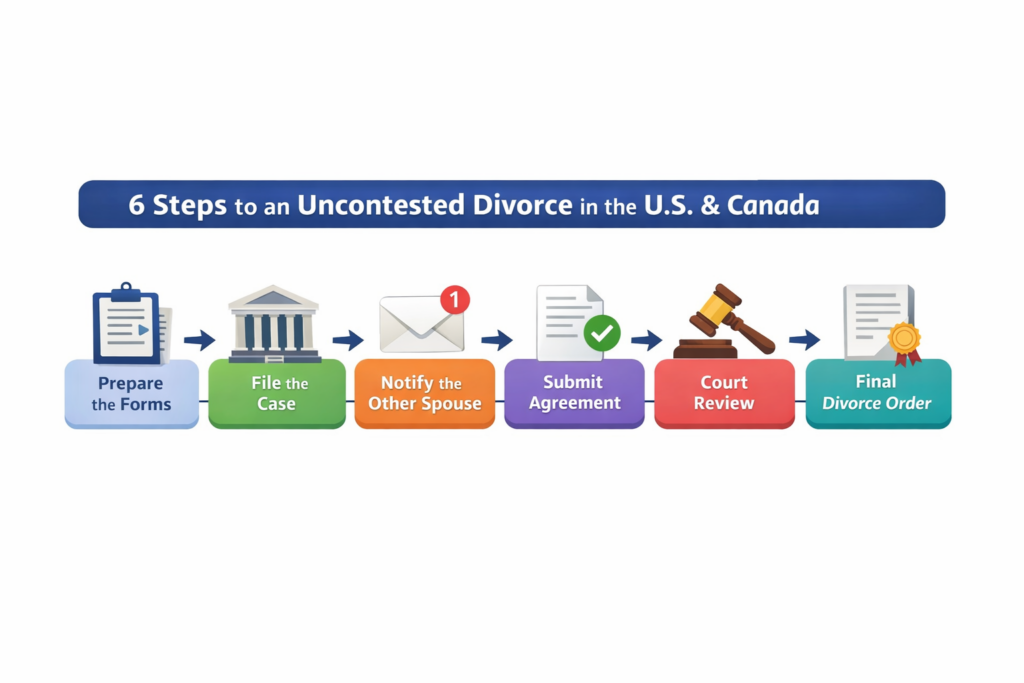
7. How an Uncontested Divorce Usually Works
The details differ by jurisdiction, but the path usually runs through six stages. Every one of them — the forms, whether service can be waived, which disclosures and worksheets are required, whether there is a hearing, and how long finality takes — is set by local rules and the facts of your case.
7.1 Prepare the Forms
One or both spouses complete the required divorce documents. Cases with children, support, or property usually need extra forms, such as a parenting plan, financial statements, and a support worksheet.
7.2 File the Case
You file in the correct court after meeting the local residency requirement and paying the filing fee (or getting a fee waiver).
7.3 Give the Other Spouse Legal Notice
In a sole filing, the other spouse must be formally served or must sign an acceptance or waiver of service. In a joint filing, many courts skip this step because there is no opposing party.
7.4 Submit the Agreement and Disclosures
Depending on the court, this can include a settlement agreement, a parenting plan, financial disclosures, support worksheets, and sworn statements or affidavits. In a default, the filing spouse submits proof of service and the supporting documents instead of a signed agreement.
7.5 Court Review
Some courts approve the divorce on the paperwork alone. Others require a short hearing, a review conference, or a final appearance — Florida’s simplified dissolution, for instance, requires both spouses to appear in person. The court also checks that any child-related terms meet legal standards.
7.6 Final Divorce Order
If everything is in order, the judge signs the divorce judgment, decree, or order. In many places a further waiting period runs before the divorce is fully final and you are legally free to remarry.
8. Five Reasons a Case Stops Being Uncontested
Plenty of couples start out sure their case is simple, then hit a real disagreement. These are the most common reasons that happens.
8.1 The Parenting Details Are Not Actually Settled
A couple may say they “agree on the kids,” but the specifics expose the gaps — where the children live, the holiday schedule, school and medical decisions, travel rules, and exchanges. A general understanding is not enough; courts want a clear, workable plan.
8.2 The Money Is Not Really Agreed
Many cases are friendly in tone but unresolved on finances: the house, retirement accounts, personal property, debts, buyouts, and who is responsible for what going forward. This is where people learn that “amicable” is not the same as “uncontested.”
8.3 Support Becomes a Problem
Child support and spousal support are frequent breaking points — the amount, how it was calculated, whether it is being waived, how long it lasts, and whether the deal is one a court will accept. Often the issue is not hostility; it is a lack of clarity.
8.4 One Spouse Stops Cooperating
A case can stall without an argument: a spouse will not sign the final papers, misses deadlines, says they agree but never returns documents, or changes their mind partway through. Noncooperation like this does not necessarily make the case contested — a spouse who is validly served and then does nothing can often be defaulted — but it does mean the process takes longer and the paperwork has to be exact.
8.5 New Information Comes Out
An uncontested divorce depends on informed agreement. If one spouse later discovers hidden debt, undisclosed income, an account that was never mentioned, or wrong property values — or realizes they were pressured — the agreement may no longer hold, and legal advice is important before going further.
9. Quick Checklist: Is Your Case Likely Uncontested?
Your case may be a good fit if:
- both spouses want the marriage to end, or one spouse wants it to end and the other will not oppose the case
- there is a clear written agreement on parenting, if there are children
- there is a clear agreement on child and spousal support, if any
- there is a clear agreement on property and debt
- both spouses are being honest about their finances
- neither spouse is using threats, pressure, or control
- both spouses are willing to follow the court’s rules and deadlines
Your case may not be truly uncontested if:
- one spouse keeps changing the deal
- there is fear, coercion, or intimidation
- financial information is incomplete or doubted
- there is a serious disagreement about the children
- the case involves a business, pension, or complex property
- one spouse does not understand what they are signing
A spouse who simply will not respond is a separate situation — that may still be resolved by default rather than as a contested case.
10. What Does an Uncontested Divorce Cost?
It varies widely by state, province, and territory, and a nationwide article cannot give you a reliable number. The total usually includes some mix of:
- the court filing fee
- a service fee, if formal service is required
- notarization, commissioning, or certified-copy fees
- a parenting-class fee, where one is required
- document-preparation or self-help kit costs
- legal-review fees, if one or both spouses get advice
An uncontested divorce is often less expensive than a contested one, because there is less conflict, fewer court appearances, and less lawyer time. But “lower cost” is not “free,” and the filing fee alone can be significant. For a real estimate, check your local court’s published fee schedule and your regional guide.
11. Does Uncontested Divorce Mean No Court Hearing?
Not always. Some uncontested divorces are granted entirely on the paperwork — British Columbia’s desk order divorce is designed that way. Others still require a short hearing or a final appearance, and a few require both spouses to attend. Even in a fully cooperative case, the court still has to confirm the paperwork is complete and that any child-related terms meet legal standards before it signs.
12. Is Uncontested Divorce the Same in the U.S. and Canada?
No. The concept is similar, but the process is not, and it is not even uniform within each country.
In Canada, the Divorce Act is federal, so the ground for divorce (marriage breakdown) and the core rules on child support and parenting are national. But the provinces and territories run the process — the forms, the filing steps, service requirements, timelines, court administration, and property division. Two provinces can handle the same uncontested divorce quite differently.
In the U.S., divorce is almost entirely a matter of state or territorial law and local court procedure. Residency rules, waiting periods, required forms, and whether a hearing is needed all change at the state line.
That is why a general article can explain the idea, but your next step should always be local.
Find your local guide
— uncontested divorce in Ontario
— uncontested divorce in Texas
— uncontested divorce in British Columbia
— uncontested divorce in New York
— uncontested divorce in Quebec
— uncontested divorce in Florida
13. When an Uncontested Divorce Is a Good Fit
An uncontested divorce is often a good fit when:
- both spouses want a lower-conflict process
- the major terms are already settled, or there is nothing genuinely in dispute
- both spouses can communicate enough to finish the paperwork — or one spouse is willing to let the case proceed unopposed
- each spouse understands the agreement before signing
- there are no serious safety or fairness concerns
14. When to Get Legal Help
A do-it-yourself divorce is not right for every case. Strongly consider legal advice if:
- there has been domestic violence or coercive control
- one spouse controls the money or the documents
- there are hidden assets or suspected dishonesty
- the case involves a business, a pension, or a significant retirement issue
- one spouse lives in another state, province, or country
- there is a serious disagreement about parenting
- you are not sure what rights you might be giving up
- the court keeps rejecting your paperwork
- you feel pressured to sign quickly
Even a single consultation can help you understand the risks before you file.
15. FAQ
15.1 What Is an Uncontested Divorce in Simple Terms?
It is a divorce with no live dispute for the judge to decide. Usually that means both spouses agree on the divorce and the terms — parenting, support, property, and debt. It also covers a case where one spouse files, serves the other correctly, and the other never responds, so the case proceeds by default. The judge’s role is to check the paperwork and grant the divorce, not to settle a fight.
15.2 Is a No-Fault Divorce the Same as an Uncontested Divorce?
No. No-fault describes the legal ground — you do not have to prove your spouse did something wrong. Uncontested describes whether the terms are disputed. A divorce can be no-fault and still heavily contested over money or children, and a fault-based divorce can still be uncontested if the spouses agree on everything.
15.3 Can One Spouse File and Still Have an Uncontested Divorce?
Yes. In most places one spouse can file and the other can cooperate by signing a settlement agreement, a consent form, or a waiver of service. In Canada, the Divorce Act allows a divorce application by either or both spouses. The case stays uncontested as long as the other spouse does not dispute the terms.
15.4 What Happens if My Spouse Ignores the Divorce Papers?
If your spouse was properly served and does not respond by the deadline, you can usually ask the court to proceed by default. That is still an uncontested divorce — there is no dispute on the record. You will need proof that service was done correctly, and some courts hold a brief hearing before signing. If your spouse is actively dodging service, you may need the court’s permission to serve them another way.
15.5 Does an Uncontested Divorce Mean Everything Is Split 50/50?
No. It means there is no dispute for the court to resolve. How property and debt are actually divided depends on your local law and the facts of your case. Some places start from an equal split of marital property; others divide it based on fairness factors. Your agreement can differ from the default as long as the court will accept it.
15.6 Can a Case Start Uncontested and Become Contested?
Yes. It usually happens when a real disagreement surfaces about children, support, property, or financial disclosure, or when one spouse files a response that disputes the terms. Noncooperation alone — missed deadlines, unreturned documents — does not always make a case contested; it may still be finished by default.
15.7 Is an Uncontested Divorce Always the Cheapest Option?
Usually, but not always. It is typically less expensive than a contested case because it uses less court and lawyer time. But you still pay the filing fee and any service, notarization, class, or legal-review costs, and those vary a lot by location. Check your local fee schedule for a real number.
15.8 Do I Have to Go to a Court Hearing?
It depends on where you file. Some courts grant an uncontested divorce entirely on the paperwork. Others require a short hearing or a final appearance, and a few — such as Florida’s simplified dissolution — require both spouses to appear in person. Your regional guide or the local court website will tell you which applies.
16. Bottom Line
If you have been asking what is uncontested divorce, the clearest answer is this: it is a divorce where the court has no real disagreement to decide, either because the spouses agree on the terms or because the case is not opposed. That can make the process simpler and more predictable, but it still demands honest disclosure, a clear agreement or a proper default, and correct paperwork filed in the right court.
If your case looks close to uncontested, the next step is to compare your situation with your local court’s requirements and forms. See your state or province guide to check eligibility and find the exact steps where you live.
Authoritative references: Divorce Act (Canada), Department of Justice Canada – how to apply for a divorce, Justice Canada – parenting arrangements under the Divorce Act, Justice Canada – provincial and territorial family law sites, and New York State Courts – uncontested divorce overview.
PlainDivorce provides self-help divorce information and document kits. It is not a law firm, and this article is not legal advice. For advice about your specific situation, consult a licensed family lawyer in your jurisdiction.
Sources and local rules can change. Use this guide as a plain-English organizer, then verify the current filing requirements with the official court or government source for your jurisdiction.

About Harry D
Expert contributor at PlainDivorce, helping Canadians and American navigate simple uncontested divorces with clarity and confidence.