In the choice of online divorce vs lawyer, the honest answer is that it depends on one thing: how much is actually in dispute. Use an online divorce service when the case is genuinely uncontested and the finances are simple. Use mediation when you are close to agreement but stuck on a few points. Use a lawyer — often just for advice or a review, not a courtroom fight — when there is conflict, missing financial information, a business, or real money at stake.
TL;DR
Pick the path by the risk in your case, not the price tag. The real question isn’t “what’s cheapest” — it’s whether you’re more likely to overpay for help you didn’t need, or sign a fast agreement that costs you far more later.
- Online divorce when the case is genuinely uncontested and the money is simple. Mediation when you’re close but stuck on a few terms. A lawyer when facts are disputed, information is missing, or real money is at stake — often just for advice or a review, not a courtroom fight.
- The mediator is not on your side. This is the most-misunderstood point in the whole comparison. A mediator is neutral — they help you reach a deal but don’t represent either spouse or tell you whether to accept an offer. If one spouse knows more or discloses less, mediation can still produce a signed agreement that works against you.
- A spouse who won’t sign doesn’t automatically kill the DIY option. Serve them correctly, and if they never answer, many courts finish the case by default.
- Online services have their own eligibility screen — often no minor children, no real estate — separate from and stricter than what your court allows.
- Discovery is a party’s right, not a lawyer-only tool — but doing it well is hard alone. Once the problem is non-disclosure, the choice stops being cheap vs. expensive and becomes guesswork vs. an enforceable process.
- Two traps that bite after the divorce is final: a quitclaim deed does not remove anyone from the mortgage, and a settlement clause alone doesn’t decide who claims a child on a U.S. return — that generally needs a signed IRS Form 8332.
- Hiring a lawyer isn’t declaring war. Limited-scope help — one consult, a document review, one issue handled right — keeps the process cooperative while protecting your side.
- Business owner or self-employed spouse? Don’t call the case financially simple until the income picture is genuinely understood. Revenue, salary, write-offs, and personal expenses blur fast.
- These aren’t rigid boxes. Many people mediate the terms, have a lawyer review the agreement, then file with self-help forms.
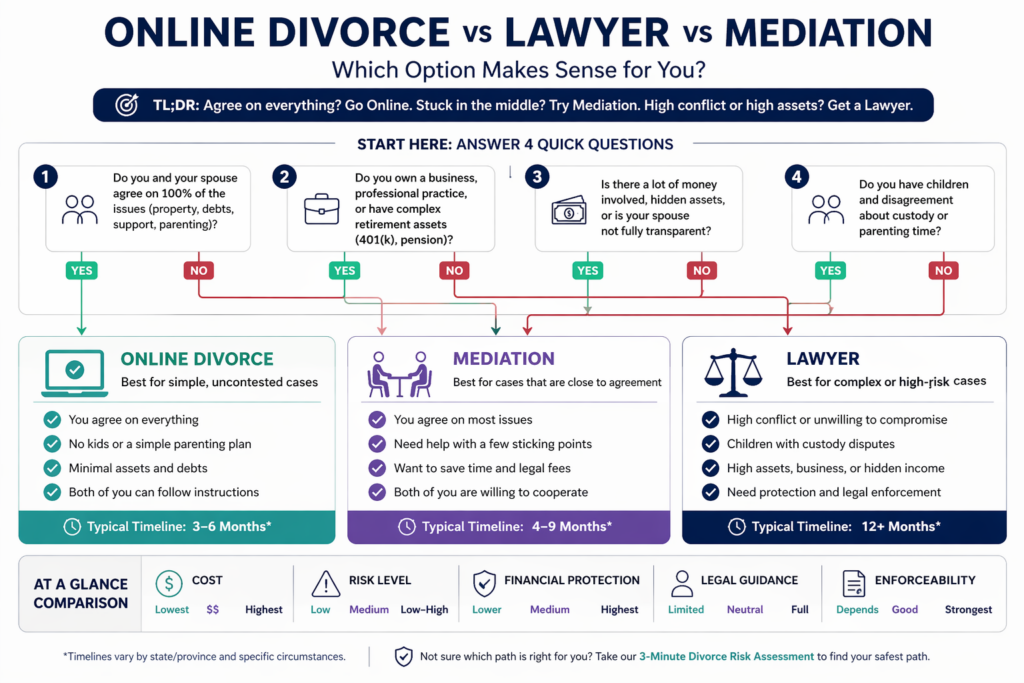
1. Online Divorce vs Lawyer vs Mediation: The Short Answer
All three options end a marriage. They differ in how much a professional does for you, how much protection you get, and how much it costs.
- Online divorce (DIY). A document-preparation service, or a court self-help packet, that helps you complete and file the forms. It does not give legal advice or review whether your deal is fair. Best when the case is genuinely uncontested and the money is simple.
- Mediation. A neutral third party helps both spouses work through open issues and reach an agreement. The mediator does not represent either person or decide what is fair. Best when you are close to agreement and both can negotiate openly.
- Lawyer. An advocate for your side who can advise you, review or draft the settlement, negotiate, and go to court if needed. You can hire one for the whole case or just for a consult or a document review. Best when the facts are disputed, information is missing, or the financial stakes are high.
These are not rigid boxes. Many people combine them — for example, using mediation to negotiate and a lawyer to review the final agreement before signing, then an online service or self-help forms to file. New to the topic? Start with what is an uncontested divorce and uncontested vs contested divorce.
2. Decision Guide: Which Path Fits Your Case?
Work through these questions in order. This is a practical guide, not legal advice, and it does not decide your eligibility — your court and any online provider set that.
Step 1: Do you already agree on the important terms?
Property, debt, support, parenting, and who signs what.
Yes → go to Step 2. No → go to Step 3.Step 2: Is the case financially simple?
No business or self-employment income, no dispute over the house, no complex retirement division, no support fight, nothing hidden.
Yes → an online divorce or self-help filing is a realistic option. No → get legal advice before you file, even if you plan to do the paperwork yourself.Step 3: Are both of you sharing full financial information and negotiating honestly?
Yes → go to Step 4. No → strongly consider a lawyer; missing or dishonest disclosure is hard to fix without one.Step 4: Are you stuck on terms but still trying to settle cooperatively?
Yes → mediation can help you finish the deal. No → the case is contested; consider a lawyer for at least part of it.
Business-owner note: if either spouse owns a business, is self-employed, or controls cash-heavy income, do not treat the case as financially simple until the income and asset picture is fully understood. That usually means at least one legal or financial consult.
Not sure whether your case qualifies as uncontested at all? Read uncontested divorce eligibility next.
3. Quick Comparison Table
This is a practical comparison, not legal advice. No option guarantees a particular cost, timeline, or outcome — those depend on your facts and on your local court’s rules, waiting periods, and calendar.
| Option | Best for | Main upside | Main downside | Typical bottom line |
|---|---|---|---|---|
| Online divorce / DIY | Fully uncontested, lower-complexity cases | Lower upfront cost and more control over the process | No advice, no fairness check; costly omissions if the case is not truly simple | Choose this only when the agreement is already complete or the case is genuinely not opposed |
| Mediation | Couples close to agreement who need help finishing the deal | Can lower conflict and resolve the last few open issues | Can stall, or produce a weak deal, if one person has more information or leverage | Choose this when you need help making decisions, not help forcing disclosure |
| Lawyer | Disputed, high-risk, or financially complex cases | Advice, protection, negotiation, and enforcement tools on your side | Higher upfront cost; full representation is a bigger commitment | Choose this when the facts are unclear, the stakes are high, or you just need one issue handled right |
4. The Real Question Is Risk, Not Price
Most people searching online divorce vs lawyer are not really asking which option is cheapest. They are weighing two different mistakes:
- paying more than you hoped for professional help, or
- signing a fast, cheap agreement that costs you far more later
That is the real comparison. A low-cost divorce process is a smart choice when the case is truly uncontested and financially simple. But if the agreement is vague, the disclosures are incomplete, or the follow-through is more complicated than it looks — a retirement account to divide, a house to refinance, support to calculate — the cheap path can quietly become the expensive one. The goal is to match the level of help to the level of risk.
5. How Complex Is Your Case? A Screening Checklist
This is an editorial checklist, not a legal test and not a score. It just helps you notice when a “simple” divorce may not be simple. The more items that apply, the more it is worth getting advice before you commit to a DIY or mediation path.
- You have children under 18 (or dependent adult children where your law treats them as such).
- You own a home together, or one of you will keep it.
- One of you has a pension, 401(k)-type account, or other retirement plan to divide.
- One of you owns a business or is self-employed.
- One of you earns significantly more than the other.
- You disagree about child support or spousal support.
- You disagree about parenting time or decision-making.
- One spouse has handled all the money and records.
- You suspect hidden income, debt, or assets.
- One of you feels pressured, rushed, or afraid to push back.
None of these makes an online divorce or mediation impossible. Parents, homeowners, and people with retirement accounts complete uncontested divorces all the time. They are prompts to slow down and get a professional opinion — not disqualifiers.
6. When Online Divorce Is a Realistic Fit
An online divorce works best for an uncontested case. To a court, “uncontested” can mean one of two things:
- An agreed or consent case. Both spouses sign the key documents — a settlement agreement plus a consent form, a joint petition, or a joint application — and the terms cover property, debt, support, and parenting.
- A default or non-opposed case. One spouse files and serves the other correctly, and the other never responds. New York’s court guidance describes an uncontested divorce as one where the defendant either signs a document agreeing to the divorce or “defaults by failing to answer the summons or summons and complaint” within the response deadline. California runs a “default” process, and a separate “default with agreement” process, for this exact situation.
So a spouse who will not sign does not automatically end your online or DIY option — if service is done validly and they do not answer, many courts let the case finish by default. What genuinely warrants legal help is getting service right, meeting every deadline, and safety planning if that is a concern.
An online divorce is a realistic fit when:
- you agree on property, debt, support, and parenting terms — or there is genuinely nothing in dispute
- both spouses understand the agreement and no one feels pressured
- the finances are straightforward and no one is hiding information
- you can follow your local court’s filing instructions carefully
Keep in mind that an online divorce service also applies its own eligibility screen — often no minor children, no real estate, or a completed agreement — and that screen is separate from what your court allows.
What an Online Divorce Service Will Not Do for You
In a DIY case, you are generally responsible for:
- gathering records and completing the court forms and any required financial disclosure
- preparing the written settlement agreement, where your jurisdiction uses one
- filing the case and handling service of process, proof of service, or a waiver where allowed
- responding to notices from the court or clerk
- waiting for the final judgment — the name varies by place (decree of dissolution, judgment of divorce, divorce order, or another local term)
The bigger risk is usually not the form itself. It is choosing a no-advice process for a case that carries hidden friction:
- a retirement division that may need a separate qualifying order (a QDRO in many U.S. plans)
- a house transfer that needs title work, lender follow-up, or a deed — and a reminder that a deed does not remove anyone from the mortgage
- incomplete financial disclosure, vague parenting terms, or unclear debt responsibility
- support terms that do not track your local child-support guidelines
- tax consequences that never made it into the agreement
- local standing orders or filing rules you did not know existed
Warning: if your case includes a house, a retirement account, a support dispute, or business income, DIY can stop being simple fast. The paperwork may look easy while the financial consequences are not.
7. Divorce Mediation vs Lawyer: When Mediation Helps
Mediation is the middle path. It helps couples who are not fully agreed yet but still want to settle without a court fight. A mediator is a neutral third party whose job is to help both people work through the open issues and reach an agreement. Mediation does not replace independent legal advice, and in many places the mediator must say so directly.
Mediation can help with parenting schedules, support discussions, the house, debt allocation, and turning a partial agreement into a final written settlement. Choose it when:
- you are mostly aligned but stuck on a few terms
- both spouses can participate honestly and speak freely
- both are sharing the full financial picture
- you want help reaching agreement without escalating conflict
Mediation is not right for every case. If you cannot safely speak freely — because of fear, control, or a history of abuse — a mediation table is not the place to sort that out. Seek local legal help or a domestic-violence resource instead.
What a Mediator Is Not There to Do
Many people assume the mediator is there to make sure the deal is fair. That is not the role. A mediator is neutral: they help both of you reach an agreement, but they do not give legal advice, do not represent either spouse, and generally cannot tell you what to do or whether to accept an offer. Indiana’s mediation rule, for example, requires the mediator to tell the parties they are “not providing legal advice” and do “not represent either party,” and to recommend that each person consult their own counsel if they want legal advice.
The neutrality point: a mediator can help you reach a deal. A mediator is not your advocate. If one spouse knows more, controls more, or discloses less, mediation can still produce a signed agreement that works against you. That is why many people mediate the terms and then have a lawyer review the agreement before signing.
Mediation may be a poor fit when one spouse is intimidated by the other, one person controls the money or records, one side uses delay as a tactic, or the case turns on technical financial or legal questions that need direct advice. Screening, disclosure duties, and whether a mediated agreement is binding all vary by jurisdiction and by case.
8. DIY Divorce vs Attorney: When to Get a Lawyer
In the DIY divorce vs attorney decision, a lawyer is often the safer choice when the facts are disputed, information is missing, or a badly drafted agreement could create long-term problems. A lawyer can give advice based on your jurisdiction, review disclosure and support issues, spot weak or missing settlement terms, draft or review the agreement, negotiate, and represent you if the case goes to court.
Strongly consider a lawyer when:
- your spouse has a lawyer and you do not
- you do not trust the financial disclosure, or records are missing
- there is a house, pension, business, or large debt to deal with
- parenting terms or support are seriously disputed
- you feel pressured or unsafe
- the proposed deal seems unfair and you cannot explain why
Legal help costs more upfront, but that cost buys something a website and a mediator do not: direct advocacy for your legal and financial position. You are paying for judgment and leverage, not just forms.
Limited-Scope Help: A Middle Option
Hiring a lawyer does not have to mean full representation. In many places you can pay for a defined piece of work — often called limited-scope or unbundled representation:
- a single consultation to understand your rights and options
- a review of a settlement your spouse or a mediator drafted
- help with one major issue, such as the retirement division or the parenting plan
- local advice before you file DIY paperwork
Many courts also run a self-help centre or family-law information service, which is a good first stop for understanding the process — alongside, not instead of, individual advice.
What About Collaborative Divorce?
Collaborative divorce is a lawyer-assisted path that sits between private settlement and litigation. Each spouse has their own collaboratively trained lawyer, and everyone signs an agreement to work toward settlement without going to court. Its defining feature is the disqualification rule: if the case moves to contested litigation, the collaborative lawyers must withdraw and each spouse hires new counsel — so no one in the room benefits from the process breaking down.
Collaborative practice is recognized by statute in many U.S. states (a number have adopted the Uniform Collaborative Law Act) and by local practice elsewhere, and the details differ by jurisdiction. It can work well when both spouses want structured negotiation with legal advice on each side and want to avoid a courtroom if possible. It is not the same as mediation, because each spouse keeps their own advocate.
9. Hidden Costs: Money, Delay, and Long-Term Impact
The cheapest path is not always the lowest-cost outcome. Watch for these in each option:
| Path | Lower upfront cost? | Hidden costs to watch for | Long-term financial risk | Time cost to watch for |
|---|---|---|---|---|
| Online divorce / DIY | Usually yes | Refiling after an administrative rejection, incomplete disclosure, vague settlement terms, missed real-estate or retirement follow-up | Higher risk of leaving value on the table if equity, support, or retirement terms are incomplete or poorly drafted | Delay from correcting filing problems, redoing service, or supplying a missing local document |
| Mediation | Often lower than full litigation | Paying for sessions without enough disclosure; reaching a deal that still needs legal cleanup | Moderate to high if one spouse negotiates from a stronger information or money position | Delay if talks stall or issues keep reopening |
| Lawyer | Usually no | Higher fees; a more formal process | Higher upfront cost, but usually better protection of long-term interests | Longer in heavily contested cases — though sometimes faster than fixing a bad DIY agreement afterward |
10. Where Amicable DIY Cases Get Stuck
Some self-filed cases lose time to back-and-forth over the paperwork. Common causes:
- missing signatures or incomplete financial disclosure
- service or proof-of-service problems
- a local standing order or required form the filer did not know about
- parenting terms that are too vague to approve
- a settlement agreement whose language does not match the court forms
How the delay tends to happen: you file, thinking the packet is complete. A court or clerk’s office identifies an administrative problem under local procedure — a service issue, a missing disclosure, or a local form requirement. You fix it and resubmit. Sometimes a second issue surfaces, such as agreement language that does not line up with the forms. Each round can add waiting time, even though the divorce itself is not contested.
The gatekeeper problem: whether your divorce is friendly is not the point. The filing package still has to meet that court’s exact requirements. Missing details, wrong formatting, or an incomplete supporting document can hold the case up under local rules.
Checking your local rules early — with a guide such as uncontested divorce in California, Texas, or Ontario — heads off most of this.
11. When Disclosure Breaks Down
This is often the point where people move from DIY or mediation to a lawyer. If your spouse is not being honest about money, a self-help website cannot compel disclosure, and a mediator cannot either.
Formal discovery is a party’s procedural right, not a lawyer-only tool. Court rules generally let a party — represented or self-represented — use methods that may include:
- interrogatories (written questions answered under oath)
- requests for production of documents
- subpoenas for bank or financial records, where allowed
- depositions
- a motion to compel when the other side does not comply
These are examples; the exact tools, deadlines, and enforcement steps are governed by the rules where you file. In practice, doing discovery well — framing the requests, meeting deadlines, and bringing the right motion when someone stonewalls — is hard without a lawyer, which is why concerns about hidden accounts, side income, crypto, business revenue, cash work, or debt that appeared out of nowhere usually push a case toward representation.
Warning: if you suspect hidden money, do not assume more conversation will fix it. Once the problem is non-disclosure, the choice is no longer cheap versus expensive — it is guesswork versus an enforceable process.
12. Financial Math People Miss in Divorce
Divorce is a money decision as well as a legal one. Depending on where you live, the following can all matter, and each is governed by your jurisdiction’s rules:
- how local child-support guidelines apply to your numbers
- whether one spouse can argue the other is voluntarily underemployed and ask for imputed income
- whether unpaid support can build into arrears
- how a court may weigh the marital standard of living in a support discussion
- who keeps the house, and whether the other spouse is removed from title and from the mortgage
- how retirement assets are divided, and whether a QDRO or similar order is needed
- whether your jurisdiction uses community property or equitable distribution
- whether a debt assigned to one spouse in the divorce is still legally owed by both to the lender
On that last point: a divorce order allocates responsibility between the spouses, but whether a lender can still pursue a co-borrower is governed by the loan contract and applicable law. If your name is on a joint debt, talk to the lender and a local lawyer about refinancing or a release — do not assume the divorce alone protects you.
Business-owner warning: if your spouse owns a business and you do not, do not assume you understand the real income. Revenue, salary, write-offs, retained earnings, and personal expenses blur together quickly. That is one reason business-owner divorces move out of DIY territory fast.
13. The Post-Divorce Tax Trap
One of the easiest things to miss is a settlement that looks complete but leaves out tax details.
Take the child-related tax benefit. A clause in a settlement agreement does not, by itself, decide who may claim a child for U.S. federal tax purposes. For decrees and agreements executed after 2008, the custodial parent generally must sign IRS Form 8332 (or a substantially similar statement) that releases the claim without conditions; a divorce decree cannot be substituted. A state court’s allocation and federal tax eligibility are two different questions. If your agreement is silent or vague, both parents may try to claim the same child and trigger a filing conflict after the divorce is final.
Similar gaps show up around the sale or transfer of the house, who is responsible for particular joint debts, support-related tax assumptions, and filing status — which the IRS bases on your marital status on the last day of the year. This is one reason “amicable” does not always mean “low risk.”
For federal background, the IRS explains filing-status basics, including Head of Household, and the U.S. Department of Labor explains why retirement-plan procedures matter when an account is divided — the plan administrator, not the divorce court, decides whether an order qualifies as a QDRO, and the order can be part of the decree or a separate document. Filing-status, dependency, support, and property-tax outcomes all depend on your facts and on current federal and state law, so confirm your situation with a tax professional or lawyer.
- IRS filing-status guidance
- IRS Publication 504, Divorced or Separated Individuals
- U.S. Department of Labor QDRO guidance
- Find legal help through a state bar or legal-aid resource
14. Red Flags: Pause and Get Legal Help
Pause and get individual legal advice before signing or filing if:
- your spouse controls the finances and you do not have full records
- you are being rushed to sign, or you feel scared to ask questions
- there is a house, business, pension, or major debt to deal with
- the parenting plan is still vague, or one spouse says “we can deal with that later”
- you do not understand the long-term effect of the agreement
- your spouse refuses full disclosure, or is cooperative in tone but evasive in substance
- one spouse has moved, or may move, raising a jurisdiction or choice-of-law question
A case can sound friendly and still be risky. None of these means you must litigate — often a single consultation is enough to tell you whether a simpler path is safe.
15. A Simple Decision Framework
Consider online divorce if…
You truly agree on all major terms (or the case is not opposed after valid service), the finances are relatively simple, both spouses are transparent, and no one needs a court to resolve a dispute.
Consider mediation if…
You are close to agreement, need help with communication or a few specific terms, and both people can negotiate in good faith and speak freely.
Consider a lawyer if…
There is a real disagreement, you do not trust the disclosures, the settlement feels one-sided, there are significant assets or support issues, or you need advice rather than document help — even if that is just one consult.
Think your case is a fit for a simpler process?
Start with what is an uncontested divorce and uncontested divorce eligibility, then check your local rules with a PlainDivorce kit for Texas, California, New York, or Ontario.
16. FAQ: Online Divorce vs Lawyer vs Mediation
Is online divorce or a lawyer better for an uncontested case?
If the case is genuinely uncontested and the finances are simple, an online divorce or a court self-help filing is often enough, and cheaper. A lawyer is worth it — even just for one consultation or a document review — when there are children, support to calculate, retirement or a business to divide, or any doubt about what the agreement gives up. The deciding factor is the risk in your facts, not the label.
Will hiring a lawyer make my spouse think I want a fight?
Not necessarily. Many people hire a lawyer for protection, not escalation — to understand their rights, review a settlement, or handle one difficult issue without turning the case into a courtroom battle. Limited-scope help lets you get advice while still keeping the process cooperative.
If we agree on everything, why would I need legal review?
Because agreeing is not the same as covering everything. Friendly couples still miss retirement-division steps, tax language, joint-debt exposure, and local filing requirements. A one-time review checks that the deal you both want is actually complete and enforceable where you live.
In divorce mediation vs a lawyer, who protects my interests?
In mediation, the mediator is neutral: they help both of you reach a deal but do not represent either spouse or give legal advice. If you want someone whose job is to protect your side, that is a lawyer. A common approach is to mediate the terms and then have your own lawyer review the agreement before you sign.
What is the clearest sign a DIY divorce is not the right fit?
Missing transparency. If you do not have full financial information, or you do not fully understand the agreement, DIY is no longer just a paperwork choice — it is a decision to proceed without knowing what you are giving up. Pressure, fear, or a refusal to disclose are the same kind of signal.
Can I use an online divorce if my spouse will not sign?
Sometimes. A spouse who will not sign does not automatically end the option. If you file, serve them correctly, and they do not respond by the deadline, many courts let the case finish by default. That path requires exact paperwork and adds time, and an online service may not support it, so check both your court’s rules and the provider’s.
What if I only need help with one issue?
That is common, and you may not need full representation. A limited-scope consultation, a document review, or help with one piece — the parenting plan, the retirement order, the support calculation — can reduce the risk without the cost of a lawyer running the whole case.
17. Bottom Line
The best path in the online divorce vs lawyer decision is not the one with the lowest upfront price. It is the one that matches the real level of risk in your case.
Choose an online divorce when the agreement is already complete, or the case is genuinely not opposed, and the finances are simple. Choose mediation when both of you are transparent and close to settlement. Choose a lawyer — full or limited-scope — when the facts are disputed, the money is unclear, the parenting issues are serious, or the process has become uneven. If you are unsure, do not ask whether the process looks easy. Ask whether the facts are complete, the agreement is clear, and the risk is actually low.
Helpful next reads: what is an uncontested divorce, uncontested divorce eligibility, and uncontested vs contested divorce.
PlainDivorce provides self-help divorce information and document kits. It is not a law firm, and this article is not legal advice. Divorce law and procedure vary by state, province, and territory and change over time. For advice about your specific situation, consult a licensed family lawyer in your jurisdiction.
Sources and local rules can change. Use this guide as a plain-English organizer, then verify the current filing requirements with the official court or government source for your jurisdiction.

About Harry D
Expert contributor at PlainDivorce, helping Canadians and American navigate simple uncontested divorces with clarity and confidence.