The difference between uncontested vs contested divorce is simple to state: in an uncontested divorce there is no live dispute for a judge to decide, while in a contested divorce the spouses disagree on one or more issues and the court has to resolve them. An uncontested case can be reached two ways — the spouses agree on the terms, or one spouse files, serves the other correctly, and the other does not oppose the case. Everything else — how much it costs, how long it takes, how much paperwork is involved — follows from how many issues are actually in dispute and from the rules where you file.
New to the topic? Start with what is an uncontested divorce for the basics, then use this guide to compare both paths in detail.
TL;DR
The whole distinction turns on one question: is there a live dispute on the record for a judge to decide? Everything people compare — cost, speed, paperwork, stress — follows from the number of unresolved issues, not from which label you pick.
- Uncontested doesn’t require both signatures. There are three case postures, not two: agreed (both sign), default (served spouse never answers), and contested. The first two are both uncontested to the court.
- A silent spouse is not a contested case. Avoiding paperwork isn’t a legal dispute — it usually means finishing by default, which needs airtight proof of service and sometimes a short hearing. What makes a case contested is a filed response disputing something.
- Cost tracks the disagreement, not the label. The useful framing: are you paying to document an agreement or to resolve a disagreement? Uncontested skips discovery, motion practice, experts, and trial prep — but it’s never free.
- “Faster” has a floor. Even a fully agreed case is bound by any mandatory waiting period, required disclosures, and your court’s backlog. Simple can still take months.
- Uncontested doesn’t mean light paperwork. You still file a petition, response or joint-filing documents, settlement terms, disclosures where required, parenting documents, and a final judgment.
- With children, the court reviews independently — parenting terms against the child’s best interests, support against the guidelines. Agreement is a starting point, not the finish line.
- The category isn’t fixed on day one. Many cases start contested and settle after disclosure or mediation. Whether the court then calls it uncontested, consent, stipulated, or default is a local question.
- An uncontested path can’t fix dishonesty, hidden assets, intimidation, a serious parenting dispute, or genuine legal complexity. Those need a different approach — forcing the simpler process doesn’t make the problem simpler.
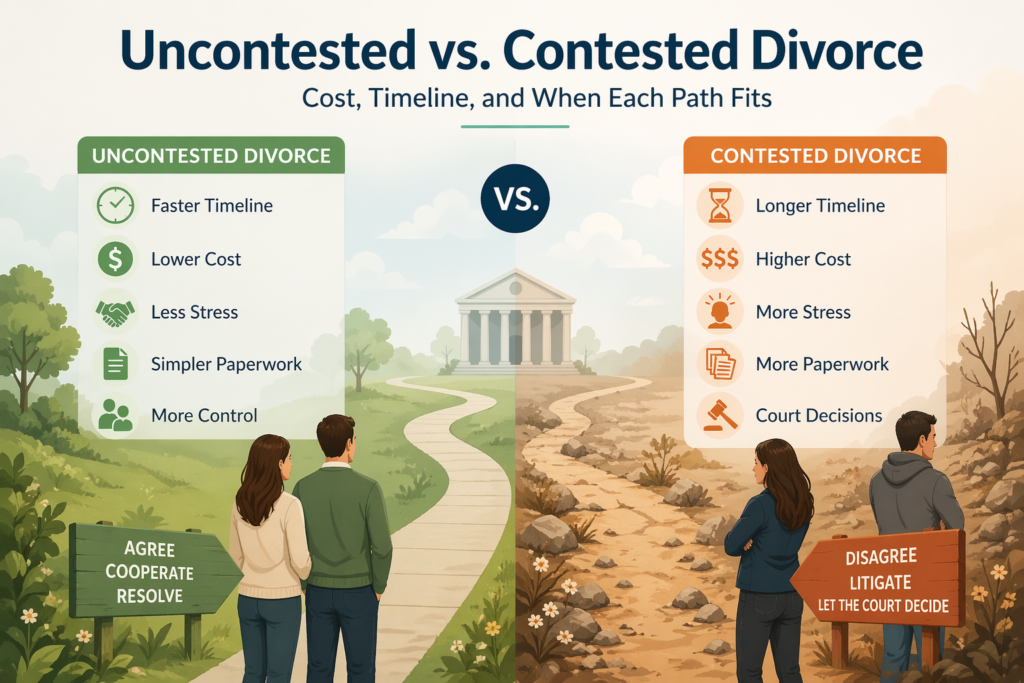
1. The Short Answer: Uncontested vs Contested Divorce
An uncontested divorce is one where the court has no real disagreement to settle. The judge’s job is to confirm the paperwork is complete and lawful and then grant the divorce — not to referee a fight over money, property, or the children. A contested divorce is one where at least one issue is genuinely disputed, so a judge (or the settlement process leading up to one) has to decide it.
The key point that many explanations get wrong: “uncontested” does not always mean both spouses sit down and sign everything together. It means nothing is left for the court to rule on. That can happen because the spouses agree, or because one spouse files, serves the other correctly, and the other never responds. Both are treated as uncontested or undefended cases.
So the difference between uncontested and contested divorce is not really about the label you pick. It is about one question: is there a live dispute on the record, or not? Everything downstream — cost, timeline, paperwork, hearings, and how much legal help you need — tends to track the number of unresolved issues, and the exact rules still change from one state or province to the next.
2. Three Case Postures: Agreed, Default, and Contested
It helps to think in three categories rather than two. The first two are both “uncontested” to the court.
- Agreed or consent case. Both spouses sign the key documents — a settlement agreement, a consent or affidavit form, or a joint application or joint petition. This is the cleanest form of an uncontested divorce, and the terms usually cover parenting, child support, spousal support, property, and debt.
- Default or undefended case. One spouse files and serves the other correctly. The served spouse does not answer within the deadline, so the case moves ahead without them. New York’s court guidance describes an uncontested divorce as one where the defendant either signs a document agreeing to the divorce or “defaults by failing to answer the summons or summons and complaint.” California’s self-help site runs a “default” process for exactly this situation, and Ontario schedules an “uncontested trial” when a served respondent files no Answer.
- Contested case. One spouse files a response that disputes something — the grounds, the court’s jurisdiction, parenting, support, property, or debt — and now there is a live issue for a judge to resolve, either at a hearing or through the settlement process on the way there.
Two practical notes. First, the labels are local. California alone distinguishes a “default,” a “default with agreement,” and an “uncontested” case (where a response was filed and the parties then settled), so check the terminology your own court uses. Second, a spouse who simply goes quiet after being served does not make the case contested. Avoiding paperwork is not a legal dispute; it usually just means the case is finished by default, which requires airtight proof that service was done correctly and sometimes a short hearing.
In Canada, the federal Divorce Act allows a divorce proceeding to be brought by either or both spouses, and marriage breakdown is shown by one year of separation, adultery, or cruelty. One spouse can seek the divorce even if the other would rather stay married; what the other spouse can genuinely dispute is the grounds, the jurisdiction, or the relief. Want to check whether your own situation is likely to qualify? See uncontested divorce eligibility.
3. The Difference Between Uncontested and Contested Divorce at a Glance
The comparison below shows general tendencies, not guarantees. How your case actually plays out depends on the facts and on your local court’s rules.
| Issue | Uncontested / undefended divorce | Contested divorce |
|---|---|---|
| Live dispute for the court | None on the record — spouses agree, or the case is not opposed | One or more issues the judge must resolve |
| Typical cost | Usually lower, because there is less court and lawyer time | Usually higher, and rises with each disputed issue |
| Typical timeline | Usually shorter, but still subject to waiting periods and court backlog | Usually longer, sometimes by many months |
| Paperwork | Still required; often a more streamlined set | The base filings plus motions, disclosures, and hearing materials |
| Court hearings | Sometimes none, sometimes one short appearance — depends on local rules | More likely, and possibly several |
| Stress level | Often lower, though not always emotionally easy | Often higher, with more deadlines and uncertainty |
| Need for a lawyer | Sometimes optional for a simple case; advice can still help | More likely to need a lawyer, at least for part of the case |
| Best fit for | Cooperative or non-opposed, lower-complexity cases | High-conflict cases, or cases with real legal or financial complexity |
4. Cost: Which One Is Usually Cheaper?
In the contested or uncontested divorce decision, cost is usually the first thing people look at. As a general rule, an uncontested case costs less — but there is no reliable nationwide figure, and your real cost depends on your location and your facts.
Why an uncontested divorce usually costs less
When there is no dispute on the record, several expensive steps often fall away or shrink:
- repeated court appearances
- formal discovery — the compelled exchange of financial and other records
- motion practice — formal requests for a judge to decide issues before the case ends
- extended lawyer negotiation
- expert reports and trial preparation
An uncontested divorce is not free. You will still likely face a filing fee, document-preparation costs, service costs in some cases, and possible notary, parenting-course, or mediation fees depending on local rules. Because filing fees and procedures vary widely, confirm the current numbers through your own court’s instructions or fee schedule before relying on any estimate.
Why a contested divorce usually costs more
Contested divorce tends to cost more because unresolved issues take time to work through. Costs climb when a case involves multiple hearings, temporary orders, lengthy negotiation, expert input such as a business valuation or a custody evaluation, extended disclosure, or trial preparation. Not every contested case goes through all of these — they are common in many jurisdictions, not universal — but the more that is disputed, the more the process usually costs.
A simple way to frame it: are you paying to document an agreement, or paying to resolve a disagreement? That question will not give you an exact number, but it usually points to the more realistic path.
5. Timeline: Which One Is Usually Faster?
In most cases, an uncontested divorce is faster than a contested one, because the court does not have to schedule and hold hearings on disputed issues. But “faster” is relative, and a nationwide article cannot give you a reliable estimate.
Why an uncontested divorce can move more quickly
When there is nothing to litigate, some courts grant the divorce entirely on the paperwork; others still require one short hearing or a final appearance. Even then, the timeline is shaped by things outside your control: a mandatory waiting or cooling-off period, a required disclosure exchange, and the court’s scheduling backlog. A simple case can still take months if the local rules or the calendar require it.
Why a contested divorce usually takes longer
A contested case adds formal steps, which in many jurisdictions may include filing and service, response deadlines, an exchange of financial information, temporary orders, mediation or settlement conferences, hearings on disputed issues, and trial scheduling. If several issues remain open, the timeline can stretch significantly. The practical rule of thumb: the more you agree on, the shorter the process usually is; the more a judge has to decide, the longer it usually takes.
6. Stress and Privacy
Divorce is rarely easy, but one path often creates less strain than the other. An uncontested or non-opposed case tends to feel more manageable because there are usually fewer confrontations, fewer court dates, more privacy, and more control over the outcome. When a judge decides the major issues, you also give up a measure of predictability.
That said, the emotional experience does not always match the legal label. Some contested cases are handled respectfully and simply remain unresolved on one point. Some uncontested cases are painful even when both people cooperate fully on the paperwork. A low-conflict process only works when both people can participate safely and voluntarily.
7. Paperwork and Court Involvement
A common assumption is that an uncontested divorce means almost no paperwork. That is usually not true.
An uncontested divorce still requires documents
Even a straightforward case usually needs a petition, complaint, or application; response or joint-filing documents; settlement paperwork in an agreed case; financial-disclosure forms where required; parenting documents if there are children; and a final judgment or final order. The names of the forms, and the exact sequence, depend on the court. Terms like “marital settlement agreement,” “separation agreement,” and “consent order” are jurisdiction-specific examples, not interchangeable nationwide labels.
A contested divorce usually involves more filings
A contested case typically includes the same base filings plus documents tied to the dispute — motions, sworn statements or affidavits, disclosure materials, evidence filings, conference briefs, and proposed orders. In plain terms, that means more paperwork, more deadlines, and more chances for delay.
For a simpler primer on the paperwork side, read what is an uncontested divorce first, then come back to compare both paths.
8. Can a Divorce Be Uncontested If You Have Children?
Yes. Parents can and do complete uncontested divorces. But child-related terms get closer review, and an agreement is a starting point, not the finish line.
You generally need a complete parenting plan — where the children live, the regular and holiday schedule, decision-making responsibility, and communication — plus a child-support figure calculated under the guidelines that apply where you live. A court reviews the parenting terms against the child’s best interests, and it checks child support against those guidelines. Under Canada’s Divorce Act, section 11, the court must “satisfy itself that reasonable arrangements have been made for the support of any children of the marriage” and can delay the divorce until they are. U.S. states apply their own child-support guidelines the same way. Parents usually cannot waive or under-set support just because a private deal suits them better.
If you agree on the divorce but not on the children, the case is contested on that point until it is resolved — through negotiation, mediation, or a court decision.
9. When an Uncontested Path Is a Realistic Fit
An uncontested or non-opposed divorce often makes sense when:
- the marriage is genuinely ending, and your spouse either agrees or will not oppose the case
- you can reach — or there is no real disagreement about — property, debt, support, and parenting terms
- both spouses are willing to exchange financial information honestly, and neither is hiding money
- the finances are relatively straightforward
- there are no safety concerns and no one is being pressured to sign
This does not mean the spouses agree on every small detail from the start. It means they can reach a workable, lawful set of terms without asking a judge to decide the big issues — or the case is simply not opposed.
Once your case looks close to uncontested, compare it against your local rules with a guide such as uncontested divorce in California, uncontested divorce in Texas, uncontested divorce in Florida, or uncontested divorce in Ontario.
10. When a Contested Process Is the More Realistic Path
A contested process may be more realistic when:
- one spouse files a response that disputes the terms and will not negotiate
- there is a serious disagreement about the children
- one spouse may be hiding assets or income, or refuses to provide financial information
- the property or debt picture is complex — a business, a pension, or an unusual asset
- there are allegations of abuse, coercion, or intimidation
Note what is not on that list: a spouse who was validly served and simply does nothing. That case can usually still be finished by default. It is a disputed response, missing information, or a genuine safety or complexity problem that pushes a case toward the contested track — not silence alone. Sometimes people want an uncontested divorce because it sounds simpler, but the facts do not support that path; in those cases, being realistic beats forcing a process that does not fit.
11. A Simple Decision Framework
Use this to get a general sense of whether your case is closer to uncontested or contested. You do not need a perfect match — the more items that line up on one side, the more that side reflects your situation.
Closer to uncontested if most are true
- The marriage is ending, and your spouse agrees or will not oppose the case.
- You both know the basic finances.
- You can agree on how to divide property and debt, or nothing is genuinely disputed.
- Support is agreed, reserved, or not an issue.
- If you have children, the parenting plan and support figure are complete.
- No one is hiding information.
- Everyone can sign voluntarily, or the case is simply not opposed.
Closer to contested if several are true
- Your spouse has filed, or will file, a response disputing the terms.
- There is fear, pressure, or abuse.
- There is serious conflict about the children.
- Someone may be hiding income, debt, or assets.
- The finances are unusually complicated.
- One spouse wants the court to decide key issues.
This checklist cannot replace legal advice, but it can help you decide whether a self-help path is worth exploring at all.
Think your case is a fit for a simpler process?
Start with what is an uncontested divorce and uncontested divorce eligibility, then check your local rules with a PlainDivorce kit for Texas, California, New York, or Ontario.
12. What If a Divorce Starts Contested and Later Settles?
A case does not always stay in the category it started in. Many begin with a disputed response and become easier to resolve once financial information is exchanged, mediation happens, one or both spouses better understand the likely outcome, or a court deadline pushes the case toward settlement.
When the spouses reach a full agreement, the case can usually be finished without a trial. Whether the court then labels or processes it as uncontested, consent, stipulated, or default is a local question — California, for instance, has a separate “default with agreement” path for a case where the other spouse never responded but the parties still wrote up terms. Either way, put the agreement in writing before you rely on it. That is one reason the difference between uncontested and contested divorce is not always fixed on day one.
13. What an Uncontested Divorce Does and Does Not Fix
An uncontested divorce can be a practical option, but it has limits.
It can help with
- documenting an agreement clearly
- organizing the required paperwork
- moving a cooperative or non-opposed case through the court process
- reducing time, cost, and conflict in the right situation
It does not solve
- dishonesty or hidden assets
- intimidation or major power imbalances
- serious parenting disputes
- legal complexity that needs individualized advice
That is why a do-it-yourself divorce is not the right fit for every case.
14. When to Get Legal Help
Even if you hope to keep your divorce simple, legal help is worth considering when:
- you are worried about your safety, or you are being pressured to sign something you do not fully understand
- your spouse has a lawyer and you do not
- there is a dispute about custody or parenting time
- there are large assets, retirement accounts, a family business, or complex debt
- you think your spouse is hiding information, or you do not understand the support issues in your case
- your case crosses state, provincial, or national lines
- the court instructions are unclear and a mistake could be costly
A lawyer is not the only resource. Many courts run a self-help centre or family law information service, and government sites publish plain-language guidance — for example, the California courts’ self-help page on finishing a divorce when a spouse does not respond. Those are a good first stop for understanding the process. For advice about your specific situation, a limited-scope consultation or a document review may be enough; in higher-stakes cases, full representation is the safer option.
15. FAQ: Uncontested vs Contested Divorce
What is the difference between uncontested and contested divorce?
In an uncontested divorce there is no live dispute for the court to decide — either the spouses agree on the terms, or one spouse files, serves the other correctly, and the other does not oppose the case. In a contested divorce the spouses disagree on one or more issues, such as parenting, support, property, or debt, and a judge has to resolve them. Uncontested cases are usually simpler, but they still follow the local process, including any waiting period.
Is an uncontested divorce always better?
No. It is often faster and less expensive, but only if both spouses are informed and the terms are fair and lawful, or the case is genuinely not opposed. A case is not truly simple if one person is being pressured, important facts are missing, or the finances are complex. In those situations, a contested process with legal support can protect you better.
Can a divorce be uncontested if we have children?
Yes. Parents complete uncontested divorces regularly, but it usually requires a complete parenting plan and a child-support figure calculated under the applicable guidelines. The court reviews child-related terms against the child’s best interests and checks support against the guidelines. In Canada, the court must be satisfied that reasonable child-support arrangements have been made before it grants the divorce.
Do you need a lawyer for an uncontested divorce?
Not always. Many people handle a straightforward uncontested divorce with self-help forms or a document service where the local court’s instructions allow it. Legal advice is still useful if the case involves children, support, complex finances, or uncertainty about the rights an agreement gives up. A single limited-scope consultation can be worth it.
Does a contested divorce always mean a trial?
No. A contested divorce means there is a dispute on the record. Many contested cases settle before trial, often after financial disclosure or mediation. Even when they settle, they usually involve more process and more court oversight than an uncontested case — more filings, more deadlines, and sometimes temporary orders along the way.
What if my spouse will not respond or cannot be found?
A silent spouse does not automatically make the case contested. If your spouse was validly served and does not answer by the deadline, you can usually ask the court to proceed by default. If you cannot locate your spouse, you can generally ask the court for permission to serve another way. Both add time and require exact paperwork, and they can be situations where legal help is worth getting.
Can a divorce change from contested to uncontested?
Yes. If the spouses reach a full agreement during the case, it can usually be finished without a trial. Whether the court then treats it as uncontested, consent, stipulated, or default depends on local procedure. Put any agreement in writing, and confirm with the court how it wants the settled case finished.
16. Bottom Line
For most people, the choice between uncontested vs contested divorce comes down to one practical question: is there a live dispute for a judge to decide, or not? If you and your spouse can reach a fair, informed, lawful agreement — or if the case is simply not opposed — an uncontested path is usually simpler, cheaper, and faster, though the exact rules depend on where you file.
If there is a genuine disagreement, missing information, or a safety or complexity problem, a contested process may be necessary, even though it takes more time, money, and effort. The goal is not to force the fastest or cheapest option — it is to choose the path that fits your situation. Once you understand the difference, the next step is to compare your local rules and decide whether a cooperative, self-help path is realistic in your case.
Helpful next reads: what is an uncontested divorce, uncontested divorce eligibility, and your local guide, such as uncontested divorce in Texas or uncontested divorce in Ontario.
Authoritative references: Department of Justice Canada – Divorce and Separation, Divorce Act (Canada), section 8, Divorce Act (Canada), section 11, New York State Courts – Uncontested Divorce Overview, California Courts Self-Help – No response from your spouse, and USAGov – divorce decree or certificate.
PlainDivorce provides self-help divorce information and document kits. It is not a law firm, and this article is not legal advice. For advice about your specific situation, consult a licensed family lawyer in your jurisdiction.
Sources and local rules can change. Use this guide as a plain-English organizer, then verify the current filing requirements with the official court or government source for your jurisdiction.

About Harry D
Expert contributor at PlainDivorce, helping Canadians and American navigate simple uncontested divorces with clarity and confidence.