Child Support and Spousal Support in an Uncontested Divorce
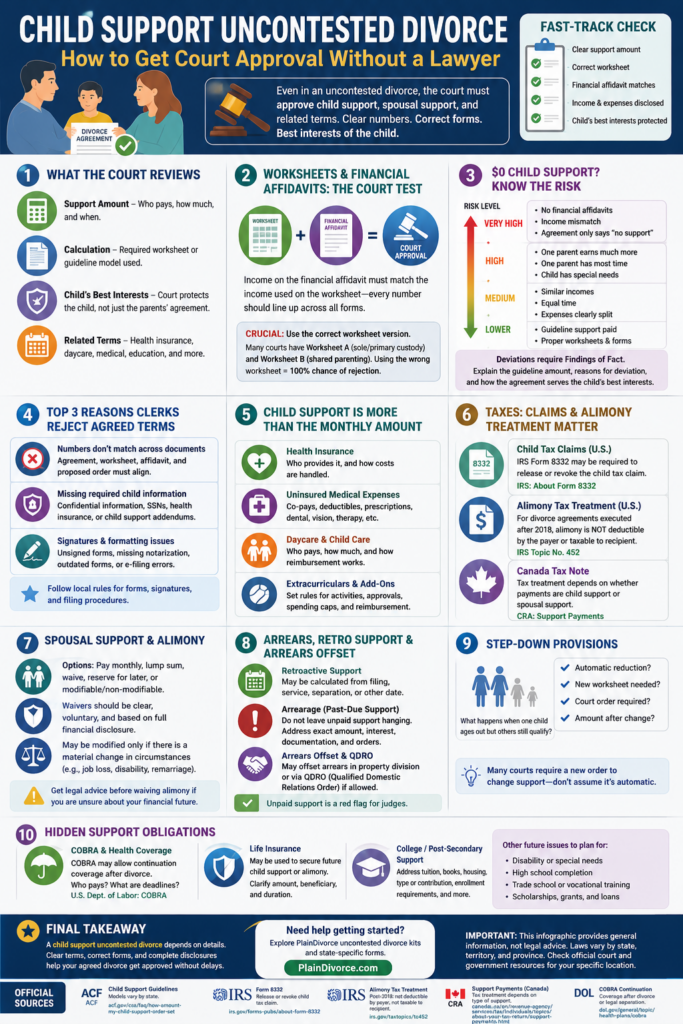
In a child support uncontested divorce, both spouses agree on the terms and no trial is needed, but the court or child support agency handling your case still checks the support arrangements before the judgment is signed. Your paperwork generally has to show who pays child support, how much, how the figure was reached, how the child’s health, medical, and child-care costs are handled, and whether spousal support is paid, reserved, or waived.
The same is true for spousal support. Whether your state or province calls it spousal support, alimony, or maintenance, the agreement needs to state the amount and duration or clearly waive it, and the waiver has to be one your local law allows. Vague language is what slows an agreed case down: “we will work it out,” “no support is needed,” or “we split everything fairly” can prompt the court to ask for corrections before it signs the final order.
Divorce and support rules vary by state, territory, and province, and this guide covers the United States and Canada at a general level. Treat every rule below as something to confirm for your own court or agency, not a nationwide guarantee. PlainDivorce is not a law firm and does not give legal, tax, or financial advice.
TL;DR
“Uncontested” describes the spouses’ agreement, not the court’s role. On child support the judge or agency applies its own guidelines regardless of what you two signed — so the filing has to show its work, not just its conclusion.
- The guideline number is a rebuttable presumption in every U.S. state (42 U.S.C. § 667). A different amount needs written findings — including what the guideline figure would have been. In Canada, the court must be satisfied reasonable arrangements exist and can stay the divorce until they do (Divorce Act s. 11).
- “We agree to no child support” is not a filing. Run the worksheet anyway, attach the income disclosure, and state the reason for the deviation and how the child’s costs are covered.
- One income figure, every document. If the disclosure, the worksheet, the agreement, and the proposed order don’t match, expect the case to come back for correction — and a shared-parenting worksheet paired with a primary-custody plan is the classic mismatch.
- Equal parenting time does not automatically mean $0. Income difference plus insurance and child-care costs can still produce an obligation.
- The monthly amount is the smallest part. Health insurance, uninsured medical, work-related daycare, and activity add-ons need shares, proof requirements, and deadlines — “split fairly” is not enforceable.
- The plan administrator qualifies a QMCSO, not the judge. Employer coverage alone doesn’t mean you need one; government and church plans follow separate rules, and agency cases often use a National Medical Support Notice instead.
- Form 8332 must be current and unconditional. A post-2008 decree cannot substitute for it, and the release can’t be tied to support being paid up. It moves the dependency claim and child tax credit only — head-of-household, EITC, and the child and dependent care credit stay with the custodial parent.
- Alimony is no longer deductible for U.S. instruments executed after December 31, 2018. Pre-2019 instruments keep the old treatment unless modified to adopt the new rule. Canada is the reverse pattern: periodic spousal support is generally deductible and taxable; child support generally isn’t.
- Arrears don’t vanish because you wrote it down. Waiving or offsetting past-due support usually needs court — and sometimes agency — approval, and interest may apply.
- Automatic step-downs often aren’t automatic. Many jurisdictions require a new order before a multi-child amount can drop, and the age or event that ends support varies — “turns 18 or graduates” is not a safe universal rule.
- COBRA has a size limit and two 60-day clocks (20+ employees; notify the plan within 60 days, elect within 60 days of the notice; up to 36 months at 102% of premium). Put the notice on a calendar and price the premium into the settlement.
1. Two Ways an Uncontested Divorce Reaches a Support Judgment
People use “uncontested” to mean different things, and the difference matters for support. A divorce with child support or spousal support issues usually finishes one of two ways without a trial.
- Agreed, joint, or consent route. Both spouses sign a settlement agreement (and, where there are children, a parenting plan and support terms), and the court reviews and enters it. This is what most of this guide is about.
- Default or non-response route. One spouse files and serves the other correctly, the other spouse does not respond within the deadline, and the case proceeds on the filing spouse’s paperwork. There may be no signed agreement at all. The relief the judge can grant is generally limited to what the filing papers asked for, and support is still decided as part of that judgment.
In both routes the court does not simply rubber-stamp the outcome on child support. It has to be satisfied that the support arrangements meet the standard its law sets. California, for example, describes a “default with agreement” path and a straight default path, and both still require the child support paperwork the court uses to check the numbers: California Courts: finish a default divorce case with minor children. Your state or province may use different labels and different forms.
If you are preparing your own paperwork, start with the filing package for your location. You can review PlainDivorce’s uncontested divorce eligibility check to see whether a self-help kit fits your situation.
2. Quick Self-Check Before You File
Use this as a planning screen, not a scoring system. It flags the support situations that usually need the most preparation before you file a child support uncontested divorce.
| Your Situation | What to Sort Out First |
|---|---|
| No minor children, both spouses waive spousal support | Make the spousal support waiver explicit and confirm your state or province allows it |
| Minor children, guideline child support is being paid | Attach the worksheet or calculation your court or child support agency requires |
| Minor children, parents want $0 child support | Run the guideline number anyway, state the reason for the deviation, and describe how the child’s costs are covered |
| One spouse is self-employed or paid in cash | Gather income records and be ready to address imputed income |
| One spouse wants to waive spousal support permanently | Confirm the waiver rules and the financial disclosure your court expects |
| A child has medical, daycare, or special-education costs | Write exact expense-sharing terms rather than “split fairly” |
| There is unpaid support from an earlier order or period | Address the amount owed, any agency involvement, and whether an offset is allowed |
The core point: “uncontested” describes the spouses’ agreement, not the court’s role. For a child support uncontested divorce, the court or agency still applies its own support rules and needs enough information to enter the order.
3. How Support Is Reviewed Even When You Agree
Both the United States and Canada build child support review into the divorce, but the mechanism is different, and the exact forms are set by the court or child support agency that handles your case.
United States: Guideline Amount as a Rebuttable Presumption
Every U.S. state and the territories run child support guidelines. Under federal law, the guideline figure in a state’s judicial or administrative support proceeding is a rebuttable presumption of the correct amount, and a court that orders a different amount has to make a written or on-the-record finding under the state’s criteria: 42 U.S.C. § 667. States use different models — the income shares model, a percentage-of-income model, and others — and the federal Office of Child Support Services explains the range: Office of Child Support Services: how a support order amount is set.
What that means in practice: many courts want a completed guideline worksheet or calculator printout, an income or financial disclosure, and a proposed support order. Some also require a wage-withholding order or route the case through the state child support agency. Which of those apply, and whether a hearing is needed, is state and county specific. Use every form and calculation your filing court or agency lists in its current packet.
Canada: Reasonable Arrangements Having Regard to the Guidelines
For a divorce under the federal Divorce Act, the court must be satisfied that reasonable arrangements have been made for the support of any children of the marriage, having regard to the applicable child support guidelines, and it can stay the divorce until those arrangements are made: Divorce Act, section 11. The court will not treat the arrangements as unreasonable only because the agreed amount differs from the guideline table figure, but it does look at whether the child is adequately provided for. Provincial and territorial rules and forms apply on top of the federal Act.
Keep the Numbers Consistent Across the Filing
Wherever you file, the income and support figures should line up across every document: the financial disclosure or affidavit, the child support worksheet or calculation, the settlement agreement, the parenting plan, the proposed support order, and any withholding or agency forms. If the disclosure shows one income and the worksheet uses another, expect the court or agency to ask which is right before it acts. A financial affidavit or financial statement, where it is required, is a sworn or verified summary of income, expenses, assets, and debts, and the income on it should match the income used in the support calculation.
Some jurisdictions also use more than one worksheet depending on the parenting arrangement — for example a primary-custody version and a shared-parenting version, plus a separate schedule for health insurance or child-care costs. Where that is the case, the worksheet has to match the parenting plan; a shared-parenting calculation paired with a primary-custody plan usually gets sent back for correction. Only rely on a specific worksheet label after you have checked your own court’s current form.
4. Asking for $0 or Below-Guideline Child Support
Parents can agree that no child support changes hands. The court is not simply agreeing with the parents; it is deciding whether the requested amount is allowed under its guidelines and adequate for the child. So the agreement has to give the court enough to work with.
These are the situations where a court or child support agency is most likely to want more before approving a $0 or reduced amount. Treat the list as a checklist of what to prepare, not a prediction about your case.
| Situation | Why It May Be Questioned |
|---|---|
| Similar incomes, roughly equal parenting time, costs clearly split | The court may still want the guideline calculation on file |
| One parent earns significantly more | The child may be entitled to support the guideline would produce |
| One parent has most of the parenting time | The primary household may need the contribution |
| No income disclosure attached | The court or agency cannot verify income |
| Worksheet income does not match the disclosure | The filing looks inconsistent |
| Public assistance is or was involved | A state or provincial agency may have its own interest in the order |
| The child has medical, therapy, daycare, or special needs | A flat $0 may not account for real costs |
| The clause only says “no support” | No calculation, reason, or explanation for the court to rely on |
Findings the Court May Need to Approve a Deviation
When a U.S. court approves an amount that differs from the guideline, it generally has to record findings of fact — the specific reasons the different amount is justified, including what the guideline amount would have been. Some courts have a dedicated form or require agency review first.
A weak $0 clause reads:
“The parties agree no child support is needed.”
A version that gives the court something to work with:
Illustrative drafting example only — not ready-to-file language, and the required wording is set by your court’s form and rules. “The parties completed the child support worksheet. The guideline amount is $____. The parties request an order of $____ because ____. The parties believe this arrangement meets the child’s needs because ____. The parties understand the request is subject to court approval.”
In Canada, remember that the court can still ask questions about a below-table amount under section 11 of the Divorce Act, even though a different figure is not automatically unreasonable. Check your court’s process before filing a below-guideline request.
5. Pre-Filing Checks for Agreed Support Terms
Agreed filings are often delayed not because the spouses disagree but because the paperwork is incomplete, inconsistent, or not in the format the court requires. A court clerk may be able to return a filing that is missing a required document; a judge or child support agency decides whether to approve the relief requested. Which office does what varies by jurisdiction. These are the checks worth running before you file.
Check 1: The Support Number Is the Same in Every Document
If the settlement agreement says $500 per month, the proposed order says $0, and the worksheet says $642, the filing contradicts itself. Compare the settlement agreement, parenting plan, child support worksheet or calculation, proposed support order, income disclosures, any withholding forms, and any child support agency forms, and make the numbers agree.
Check 2: Required Child Information Is Filed the Right Way
Many courts keep a child’s identifying details — date of birth, Social Security or Social Insurance number, health-plan information, support account numbers — on a confidential addendum rather than in the public settlement agreement. Do not put a child’s full Social Security or Social Insurance number or a protected address in a public filing unless the court’s confidential-information form or rule tells you to. A case can stall if that separate form is required and missing.
Check 3: Signatures and Formatting Match Local Rules
Courts differ on original signatures, notary or verification blocks, witness signatures, initials, margins, e-filing document names, whether the child support worksheet must be signed, case-number placement, and form editions. A sound agreement can still be delayed by a formatting problem. Court-ready support paperwork is about matching the court’s required forms and procedure as well as getting the words right.
6. Child Support Is More Than the Monthly Amount
“Parent A pays Parent B $500 per month” is a start, not a complete support section. A thorough child support uncontested divorce agreement also handles the add-ons, and many guidelines treat some of these as separate line items on the worksheet.
Health Insurance and Medical Child Support Orders
The agreement should say whether health insurance is available for the child and which parent provides it. Having employer coverage does not by itself mean a Qualified Medical Child Support Order (QMCSO) is needed. A QMCSO is a separate order that directs an ERISA-covered group health plan (with some exceptions) to enroll a child, and it is the plan administrator — not the divorce court — that decides whether a medical child support order is “qualified,” using the plan’s written procedures. Government and church plans follow their own rules, and in child support agency cases a National Medical Support Notice is often used instead. The U.S. Department of Labor explains the framework: U.S. Department of Labor: Qualified Medical Child Support Orders.
Illustrative drafting example only. “Parent A shall maintain health insurance for the child through available employer coverage for as long as it remains available at reasonable cost. The parents shall divide uninsured medical expenses as stated below.”
Uninsured Medical Expenses
Uninsured costs can include co-pays, deductibles, prescriptions, dental and vision care, therapy, and specialist care. Guidelines and forms in some places prescribe the split (often proportional to income) and the notice and reimbursement timeline, so check yours before you pick numbers.
Illustrative drafting example only — percentages and deadlines vary by jurisdiction and may be set by a form or order. “The parents shall divide uninsured medical expenses for the child. A parent seeking reimbursement provides proof of payment, and the other parent reimburses their share within the period required by local rule or, if none, a reasonable time.”
Daycare and Work-Related Child Care
Child-care cost is one of the most common missing terms. If care is needed because a parent works, studies, or looks for work, the agreement should say who pays, in what share, and how reimbursement works. Many guidelines add work-related child care to the support calculation directly.
Illustrative drafting example only. “Work-related child-care costs shall be shared between the parents in proportion to their incomes, or as the guideline worksheet provides. The parent seeking reimbursement provides a receipt or invoice, and the other parent pays their share within a reasonable time.”
Extracurriculars and Other Add-Ons
Basic child support may not cover every optional activity. Sports, music, tutoring, camp, school trips, and competitive travel are common friction points. If you address them, spell out:
- Which activities both parents agree to fund
- Which need advance written agreement
- Whether there is a spending cap
- How reimbursement works
- What happens if one parent enrolls the child without consent
In Canada, some of these are handled as special or extraordinary expenses (often discussed as section 7 expenses under the Federal Child Support Guidelines), shared in proportion to income. The categories and terminology depend on the province or territory.
7. Taxes: Dependency Claims, Form 8332, and Alimony
Support agreements often skip the tax questions, and that creates problems years later.
Who Claims the Child in the United States
By default the custodial parent — the one the child lived with for the greater number of nights during the year — claims the child. If the custodial parent wants to let the other parent claim the child, that release generally has to be on IRS Form 8332 or a substantially similar statement. For any decree or agreement executed after 2008, the noncustodial parent cannot attach pages of the divorce decree instead of Form 8332. The release also has to be unconditional — it cannot be written to depend on child support being paid up to date.
A Form 8332 release only moves the dependency claim and the related child tax credit, additional child tax credit, and credit for other dependents. It does not transfer head-of-household filing status, the earned income credit, or the child and dependent care credit — those stay with the custodial parent. The current form is Form 8332 (Rev. December 2025); the rules are in IRS Publication 504.
Illustrative drafting example only. “For each year the noncustodial parent is entitled to claim the child, the custodial parent shall sign and provide a current IRS Form 8332. The parties will follow applicable federal and state tax rules for child-related tax benefits.”
Alimony Tax Treatment for U.S. Divorces
For a divorce or separation instrument executed after December 31, 2018, alimony or separate maintenance is not deductible by the payer and not included in the recipient’s income: IRS Topic No. 452. Instruments executed on or before that date keep the old treatment (deductible to the payer, taxable to the recipient) unless they are modified after 2018 and the modification expressly adopts the new rule. If your agreement assumes alimony is deductible, confirm which rule applies before signing.
Canadian Support Tax Treatment
In Canada, the baseline is: qualifying periodic spousal support paid under a court order or written agreement is generally deductible to the payer and included in the recipient’s income, while child support under an order or agreement made or last varied after April 1997 is generally neither deductible nor taxable. Lump sums, informal payments, and payments not made under an order or written agreement can be treated differently, and unpaid child support is applied first before any spousal support is deductible. See Canada Revenue Agency: what are support payments. If the amounts are significant, check the current CRA guidance or talk to a tax professional.
8. Spousal Support and Alimony in an Uncontested Divorce
Spousal support is money one spouse pays the other after separation or divorce. Depending on the jurisdiction it is called alimony, maintenance, or spousal maintenance. In a spousal support uncontested divorce, spouses commonly agree to one of: monthly support for a set period, temporary support only, a lump sum, a full mutual waiver, reserving the issue for later, or making support modifiable or non-modifiable where local law allows that choice.
A clear clause answers who pays, who receives, how much, when payments start and end, what events end support (for example remarriage or death), whether it can be modified, and how payment is made. Options like a permanent waiver, a reservation of the issue, or a non-modifiable term are only available where local law and the court’s order permit them; in some places a court keeps discretion over support regardless of the label the parties use.
Weak: “No alimony.”
Illustrative drafting example only. “Each spouse understands spousal support may be available under applicable law. After reviewing their finances, each spouse voluntarily waives spousal support from the other, subject to court approval and applicable law.”
Whether financial disclosure or a court fairness review is required before a waiver is enforceable varies; do not assume it is universal, and do not assume it is skipped. Modification, where it is allowed, usually turns on a material change in circumstances such as job loss, a major income change, disability, remarriage, or retirement — but the threshold and the process are set by local law and the order.
Get legal advice before waiving spousal support if one spouse does not understand the finances, gave up career earnings during the marriage, has health problems, or feels pressured to sign.
9. Retroactive Support, Arrears, and Arrears Offset
Support questions often build up between separation and the final judgment. A child support uncontested divorce should deal with that period rather than ignore it.
Retroactive Child Support
Retroactive child support is support for a past period. The date it can run from — filing, service, separation, a demand letter, or another date — and how far back a court will go are jurisdiction-specific. Questions to work through:
- Was support paid before filing, and is any of it documented?
- Is any amount claimed for the past period?
- Is either parent giving up a claim for temporary or retroactive support?
- Does local law allow that waiver, and does it need court approval?
Arrears and Whether They Can Be Offset
An arrearage is past-due support under an existing order. Do not ignore it and do not assume a divorce agreement can erase it — whether arrears can be reduced or waived, and whether interest applies, depends on local law, and a child support agency may have to sign off if it is involved. If back support is owed, address the exact amount, whether it is disputed, what has already been paid, whether interest applies, and whether an arrears offset is allowed.
An arrears offset handles the past-due amount through another part of the settlement, such as property division, where local law allows it. If retirement funds are being used, note that a Qualified Domestic Relations Order (QDRO) is a specific instrument for dividing an ERISA-covered employer plan, qualified by that plan’s administrator; it is not a general retirement or arrears tool, and IRAs and government or military plans use different rules. Do not improvise a retirement order inside a basic divorce agreement.
Temporary Household Payments
Sometimes one spouse covers the mortgage, rent, utilities, insurance, or a car payment before the divorce is final. Those payments may or may not count as support. If they are meant to satisfy a support obligation, say so in the agreement. If they are separate, say that too.
10. Step-Down Provisions When One Child Ages Out
With more than one child, support may need a step-down provision — a term describing what happens when the obligation ends for one child but continues for the others.
Example: support is $1,200 per month for three children and the oldest reaches the age support ends in your jurisdiction. Does the amount drop automatically? To what? Is a new worksheet or a court order required first? The age and event that end support (a birthday, high-school graduation, or another trigger) are set by local law, so “turns 18 or graduates” is not a safe universal rule.
Weak: “Support will reduce when each child turns 18.”
Illustrative drafting example only. “When support ends for one child under applicable law, the parties shall follow the local process to recalculate or modify support for the remaining child or children.”
Some jurisdictions do not let parents change a support amount without a new order, even by agreement. Confirm the rule before relying on automatic step-down language.
11. Longer-Term Support: Health, Life Insurance, and College
Support planning does not stop at the monthly payment. A thorough agreement also addresses the obligations that surface later.
COBRA and Health Coverage After Divorce
In the United States, divorce or legal separation is a COBRA qualifying event for a covered employee’s spouse and dependents, but only when it actually causes a loss of coverage under a plan subject to COBRA. Key limits:
- COBRA applies to private employers and unions with 20 or more employees; federal-government and church plans are excluded, and small employers may be covered only by a state “mini-COBRA” law.
- A filed-but-not-final divorce does not itself qualify — coverage has to be lost.
- The qualified beneficiary generally must notify the plan within 60 days of the divorce, and then has 60 days to elect coverage after the election notice.
- Continuation for divorce or legal separation can run up to 36 months, at up to 102% of the premium.
Put the notice task in the agreement and on a calendar. See U.S. Department of Labor: COBRA continuation coverage FAQs. Children usually keep their own coverage under a parent’s plan; confirm with the plan.
Life Insurance to Secure Support
If child support or spousal support will run for years, the agreement may address what happens if the paying spouse dies. A life insurance requirement is a common tool, but whether a court can order it, and how it is drafted, varies.
Illustrative drafting example only. “While support remains payable, the paying parent shall maintain life insurance of $____ naming the child, or an appropriate trustee or custodian for the child, as beneficiary, subject to availability and applicable law.”
College or Post-Secondary Support
Support does not always end at 18. Some jurisdictions allow or require support past 18 for high-school completion, disability, or post-secondary education; others do not. Even where post-secondary support is not otherwise required, a parental agreement to share those costs can still be enforceable, subject to local law. If you address it, work through:
- Does local law require support after 18 in any situation?
- Will either parent contribute to college or trade school, and how much?
- Which costs are covered — tuition, fees, books, housing, transportation?
- Is there a cap (for example, a public-university figure)?
- Must the child stay enrolled and maintain grades?
- How are scholarships, aid, and loans counted?
Illustrative drafting example only. “Post-secondary education expenses shall be addressed only by later written agreement or court order, unless applicable law requires otherwise.”
12. Weak vs. Specific Support Language
This is where many agreed divorces slow down. Use the table to check whether your support language is specific enough to follow and enforce. The right column shows a more specific version of the idea, not court-approved wording — the exact terms, percentages, and deadlines are set by your guidelines, forms, and order.
| Vague Language | Why It Causes Problems | More Specific Version |
|---|---|---|
| “We will share child expenses.” | No amount, schedule, or method | “Parent A pays Parent B $____ per month beginning ____, by ____.” |
| “No child support is needed.” | No guideline figure or reason for the court | “The worksheet shows $____; the parties request $____ because ____.” |
| “Medical costs will be split fairly.” | “Fairly” is not enforceable | “Uninsured medical costs are shared ____; reimbursement follows the local rule or, if none, a reasonable time.” |
| “We will split daycare.” | No share, proof, or deadline | “Work-related daycare is shared ____ and reimbursed on proof of payment.” |
| “Activities will be handled later.” | Creates future conflict | “Activity costs over $____ need advance written agreement before reimbursement.” |
| “Parent A keeps insurance.” | Does not identify the child or plan | “Parent A maintains coverage for the child through available employer insurance while it stays available at reasonable cost.” |
| “Support ends when the child is grown.” | No defined trigger | “Support ends for each child as provided by applicable law or further court order.” |
| “No alimony.” | May not show an informed waiver | “Each spouse voluntarily waives spousal support, subject to court approval and applicable law.” |
| “Back support is forgiven.” | May not be allowed without court or agency approval | “Any arrears resolution or offset is stated in full and approved as required by law.” |
Specific support language is not about sounding legal. It is about being clear enough that both people, and the court, can follow it.
13. PlainDivorce Decision Guide: What to Do Next
| Your Situation | What You Need Next |
|---|---|
| Minor children, you agree on support | Start with the uncontested divorce package for your filing location |
| You want $0 or below-guideline child support | Run the worksheet, prepare the income disclosure, and check your court’s deviation rules |
| Health insurance, daycare, or medical costs are involved | Write the add-on terms before signing the settlement agreement |
| One spouse will pay spousal support | Set the exact amount, start date, end date, and modification terms |
| Both spouses waive spousal support | Confirm the waiver is clear, voluntary, and allowed in your jurisdiction |
| A child may need college or special-needs support | Address the long-term issue before filing |
| Income, arrears, or agency involvement is unclear | Get legal help before filing |
For a cooperative divorce, a location-specific PlainDivorce kit is a general organizing aid: it helps you gather the forms, agreement terms, and a filing checklist so support issues are not left as one-line promises. It is not a law firm, does not give legal advice, and does not guarantee your filing will be accepted.
You may also want to read related guides on uncontested divorce with children, the parenting plan for an uncontested divorce, the marital settlement agreement, and property division in an uncontested divorce.
14. When to Get Legal Help
Consider legal advice before filing if:
- You want $0 child support, a guideline deviation, or a custom support amount.
- A parent is self-employed, unemployed, underemployed, paid in cash, or income may need to be imputed.
- There are arrears, retroactive support, an arrears offset, public assistance, or an earlier support order.
- A child has significant medical, educational, disability-related, daycare, or post-secondary needs.
- One spouse is waiving spousal support, does not understand the finances, or feels pressured to sign.
Legal help does not turn an agreed case into a contested one. Many people use limited-scope (unbundled) help to review support terms before filing an alimony uncontested divorce or a child support case, then file the paperwork themselves.
15. FAQ: Child Support and Spousal Support in an Uncontested Divorce
Can we get an uncontested divorce if we disagree about child support?
Usually not as a fully agreed case. If child support is unresolved, you may need negotiation, mediation, a child support agency, or a short hearing to settle the amount. Once support is decided, the rest of the divorce can still proceed without a trial, and in some places it can finish by default if one spouse does not respond after valid service.
Can we agree to no child support?
Sometimes. Many U.S. courts still want a guideline calculation, an income disclosure, and written findings explaining why a different amount is appropriate. In Canada, a court can question a below-table amount under the Divorce Act, though it will not reject it only because it differs from the table. A bare “we agree to no support” line is often not enough.
Does the court review child support if we already agree?
Yes, in both the U.S. and Canada, though the mechanism differs. U.S. guideline amounts carry a rebuttable presumption, so a court needs a reason to approve something else. Under the Canadian Divorce Act, the court must be satisfied that reasonable child support arrangements have been made, having regard to the guidelines, and can pause the divorce until they are.
What is a financial affidavit or child support worksheet?
A financial affidavit or financial statement is a sworn or verified summary of income, expenses, assets, and debts. A child support worksheet or calculator applies your jurisdiction’s guideline formula to each parent’s income and certain costs. Not every court uses both, and the labels vary; the income figure should be the same on each document you file.
Does equal parenting time mean no child support?
Not necessarily. Equal parenting time changes the calculation in many guidelines, but a difference in incomes, plus health insurance and child-care costs, can still produce a support obligation. Run your jurisdiction’s shared-parenting worksheet to see the number.
What are findings of fact for a support deviation?
They are the specific reasons a court records when it orders an amount different from the guideline — typically what the guideline amount would have been and why the different amount is justified and adequate for the child. Some courts have a dedicated form for this.
What is retroactive child support?
It is support for a past period, such as the time between separation and the final order. The date it runs from and how far back a court will go vary by jurisdiction, and documented voluntary payments during that period may be credited.
What is an arrears offset?
It is a way of resolving past-due support through another part of the settlement, such as property division, where local law allows it and the court or child support agency approves. Arrears generally cannot be wiped out just by writing it into the agreement.
What is a step-down provision?
It is a term describing what happens to a multi-child support amount when the obligation ends for one child but continues for the others — whether the amount drops automatically, and whether a new worksheet or court order is needed first.
What is imputed income?
Imputed income is income a court assigns to a parent or spouse who is voluntarily unemployed, underemployed, or not fully disclosing earnings. It can raise the child support or spousal support figure above what the person reports.
Is alimony the same as spousal support?
In most places, yes — it is the same concept under different names. Some jurisdictions say alimony, others say spousal support, maintenance, or spousal maintenance.
Can we waive alimony in an uncontested divorce?
Often, yes, if the waiver is clear, voluntary, and based on financial disclosure. In some jurisdictions a waiver is permanent; in others a court can revisit support only in limited circumstances, and a few keep discretion regardless of the parties’ wording. Confirm your local rule.
Is alimony tax deductible?
For U.S. instruments executed after December 31, 2018, no — alimony is not deductible by the payer and not taxable to the recipient. Older instruments keep the prior treatment unless modified after 2018 to adopt the new rule. In Canada, qualifying periodic spousal support is generally deductible to the payer and taxable to the recipient, while child support is generally neither.
Who claims the child on taxes after divorce?
In the U.S., the custodial parent (more overnights) claims the child by default. To shift the dependency claim and the related child tax credit to the other parent, the custodial parent generally signs a current IRS Form 8332; a post-2008 decree cannot substitute for it, and the release cannot be conditioned on support being paid. Head-of-household status, the earned income credit, and the child and dependent care credit stay with the custodial parent.
Can support be changed later?
Child support is generally modifiable after a material change in circumstances, but the threshold and process are set by local law. Spousal support may or may not be modifiable depending on the agreement and the jurisdiction; a non-modifiable term is only possible where local law allows one.
16. Final Takeaway
A child support uncontested divorce is more than a signed agreement between parents. Whether the case finishes by agreement or by default, the court or child support agency applies its own guidelines and usually wants a calculation, an income disclosure, the correct worksheet, clear terms for the child’s other costs, and findings for any deviation.
Spousal support and alimony need the same care. Whether support is paid, reserved, waived, offset, or secured with life insurance, and whether it can change later, the agreement should be specific enough for a court to review and for both spouses to follow. The goal is not a harder divorce — it is an agreement complete enough to move through without avoidable delay.
Sources and local rules can change. Use this guide as a plain-English organizer, then verify the current filing requirements with the official court or government source for your jurisdiction.

About Harry D
Expert contributor at PlainDivorce, helping Canadians and American navigate simple uncontested divorces with clarity and confidence.