Property Division in an Uncontested Divorce: How to Split the House, Debt, and Retirement
Property division in an uncontested divorce means you and your spouse decide how to split what you own and what you owe, then write it into your settlement agreement instead of leaving it to a judge. The catch is simple: your agreement binds the two of you, not your mortgage lender, retirement plan, credit-card company, or the IRS. Most costly mistakes trace back to that gap.
The problems usually surface after the divorce is final. One spouse keeps the house but cannot refinance. A joint credit card stays open. A quitclaim deed transfers title, but the mortgage still has both names on it. A 401(k) split is written into the agreement, but the plan administrator will not divide the account without a qualifying order. A spouse accepts retirement funds as if they were cash, with no allowance for taxes, vesting, early-withdrawal rules, or plan restrictions.
This U.S.-focused guide covers how to handle the house, debt, and retirement in an uncontested divorce: the mortgage, equity, quitclaim deeds, loan assumptions, splitting debt in a divorce, 401(k)s, IRAs, pensions, QDROs, tax basis, and the settlement language that makes each piece actually work.
Canadian reader? This guide is written for U.S. divorce property division. If you are in Canada, use a Canada-specific resource for RRSPs, LIRAs, CPP credit splitting, equalization, and provincial matrimonial or family property rules.
TL;DR
Your agreement binds you and your spouse — not your mortgage lender, retirement plan administrator, credit-card issuer, or the IRS. Almost every expensive mistake in property division traces back to that one gap.
- The deed gap is the big one. A quitclaim deed transfers ownership but does nothing to the mortgage. Sign one before the refinance closes and you can lose the asset while keeping the debt.
- Every house clause needs a refinance deadline AND a fallback. “Will refinance when possible” is how a departing spouse stays on a loan for years. Name the deadline, who pays meanwhile, and what triggers a listing if the lender says no.
- Don’t overlook a loan assumption. If the existing rate is far below market, assuming the mortgage may beat refinancing — but only a written release of liability actually gets the other spouse off the loan.
- Joint credit cards don’t split. Each holder owes the full balance, even after closure. Pay off, close, and require written proof — an indemnification clause allocates blame, not the creditor’s rights.
- Joint tax returns mean joint and several liability. A decree assigning tax debt does not bind the IRS. Relief only comes through innocent spouse, separation of liability, or equitable relief (Form 8857).
- Retirement accounts each split differently. A private 401(k) usually needs a QDRO; government and church plans are outside ERISA; federal and military use their own orders; an IRA is a “transfer incident to divorce.” The plan administrator — not the judge — decides if an order qualifies.
- Check vesting before you set a percentage. Unvested employer contributions may not be available to divide at all.
- There’s a real QDRO tax opening — a distribution to an alternate payee from a qualified plan escapes the 10% early-withdrawal penalty under IRC 72(t)(2)(C). It is still ordinary income, and it does not apply to IRAs. Never withdraw from an IRA to “pay” a spouse.
- $100,000 is not always $100,000. Cash is after-tax; a traditional 401(k) is taxed on withdrawal; a brokerage account carries built-in gain because the receiving spouse takes the carryover basis, not a stepped-up value.
- Timing the home sale matters. The Section 121 exclusion is up to $250,000 of gain single, $500,000 joint — so whether you sell before or after the divorce is final, and who’s on title at closing, can change the tax bill substantially.
- COBRA has two 60-day clocks and an employer-size limit (20+ employees; federal and church plans excluded). Miss the notice window and the right is gone — price the premium into the settlement.
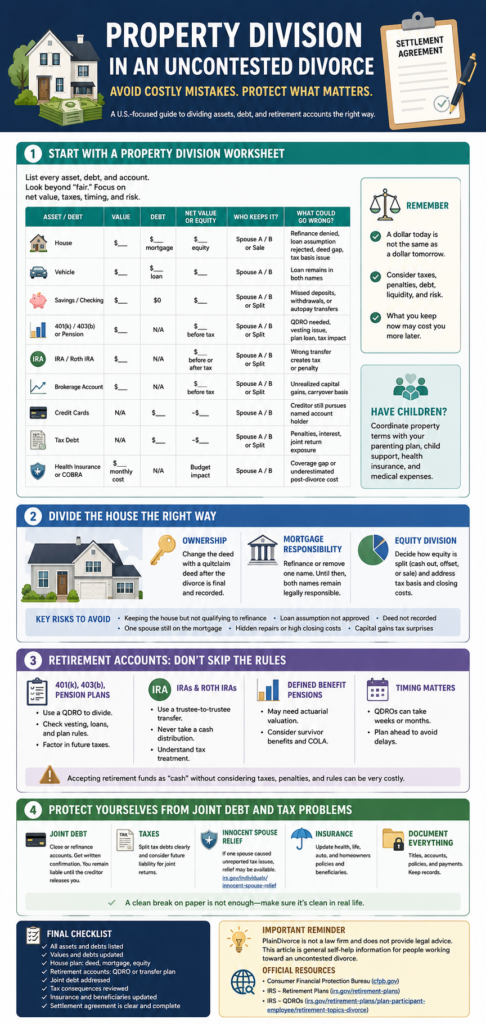
1. Start With a Property Division Worksheet Before You Agree to Anything
Before drafting a marital settlement agreement, build a worksheet. Property division in an uncontested divorce should not start with who deserves the house, car, savings, or retirement account. It should start with values, debts, tax issues, deadlines, and the points where a plan can fail.
| Item | Estimated Value | Debt Attached | Net Value or Equity | Who Keeps It? | What Could Go Wrong? |
|---|---|---|---|---|---|
| House | $___ | $___ mortgage | $___ equity | Spouse A / Spouse B / Sale | Refinance denied, loan assumption rejected, deed gap, capital gains on a later sale |
| Vehicle | $___ | $___ loan | $___ | Spouse A / Spouse B | Title changes but the loan stays in both names |
| Checking or savings | $___ | $0 | $___ | Spouse A / Spouse B / Split | Pending deposits, withdrawals, or autopay transfers missed |
| 401(k), 403(b), or pension | $___ | N/A | $___ before tax | Spouse A / Spouse B / Split | Qualifying order needed, vesting, plan loan, tax on withdrawal |
| IRA or Roth IRA | $___ | N/A | $___ before or after tax | Spouse A / Spouse B / Split | Wrong transfer method creates tax or a penalty |
| Brokerage account | $___ | N/A | $___ before tax | Spouse A / Spouse B / Split | Unrealized capital gains, carryover basis |
| Credit cards | N/A | $___ | -$___ | Spouse A / Spouse B | Issuer still pursues every named account holder |
| Tax debt | N/A | $___ | -$___ | Spouse A / Spouse B / Split | Joint and several liability on a joint return; penalties and interest |
| Health insurance or COBRA | $___ monthly cost | N/A | Budget impact | Spouse A / Spouse B | Coverage gap or underestimated post-divorce cost |
A common mistake in property division in an uncontested divorce is treating every dollar as equal. A $100,000 savings account is not the same as a $100,000 traditional 401(k). The savings is available now. The 401(k) is generally taxed when withdrawn and can trigger a penalty if it is withdrawn incorrectly. A home with $100,000 of equity is different again, because selling costs, repairs, market risk, refinance risk, deed timing, and possible capital gains tax all move the real number.
The better question is not only, are we splitting this 50/50? It is: what is each spouse actually receiving after debt, taxes, timing, and risk are taken into account?
If children are involved, line up your property terms with your parenting plan, child support, health insurance, and medical-expense terms. See our guides on uncontested divorce with children and getting child support approved without a lawyer before you finalize the numbers.
2. Divide the House Without Creating a Mortgage, Deed, or Equity Problem
The house is often the largest single issue in property division in an uncontested divorce, because it is an asset and a debt at the same time. A house decision has three separate parts: ownership, mortgage responsibility, and equity division. They do not move together.
A divorce judgment can award the home to one spouse. It does not, by itself, force the mortgage lender to remove the other spouse from the loan. The Consumer Financial Protection Bureau’s research on homeowners and mortgage companies after divorce documents how often people are stuck on a loan the decree told them to leave.
One Spouse Keeps the House With a Buyout
A buyout means one spouse keeps the home and pays the other for that spouse’s share of the equity. The starting formula is home value minus mortgage balance equals equity.
For example, if the home is worth $500,000 and the mortgage balance is $300,000, the estimated equity is $200,000. If the spouses divide equity equally, each share is $100,000 before any agreed deductions or tax adjustments.
For an accurate buyout, decide whether the number accounts for repairs, realtor commissions, closing costs, liens, a home equity line of credit, documented separate-property contributions, and possible capital gains tax on a future sale. A buyout based only on a rough guess is one of the more common ways a split turns out lopsided.
The House Is Sold
If the house will be sold, the agreement should spell out who selects the realtor, how the listing price is set, who pays for repairs, who lives in the home until closing, who pays the mortgage and utilities in the meantime, who approves offers, and how net proceeds are divided.
Define net proceeds. In most agreements it means the money left after mortgage payoff, liens, commissions, transfer taxes, closing costs, and agreed sale expenses are paid.
A Deferred Sale
A deferred sale means both spouses keep an interest in the home for a while, with a sale, refinance, assumption, or buyout planned later. Couples use it when children need housing stability, the market is weak, or one spouse needs time to qualify for financing.
A deferred sale needs trigger events: a refinance denial, missed mortgage payments, remarriage or cohabitation, a child reaching a set age, or a fixed sale deadline. Without triggers, the spouses are only postponing the conflict, and often the cost.
The Refinance Trap
The refinance trap happens when one spouse agrees to keep the house but later cannot qualify to refinance the mortgage. The other spouse stays tied to the loan even though the agreement says the keeping spouse is responsible for payment. If the keeping spouse then misses payments, both credit reports take the hit.
This matters most in a higher-rate environment. If the current mortgage carries a low rate, refinancing into a much higher rate can make the payment unaffordable and can make the buyout math impossible.
A strong house clause should state the refinance deadline, who pays the mortgage while a refinance is pending, what happens if the lender denies it, whether the home must then be listed, and whether the buyout amount changes if the refinance is delayed.
Weak: Spouse A keeps the house and will remove Spouse B from the mortgage when possible.
Stronger (illustrative concept, not ready-to-file language): Spouse A will refinance the mortgage into Spouse A’s sole name, or complete an approved assumption with a written release of Spouse B’s liability, within a set number of days after entry of judgment. If Spouse A cannot do so by the deadline, the home will be listed for sale within a short fixed period unless both spouses agree in writing to extend it.
Loan Assumption: The Refinance Alternative People Miss
A loan assumption means the spouse keeping the home asks the lender or servicer to approve that spouse taking over the existing mortgage on its current terms. It can matter a lot when the existing rate is far below what a new refinance would cost.
Assumption is not automatic. The loan has to be assumable, the servicer and investor have to allow it, and the spouse keeping the home generally has to pass the same kind of underwriting a new borrower would. The CFPB notes that a successor in interest who wants to keep the home “do not generally need to refinance to do so, provided they are willing to assume liability on the loan and can pass the investor’s underwriting criteria for assumptions.” The departing spouse still needs a written release of liability; without it, the mortgage risk stays.
If assumption is on the table, the agreement should say who applies, the application deadline, who pays the fees, that a lender release of the other spouse is required, and what happens if the assumption is denied.
The Deed Gap: A Deed Changes Title, Not the Mortgage
A deed changes ownership. It does not change mortgage liability. That difference is the deed gap.
A spouse can sign a quitclaim deed or interspousal transfer deed, give up all ownership of the house, and still be fully liable on the mortgage. That is a serious risk in property division in an uncontested divorce, because the departing spouse loses the asset while keeping the debt. The deed type that is used, who records it, recording and transfer-tax treatment, and whether a court has to approve the transfer are all state- and lender-specific.
Before signing any deed, the agreement should identify the deed type, who records it and pays the fees, whether the deed is signed before or after the refinance or assumption closes, and what happens if the lender never releases the departing spouse. In many situations the safer sequence is: refinance or assumption with release first, deed second, but confirm the right order for your state and lender.
Tax on the House: Section 1041 Basis and the Section 121 Exclusion
If the home has gained a lot of value, do not look only at equity. Two federal rules drive the tax result, and IRS Publication 504 covers both for divorced or separated individuals.
Section 1041 transfers. A transfer of property between spouses, or between former spouses when it is incident to the divorce, generally happens with no recognized gain or loss. “Incident to divorce” means the transfer occurs within one year after the marriage ends, or is related to the end of the marriage (pursuant to a divorce or separation instrument and no later than six years after the marriage ends). The spouse who receives the property takes the other spouse’s adjusted basis, not the current market value, so built-in gain moves with the asset. Section 1041 does not apply in a few situations, including a transfer to a spouse or former spouse who is a nonresident alien and certain transfers in trust.
Section 121 home-sale exclusion. When a main home is sold, an owner can generally exclude up to $250,000 of gain, or up to $500,000 on a joint return, if the ownership and use tests are met (owned and lived in the home at least two of the last five years, with a two-year lookback). For divorcing couples this is usually the bigger number. Special rules can let one spouse count time the other spouse owned or used the home, or count use of the home under a divorce or separation instrument; IRS Publication 523 and IRS Topic 701 explain how. Whether to sell before or after the divorce is final, and who is on title at closing, can change how much gain is excluded.
For a practical review, note what the home is worth, the mortgage balance, the original purchase price, the cost of major improvements, the resulting adjusted basis, and who would owe capital gains tax if the home is sold later. Carryover basis is a federal rule; it does not replace state property-law or local transfer-tax advice.
3. Split Debt With Payoff, Closure, Proof, and Indemnification
Splitting debt in a divorce is where an agreement can read cleanly on paper and still fail in real life. A divorce agreement can assign a debt to one spouse. The lender, card issuer, or collection agency still follows the original contract. If your name is on the account, you stay exposed if payments are missed.
Effective debt division focuses on account control, payoff, closure, refinancing, written proof, and indemnification.
Joint Credit Cards
Joint credit cards are high-risk because both account holders remain responsible to the issuer. The CFPB is blunt about it: “When you have a joint account, each account holder is responsible for the full amount of the balance,” and even after you close the account, “each of the joint account holders will be responsible to repay the entire balance.” See the CFPB explainer on joint credit card responsibility.
First, confirm the account’s real status. A true joint or co-signed account is different from an authorized-user card, which can usually be removed with a phone call. For each joint card, ask the issuer about its closure and removal process, then have the agreement identify the account, the balance as of a specific date, who pays it, whether the account is frozen or closed, whether new charges are banned, the payoff deadline, and the proof requirement.
Weak: Husband will pay the Visa card.
Stronger (illustrative concept only): Husband is responsible for the balance on the joint Visa account ending in 1234, roughly $8,250 as of a stated date. Neither party may make new charges. Husband will pay the account in full by a fixed date, close it after payoff, and give Wife proof of payment and closure within a short set period.
Indemnification: What It Does and Does Not Do
An indemnification clause says that if one spouse agrees to pay a debt and does not, that spouse must reimburse the other for losses caused by the failure.
Be clear about its limits. Indemnification allocates responsibility between the spouses. It does not change the creditor’s contract, does not stop the creditor from collecting from a joint account holder, and does not by itself guarantee that a court will award attorney’s fees or credit-damage losses. Whether those remedies are available depends on your state’s law and the wording of the order. The clause still helps: it gives the paying-but-stiffed spouse a defined claim to bring.
Sample language (illustrative only): Spouse A will indemnify and hold Spouse B harmless from missed payments, late fees, collection costs, credit damage, and other losses caused by Spouse A’s failure to pay a debt assigned to Spouse A under this agreement, and will reimburse attorney’s fees to the extent allowed by the court and applicable law.
Vehicle Loans
Vehicles create the same title-versus-loan problem as houses, on a smaller scale. The agreement can say one spouse keeps the car, but if both signed the loan, both stay tied to the debt unless the loan is refinanced, paid off, or the lender releases one borrower.
Identify the vehicle year, make, model, and VIN, the loan balance, who pays it, any refinance deadline, who carries insurance, the title-transfer steps, and the repossession risk if payments stop.
Tax Debt and Joint Returns
Tax debt deserves its own review, and the rule is stronger than most people expect. When spouses file a joint federal return, both are jointly and severally liable for the tax, interest, and penalties. A divorce decree that assigns the debt to one spouse does not bind the IRS. As Publication 504 puts it, “Both you and your spouse may be held responsible, jointly and individually, for the tax and any interest or penalty due on your joint return.”
Relief is possible only under separate statutory tracks: innocent spouse relief, separation of liability, or equitable relief, each requested on Form 8857. See the IRS page on innocent spouse relief. Before assigning tax debt, identify the tax year, whether the return was joint or separate, whether the debt is federal, state, or local, and whether penalties and interest are included. Tax debt is one of the clearest reasons to get professional advice before signing.
4. Divide 401(k)s, IRAs, and Pensions Without Treating Retirement Like Cash
Retirement accounts are where property division in an uncontested divorce can look equal and end up uneven. A $100,000 checking account is after-tax money. A $100,000 traditional 401(k) is taxed when withdrawn and can trigger a penalty if it is handled wrong. The instrument used to divide the account also depends on what kind of account it is.
| Account Type | How It Is Usually Divided | Common Issue |
|---|---|---|
| Private 401(k) or 403(b) | Qualified Domestic Relations Order (QDRO), if the plan requires one | Plan administrator qualifies the order; vesting and plan loans matter |
| Government or church plan | The plan’s own domestic-relations-order rules (not ERISA/QDRO) | Each system has its own form, terms, and timing |
| Federal or military retirement | Its own order type (for example, a court order acceptable for processing) | Separate agency rules and formulas |
| Traditional or Roth IRA | Transfer incident to divorce under the decree or a written instrument | A QDRO is not used; a casual withdrawal is taxable |
| Defined-benefit pension | Order dividing the benefit stream, often with a survivor election | Valuation, payment timing, and survivor benefits |
| Stock options or RSUs | Allocation formula in the agreement | Vesting, tax, and timing |
Vesting: The Retirement Detail Many People Miss
Vesting means the employee has earned the right to keep an employer-provided benefit. In an ERISA plan, an employee’s own elective contributions are always fully vested; employer contributions and matching funds can be subject to a vesting schedule. If a 401(k) balance includes unvested employer money, that portion is not fully available to divide.
Vesting and divisibility depend on the specific plan and the governing law, so do not treat every unvested dollar in every 401(k), pension, or deferred-comp plan the same way. Before dividing one, ask what portion is vested, what is employee versus employer contribution, whether matching funds are unvested, and whether the benefit was earned during the marriage, after separation, or both.
QDROs and ERISA Plans
A Qualified Domestic Relations Order, or QDRO, is the federal mechanism for dividing a retirement plan that is covered by ERISA, which generally means a private-employer plan such as a 401(k), 403(b), or private pension. A QDRO is not a universal retirement tool. The U.S. Department of Labor’s QDRO practical guide explains that plans “provided for employees by governmental entities, like public schools and universities, or by churches are typically not covered,” and that “only the retirement plan can confirm the alternate payee’s legal right to receive a portion of any retirement benefits and ‘qualify’ it as a QDRO, not the court.”
So the first step is not drafting. It is identifying the exact plan and asking the administrator for the plan document, the summary plan description, the plan’s written QDRO procedures, and any model order language. Then the retirement clause should name the exact plan, the participant spouse, the alternate payee spouse, the dollar amount or percentage, the valuation date, whether gains and losses are included, whether plan loans are included or excluded, who prepares the order, who pays the fees, and what happens if the plan rejects it.
Weak: Wife receives half of Husband’s 401(k).
Stronger (illustrative concept only): The marital portion of the named 401(k) will be divided by a qualifying order. Wife receives 50% of the vested marital portion as of a stated valuation date, adjusted for gains and losses until distribution. Outstanding plan loans are excluded from Wife’s share. The parties will cooperate in preparing and submitting the order, and the preparation fee is shared equally.
The Alternate-Payee Exception to the 10% Penalty
Dividing a qualified plan by QDRO opens a narrow tax opening that some agreements miss. Under Internal Revenue Code section 72(t)(2)(C), a distribution paid to an alternate payee under a QDRO from a qualified employer plan is exempt from the 10% additional tax on early distributions. The IRS lists it on its page of exceptions to tax on early distributions, and marks the same exception “n/a” for IRAs.
Read the limits carefully. This is not a general “QDRO advantage” for retirement money, and it does not make the distribution tax-free. Ordinary income tax still applies unless the alternate payee rolls the money into an IRA or another eligible plan, and withholding and reporting rules still apply. It does not help with an IRA: a plain IRA withdrawal used to fund a settlement can still hit the 10% additional tax unless a different exception applies (see IRS Topic 558).
This matters when one spouse needs cash for a house buyout or debt payoff. Before using retirement money for a settlement payment, confirm whether the account is a qualified plan or an IRA, whether a valid QDRO is required, whether the distribution actually goes to the alternate payee, how much tax will be withheld, and whether a direct rollover is the better move.
IRAs Are Divided Differently From 401(k)s
An IRA is not divided by QDRO. It is split as a “transfer incident to divorce,” which must be made under a divorce or separate-maintenance decree, or a written instrument incident to one. Done that way, the IRS treats the transferred portion as the receiving spouse’s own IRA, with no current tax. IRS Publication 590-A sets out the rule.
The safe route is a direct trustee-to-trustee transfer arranged through the custodian’s divorce-transfer process, referencing the decree. Do not withdraw IRA funds and hand your spouse a check to “pay” them: that is a taxable distribution to you, and often a penalty too.
Pensions Are Not Just Account Balances
A defined-benefit pension may not show a simple cash balance. It promises monthly payments in the future, and valuing that stream is its own exercise. Before waiving or dividing a pension, ask whether it is already in pay status, when payments can begin, whether there is a survivor benefit and who elects it, whether the non-employee spouse can take a separate interest, and whether the plan provides model order language.
If either spouse has a pension, targeted legal or pension advice is usually worth the cost.
5. Separate Property, Commingling, and Transmutation
Commingling happens when separate property is mixed with marital property. It can complicate property division in an uncontested divorce even when both spouses want the case to stay uncontested. States use materially different rules for classifying property, for reimbursement claims, for transmutation, and for tracing, so none of the situations below automatically changes title or character everywhere.
- One spouse owned a house before marriage, but marital income paid the mortgage.
- An inheritance was deposited into a joint bank account.
- Separate funds were used to renovate the marital home.
- A premarital retirement account kept receiving contributions during the marriage.
- Business income and household income were mixed in one account.
- One spouse added the other spouse’s name to a deed or account.
Commingling can create a tracing problem. Tracing means following the money through account statements, deposits, withdrawals, transfers, and purchases to prove where funds came from and how they were used. In high-value or disputed cases, that can require forensic accounting.
Transmutation is the idea that separate property can change character and become marital property, depending on state law and the facts. Depositing an inheritance into a joint account, adding a spouse to a deed, or using marital funds to improve separate property can all trigger a dispute over whether the asset stayed separate, became marital, or became partly each.
A strong agreement makes waivers intentional and specific. Instead of “each spouse keeps property in their own name,” a clearer clause says: the parties acknowledge that Spouse A’s inheritance account ending in 4321 is being treated as Spouse A’s separate property, and Spouse B waives any claim to it after reviewing the available records. Do not waive a home-equity claim, inheritance claim, business interest, investment growth, or retirement share unless you understand the value and history of the asset.
6. Account for Taxes, Basis, COBRA, and Insurance Before Calling the Split Equal
A settlement can look equal on paper and still be unequal after taxes and insurance costs. This is one of the more common hidden problems in property division in an uncontested divorce.
Pre-Tax Versus After-Tax Dollars
Spouse A receives $100,000 in savings. Spouse B receives $100,000 in a traditional 401(k). That looks equal, but Spouse A holds spendable after-tax cash while Spouse B holds money that is generally taxed on withdrawal. A rough way to compare is to discount the pre-tax account by the expected tax rate before calling the split even.
Tax Basis and Carryover Basis
Tax basis is the figure used to measure gain or loss when property is sold. In divorce it matters because a qualifying transfer between spouses can occur without immediate tax, but the receiving spouse takes the transferor’s basis rather than a stepped-up value.
For example, a brokerage account worth $100,000 with a basis of $40,000 carries $60,000 of built-in gain. Compared with $100,000 in cash, the two are not economically identical. Basis can matter for a house, brokerage account, business interest, cryptocurrency, or rental property. The carryover-basis rule is federal; state property law and local transfer taxes are separate questions.
COBRA and Health Insurance Value
Health coverage affects the real value of a settlement, but COBRA is not automatic for every spouse. It applies to a group health plan of a private employer (or a state or local government) with 20 or more employees; federal and church plans are excluded. Divorce or legal separation is a qualifying event that can give the former spouse up to 36 months of continuation coverage, but the covered employee or family member must notify the plan within 60 days of the divorce, and there is a 60-day window to elect. See the DOL’s COBRA FAQ for workers.
If the plan is a smaller employer’s, ask about your state’s “mini-COBRA” continuation law and check with the state insurance regulator. Either way, put the notice deadline and the election deadline in the agreement and on a calendar, and price the monthly premium into the settlement, because a spouse leaving a family plan can face a large cost the month the divorce is final.
Early Withdrawal Penalties
The IRS explains that early distributions from most retirement plans can be subject to a 10% additional tax unless an exception applies. See IRS Topic 558. Retirement money should not be pulled out casually to settle property division in an uncontested divorce. Before moving any of it, confirm the account type, the tax treatment, the withholding, whether a qualifying order is required, and whether an exception applies.
7. Use Specific Settlement Language Instead of Vague Promises
A property agreement should be clear enough that a spouse, court clerk, lender, plan administrator, mediator, or future attorney can tell what happens next. The examples below are illustrative issue-spotting drafts, not ready-to-file language. Property characterization, community-property versus equitable-distribution rules, court approval, deed formalities, deadlines, enforcement, and fee shifting all vary by jurisdiction.
House and Refinance Language
Weak: Husband keeps the house.
Stronger: Husband keeps the marital home at a stated address. Within a set number of days after entry of judgment, Husband will refinance the mortgage into his sole name or complete an approved assumption with a written release of Wife’s liability. Husband will pay Wife an equity buyout of a stated amount by a fixed date. Until the refinance or assumption closes, Husband pays the mortgage, property taxes, insurance, HOA dues, utilities, and ordinary repairs. If Husband cannot refinance or assume the loan by the deadline, the home is listed for sale within a short fixed period unless both parties agree in writing to extend it.
Deed Transfer Language
Weak: Wife will sign the house over to Husband.
Stronger: Wife will sign the deed required in the state where the property is located only after Husband completes a refinance, an assumption with release of Wife’s liability, or a mortgage payoff. Husband is responsible for recording the deed and paying recording and transfer costs unless otherwise agreed in writing.
Joint Credit Card Language
Weak: Husband pays the joint credit card.
Stronger: Husband is responsible for the balance on the joint Visa account ending in 1234, roughly $8,250 as of a stated date. Neither party may make new charges. Husband will pay the account in full by a fixed date, close it after payoff, and give Wife proof of payment and closure within a short set period. Husband will indemnify Wife for missed payments, late fees, collection costs, credit damage, and other losses caused by his failure to pay this debt, and for attorney’s fees to the extent the court allows.
401(k) Language
Weak: Wife receives half of Husband’s 401(k).
Stronger: The marital portion of the named 401(k) will be divided by a qualifying order acceptable to the plan. Wife receives 50% of the vested marital portion as of a stated valuation date, adjusted for gains and losses until distribution. Outstanding plan loans are excluded from Wife’s share. The parties will cooperate in preparing and submitting the order, and preparation and plan-review fees are shared equally.
IRA Transfer Language
Weak: Husband will pay Wife $25,000 from his IRA.
Stronger: As a transfer incident to divorce under this judgment, Husband will transfer $25,000 from his IRA ending in 9876 to an IRA in Wife’s name by direct trustee-to-trustee transfer, using the custodian’s divorce-transfer process. The parties will complete all custodian forms and will not carry out the transfer as an ordinary taxable withdrawal.
Across every clause, avoid soft deadlines such as “soon,” “promptly,” or “when possible.” Use exact dates or fixed periods, such as “within 90 days after entry of judgment,” “on or before a stated date,” or “within 10 days after closing.”
8. Know When to Pause and Get Targeted Help
Some uncontested divorces are simple enough to handle with self-help forms. Others only look simple until the property details are examined. Pausing for targeted help on one issue can protect the outcome without turning the case into a contested divorce. Consider getting advice when:
- One spouse is keeping the house but has not confirmed refinance or assumption eligibility.
- A loan assumption is being considered but the lender has not confirmed a release of liability.
- A spouse is being asked to sign a quitclaim or interspousal transfer deed before the mortgage is resolved.
- Both names will stay on a mortgage, vehicle loan, or credit card.
- A home-equity buyout is based only on a rough estimate.
- Either spouse has a pension, 401(k), 403(b), IRA, deferred compensation, stock options, or RSUs.
- A QDRO or another retirement-division order is required.
- Retirement money will be used for a cash buyout.
- There is tax debt, a joint return still open to audit, capital gains exposure, unclear basis, or a business interest.
- Separate property has been commingled and tracing may be needed.
- One spouse may file bankruptcy.
- One spouse is giving up a major asset without understanding its value.
Targeted help can come from a tax professional, a financial planner, a mediator, a lawyer, a QDRO preparer, a pension expert, a forensic accountant, or a mortgage professional. The goal is not to complicate the divorce. It is to make the agreement work after the divorce is final.
PlainDivorce can help with the self-help paperwork path for an uncontested divorce. It does not replace legal, tax, mortgage, or retirement-plan advice for high-value property decisions.
You can also review related PlainDivorce guides on the marital settlement agreement, uncontested divorce with children, and parenting plans.
9. Frequently Asked Questions About Property Division in an Uncontested Divorce
Is a 50/50 property split always fair in divorce?
No. A 50/50 split can still be uneven if one spouse receives taxable retirement funds while the other receives cash, or if one spouse takes an asset that carries more debt, more risk, or a larger future tax bill. Compare what each spouse nets after debt, taxes, timing, and risk, not just the face values. Community-property and equitable-distribution states also start from different default rules.
Can a divorce agreement remove my name from the mortgage?
Not by itself. A divorce agreement can assign the payment responsibility between spouses, but the lender is not required to release a borrower. The spouse keeping the home generally needs a refinance, a lender-approved assumption with a written release of liability, a payoff, or a sale. Until one of those closes, both borrowers stay on the loan and both credit reports are affected if a payment is missed.
What is the deed gap in divorce?
The deed gap is the space between changing title and changing the loan. One spouse signs a quitclaim deed or interspousal transfer deed and gives up ownership, but stays liable on the mortgage because a deed does not touch the loan contract. The fix is to align the deed with a refinance, an assumption with release, or a payoff, in the order your state and lender require.
What is a loan assumption in divorce?
A loan assumption is when the spouse keeping the home asks the servicer to approve that spouse taking over the existing mortgage on its current terms. It can preserve a lower interest rate than a new refinance. It only protects the departing spouse if the lender also issues a written release of liability, and the remaining owner usually has to pass the investor’s underwriting to be approved.
What does vesting mean when dividing a 401(k)?
Vesting means the employee has earned the right to keep an employer-provided benefit. In an ERISA plan the employee’s own contributions are always fully vested, while employer contributions can follow a vesting schedule. If part of a 401(k), pension, or deferred-compensation account is unvested, that portion may not be available to divide. Ask the plan what is vested before you set a percentage.
Do we need a QDRO to divide a 401(k)?
Usually, for a private-employer plan covered by ERISA. The plan administrator decides whether an order qualifies, and a divorce decree alone is not enough for most of these plans. Government and church plans are outside ERISA and use their own order rules, federal and military systems use their own order types, and an IRA is not divided by QDRO at all. Get the specific plan’s written procedures first.
Does a QDRO avoid the 10% early withdrawal penalty?
It can, within limits. A distribution paid to an alternate payee under a QDRO from a qualified employer plan is exempt from the 10% additional tax under IRC section 72(t)(2)(C). The money is still ordinary taxable income unless it is rolled into an IRA or another eligible plan. The exception does not apply to IRAs, so confirm the account type and get tax advice before taking any cash.
How is an IRA split in a divorce?
An IRA is divided as a transfer incident to divorce, made under the divorce or separate-maintenance decree or a written instrument incident to it. Handled as a direct trustee-to-trustee transfer through the custodian’s process, the moved portion becomes the receiving spouse’s IRA with no current tax. Withdrawing the money and paying the other spouse directly is a taxable distribution, often with a penalty.
What is indemnification in divorce debt division?
Indemnification means the spouse assigned a debt must reimburse the other spouse for losses caused by nonpayment, such as late fees, collection costs, or credit damage. It allocates responsibility between the spouses only. It does not change the creditor’s rights, does not stop collection from a joint account holder, and does not guarantee a fee award, which depends on state law and the order.
Do we need a lawyer for an uncontested divorce with property?
Not always. Many couples with straightforward finances complete an uncontested divorce with self-help forms. Targeted legal, tax, mortgage, or financial advice is worth it when there is a house to refinance, a pension or retirement division, a QDRO, a basis or tax-debt issue, a business, a bankruptcy risk, a tracing problem, or any asset one spouse does not fully understand.
10. Final Takeaway
Property division in an uncontested divorce should do more than say who keeps what. It should spell out how the house, mortgage, equity, deeds, vehicles, credit cards, tax debt, pensions, 401(k)s, and IRAs will actually be handled, and by when.
The risks that cause the most damage are practical: no refinance backup plan, no loan-assumption review, no debt-closure plan, no indemnification clause, no qualifying retirement order, no vesting check, no basis review, no deed-timing rule, and no firm deadline.
A simple agreement can work. A vague one can break. Before signing, make the numbers visible, name the risks, and write the agreement so both spouses know exactly what happens next.
Sources and local rules can change. Use this guide as a plain-English organizer, then verify the current filing requirements with the official court or government source for your jurisdiction.

About Harry D
Expert contributor at PlainDivorce, helping Canadians and American navigate simple uncontested divorces with clarity and confidence.