A marital settlement agreement is the written contract that says how divorcing spouses will divide property, debts, support, parenting time, retirement accounts, taxes, insurance, and the follow-up tasks that come after the judge signs. Read it the way a lender, a retirement plan, or a judge will read it later — as an enforcement document, not a statement of goodwill.
Before you sign, the useful question is not only “do we agree today?” It is: will this still work if someone refuses to refinance, misses a payment, changes jobs, remarries, moves, or ignores a deadline? This guide is a pre-signing checklist for that question. It is written for a United States reader, but the rules that make an agreement valid and enforceable vary by state, territory, and province, so confirm the specifics with your own court.
Depending on where you file, the same document may be called a divorce settlement agreement, a separation agreement used in a divorce, a property settlement agreement, or simply the uncontested divorce agreement. The label matters less than whether the terms are specific enough to act on.
New to this? Start with what an uncontested divorce is and whether your case qualifies. For the full filing path, see the uncontested divorce process, and if unclear terms are causing delays, read why divorce paperwork gets rejected.
TL;DR
Read your agreement the way a lender, retirement plan, or judge will read it later — as an enforcement document, not a statement of goodwill. The test isn’t “do we agree today?” It’s “will this still work if someone refuses to refinance, misses a payment, changes jobs, or ignores a deadline?”
- Vague language is the number one failure. “As agreed,” “split fairly,” “will refinance,” “reasonable” — these feel cooperative now and become the exact flashpoints later. Every clause needs a name, a date, a dollar figure, a deadline, and a consequence.
- The deed is not the mortgage. Transferring the deed does not remove anyone from the loan. Same for a car title and a car loan. A refinance clause needs a deadline, a proof requirement, and a fallback if the lender says no.
- Your agreement doesn’t bind creditors. A decree assigns debt between spouses. If your name is on a joint account, the creditor can still come after you. Close or refinance joint accounts — don’t rely on a promise.
- “Split 50/50” fails at the plan administrator. Fifty percent as of when? Which account? Before or after loans? Name the plan, the date, the method, and who prepares the order.
- A QDRO isn’t universal. It covers ERISA employer plans. An IRA is a “transfer incident to divorce” — done wrong, it’s taxable. Federal, state, and military systems use their own orders entirely.
- Form 8332 has limits. It moves the dependency claim and child tax credit — not head-of-household status, the EITC, or the dependent care credit. Your agreement cannot reassign those.
- COBRA has a 60-day trap. Divorce is a qualifying event worth up to 36 months of coverage, but you must notify the plan within 60 days or lose the right. Put it in the agreement and on a calendar.
- You usually can’t waive child support privately — it’s often treated as the child’s right, and courts may require guideline math and written findings.
- Don’t skip the merger-versus-survival clause. Whether the agreement merges into the judgment or survives as a contract changes how it’s enforced and how hard it is to modify. If you don’t understand it, get advice before signing.
- Alimony tax flipped in 2019. Instruments executed after December 31, 2018 are not deductible to the payer or taxable to the recipient.
1. What a Marital Settlement Agreement Is and When You Need One
A marital settlement agreement is a written contract between spouses that resolves the issues in the divorce so a judge does not have to decide them. When spouses negotiate a full agreement, the court usually reviews it, and in many places it is incorporated into the final judgment.
It is not, however, a requirement in every uncontested case. A divorce can be uncontested in more than one way:
- Agreed or joint route. Both spouses sign a settlement agreement (or a joint petition) that covers property, debt, support, and any parenting terms. This is where this checklist applies.
- Consent route. The non-filing spouse signs a short affidavit agreeing to the divorce and not asking the court for anything, without a negotiated comprehensive agreement.
- Default route. The served spouse never responds, and the case proceeds on what the filing spouse asked for, within the limits of local law. Relief granted by default can be narrower than what a signed agreement can arrange.
Most couples with a home, joint debt, retirement accounts, children, or support to sort out will still want a written divorce settlement agreement, because those issues do not resolve themselves. Some courts also require specific forms — a parenting plan, a child support worksheet, financial disclosures — alongside or instead of a single agreement. Check what your court actually requires before you assume one document covers everything. To compare the routes, see uncontested versus contested divorce.
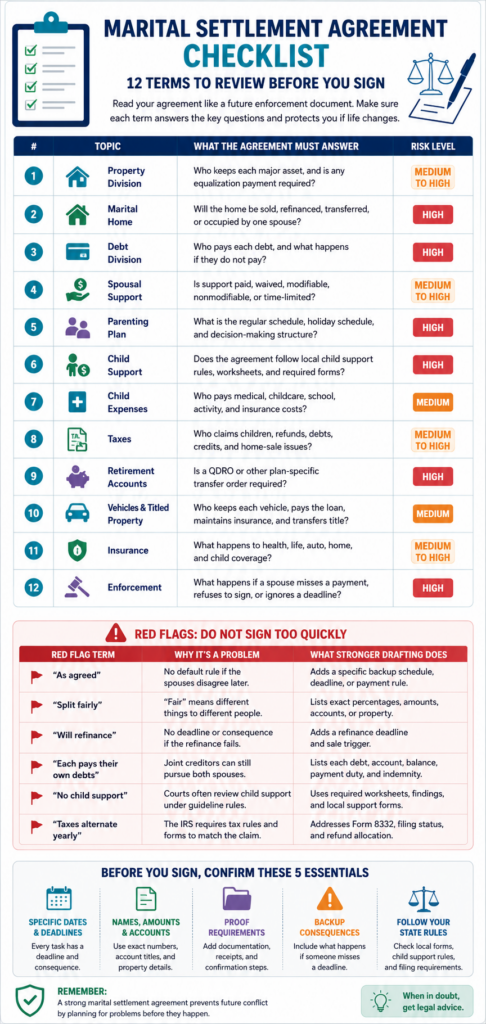
2. The 12-Part Review Checklist
Use this as a review map for your draft marital settlement agreement. These are the topics that most often need tightening in DIY drafts, not a ranked list of what goes wrong. Work through each one and confirm the agreement gives a clear answer.
| # | Topic | What the agreement should answer |
|---|---|---|
| 1 | Property division | Who keeps each major asset, and is an equalization payment owed? |
| 2 | Marital home | Sold, refinanced, transferred, or occupied by one spouse — and by when? |
| 3 | Debt division | Who pays each debt, and what happens if they do not? |
| 4 | Spousal support | Paid, waived, modifiable, nonmodifiable, or time-limited? |
| 5 | Parenting plan | Regular schedule, holiday schedule, and decision-making structure? |
| 6 | Child support | Does it follow local guidelines, worksheets, and required forms? |
| 7 | Child expenses | Who pays medical, childcare, school, activity, and insurance costs? |
| 8 | Taxes | Who claims the children, refunds, credits, and prior-year returns? |
| 9 | Retirement accounts | Is a QDRO or a plan-specific transfer order required, and for which account? |
| 10 | Vehicles and titled property | Who keeps each one, pays the loan, insures it, and transfers title? |
| 11 | Insurance | What happens to health, life, auto, home, and child coverage? |
| 12 | Enforcement | What happens if a spouse misses a payment, refuses to sign, or ignores a deadline? |
A workable agreement does not need dense legal language. It needs names, dates, dollar amounts, account details, deadlines, proof requirements, and a stated consequence when someone does not follow through.
3. Red Flags to Fix Before You Sign
Scan your draft for these patterns first. If one appears, slow down and rewrite that clause before signing the marital settlement agreement.
| Language in the draft | Why it can create problems later | What tighter drafting does |
|---|---|---|
| As agreed | There is no fallback if the spouses disagree later. | Adds a specific default schedule, deadline, or payment rule. |
| Split fairly | Fair means different things to different people. | Lists exact percentages, amounts, accounts, or items. |
| Will refinance | No deadline and no consequence if the refinance fails. | Adds a refinance deadline and a sale or fallback trigger. |
| Each pays their own debts | Joint creditors can still pursue both spouses. | Lists each debt, account, balance, payer, and indemnity. |
| We already divided everything | The agreement does not record who kept what. | Attaches an item list or a possession confirmation. |
| Retirement divided 50/50 | The plan may need exact order language and a defined date. | Names the plan, date, percentage, gains and losses, and who prepares the order. |
| No child support | Courts often apply guideline rules and required forms. | Uses the local worksheet, findings, and support forms. |
| Taxes alternate yearly | The return must follow the Code, not just the agreement. | Addresses Form 8332, filing status, credits, refunds, and tax debt. |
| Health insurance continues | Divorce can end eligibility under a spouse’s employer plan. | Addresses COBRA, child coverage, and any QMCSO. |
| Support waived forever | A waiver can be hard or impossible to undo. | States whether support is waived, modifiable, or nonmodifiable. |
| No enforcement clause | The agreement depends entirely on future cooperation. | Adds signing deadlines, cost-shifting, and court-enforcement language. |
The drafting standard is practical: if a court, lender, retirement plan, insurer, tax agency, title office, or employer will need to act on the agreement later, give them more than good intentions to work with.
4. Vague Language Is the Number One Problem
Across every section below, the most common weakness in a self-drafted separation agreement is vague language. Words like reasonable, soon, as needed, split fairly, and as agreed feel cooperative while you are getting along. They become the exact points of conflict when circumstances change.
Replace each one with a concrete answer: a name, a date, a dollar figure, an account, a deadline, a proof requirement, and a stated consequence. A good test for any clause is to ask, “if we stop cooperating tomorrow, could a stranger read this and know exactly what each of us has to do?”
5. Property Division and the Equalization Payment
Property division covers the marital home, other real estate, vehicles, bank and investment accounts, retirement accounts, furniture and personal property, business interests, cash, refunds, and digital assets. A strong clause states who keeps each item and whether either spouse owes the other money to balance the split.
Do not copy property language from a random online template. How property is classified and divided depends on whether you are in a community property state, an equitable distribution state, or a jurisdiction with its own family-property rules. The same facts can produce a different result and a different equalization payment in different courts.
If one spouse keeps more value, a complete clause identifies which assets are marital, community, or separate under local law; who keeps each asset; the value and valuation date used; any equalization payment and its due date; whether interest applies if payment is late; and whether a lien or court-enforcement provision is needed. For related reading, see uncontested divorce eligibility.
The Two-List Method for Household Goods
Furniture, tools, electronics, and appliances cause more day-to-day conflict than most couples expect. One practical way to divide ordinary household goods:
- One spouse sorts the household items into two lists of roughly equal value.
- The other spouse picks which list they want.
- High-value or disputed items are negotiated separately.
- The final selected list is attached to the marital settlement agreement.
Visual: The Two-List Method
Furniture, kitchen items, office desk, decor, and selected household goods.
Appliances, tools, electronics, garage items, and selected household goods.
Step 1: Spouse 1 builds both lists. → Step 2: Spouse 2 chooses first. → Step 3: The final list is attached to the agreement.
The spouse making the lists has an incentive to keep them balanced, because the other spouse chooses first. It works for ordinary goods, not for heirlooms, collectibles, jewelry, firearms, business equipment, or anything with disputed ownership — handle those separately.
Vehicles Need Loan, Title, and Insurance Language
A vehicle carries a title, often a loan, insurance, registration, and toll or ticket exposure, and those do not always line up. For each vehicle, state who keeps it, who pays the loan, who insures it, who handles the title transfer and by when, who covers registration and tickets, and what happens if the lender will not release the other spouse.
Transferring the title does not remove a spouse from the car loan. If both are on the loan, the agreement needs a lender-approved solution — a refinance, a payoff, or an assumption the lender allows.
6. The Marital Home: Deed Versus Mortgage
The home is where a divorce settlement agreement most often falls short, because two different documents control it. A deed affects ownership. A mortgage is the loan contract with the lender. Changing the deed does not change the mortgage. If both spouses signed the loan, both stay liable to the lender until the loan is refinanced, paid off, or formally assumed with the lender’s approval.
Visual: If One Spouse Keeps the Home
Keeps the home → refinance or assumption deadline → proof provided → if denied or missed → agreed fallback (list for sale) → listing process defined → net proceeds divided
A Refinance Clause Needs a Deadline and a Fallback
If one spouse keeps the home, the agreement should not simply say that spouse “will refinance.” Address who must refinance, the deadline, whether the other spouse must cooperate, what proof is required, what happens if the lender denies the application, and what happens if the deadline passes.
Illustrative concept only, not ready-to-sign language: The spouse keeping the home refinances or assumes the mortgage in their sole name within a set number of days after the judgment. If that is not done by the deadline, the home is listed for sale within a short fixed window unless both spouses agree in writing to extend.
Pick timelines that fit your situation and local practice, not a number from an article. Note also that a divorce-related transfer, a loan assumption, a release of liability, and a full refinance are separate requests to make to the servicer, each with its own rules. The Consumer Financial Protection Bureau has documented that homeowners often face delays and refusals from mortgage servicers after a divorce, so build in time and a fallback.
Your Agreement Does Not Bind the Lender
A marital settlement agreement assigns responsibility between spouses. It does not force a lender to release a borrower. If both names are on the mortgage, the lender can still look to both if payments are missed. That is exactly why home clauses need deadlines, proof requirements, and a fallback such as a sale trigger that spells out when to list, who selects the agent, how the price is set, how carrying costs are shared, and how proceeds are divided.
7. Debt Division and the Limits of a Spouse-to-Spouse Promise
Debt division states who pays which debts after divorce: credit cards, personal loans, car loans, the mortgage, medical bills, tax debt, student loans, lines of credit, and business debt. A strong clause names the creditor, the account type, the last four digits, the approximate balance, the responsible spouse, a payment deadline, an account-closure plan, and a consequence if payment is missed.
| Debt type | What the agreement should say |
|---|---|
| Joint credit cards | Who pays, when the account closes, and whether a balance transfer is required. |
| Mortgage | Who pays until sale or refinance, and what happens if a payment is missed. |
| Car loan | Who keeps the car, who pays the loan, and when refinance or title transfer happens. |
| Tax debt | Which tax year, which agency, the amount, and who pays. |
| Medical debt | Who incurred it, who pays it, and whether insurance reimbursement applies. |
| Student loans | Whether the loan is separate or marital under local law. |
| Business debt | Who is responsible and whether the other spouse is released or indemnified. |
In plain terms, indemnity means one spouse agrees to cover the other’s losses — late fees, interest, collection costs, credit damage — if they fail to pay a debt they took on.
Here is the limit you cannot draft around: the agreement is between the spouses. It does not bind a bank, card issuer, lender, or the tax agency. The Consumer Financial Protection Bureau explains that a divorce decree does not change your contract with a creditor: if your name is on a joint account, the creditor can still collect from you even when the decree assigns the debt to your ex. You are generally released only if the creditor releases you in writing or the account is refinanced out of your name. A joint borrower and an authorized user are also treated differently, and community-property rules add their own liability wrinkles. Where possible, close or refinance joint accounts rather than relying on a promise. For context, see why unclear terms can get divorce paperwork rejected or held up by a third party.
8. Spousal Support or Alimony
Spousal support is also called alimony or maintenance, depending on the jurisdiction. The agreement should state whether support is paid or waived, the amount, the schedule, the start and end dates, whether it is modifiable or nonmodifiable, and what happens if either spouse remarries, retires, becomes disabled, loses a job, or has a major income change.
Before You Waive Support
A support waiver can be difficult or impossible to reverse. Before waiving, confirm both incomes and budgets, earning capacity, health issues, childcare responsibilities, the length of the marriage, the local support standard, and whether the waiver would be modifiable or final. This deserves extra care when one spouse earned much more, one spouse stepped back from work to raise children, or one spouse lacks access to the financial records.
How Alimony Is Taxed
Federal tax treatment turns on the date of the instrument. Under the Tax Cuts and Jobs Act, alimony paid under a divorce or separation instrument executed after December 31, 2018 is not deductible by the payer and not included in the recipient’s income. The older rule — deductible to the payer, taxable to the recipient — applies only to instruments executed on or before that date and not later modified to adopt the new treatment. The details are in IRS Publication 504. Because the result depends on exact dates and wording, review support terms with a tax professional before signing.
9. Parenting Time and Decision-Making
If you have minor children together, the agreement needs clear parenting terms, which many courts require in a separate parenting plan. Cover where the child lives, how major decisions (school, medical, religion) are made, the weekday and weekend schedule, holidays and school breaks, transportation and exchange locations, communication between parents and with the child, travel, relocation, and how future disagreements are handled.
As Agreed Is Not a Schedule
Weak: The parents will share parenting time as agreed.
Stronger: Parent A has the child from Monday after school to Wednesday school drop-off. Parent B has the child from Wednesday after school to Friday school drop-off. The parents alternate weekends from Friday after school to Monday school drop-off.
Flexibility works only when there is also a written default schedule that takes over when the parents cannot agree.
Holidays Need Their Own Rules
Address the holidays your family actually observes — for example Thanksgiving, Christmas, Hanukkah, Eid, Lunar New Year, Diwali, New Year’s, spring break, summer, Mother’s Day and Father’s Day, and each child’s birthday. Without holiday rules, the weekly schedule will not answer the highest-conflict dates of the year. For broader planning, see the uncontested divorce process.
10. Child Support, Child Expenses, and Medical Coverage
Child support follows local guidelines, formulas, worksheets, and court rules. Parents can agree on many practical details, but the court may require guideline calculations, financial disclosures, worksheets, specific findings, or additional forms before approving the support terms, depending on the jurisdiction. California, for example, requires the agreement to cover all issues and a judge to enter the judgment; New York lists support forms that depend on the circumstances. Check your court’s rule before you assume anything.
Beyond the base amount, address the payment method and start date, health insurance for the child, uninsured medical and dental and vision costs, childcare, school fees, activities, and any post-secondary expenses your jurisdiction allows or requires.
You Usually Cannot Waive Child Support Privately
Do not assume you can waive child support by private agreement. In many places child support is treated as a right of the child, not only a matter between the parents, and a court can require guideline math, disclosures, or written findings before approving anything below guideline. Confirm the rule for your state or court before signing.
Health Coverage and the QMCSO
If a child needs coverage under a parent’s employer health plan, ask whether a Qualified Medical Child Support Order, or QMCSO, is needed. The U.S. Department of Labor describes a QMCSO as a medical child support order that a group health plan determines meets the requirements to cover a participant’s child. The plan administrator decides whether an order qualifies, and the rule applies to employer-sponsored (ERISA) group health plans.
A QMCSO is not automatically required just because the agreement says a parent will insure a child, and it is not available for every type of plan. If a specific order is needed and the agreement only says “Parent A will cover the child,” the coverage term may not work as written. Confirm the plan’s process before you rely on it.
11. Retirement Accounts, QDROs, and IRAs
Retirement clauses need precision because the agreement alone usually does not complete the transfer. Address which accounts exist (401(k), 403(b), IRA, pension, or similar), whether each spouse keeps their own, whether one spouse receives a share of the other’s, the percentage or dollar amount, the valuation date, treatment of gains and losses and any plan loans, who prepares the transfer order, who pays the preparation fee, and the tax consequences.
A Qualified Domestic Relations Order, or QDRO, is a federal mechanism for employer-sponsored plans covered by ERISA and the Internal Revenue Code — a private 401(k), 403(b), or most private pensions. The U.S. Department of Labor explains that a QDRO creates or recognizes an alternate payee’s right to receive part or all of a participant’s plan benefits, and the plan administrator is the party that first decides whether an order is qualified. A QDRO is not the right tool for every account:
- An IRA is divided as a “transfer incident to divorce” under the decree or agreement, not by QDRO. Done incorrectly, the transfer can be taxed. See IRS Publication 504.
- Federal, state, and military retirement systems use their own order types and rules, not a private-plan QDRO.
- Each covered plan has its own written QDRO procedures. Get them before you draft the clause, so the wording matches what the administrator will accept.
Split 50/50 Is Too Vague
Does 50/50 mean the balance on the date of separation, the date of divorce, or the date the order is processed? Contributions during the marriage only, or the whole account? Before or after account loans? Which account, if there are several? A one-line split often fails at the plan-administrator stage. Name the plan, the date, the method, and who is responsible for preparing and filing the order.
12. Taxes: Dependents, Form 8332, Refunds, and Debts
A thorough agreement addresses four tax triggers: children and dependency claims, refunds and tax debts, spousal support, and home-sale or property-transfer issues. State who claims each child, who claims child-related credits, how refunds and any tax debt are divided, who files or signs any prior-year return, and whether a tax professional must be consulted.
For federal purposes, only one taxpayer can claim a given child for a tax year. The custodial parent — the one the child lived with for more nights — normally claims the child. The noncustodial parent can claim the dependent only if the custodial parent signs Form 8332 (or a substantially similar statement) and it is attached to the return. Two limits matter when you draft:
- For a decree or agreement executed after 2008, the noncustodial parent cannot attach decree pages instead of Form 8332, and the release cannot be conditioned on anything, including payment of support.
- Form 8332 moves only the dependency claim and the child tax credit or credit for other dependents. It does not transfer head-of-household filing status, the earned income credit, or the child and dependent care credit — an agreement cannot reassign those.
The agreement records what the parents intend; the return still has to follow current tax law. See IRS Publication 504 and IRS Form 8332.
13. Bank Accounts, Refunds, and Money That Arrives Later
Explain how checking, savings, and joint accounts, cash on hand, payment apps, and digital wallets are divided, including transfer deadlines and closing dates for joint accounts.
Do not stop at current balances. Also address money expected after signing: tax refunds, security deposits, insurance reimbursements, escrow refunds, settlement payments, bonuses, and pending payroll. If money is coming, the marital settlement agreement should say who gets it, when it must be paid over, and what proof is required.
14. Insurance: Health, COBRA, and Life Insurance
Address health, dental and vision, life, auto, and homeowners or renters insurance, plus coverage for the children.
If one spouse has been covered under the other’s employer plan, divorce usually ends that eligibility. Under COBRA, a divorce or legal separation is a qualifying event that lets a covered spouse and dependent children continue group coverage for up to 36 months — longer than the 18 months tied to a job loss or reduced hours. There is a catch: the U.S. Department of Labor explains that a qualified beneficiary must notify the plan of the divorce or legal separation within 60 days, then has 60 days to elect coverage. Miss the window and the right can be lost, so put the notification task in the agreement and on a calendar.
If one spouse will pay child support or spousal support, the agreement may require them to maintain life insurance as a backstop. If so, state the coverage amount, the policy owner, the beneficiary, how long coverage must continue, the proof of coverage required, and what happens if the policy lapses.
15. Merger Versus Survival: The Clause Most People Skip
Your agreement should say what happens to it when the divorce judgment is entered. Whether the agreement is incorporated into the decree, merges into it, survives as an independent contract, or does some combination — and how that affects enforcement and later modification — is governed by the decree, the agreement’s own wording, and the law of your jurisdiction. There is no single national rule.
The practical stakes: a merged agreement is generally enforced as part of the court order and modified under the court’s rules. A surviving contract may keep contract-based enforcement rights and can be harder to change. Massachusetts, for instance, distinguishes an agreement that is “incorporated but not merged” — it survives as a contract the Probate and Family Court cannot rewrite — from one that merges into the judgment. Before signing, confirm which treatment applies, which terms are modifiable, which are final, and which court keeps authority to enforce the agreement. If you do not understand this clause, get legal advice before you sign.
16. Enforcement and Follow-Through
Spell out what each spouse must do after signing: deadlines for payments, for signing deeds and titles, for refinancing, for listing property, for closing joint accounts, for transferring retirement funds, and for paying any preparation fees. Then say what happens if someone does not.
Illustrative concept: Each party signs the documents reasonably needed to complete the transfers in this agreement within a short set number of days after receiving them. If a party fails to sign, the other party may ask the court to enforce the agreement and to award reasonable costs and fees where local law allows.
The exact wording depends on local law, but the principle holds: do not leave future cooperation to chance.
17. Give Yourselves Time to Review Before Signing
No national law sets a required waiting period before you sign a marital settlement agreement, and a self-imposed pause does not by itself cure a problem with disclosure, fairness, or pressure. As a personal habit, though, it is worth giving each spouse a few days — a common suggestion is a couple of days or more — with the final version in hand before signing, especially when the agreement includes property transfers, a support waiver, child terms, retirement division, or home-refinance language.
A clean signing process usually includes a version clearly marked final, no edits slipped in after review, enough time to read and ask questions, and access to the underlying financial documents. Independent legal review is worth it when the terms are significant.
On the numbers themselves: before signing, check the balances in the agreement against the actual statements. How far back to look depends on the asset, the debt, the income period, and your local disclosure rule — a single recent statement may be enough for a simple account, while several months or more makes sense for income, a business, or an account one spouse controlled. Pull bank, card, loan, mortgage, and retirement statements, tax notices, and pay records, and reconcile them against the draft.
18. Simple Agreement Versus Professional Review
This is a guide to when a self-prepared agreement is realistic and when a review pays for itself — not a scored test. Getting help does not make your divorce contested; it just helps you understand what you are signing before it becomes harder to change.
| Issue | Self-help documents are more realistic when… | Get professional help when… |
|---|---|---|
| Children | The schedule and support are clear and guideline-based. | Custody, relocation, special needs, or safety concerns exist. |
| Home | The home is sold before divorce and proceeds are divided. | One spouse keeps the home, a refinance is needed, or both are on the mortgage. |
| Debt | Debts are separate or already paid. | Joint debts stay open after divorce. |
| Retirement | Each spouse keeps their own accounts. | A pension, 401(k), or QDRO is involved. |
| Support | Both spouses are self-supporting and understand the terms. | Large income gap, disability, a long marriage, or a support waiver. |
| Taxes | No children, no joint tax debt, no home sale. | Dependency claims, tax debt, alimony, or prior joint returns. |
| Business | No business exists. | One spouse owns a business or is self-employed. |
| Merger/survival | Local court forms clearly handle it. | You are not sure whether the agreement merges or survives. |
If several rows on the right apply to you, compare your options in online divorce versus a lawyer versus mediation before you sign.
19. What to Do Right After You Sign
Signing starts the follow-through stage. Three things to do the same day:
- Build a deadline list. Pull every date out of the agreement — payments, refinance, sale, account closures, title transfers, retirement transfers, insurance, document signings — and put them on a calendar now.
- Separate court tasks from life-admin tasks. Some steps belong to the divorce filing; others belong to banks, lenders, employers, plan administrators, insurers, and title offices. The court will not do the private ones for you.
- Save proof of completion. Keep signed deeds and titles, payoff and refinance letters, transfer confirmations, insurance notices, and emails confirming cooperation. If enforcement comes up later, proof is what you will need.
Visual: Court Tasks vs. Life-Admin Tasks
- File the signed agreement if required
- Submit the parenting plan if required
- Submit the child support worksheet if required
- Submit the final judgment paperwork
- Refinance or assume the mortgage
- Transfer the vehicle title
- Close the joint credit card
- Request the QDRO or IRA transfer
- Update insurance and beneficiaries
20. When to Get Legal Help
Even in an uncontested divorce, some situations call for advice. Talk to a family-law attorney if you do not understand the agreement, your spouse has a lawyer and you do not, you feel pressured to sign, there is abuse or financial control, you are giving up property or support, child support does not match local guidelines, there are major debts, you own a home or business, retirement accounts are involved, a QDRO or QMCSO is required, one spouse may be hiding income or assets, or you do not follow the tax consequences or the merger-versus-survival language.
Depending on the issues, you may also want a tax professional, a financial advisor, a mediator, a pension or QDRO specialist, or a real estate professional.
21. How PlainDivorce Fits Into the Process
When a divorce is cooperative, the hard part is usually not conflict — it is organizing the details so the paperwork holds up. PlainDivorce self-help uncontested divorce kits are built to help with that: the aim is to give you the documents that fit your location and situation, plus checklists and plain-language guidance to keep the pieces in order. If you know where you will file, start with your state guide, such as uncontested divorce in California or uncontested divorce in Texas.
PlainDivorce is not a law firm and does not give legal advice. If your situation involves a home refinance, retirement division, a support waiver, a business, possible hidden assets, family violence, disputed parenting terms, a QMCSO, a QDRO, or merger-versus-survival language you do not understand, legal advice is the safer path. To weigh your options first, read online divorce versus a lawyer versus mediation.
22. Marital Settlement Agreement FAQ
What is a marital settlement agreement in simple terms?
It is a written contract between divorcing spouses that spells out how they will handle property, debts, support, parenting, child expenses, taxes, insurance, and the follow-up tasks after the judgment. When it is complete and approved, a judge does not have to decide those issues.
Is a marital settlement agreement the same as a divorce settlement agreement?
Usually, yes. Most people use marital settlement agreement and divorce settlement agreement to mean the same document. The exact name depends on the court and the jurisdiction, and some places use a different term entirely.
What else can a marital settlement agreement be called?
Depending on where you file, you may see separation agreement, property settlement agreement, settlement agreement, uncontested divorce agreement, or parenting plan. Some courts also require separate forms for parenting, support, or financial disclosure alongside the main agreement.
Do we need a marital settlement agreement for an uncontested divorce?
Not always. A case can be uncontested when one spouse signs a short affidavit consenting to the divorce, or simply does not respond and the case proceeds by default. But if you have property, debt, retirement accounts, children, or support to resolve, a written agreement is how those issues get settled, and some courts require specific agreements or forms.
Can we write our own marital settlement agreement?
Many spouses prepare their own using court forms, self-help materials, mediation, or a document kit. It still has to meet local requirements and be specific enough to enforce. Complex issues — a business, a pension, a support waiver, possible hidden assets — are worth a professional review before signing.
What happens if my spouse does not follow the agreement?
It depends on whether the court approved or incorporated the agreement, whether it merged or survived, and what local law allows. Options can include mediation, a motion to enforce, a contempt proceeding, a reimbursement claim, or a separate breach-of-contract action. A clear enforcement clause and saved proof of completion make any of these easier.
Can a marital settlement agreement be changed later?
Some terms can change; others are final. Parenting and child support are often modifiable when circumstances change, while property division is usually final. The rules depend on your jurisdiction, the wording of the agreement, and whether it merged into the judgment or survived as a separate contract.
What is a QDRO, and does it cover every retirement account?
A QDRO, or Qualified Domestic Relations Order, is a federal order used to divide employer-sponsored retirement plans covered by ERISA, such as a private 401(k) or pension, and the plan administrator decides whether it qualifies. It is not used for an IRA, which is split as a transfer incident to divorce, and federal, state, and military retirement systems use their own order types. Ask each plan for its written procedures before drafting.
What does merger versus survival mean in a divorce agreement?
Merger generally means the agreement becomes part of the divorce judgment and is enforced and modified as a court order. Survival generally means it continues as a separate contract, at least for some terms, which can affect how it is enforced and how hard it is to change. Which applies depends on the decree, the agreement’s wording, and local law, so confirm it before signing.
Should we wait before signing a marital settlement agreement?
No law requires a waiting period, and a pause alone does not fix a fairness or disclosure problem. As a personal practice, giving each spouse a few days with the final version — and time to verify the numbers and ask questions — helps reduce later disputes about pressure or surprise terms.
23. Bottom Line: The Agreement Should Survive Real Life
A marital settlement agreement should not depend on perfect memory or perfect cooperation. The strongest agreements answer practical questions in advance: Who pays? Who signs? By when? From which account? What proof is required? What happens if someone does not comply, and who covers the cost of fixing it?
Before you sign, make sure you understand what the agreement says, what it leaves out, and what still has to happen after the divorce is final. If the issues are simple and cooperative, organized self-help documents can be enough. If they are complex, unclear, or high-stakes, legal or financial help before signing can prevent much larger problems later. Next, choose the uncontested divorce process guide to see how the agreement fits into filing.
Sources and local rules can change. Use this guide as a plain-English organizer, then verify the current filing requirements with the official court or government source for your jurisdiction.

About Harry D
Expert contributor at PlainDivorce, helping Canadians and American navigate simple uncontested divorces with clarity and confidence.