The uncontested divorce process runs in nine stages: confirm where you can file, settle the four core issues, exchange financial disclosure, prepare the forms, build a clerk-ready packet, file the case, give legal notice, clear the waiting period or review, and receive the final judgment. A divorce is uncontested when the other spouse either agrees and signs, or is served correctly and never responds. This guide is a checklist to adapt to your court—not a set of rules that fit every jurisdiction.
New to the topic? Start with what is an uncontested divorce, check uncontested divorce eligibility, and if you are not sure which category your case is in, read uncontested vs contested divorce.
TL;DR
An uncontested divorce is a court procedure, not a relationship status. A friendly couple can still get a filing rejected; a tense couple can still finish one. Nine stages, and these are the points where people actually get tripped up.
- Two routes get you to a judge: the agreed route (both sign) and the default route (served correctly, no response). Knowing which one you’re on changes the service rules, the waiting periods, and what you must prove.
- A discovery waiver is not a disclosure waiver. These are different things, and in many places the mandatory financial forms cannot be waived no matter how much you trust each other. Prepare as if a judge will ask: how do we know both spouses had enough information to agree?
- The clerk is the first gate, not the judge. Signatures, notarization, cover sheets, e-filing codes, even stapling — a packet can bounce before anyone reads the merits.
- “I filed” by text is not legal service. In a default case especially, service is where the whole thing is won or lost.
- The agreement and the proposed judgment must match, line by line. If they don’t, the court may bounce it — or sign an order that isn’t what either of you thought you agreed to.
- The judgment doesn’t move your assets. A house transfer still needs a deed; a workplace retirement plan still needs a QDRO — and the plan administrator, not the judge, decides whether it qualifies. IRAs and government plans use different mechanisms entirely.
- Don’t confuse the judgment with the certificate. The decree ends the marriage; a certificate of divorce is usually a separate vital-records document.
- Digital assets get forgotten: shared cloud storage, password managers, crypto wallets, domains, monetized accounts, loyalty points. Name them and say who keeps what.
- Keep legal strategy out of public AI tools. A February 2026 federal ruling (United States v. Heppner) found one defendant’s consumer chatbot exchanges were not privileged.
- A joint petition isn’t a shortcut. California’s new one (effective January 1, 2026) still requires disclosure, a written agreement, a filed judgment, and the full six-month wait.
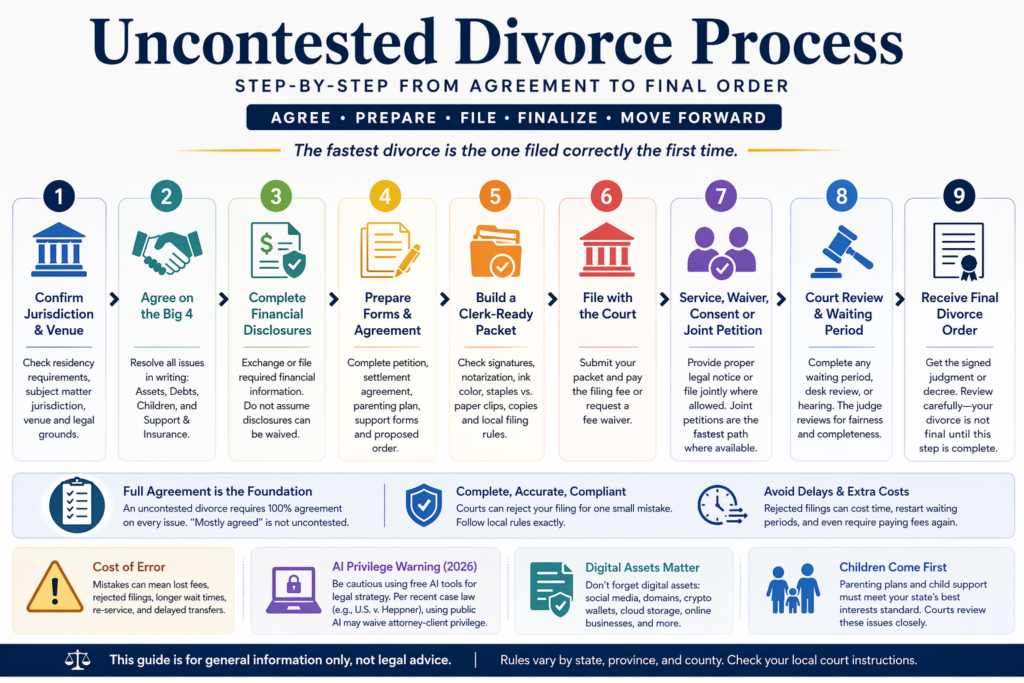
1. The Uncontested Divorce Process, Step by Step
An uncontested divorce is a court procedure, not a relationship status. A friendly couple can still have a filing rejected, and a tense couple can still finish an uncontested case if the required issues are resolved and the court’s rules are followed. Here is the whole arc.
| Step | What you do | Where it commonly goes wrong |
|---|---|---|
| 1. Confirm the court’s authority | Check residency or domicile, subject-matter jurisdiction, venue, and grounds | Filing in the wrong state, province, or county wastes the fee and time |
| 2. Settle the four issues | Reach terms on property, debts, children, and support—or plan for a default case | “Mostly agreed” is not the same as ready to finalize |
| 3. Complete financial disclosure | Exchange or file the financial information your court requires | Some disclosures cannot be waived; missing ones stall the case |
| 4. Prepare the documents | Petition or joint petition, agreement, parenting and support forms, proposed judgment | Wrong forms, missing signatures, or an agreement that does not match the proposed order |
| 5. Build a clerk-ready packet | Follow local rules on signatures, notarization, copies, e-filing codes, and attachments | A clerk can bounce the packet before a judge ever sees it |
| 6. File and pay or waive the fee | Submit the packet; pay the filing fee or apply for a fee waiver | A rejected filing can send you back to an earlier step |
| 7. Give legal notice | Serve the other spouse, obtain a signed waiver or consent, or file jointly | A text saying “I filed” is not legal service |
| 8. Clear the waiting period or review | Wait out any required period; pass a desk review or short hearing | The judge may send paperwork back for corrections |
| 9. Receive the final judgment | Get the signed judgment, decree, or order and read it against your agreement | The divorce is not final until this document is entered |
Local checklist:
Before you file, match every step below to the forms, filing method, service rules, waiting periods, and review process published by your own court.
2. Two Ways an Uncontested Divorce Reaches a Judge
“Uncontested” describes how the case ends, not whether the spouses are on good terms. Most courts allow an uncontested judgment through one of two routes.
- The agreed route (consent or joint filing). Both spouses take part. They sign a written settlement, one spouse signs a waiver or consent (or they file a joint petition), and the court is asked to approve the terms. This is the route the checklists in this guide describe in most detail.
- The default route (no response). One spouse files and serves the other correctly. If the served spouse does not answer within the response period, the filing spouse can ask the court to finish the case by default. New York’s official materials, for example, describe an uncontested divorce where the defendant either signs the papers or is served and fails to answer. The default route has its own notice, proof, and waiting requirements, and the terms usually track what the filing spouse requested.
Knowing which route you are on matters, because the steps for service (Step 7), the waiting periods (Step 8), and what you must prove at review or a hearing all differ between an agreed case and a default case. For the underlying framework, U.S. readers can start with a state court’s self-help site and Canadian readers with the federal Divorce Act.
3. Are You Ready to File? A Readiness Check
Work through these questions before you prepare documents. A “no” does not disqualify your case—it points to what still needs work or where advice would help.
- Do you have a legal basis to file where you plan to file (residency or domicile), and do you know the correct venue—county, district, parish, or region?
- Does your jurisdiction’s grounds requirement fit your situation (usually no-fault: irretrievable breakdown or a separation period)?
- Have you and your spouse agreed on property and asset division—or are you planning a default case because your spouse will not participate?
- Have you agreed on responsibility for every debt?
- Have you addressed spousal support, alimony, or maintenance—including a decision to waive it, if that is allowed and understood?
- If you have children, have you settled parenting time, decision-making, child support, and child-related expenses to the standard your court applies?
- In an agreed case, is each spouse willing to sign the required papers freely, without pressure or fear?
- Are you prepared to complete the financial disclosure your court requires, even if the divorce is friendly?
- Do you understand that the court can still reject incomplete or improperly prepared paperwork?
If your spouse will not sign but has not been served yet, your case is not contested—it is a potential default case, and the steps below still apply with the service and proof rules for that route.
4. What Filing Mistakes Actually Cost
A mistake in an uncontested divorce is rarely just annoying. Depending on the court and the type of error, a rejected or incomplete filing can mean:
- paying a filing fee again
- correcting and resubmitting the packet, then waiting for a fresh clerk review
- restarting or extending a required waiting period
- losing a hearing date and waiting for the next one
- re-serving the other spouse
- redoing notarization, signatures, child support worksheets, or disclosure forms
- delaying real estate transfers, retirement division, name changes, or remarriage plans
- creating future disputes over vague settlement language
Not every mistake causes all of these, and local rules decide what actually happens. But the risk is real: a “simple” divorce becomes slow and expensive when the paperwork is treated casually. A complete, compliant filing is what avoids preventable delay.
Practical rule:
Treat an uncontested divorce as a court packet that has to survive clerk review, legal-notice rules, judicial review, and final-order processing—not as “easy paperwork.”
5. Step 1: Confirm Residency, Jurisdiction, and Venue
Before you draft anything, confirm the court has authority to handle your divorce. That usually means checking:
- subject-matter jurisdiction—whether that court can decide divorce cases at all
- residency or domicile—whether one or both spouses have the required connection to the state, territory, or province, and for how long
- venue—the proper local court within that system (often the county or district where a spouse lives)
- grounds—irretrievable or irremediable breakdown, a no-fault separation period, or another accepted basis
- whether a joint filing is available, and whether children or certain assets trigger extra forms or disclosures
Residency and venue are related but different. Residency asks whether you can file in the jurisdiction at all; venue asks which local court is the correct place. A filing-location mistake can waste the fee and delay the whole case, so do not rely on a general article for this step.
For authoritative local requirements, use your court’s divorce self-help page, its family-law forms list, its filing-fee schedule, and its service and fee-waiver instructions. A court self-help center is also the best first stop for the rules this guide cannot supply. Canadian readers should review the federal Divorce Act alongside their province or territory’s court instructions, especially where parenting, support, or jurisdiction questions are involved.
6. Step 2: Settle Property, Debts, Children, and Support
In an agreed case, the court needs a written settlement that resolves every required issue. In a default case, the filing spouse still has to state what they are asking for on each of these issues, and a judge still reviews whether it is acceptable—particularly for children and support.
Property and Digital Assets
Property can include bank and investment accounts, vehicles, real estate, retirement accounts and pensions, business interests, and valuable personal property. It also includes digital assets that are easy to overlook:
- cryptocurrency wallets and exchange accounts
- domain names, monetized websites, and online stores
- business social media accounts and creator channels
- shared cloud storage and digital photo libraries
- loyalty points, travel rewards, and stored-value accounts
- intellectual property and royalties
A shared cloud account can hold tax records, business files, saved passwords, and private communications. A domain or handle can be tied to a business. A crypto wallet can hold value that is hard to trace later. Name these assets in the agreement and say who keeps what.
Some transfers need a document beyond the divorce judgment. A house transfer usually needs a deed, such as a quitclaim deed or another locally accepted form. Dividing a workplace retirement plan—a 401(k), 403(b), or pension—usually needs a Qualified Domestic Relations Order (QDRO). A QDRO applies to plans governed by federal pension law (ERISA); an IRA is divided instead as a “transfer incident to divorce” under the decree, and government or military retirement plans use their own order formats. A QDRO does not have to be a separate order—it can be part of the decree or the court-approved property settlement—and the retirement plan administrator, not the divorce judge, decides whether the order actually qualifies. The U.S. Department of Labor’s QDRO guidance explains the requirements.
If real estate, retirement accounts, a business, cryptocurrency, or other higher-value assets are involved, consider a document review or limited legal advice before you sign. A basic divorce packet does not automatically complete title transfers or retirement division.
Debts
Debt terms should be specific. Address credit cards, personal and family loans, mortgages, vehicle loans, tax debts, medical bills, lines of credit, buy-now-pay-later balances, and business debts by name and account.
A divorce agreement can divide responsibility between spouses, but it does not rewrite the lender’s contract. If both names are on a loan, the creditor can still treat both people as responsible until the account is refinanced, paid, closed, or otherwise changed. The Consumer Financial Protection Bureau explains this in its guidance on a joint debt after divorce.
Children
If you have children, the agreement or parenting plan may need to cover the parenting schedule, decision-making authority, child support, health insurance, uncovered medical costs, childcare and school expenses, transportation, holidays, communication between parents, and access to school and medical portals.
Courts review child-related terms against a legal standard, and a judge can decline to approve terms that do not meet it—even when both parents agree. Child support is usually set by a guideline formula, and many courts will not simply rubber-stamp a number the parents picked. Check the official child support rules where you file. In Canada, the Federal Child Support Guidelines are made under the Divorce Act and govern child support in a divorce; provincial and territorial guidelines apply to other family proceedings, and local court rules still apply.
Support and Health Insurance
Spousal support, alimony, or maintenance terms should state the amount, frequency, start and end dates, payment method, and whether the amount can change later. Giving up support can have long-term consequences, and whether an order can be modified later depends on local law and the exact wording of the final order.
Health insurance belongs in this conversation too. A spouse covered under the other’s plan may lose that coverage at divorce and need to review employer coverage, a marketplace plan, or COBRA continuation. Address coverage for the children as well.
7. Step 3: Complete Financial Disclosure
Financial disclosure is where many “simple” divorces stall. Depending on where you file, spouses may need to disclose income, bank accounts, real estate, vehicles, retirement accounts and pensions, debts, monthly expenses, tax information, business interests, insurance, crypto holdings, online business income, and stock or deferred compensation.
Some spouses skip disclosure because they trust each other. That can be a costly assumption. In many jurisdictions, financial disclosure is required even in an uncontested case; in some places certain disclosures can be waived and in others they cannot; and a court can reject the paperwork if a required financial form is missing. Incomplete disclosure also creates a future opening for one spouse to claim they did not understand the finances before signing.
Courts that require detailed disclosure often use a standard form. California’s Income and Expense Declaration (FL-150) and New York’s Statement of Net Worth are two examples of the kind of financial detail a court may want—they are illustrations, not a nationwide requirement, and your court may use something different or nothing at all.
Mandatory Disclosure vs. Discovery
Mandatory disclosure is the financial information a court requires the spouses to exchange or file. Discovery is a broader set of formal tools—requests for documents, written questions, depositions—that a party can use to get information. Discovery is not only for a courtroom fight: a spouse can use it to obtain the information needed to negotiate an agreement.
In an uncontested case, spouses often waive formal discovery because they are resolving everything by agreement. A discovery waiver does not automatically waive the mandatory disclosure forms, and neither waiver excuses hidden income, missing assets, or misleading information. Whether a particular waiver is effective depends on your court’s rules, not on the label on the case.
Practical rule:
Even in a friendly divorce, prepare as if a judge will ask: how do we know both spouses had enough financial information to agree?
Keep Legal Strategy Out of Public AI Tools
Be cautious about typing legal strategy, settlement positions, negotiation limits, or abuse details into free or public AI tools. In United States v. Heppner, a February 2026 ruling of the U.S. District Court for the Southern District of New York, the court held that a defendant’s written exchanges with the consumer version of an AI chatbot were not protected by attorney-client privilege or the work-product doctrine—because the exchanges were not with a lawyer, were not kept confidential, and were not made at a lawyer’s direction. You can read the court’s order directly.
That decision turns on its facts—it does not mean every AI use waives privilege in every case—but the caution is simple: do not assume a public AI chat is private, privileged, or beyond the reach of discovery. Keep confidential legal strategy, hidden-asset concerns, and lawyer communications out of public tools, and if you are working with a lawyer, ask which tools are safe to use.
8. Step 4: Prepare the Petition, Agreement, and Proposed Judgment
The exact forms depend on where you file, but an uncontested divorce packet often includes:
- a petition, complaint, or application for divorce—or a joint petition, where available
- a summons or notice document
- an acceptance, acknowledgment, waiver of service, or consent
- financial disclosure forms
- a settlement or separation agreement
- a parenting plan and child support worksheet, if children are involved
- affidavits or sworn statements, including the ones a default case requires
- a proposed final judgment, decree, or divorce order
Do not assume forms are interchangeable. A form that works in one state, province, or county can be rejected in another. Use your court’s current official forms.
Writing a Settlement Agreement a Court Will Accept
A settlement agreement should be clear enough for a court to approve and for both spouses to follow years later. Trade vague promises for specific ones.
| Weak language | Stronger language |
|---|---|
| “We will divide expenses fairly.” | “Spouse A will pay the Visa account ending 1234 and hold Spouse B harmless from that debt.” |
| “We will share time with the children.” | “The children will be with Parent A on alternating weekends from Friday after school to Monday drop-off.” |
| “We will each keep our online accounts.” | “Each spouse keeps sole access to accounts in that spouse’s individual name, and both will remove the other from shared cloud storage, password managers, and subscriptions by [date].” |
Clear language reduces confusion and makes the final order easier to enforce if a dispute comes up later.
The Proposed Judgment
The proposed final judgment must match the settlement agreement. If the agreement says one thing and the proposed order says another, the court may send it back—or sign an order that does not reflect what both spouses thought they agreed to. Before filing, compare the two documents line by line: names, dates, property descriptions, support terms, and parenting language.
9. Step 5: Assemble a Clerk-Ready Filing Packet
Court clerks review filings for compliance before a judge sees the case. In some courts and e-filing systems, a single missing signature, a wrong attachment, or an incorrect filing code is enough to send the packet back. Whether that happens—and how strict the review is—varies by court, so check your clerk’s and e-filing system’s instructions for:
- original vs. electronic signatures, and ink color if specified
- notarization and witness requirements
- one-sided vs. double-sided printing, and stapling vs. paper clips
- required cover sheets, case information statements, and confidential-information forms
- child support worksheets and parenting plan attachments
- proposed order format, number of copies, and self-addressed stamped envelopes
- e-filing document categories, file-size limits, and exhibit labels
- whether sensitive data must be redacted or placed on a separate confidential form
Clerk-ready rule:
Read the court’s filing instructions like a recipe. If it says attach, attach. If it says do not staple, do not staple. If it says notarize before filing, notarize before filing.
10. Step 6: File the Case and Pay or Waive the Fee
Filing opens the court case. Depending on the court, you may file online, in person, by mail, or through an approved filing service. You will usually pay a filing fee; if you cannot afford it, many courts offer a fee waiver, deferral, or indigency application. A waiver is not automatic—you may need to submit income, expense, or benefit information.
After filing you may receive a case number, stamped copies, a summons, an e-filing confirmation, service instructions, a hearing date, a correction request, or a rejection notice. If you get a rejection or correction notice, read it closely—the court usually tells you what is missing, but it will not draft the fix for you.
11. Step 7: Give Legal Notice, or File a Joint Petition
Almost every court needs proof that the other spouse had proper notice of the case. In an uncontested divorce, that can happen through:
- formal service by an approved server or by sheriff
- acceptance or acknowledgment of service signed by the other spouse
- a waiver of service
- a consent or appearance filing
- a joint petition or joint application, where the spouses start the case together
- a default, after proper service and no response within the deadline
Do not rely on casual notice. A text message saying “I filed” does not replace formal service unless a local rule specifically allows it. A waiver of service means the other spouse accepts notice without formal delivery; it does not by itself waive financial disclosure, waiting periods, child support review, or the right to receive filed documents.
If you are proceeding by default, the service step is where the case is won or lost: the court will only enter a default judgment if service was done exactly the way the rules require and the response period has run out. Keep every proof-of-service document.
The Joint Petition Path
Where it is available, a joint petition can be the cleanest filing path for spouses who already agree. Instead of one spouse filing against the other, both start the case together, which can lower the adversarial feel and skip some service steps because both spouses are participating from the start.
It is not a shortcut around disclosure, settlement terms, child support review, waiting periods, or judgment paperwork. California is one example: since January 1, 2026, spouses or partners can file a single joint petition (California’s forms are FL-700 and FL-710, with FL-105 where there are children under 18). California’s self-help materials are explicit that the joint petition does not finish the divorce—the spouses still complete financial disclosure, sign a written agreement, prepare and file the judgment, and wait out the six-month period. California readers can also see the California uncontested divorce kit.
Local rule checkpoint:
If your jurisdiction offers a joint petition, check whether it actually changes the service requirements or just changes how the case begins.
12. Step 8: Waiting Period, Court Review, or Hearing
Uncontested does not mean immediate. Depending on where you file, there may be a waiting period after filing, a response period after service, a separation period, a desk review, a judicial review, a short hearing, and a correction window—plus an effective date after the order is signed.
Some uncontested divorces are decided on the paperwork alone—this may be called a desk divorce, divorce by affidavit, administrative review, or default review. Others require a brief hearing where the judge confirms filing eligibility, valid service or waiver, the voluntariness of the agreement, financial disclosure, parenting terms, child support, and property and debt division.
A short hearing is not a trial, but prepare for it: bring identification, filed copies, proof of service or the signed waiver, financial forms, the settlement agreement, and anything the court’s instructions list. In a default case, be ready to prove up the facts in your petition.
13. Step 9: Read and Audit the Final Judgment
Your divorce is not final when you sign the settlement agreement, and not final when you file. It is final only when the court enters the operative final document. Depending on where you file, that document may be called a final judgment, judgment of divorce, divorce decree, divorce order, or final order.
Identify which document is the operative one in your jurisdiction, and do not confuse it with a certificate. In many places a certificate of divorce or certificate of dissolution is a separate vital-records or proof document—useful for changing a name or remarrying, but not the order that actually dissolves the marriage. Some jurisdictions also require a separate registration step with a vital-records office.
When the judgment arrives, check it against your settlement agreement line by line. Clerical errors happen—names, dates, property descriptions, support terms, and parenting language should match what the court approved. Also check for a separate effective date, an appeal period, or post-order waiting rules before you treat remarriage, a property transfer, or account changes as safe.
14. After the Divorce: Paperwork People Forget
The final order ends the marriage, but it does not automatically transfer every asset or update every outside company’s records. You may still need to:
- record a deed for real estate and transfer vehicle titles
- complete a QDRO or other retirement order and submit it to the plan
- refinance, pay off, or close joint debt, and close joint accounts
- update beneficiary designations on life insurance and retirement accounts
- change health insurance and review COBRA or other continuation coverage
- update tax withholding and estate-planning documents
- change names on utilities, leases, and mortgages
- separate shared cloud storage and revoke shared password-manager access
- update business domain ownership and access to monetized accounts
- request certified copies of the final judgment
Taxes: Filing Status and Who Claims the Children
For U.S. taxpayers, filing status follows marital status on December 31: if your divorce is final by the last day of the year, you are treated as unmarried for that whole tax year; if not, you are still married for tax purposes. See the IRS filing-status guidance.
A parenting plan or decree can say which parent claims a child, but it does not settle the federal tax question by itself. Under IRS Publication 504, for a decree that took effect after 2008 the noncustodial parent generally needs the custodial parent’s signed Form 8332 (or a substantially similar unconditional release) to claim the child; pages from the decree cannot be substituted. A release also does not transfer every benefit—head-of-household filing status, the Earned Income Credit, and the child-and-dependent-care credit stay with the custodial parent.
15. Glossary of Uncontested Divorce Terms
- Petitioner / Plaintiff / Applicant. The spouse who starts the case by filing the first papers.
- Respondent / Defendant. The spouse who receives the papers and can respond. In a joint petition, the spouses are not framed as opponents.
- Pro se / Self-represented litigant. A person handling their own case without a lawyer.
- Default. A judgment entered because a validly served spouse did not respond in time. A default case can still be uncontested.
- Decree / Judgment. The final court order that dissolves the marriage. Named differently by jurisdiction.
- Certificate of divorce. A separate vital-records or proof document in many jurisdictions—not the order that ends the marriage.
- Stipulated / settlement agreement. The spouses’ written agreement resolving the divorce issues, which the court can review and incorporate into the judgment.
- Venue. The correct local court—county, district, parish, or region—for filing.
- Irretrievable breakdown. A common no-fault basis for divorce: the marriage has broken down and cannot be repaired. Exact wording varies.
- Waiver of service. A document showing a spouse accepts notice without formal delivery. It does not waive other legal requirements.
- Discovery waiver. An agreement not to use formal information-gathering tools. Different from mandatory financial disclosure.
- QDRO. Qualified Domestic Relations Order—used to divide certain employer retirement plans; the plan administrator decides whether it qualifies.
16. When to Get Legal Help
Consider legal advice—often just a consultation or a document review, not full representation—if:
- you feel pressured to sign, or there has been abuse, intimidation, or coercive control
- you do not understand the finances, or your spouse has more financial information than you
- you suspect hidden assets
- either spouse owns a business, a pension, or a retirement account, or you own real estate
- you have cryptocurrency, stock options, or complex digital assets
- you have significant debt, or you are waiving support or major property rights
- you disagree about parenting or support, or one spouse lives in another country
- you do not understand the tax impact of the agreement
Many people use limited-scope help for one piece—document review, a QDRO, a real estate transfer, or advice on a single high-risk issue. To weigh your options, see online divorce vs lawyer vs mediation. If your case may not be fully uncontested, read uncontested vs contested divorce before you file.
17. Uncontested Divorce Process FAQ
How long does the uncontested divorce process take?
It depends on your jurisdiction’s waiting period, the response period after service, the court’s workload, whether children are involved, and whether the paperwork is accepted the first time. A complete, compliant filing moves faster than a rejected packet that has to be corrected and resubmitted. Check your court’s published waiting periods for a realistic estimate.
Do both spouses have to agree for a divorce to be uncontested?
No. A case is uncontested if the other spouse agrees and signs, or if that spouse is served correctly and does not respond by the deadline. The second path is a default, and most courts still treat it as uncontested. A default case has stricter service and proof rules, and the terms usually follow what the filing spouse requested.
Can we skip financial disclosure if we trust each other?
Often not. Many courts require financial disclosure even in an uncontested case. Some allow limited waivers; others do not. A court can reject the filing if a required financial form is missing, and incomplete disclosure gives one spouse room to challenge the agreement later. Check your court’s rules before assuming disclosure can be waived.
What is the difference between a waiver of service and a discovery waiver?
A waiver of service deals with how the other spouse receives legal notice—it lets them accept the papers without formal delivery. A discovery waiver deals with formal information-gathering tools like document requests and depositions. Neither one waives mandatory financial disclosure or the court’s own review of the case.
Do we have to go to a hearing?
It depends on the jurisdiction. Many uncontested divorces are decided on the paperwork through a desk review, an affidavit process, or a default review. Others require a short hearing where the judge confirms service, the voluntariness of the agreement, disclosure, and any child-related terms. Your court’s self-help page will say which applies.
Is the divorce final the day the judge signs?
Not always. Some jurisdictions add an effective date, an appeal period, or a post-order waiting rule before the divorce takes full effect, and a separate certificate or registration step may follow. Read the final judgment and your court’s instructions before treating remarriage, property transfers, or account changes as safe.
Who claims the children on taxes after divorce?
For U.S. taxpayers, the custodial parent generally claims the child. For a decree that took effect after 2008, the other parent needs the custodial parent’s signed IRS Form 8332 or a similar unconditional release; the decree alone is not accepted. A release does not move head-of-household status, the Earned Income Credit, or the dependent-care credit, which stay with the custodial parent.
Can we use AI to write our divorce agreement?
Be careful. Public AI tools may not protect confidential legal strategy or lawyer-directed work product—a 2026 federal court ruling, United States v. Heppner, found that one defendant’s chatbot exchanges were not privileged on those facts. Keep hidden-asset concerns, negotiation limits, abuse details, and attorney communications out of public AI tools unless a lawyer has told you a specific tool is safe.
18. Bottom Line
The uncontested divorce process is simpler when both spouses agree, but it is still a formal court procedure—and it also covers the default route, where a served spouse never responds. The strongest cases are complete, properly disclosed, correctly served, and filed in a clerk-ready packet.
Start by settling property, debts, children, and support—or by planning the service and proof a default case needs. Then match every step above to your own court’s forms, filing method, and waiting periods. Once you know your local rules, you can decide whether a self-help kit, an online service, limited lawyer review, or full representation is the right next step. Check your jurisdiction with a PlainDivorce kit for Texas, California, New York, or Ontario.
PlainDivorce provides self-help divorce information and document kits. It is not a law firm, and this article is not legal advice. Divorce law and procedure vary by state, province, and territory and change over time. For advice about your situation, consult a licensed family lawyer in your jurisdiction.
Sources and local rules can change. Use this guide as a plain-English organizer, then verify the current filing requirements with the official court or government source for your jurisdiction.

About Harry D
Expert contributor at PlainDivorce, helping Canadians and American navigate simple uncontested divorces with clarity and confidence.