Yes, you can get an uncontested divorce with children. It happens two ways: both parents sign a full parenting and child-support agreement (an agreed or joint divorce), or one parent is served, files no response, and the case moves forward on the filing parent’s papers (a default). Either way, the court still addresses custody, parenting time, and support before the divorce is final, and the exact forms, waiting periods, and review process are set by your state and county — not by a single national rule.
A simple divorce with kids still takes more than “we both want the divorce.” The paperwork has to spell out where the children live, the parenting schedule, decision-making, child support, health coverage, unreimbursed medical costs, tax claims, and what happens if someone stops following the plan. In an uncontested divorce child custody is not skipped just because the parents agree; in most courts a judge still reviews the children’s terms before signing.
New to this? Start with what an uncontested divorce is and whether your case qualifies. For the full filing path, see the uncontested divorce process; if unclear language is causing delays, read why divorce paperwork gets rejected.
TL;DR
Yes, you can do this — but “we both agree” is the starting point, not the finish line. The court still reviews the children’s terms, and whatever you write becomes an enforceable order that can be hard to change.
- Two routes qualify: both parents sign a full parenting and support agreement, or one parent is served and never responds (a default). In a default, you generally can’t be awarded more than the petition asked for — so ask for everything you need.
- Agreement doesn’t skip judicial review. In most courts a judge still checks custody and parenting time against the best interest of the child standard before signing.
- Support is judged separately. It runs on your state’s guidelines, not the best-interest factors — a judge can approve your custody deal and still reject the support number.
- The modification trap is the real risk. Once entered, changing custody, parenting time, or support often requires proving a substantial change in circumstances. Vague language accepted just to “get it done” can govern your family for years.
- “Reasonable visitation” and “as agreed” are the most common rewrites. Courts need days, times, exchange locations, a holiday rotation, and a stated consequence — something enforceable if cooperation stops.
- You usually can’t waive child support privately. It belongs to the child. Expect a guideline worksheet, and written findings for any deviation. An agreement also can’t erase existing arrears owed to the state.
- Form 8332 has hard limits. For post-2008 decrees you cannot attach decree pages instead, the release cannot be conditioned on paying support, and it does not transfer head-of-household status, the EITC, or the dependent care credit.
- Health coverage has two moving parts: a QMCSO (the plan administrator decides if an order qualifies — your agreement doesn’t create one) and COBRA’s 60-day notice window, which is easy to miss and lost if you do.
- Keep SSNs out of public filings. Most courts have a separate confidential form for child identifying information.
- Address relocation now, even if nobody plans to move. No mileage limit applies by default — your state sets the notice and consent standard.
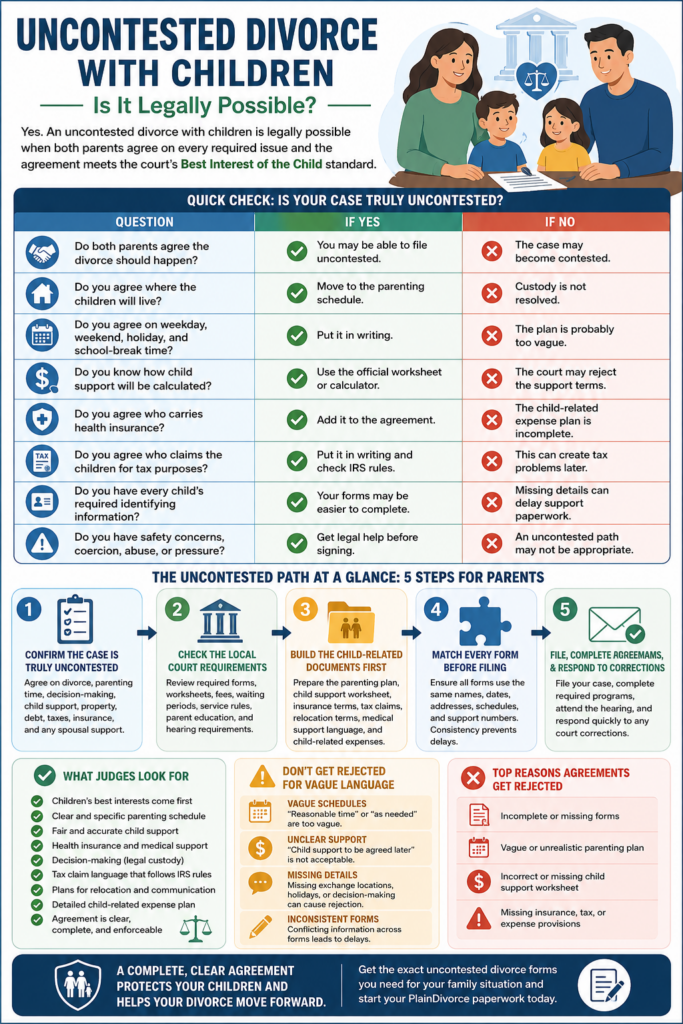
1. Two Routes to an Uncontested Divorce With Children
“Uncontested” is a plain-English label, not a single legal procedure. When people say an uncontested divorce with children, they usually mean one of two situations, and the paperwork is different for each.
- Agreed, joint, or consent divorce. Both parents sign off on every required issue — the grounds for divorce, parenting time, decision-making, child support, child expenses, and property — and file a written parenting and settlement agreement. Some states let the parents file together; others have one parent file and the other sign a consent or appearance form.
- Default or unopposed divorce. One parent files and formally serves the other. The served parent does not file a response within the deadline, so the case proceeds on the filing parent’s papers. The court still decides custody and support, but the filing parent generally cannot be awarded more than what the petition asked for. California, for example, describes a plain “default” and a separate “default with agreement” where the couple still submits a written agreement. See the California Courts overview of a default in a divorce or legal separation.
A case can also start uncontested and turn contested if the other parent files a response that disagrees on custody, support, or property. That does not mean every “no” on the checklist below ends the uncontested path — it means that issue is not resolved yet and needs negotiation, mediation, or, if service was completed, a possible default.
In both routes, once the judge signs the final judgment, the parenting and support terms become enforceable court orders. The rest of this guide is about making those terms specific enough to be approved and to work later.
Not sure which route fits your family? Check your eligibility with PlainDivorce and start the uncontested divorce paperwork built for your state and your family situation.
2. The Path at a Glance: A 5-Step Checklist for Parents
Step 1: Confirm the Case Is Actually Uncontested
Before preparing forms, confirm that both parents agree on divorce, parenting time, decision-making, child support, property, debt, taxes, insurance, and any spousal support. If you are relying on the default route instead, confirm you can complete valid service and that you only need what the petition requests.
If one parent agrees only because of pressure, fear, financial control, or confusion — or if there is any history of abuse or coercion — a self-help uncontested process may not be appropriate. Get legal help first.
Step 2: Check Your Court’s Rules and Packet
Look up your court’s current self-help materials for the required divorce forms, the child support worksheet or calculator, parenting-plan rules, filing fees, any waiting or cooling-off period, service rules, parent-education requirements, and whether a hearing is scheduled. These differ from state to state and often from county to county.
Self-represented parties — sometimes called pro se or pro per — have to follow the same filing and confidentiality rules that apply to everyone else in that court. Use that court’s current self-help packet and local rules, and a PlainDivorce state kit to start with the correct uncontested paperwork for your location.
Step 3: Build the Child-Related Documents First
Draft the parenting plan, child support worksheet, health-coverage terms, tax-claim language, relocation terms, and child-expense provisions before you finalize the full settlement. For many parents the child-related documents matter more than the property section, because they become the daily operating rules after the divorce.
Step 4: Make Every Form Match
The divorce petition, parenting plan, child support worksheet, any financial disclosure, the marital settlement agreement, and the proposed final order should use the same names, dates, addresses, schedules, and support numbers throughout. A child’s name, birth date, support amount, or insurance term that reads one way in the petition and another way in the proposed order is a common reason paperwork comes back for correction.
Step 5: File, Finish Required Steps, and Fix Corrections
After filing, complete any required parenting class, disclosure exchange, hearing, or court-review step. If the clerk or judge returns documents, fix the exact issue identified rather than refiling the same packet. Once the judge approves the final order, the parenting and support terms become enforceable.
3. Vague vs. Specific: Why Parenting Language Gets Rewritten
Many parents think they have an agreement because they have talked the children through verbally. A judge reviewing an uncontested divorce with children generally needs terms specific enough to enforce if the parents stop cooperating. Vague language is the most common reason a proposed parenting plan gets questioned or sent back.
The table below shows the pattern. It is not a template — the right wording depends on your state’s parenting-plan rules and your family’s facts — but it illustrates the level of detail courts tend to look for.
| Vague language | More specific version |
|---|---|
| “We will share custody.” | “The parents share decision-making for education, non-emergency medical care, and major welfare decisions; day-to-day decisions are made by the parent the child is with.” |
| “The children will visit the other parent often.” | “The children are with Parent B every other weekend from Friday at 6:00 p.m. to Sunday at 6:00 p.m., plus Wednesdays from after school to 7:30 p.m.” |
| “We will split expenses.” | “The parents divide agreed extracurricular costs 50/50; neither parent must pay for a new activity unless both agree in writing first.” |
| “Support will be handled privately.” | “Child support is calculated under the state guidelines, paid monthly on the first, and documented as the court requires.” |
| “We will work out holidays later.” | “The parents alternate Thanksgiving each year, divide winter break equally, and alternate the child’s birthday by even and odd years.” |
| “Either parent can move if needed.” | “Neither parent relocates the child’s primary residence beyond [distance / county] without written agreement or a court order, following the state’s relocation-notice law.” |
Clear language matters because the parenting plan usually becomes part of the final divorce order. If the agreement cannot be understood a year later, it does not protect either parent or the children.
4. How Courts Look at the Children’s Terms
When parents file an uncontested divorce child custody arrangement, the judge in most states reviews the custody and parenting-time terms under a best interest of the child standard. The specific factors are set by each state’s custody statute. Indiana’s list, for example, appears in Indiana Code § 31-17-2-8, and other states have their own versions.
Best-interest factors commonly include:
- The child’s safety, health, and stability
- The child’s age, developmental needs, school routine, and medical needs
- Each parent’s ability to provide care, supervision, and a stable home
- The child’s existing bond with each parent and other close family
- The parents’ ability to communicate and make decisions together
- Any history of abuse, neglect, coercion, or substance misuse
- Whether the parenting schedule is practical, specific, and enforceable
Child support is judged differently. It runs on a separate statute and the state’s child support guidelines, not the best-interest factors. A judge can approve a custody agreement the parents both signed and still adjust or reject a support number that does not match the guideline calculation. Whether a hearing is required, and how closely the judge reviews a signed agreement or a default, also depend on the state and county.
5. The Modification Trap: Why “Good Enough” Can Be Hard to Undo
Once the divorce is final, the child-related terms are court orders, not a private understanding. If a parent later wants to change custody, parenting time, child support, or relocation terms, many states require a showing of a substantial or material change in circumstances before the court will modify the order.
That threshold is not identical everywhere. It varies by state, by the type of order (custody, parenting time, and support can each have a different test), by how long the order has been in place, and sometimes it is relaxed when both parents agree to a new order. Check your state’s modification rule before assuming a term is easy — or impossible — to change. California, for instance, explains its process for changes after a divorce is final.
The practical takeaway: a parent who accepts vague language just to “get it done” may be living with that plan for years. Terms that tend to cause later modification fights include:
- “Reasonable visitation” instead of listed days and times
- A support amount never matched to the guideline worksheet
- A vague promise that one parent will “help with expenses”
- No relocation terms, even though a move is foreseeable
- No medical-support language, even though one parent is to carry insurance
- No holiday schedule because the parents plan to “work it out”
- No language about what happens if a parent ignores the plan
6. Drafting Problems That Slow Down a Children’s Case
There is no national dataset on why judges send parenting agreements back, and the reasons vary by court. But across self-help divorce work, a few drafting problems come up again and again. This is a non-exhaustive list of risks to check, not a ranking.
A Parenting Schedule That Is Too Loose
A plan that says “reasonable visitation” or “as agreed by the parties” can work while both parents cooperate, but it gives a court little to enforce if one parent later blocks time. A more durable schedule addresses the regular school-week routine, weekends, exchange times and locations, holiday rotation, school breaks, summer, transportation, late-pickup rules, makeup time, and phone or video contact.
Terminology varies. Texas parenting-time orders, for example, use Possession and Access and “Standard Possession Order” language, and a Texas court can set a different schedule in the child’s best interest. A parent searching only for “custody” or “visitation” may miss the terms their court actually uses.
In some jurisdictions, if a judge believes an agreement is one-sided or unsafe for the children, the court can appoint a guardian ad litem to represent the child’s interests, or in higher-conflict cases a parenting coordinator to help implement the order. Whether those roles exist, who pays, and when they are used are set by state law and local rule — they are not available everywhere.
Child Support That Does Not Match the Guidelines
Child support is not a private side deal. Most states require a guideline calculation, a worksheet or calculator printout, and often financial disclosure, plus a written explanation for any deviation. A court may question an agreement when the support amount is missing, one parent says support is “waived,” income figures are incomplete, health-insurance or childcare costs are left out, existing arrears are not addressed, or the number simply does not match the guideline worksheet.
The rules are state-specific. Indiana, for instance, provides an official child support calculator that produces the court worksheets, and the Indiana guidelines call for both parents to file a support worksheet even when they agree. Your state’s calculator and filing requirements will look different — use the one your court points to.
Missing Child Identifying Information
Many child-related divorce and support forms ask for each child’s full legal name, date of birth, and current residence, and depending on the form and jurisdiction, a Social Security number or other identifiers. Before drafting, gather each child’s name and birth date, current address, health-insurance details, school or daycare information, and any existing support order.
Do not put a child’s Social Security number or a protected address into a public filing unless your court’s confidential-information form or rule specifically directs it. Most courts have a separate confidential form for that data. When the same child information does not line up across the petition, parenting plan, support worksheet, and proposed order, the filing can be delayed or returned.
An Agreement That Ignores Future Enforcement
A good parenting plan does not assume the parents will always agree. It gives them rules for predictable friction points and says what happens if someone does not follow the order. Depending on the family, that can include relocation, school choice, medical decision-making, passports and international travel, missed exchanges, communication methods, emergency notice, a right of first refusal, step-up parenting time for young children, and a dispute-resolution step before returning to court.
Enforcement language matters because the plan becomes a court order. If one parent refuses exchanges, ignores the holiday schedule, or does not pay agreed expenses, the other parent needs clear written terms to ask the court for help. Which of these clauses a court will actually enforce depends on local law, so treat them as options to review, not a guaranteed checklist.
7. Why State and Local Rules Matter More With Children
Your local court controls the forms, any waiting period, parenting-plan requirements, the child support worksheet, parent-education rules, whether a hearing is held, and the final-order language. A few examples of how much this varies:
| Jurisdiction example | Why it matters |
|---|---|
| California | A divorce takes at least six months to finalize, measured from the date the responding spouse was served or first appeared, and the case is not final until a judge signs and files the judgment — agreement alone does not shorten it. |
| Michigan | No proofs or testimony may be taken for 60 days after filing, and for six months when there are dependent minor children under 18, unless the court shortens it (not below 60 days) for “unusual hardship or compelling necessity.” |
| Texas | Parenting-time orders use “Possession and Access” and “Standard Possession Order” terminology; a court can order a different schedule in the child’s best interest. |
| Many other courts | May require a child support worksheet, a parenting class, financial disclosure, or a child-specific affidavit — depending on the jurisdiction. |
Before filing, check your state, province, territory, county, or court website for the required divorce and parenting-plan forms, the official support worksheet or calculator, any financial-disclosure forms, parent-education requirements, waiting periods, filing fees, service or waiver rules, hearing requirements, and the final judgment or decree form. PlainDivorce state kits are built to help self-represented spouses start with the correct uncontested paperwork for their location and family situation.
8. What Makes Divorce Different When You Have Children
An uncontested divorce means the spouses are not fighting over the issues needed to end the marriage. Without minor children, that usually means property, debt, spousal support, and procedure. With children, the court has an added job: making sure the children’s arrangements are addressed before the judgment is entered.
So an uncontested divorce with children usually needs clear answers to:
- Where will the children live, and on what schedule?
- Who makes major decisions about school, health, and welfare?
- How is child support calculated, and who pays whom?
- Who provides health insurance, and how are uninsured costs split?
- How are childcare, school fees, and activities paid?
- Who claims the children for taxes?
- What happens during holidays and school breaks?
- Can either parent move with the children, and with what notice?
- How will the parents communicate, and what happens if the plan is broken?
Comparing a divorce with children to one without, the biggest difference is not just the number of forms — it is the level of detail a court needs before approving the final order.
9. Custody, Parenting Time, and Decision-Making: Sorting Out the Terms
An uncontested divorce child custody arrangement means both parents agree on legal custody, physical custody, parenting time, and decision-making. The labels vary a lot. Some courts still say “custody” and “visitation”; others use parenting time, parenting schedule, decision-making responsibility, parental responsibility, possession and access, or a parenting plan.
Underneath the labels, a court generally wants to know two things:
- Who makes major decisions for the child (education, non-emergency medical and mental-health care, religious upbringing, activities)?
- When is the child with each parent?
The terms below do not map identically across US states and Canadian provinces, so treat these as rough, general meanings and use your own jurisdiction’s definitions in the agreement:
| Term | Rough general meaning | What it does not automatically mean |
|---|---|---|
| Sole legal custody | One parent makes major decisions | The other parent has no parenting time |
| Joint legal custody | Both parents share major decisions | The child lives exactly 50/50 |
| Sole physical custody | The child primarily lives with one parent | The other parent is cut off |
| Joint physical custody | The child lives with both parents on a schedule | Each parent has equal time in every case |
| Parenting time / visitation | The schedule for each parent’s time | One parent has fewer rights automatically |
| Decision-making responsibility | Authority over school, medical, religious, and welfare choices | The same thing as child support |
Before filing, confirm both parents are using the same definitions. Many later disputes start because both parents said “joint custody” and meant different things.
10. Parenting-Plan Clauses That Prevent Future Conflict
For a simple divorce with kids, the parenting plan is often the document parents rely on most after the divorce. A practical plan covers the regular weekly schedule, weekends, holidays, school vacations, summer, transportation and exchanges, late pickups and missed time, travel and passport rules, phone and video contact, school communication, medical decision-making, emergency notice, activities, parent-to-parent communication, a dispute process, and enforcement.
The clauses below are optional examples, not required or automatically enforceable everywhere. Check how your state treats each one before relying on it.
Right of First Refusal
A right of first refusal says that if one parent cannot personally care for the children during their scheduled time, the other parent gets the first chance to take them before a babysitter or relative is used.
Illustrative concept only, not ready-to-sign language: if a parent needs childcare for more than a set block of consecutive hours during their scheduled time, that parent first offers the other parent the chance to care for the children.
Written too broadly, this clause creates conflict. A one-hour trigger for a grocery run or a short appointment can turn into constant text-message friction. If you use it, define how many hours trigger it, whether it applies during work or school hours, how notice is given, how fast the other parent must respond, and what happens if there is no response.
Step-Up Parenting Plans
A schedule that works for a teenager may not work for a nursing infant, and a toddler’s schedule may not fit once the child starts school. A step-up plan increases parenting time in stages as the child grows or as a parent completes agreed steps — shorter visits for a baby, overnights starting at a set age, more summer time once school starts, or a review date. Avoid vague promises like “we will increase time later”; if you already know the schedule should change, write down when and how.
Relocation and Distance Limits
Relocation is a frequent flashpoint for co-parents. Even if both parents live nearby now, the plan should say what happens if one wants to move with the children — advance notice, written consent or court approval, effects on the schedule, and who covers added travel costs.
Some agreements use a mileage limit, such as 50 miles, but no mileage number applies by default. Your state sets the relocation-notice and consent standard — Indiana’s is in Indiana Code chapter 31-17-2.2, and other states differ on distance, notice period, and what the moving parent must prove. The point is to address relocation before one parent signs a lease or changes schools.
11. Child Support, Arrears, and Children’s Expenses
Child support is calculated under each state’s guidelines, usually with a required worksheet, calculator printout, or financial statement. A support section generally should state the guideline amount, the start date, payment frequency and method, whether income withholding applies, the health-insurance and childcare costs used in the calculation, how uninsured medical expenses are divided, any existing support obligations or arrears, and any requested deviation from the guideline.
Be careful with “no child support” language. Because support belongs to the child, many courts will reject a private waiver or require a written explanation and a guideline calculation before considering a deviation. An agreement between parents also cannot, by itself, wipe out an existing support order or an arrears balance owed to the state — that takes the process your jurisdiction requires.
Sometimes parents separate before filing, and one is already paying temporary support, contributing informally, or falling behind. If arrears may exist, the agreement should say whether they exist, the amount, whether it is disputed, and how it will be repaid.
Guideline support also may not cover every child cost. A strong agreement explains how the parents divide health-insurance premiums, uninsured medical and dental and vision and therapy costs, prescriptions, childcare, school fees, extracurricular activities, tutoring, special-needs expenses, and travel for parenting time.
Illustrative concept only: neither parent has to pay for a new extracurricular activity unless both agree in writing before the child enrolls, except for school-required activities.
One sentence like that can head off a future expense fight.
12. Taxes, Form 8332, Health Insurance, COBRA, and QMCSOs
Tax and insurance details are easy to skip in an uncontested divorce with children, and they are a common source of post-divorce conflict.
Who Claims the Children on Taxes
For federal tax purposes, the custodial parent is generally the parent the child lived with for the greater number of nights during the year. The IRS explains the rules for divorced and separated parents in Publication 504.
If the parents want the noncustodial parent to claim a child, the custodial parent generally must sign IRS Form 8332 (or a substantially similar statement). Key limits under current federal rules:
- For any divorce decree or separation agreement executed after 2008, the noncustodial parent cannot attach decree or agreement pages instead of Form 8332.
- The release must be unconditional. It cannot be made to depend on the noncustodial parent being current on child support.
- A Form 8332 release moves the dependency claim, the child tax credit, the additional child tax credit, and the credit for other dependents. It does not transfer head-of-household filing status, the earned income credit, or the child and dependent care credit — those stay with the parent who qualifies under the usual rules.
- A release can cover one year, specified years, or all future years, and the custodial parent can later revoke it going forward.
A divorce agreement and tax law are not the same thing. If tax benefits are significant, run the numbers with a tax professional before signing.
Health Insurance, COBRA, and QMCSOs
The agreement should say which parent covers the children, how premiums are split, how uninsured costs are paid, how reimbursement claims are handled, and what notice is required if coverage changes.
A Qualified Medical Child Support Order (QMCSO) can require an employer’s group health plan to cover a child, but only when the order meets federal requirements — and the plan administrator, not the divorce court, decides whether an order is “qualified.” A QMCSO is not created automatically by the parents’ agreement. Plan-specific rules and your state’s medical-support rules control the details. See the U.S. Department of Labor’s QMCSO guidance, and get the plan administrator’s written requirements before assuming coverage will transfer.
Divorce can also end a spouse’s own coverage. Under COBRA, a former spouse and dependent children can often continue an employer group health plan for up to 36 months after divorce or legal separation — but only if the plan is subject to COBRA (generally employers with 20 or more employees), and only if the deadlines are met:
- The qualified beneficiary must notify the plan within 60 days of the divorce or legal separation.
- There is then a 60-day window to elect continuation coverage.
- The beneficiary can be charged up to 102% of the plan’s cost, so it is often expensive.
Put the COBRA notice task in the agreement and on a calendar. See the Department of Labor’s COBRA continuation coverage overview and its separation and divorce resources. If either parent relies on the other’s employer plan, sort this out before the divorce is final.
13. What a Complete Children’s Agreement Covers
A complete uncontested divorce with children has child-related terms specific enough to approve, follow, modify, and enforce. Not every court requires every item below — use it as a drafting checklist and confirm the required forms with your court.
| Topic | What to include |
|---|---|
| Decision-making | Who decides education, health, religion, and welfare questions |
| Parenting time | Regular weekly schedule, weekends, holidays, vacations, and school breaks |
| Exchanges | Pickup and drop-off times, locations, transportation, and late arrivals |
| Child support | Guideline amount, start date, frequency, and payment method |
| Arrears | Whether past-due support exists and how it is handled |
| Child identifying information | Names, birth dates, and any identifiers required by the form — using the court’s confidential form where one exists |
| Health insurance | Which parent covers the children and how premiums are shared |
| Medical support / QMCSO | Whether an employer-plan coverage requirement or medical child support order applies |
| Medical expenses | How uninsured costs, dental, vision, therapy, and prescriptions are divided |
| Childcare | Daycare, after-school, and summer care, and who pays |
| School | School of enrollment, records access, and parent-teacher communication |
| Tax claims | Who claims each child and whether Form 8332 is needed |
| Relocation | Notice, consent, distance, school changes, and travel costs |
| Travel | Notice, passports, and out-of-state or international travel |
| Communication | How parents share updates and how children contact each parent |
| Right of first refusal | Whether one parent must offer childcare time to the other first |
| Step-up plan | How parenting time changes as the child grows |
| Modification | A note that changing the order later may require meeting the state’s modification standard |
| Enforcement | What happens if a parent does not follow the parenting, support, or expense terms |
| Future disputes | Mediation, written notice, or another step before returning to court |
Work through this before you complete a broader uncontested divorce checklist, because the child terms usually have to be settled before the final order can be prepared correctly.
14. When to Get Legal Help
Consider talking with a family-law attorney or another qualified professional if:
- You disagree about custody or parenting time
- One parent wants to move far away
- There are safety concerns, domestic violence, or coercive control
- A child has significant medical, educational, or special needs
- One parent has irregular income, owns a business, or is self-employed
- You are unsure how child support should be calculated, or one parent wants to waive it
- There are child support arrears
- Tax claims for the children matter, or health insurance will be lost after divorce
- A QMCSO or medical support order may be needed
- You are worried the order will be hard to modify later, or your court has rejected your paperwork before
- You do not understand what you are signing
PlainDivorce provides self-help uncontested divorce kits. It is not a law firm and does not give legal advice. If your situation is complicated or unsafe, legal help can protect you and your children.
15. How PlainDivorce Fits Into the Process
PlainDivorce is built for parents whose case is genuinely uncontested and who are ready to cooperate. The kits are designed to help self-represented spouses start with the uncontested divorce paperwork that fits their state and their family situation — a divorce with children needs different documents than one without, including child-related schedules, support information, and parenting terms.
Because court forms and local rules change, always confirm the current packet and any child support worksheet with your own court before filing. To see whether an uncontested kit fits your situation, check your eligibility, then work through the parenting and support terms above so the child-related paperwork is complete before you file.
16. FAQ: Uncontested Divorce With Children
Can a divorce be uncontested if we have children?
Yes. It can be uncontested when both parents sign a full agreement on custody, parenting time, child support, child expenses, taxes, insurance, and the divorce terms, or when one parent is served and does not respond and the case proceeds by default. In both routes the court still addresses custody and support, and the required forms depend on your state and county.
Is an uncontested divorce with children harder than one without children?
Usually it involves more. There are more forms, more detail in the parenting and support terms, and in many courts more review before the judge signs. The process can still be cooperative and done without a lawyer, but the child-related paperwork has to be complete and consistent.
What is the best interest of the child standard?
It is the test most states use to decide custody and parenting time. The factors are set by each state’s custody statute and usually look at the child’s safety, stability, needs, and bond with each parent, plus any history of abuse. Child support is decided separately, under the state’s support guidelines rather than the best-interest factors.
Do we need a parenting plan?
Many courts require a parenting plan or a similar document when minor children are involved. Even where it is not required, a written schedule that covers regular time, holidays, exchanges, and decision-making helps prevent later disputes and gives a court something concrete to enforce.
Can parents agree to no child support?
Rarely without scrutiny. Child support belongs to the child, and most states apply a guideline calculation. A court may reject a private waiver or require a written explanation and a guideline worksheet before approving any deviation. An agreement also cannot erase an existing support order or arrears owed to the state.
What is the difference between custody and parenting time?
Custody often refers to decision-making authority or where the child primarily lives. Parenting time refers to the schedule for when the child is with each parent. The exact terms and how they are split vary by jurisdiction, so the agreement should define what the parents mean.
What is a right of first refusal in a parenting plan?
It gives the other parent the first chance to care for the children when the scheduled parent needs childcare for a defined period. It can reduce reliance on third parties, but a threshold set too low creates constant friction, so it should specify the trigger, notice, and response rules — and it is not enforceable in every state.
Can we change the parenting plan later?
Sometimes, but not automatically. After the order is entered, many states require a substantial or material change in circumstances before modifying custody, parenting time, or support. The exact standard varies by state, by the type of order, and sometimes it is easier when both parents agree to the change.
Who claims the children on taxes after divorce?
By default, the custodial parent — the one the child lived with for more nights during the year. The parents can agree to let the noncustodial parent claim a child, but for post-2008 decrees that requires a signed IRS Form 8332, the release cannot be conditioned on paying support, and it does not transfer head-of-household status, the earned income credit, or the dependent care credit.
What is a QMCSO?
A Qualified Medical Child Support Order is an order that can require an employer’s group health plan to cover a child when it meets federal requirements. The plan administrator, not the divorce court, decides whether an order qualifies, and plan rules and state medical-support law control the details. It is not created automatically by the parents’ agreement.
What happens to health insurance after divorce?
The children’s coverage should be assigned in the agreement. A spouse who loses employer coverage because of the divorce may be able to continue it under COBRA for up to 36 months if the plan is subject to COBRA, but they must notify the plan within 60 days and elect within 60 days, and the premium can be costly.
Will we have to go to court?
It depends on your jurisdiction. Some uncontested divorces are decided on the paperwork; others require a brief hearing, and courts are somewhat more likely to set a hearing when minor children are involved. Your court’s self-help pages will say what to expect.
What if we agree now but disagree later?
Once approved, the parenting plan and support terms are court orders. If circumstances change, you follow your state’s process to modify the order, which often means showing a change significant enough to meet the modification standard. A clear dispute-resolution clause and specific original terms make that process easier.
17. Bottom Line
You can get an uncontested divorce with children when both parents agree on every required issue, or when one parent is served and does not respond. In either route, the child-related terms become enforceable orders once the judge signs.
The strongest plans spell out parenting time, decision-making, support, taxes, insurance, relocation, holidays, school, medical support, and enforcement in specific language — and they check each term against the parents’ own state rules rather than assuming a national default. Once approved, these terms can be hard to change without meeting your state’s modification standard, so do not treat them as placeholders.
Start with the right forms for your state, keep the language specific, and make sure the child-related paperwork matches your court’s requirements before filing. Check your eligibility with PlainDivorce to begin.
Sources and local rules can change. Use this guide as a plain-English organizer, then verify the current filing requirements with the official court or government source for your jurisdiction.

About Harry D
Expert contributor at PlainDivorce, helping Canadians and American navigate simple uncontested divorces with clarity and confidence.