Uncontested Divorce Eligibility: A 12-Question Checklist Before You File
Uncontested divorce eligibility comes down to a practical readiness test: can you file in a court that has power over your case, give your spouse proper legal notice, and either reach a complete written agreement or move forward under your court’s no-response rules? If you are asking “do I qualify for uncontested divorce” or “can I get divorced without a lawyer,” this uncontested divorce checklist walks through the twelve questions that decide it. In most cases, being ready means residency, service, property, debt, parenting, support, and any local forms are handled before you file.
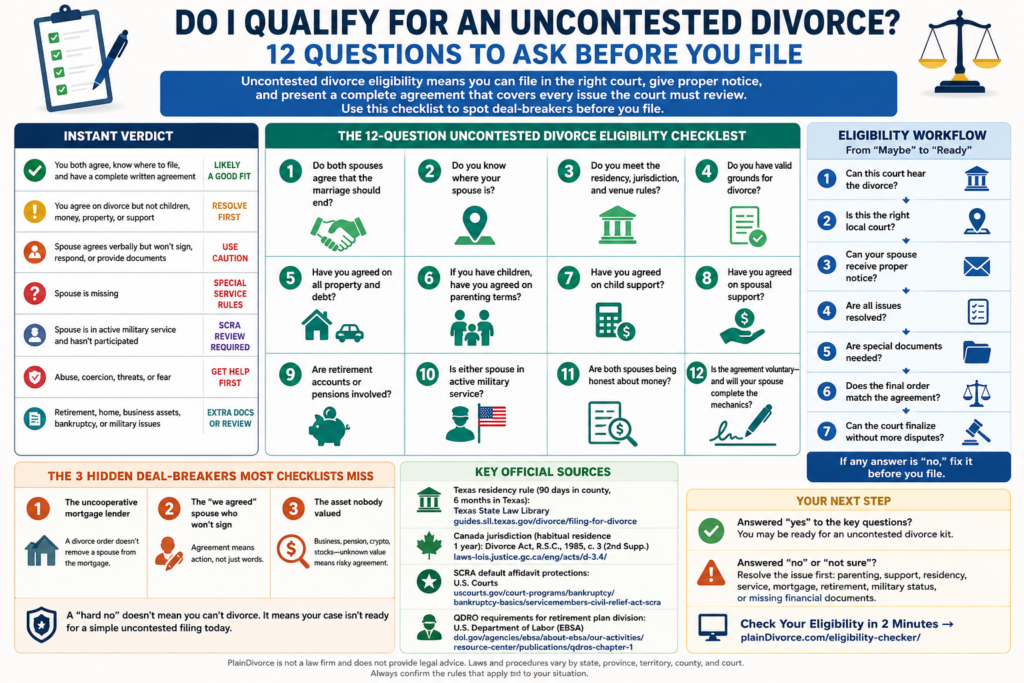
| Your situation | What it usually means |
|---|---|
| You both agree to divorce, know where to file, and have a complete written agreement | Likely a good fit for an agreed (or joint) uncontested divorce |
| You agree on the divorce but not on children, money, property, or support | Resolve those issues before filing an agreement-based case |
| Your spouse will be served and simply will not respond | May proceed as a default or non-opposed case under your court’s rules, not a joint filing |
| Your spouse agrees verbally but will not sign, respond, or share documents | Use caution; you may need formal service and default steps, or legal review |
| Your spouse cannot be located | Expect a request for alternative service before the court can proceed |
| Your spouse is in military service and has not appeared | Federal law requires a military-status affidavit and, if they are serving, appointed counsel before any default judgment |
| There is abuse, coercion, threats, or fear | Do not use a standard DIY process without safety planning and legal help |
| You have a home, retirement plans, a business, or a pending bankruptcy | You can still be uncontested, but extra documents or review are usually needed |
TL;DR
Eligibility is a readiness test, not a personality test. It asks three things: can this court hear your case, can your spouse get proper notice, and is there either a complete written agreement or a valid path to a default? Everything else is detail.
- An online service’s “you qualify” screen means the service can prepare your forms. It says nothing about whether the court will grant the divorce — the court applies its own definition of an uncontested or default case.
- Your spouse cannot block the divorce by refusing to cooperate. In nearly every U.S. state and Canadian province, agreement changes the route — agreed versus default after service — not whether you can divorce at all.
- A verbal “I agree” is not a court-ready agreement. The step that most often collapses a friendly case is the notary or ID-verification appointment, not the negotiation.
- Residency and venue are two separate rules. Texas requires six months in the state and 90 days in the filing county. File a week early and the case can be rejected or dismissed — clerks don’t weigh whether you were “basically living there.”
- Canada’s rule is one year of habitual residence in the province, with one narrow Civil Marriage Act exception for couples who married in Canada, live abroad, and cannot divorce where they are.
- “Corollary relief” is narrower than it sounds. Under the Divorce Act it means child support, spousal support, and parenting orders — property division is provincial law and sits outside the divorce entirely.
- A Canadian court must be satisfied that reasonable child support arrangements exist before granting the divorce, and stays the case until they are — though an agreed amount differing from the table figure is not automatically unreasonable.
- Military service only matters on the default side. If the servicemember signs or responds, there is no default and the SCRA steps never come up. If they haven’t appeared, 50 U.S.C. § 3931 requires a military-status affidavit — and if they are serving, the court must appoint them an attorney and grant at least a 90-day stay before any default judgment.
- Your decree does not release anyone from a mortgage. The lender isn’t a party to your divorce; removing a co-borrower takes a refinance, a lender-approved assumption, a payoff, or a sale. “I’ll take over the house” needs a deadline and a backup plan.
- The plan administrator qualifies a QDRO, not the judge, against the plan’s own written procedures. Government and church plans sit outside ERISA, military pensions use a USFSPA order, and an IRA moves by transfer incident to divorce — no QDRO at all.
- “We’ll divide it later” is not an agreement. Nor is “we’ll share custody.” Courts want who gets what, who pays what, by when — and a parenting schedule someone else could actually follow.
- A case with a Guardian ad Litem is rarely a DIY filing. The court is already taking extra steps to examine the child’s interests, which is the opposite of a paperwork-only case.
- A “no” anywhere on this list is a sequencing problem, not a verdict. Fix the one issue — residency, service, support, the mortgage clause, the retirement order — then come back to the checklist.
Check your eligibility in 2 minutes →
1. A Quick Safety Note Before You Continue
If you have any concern about privacy, safety, pressure, or financial control, take extra care before researching or starting divorce paperwork. Use a device, email account, and location where you feel safe.
A standard DIY divorce may not be the right first step if you do not feel free to ask questions, review documents, delay signing, or get outside help. In that situation, consider speaking with a domestic violence hotline, a legal aid office, a court self-help center, or a lawyer before you file.
Plain-language rule: an uncontested divorce works best when both people can make decisions freely and safely. If that is not true right now, get support first.
2. Agreed vs Default: What Uncontested Really Means
“Uncontested” is not one thing. Courts reach a divorce without a trial in two different ways, and your uncontested divorce eligibility depends on which route fits your facts.
- The agreed route (also called a joint, consent, or stipulated case in various places): both spouses sign the papers and a written agreement that settles property, debt, support, and parenting. Nothing is left for the judge to decide.
- The default or non-response route: you file, your spouse is validly served, and they never file a response within the deadline. In many states the case then proceeds as uncontested on your paperwork. California, for example, lets you request a default after 30 days with no response, and even allows a default with a written agreement if your spouse later signs one.
This checklist mainly screens you for the agreed or joint route, because that is the path most DIY and online kits are built for. If your spouse will not participate, you are not automatically stuck — but you are on the default path, which has its own service proof, waiting periods, and protections (see Questions 2 and 10). A pressured or unsafe “agreement” is a different problem: that case is not ready for either route until the safety and fairness issues are addressed.
Insider tip: An online service’s “you qualify” screen tells you the service can prepare your forms. It does not tell you the court will grant the divorce. The court applies its own definition of an uncontested or default case, and that is what this checklist is aimed at.
3. U.S. Eligibility Rules: State Statutes, Local Courts, and Service
In the United States, divorce is governed by state law and local court procedure. Your state sets residency, waiting periods, grounds, service of process, child support forms, parenting plan requirements, default rules, and whether a hearing is required. Two counties in the same state can even run their paperwork differently.
For example, Texas Family Code Section 6.301 says a divorce suit may not be maintained unless, when it is filed, either the petitioner or the respondent has been a domiciliary of Texas for the preceding six months and a resident of the filing county for the preceding 90 days. The Texas State Law Library explains the same rule in plain language. File before either spouse meets both periods and the court can reject, delay, or dismiss the case. Every state has its own version of this rule — check yours.
U.S. uncontested divorce eligibility usually turns on these mechanics:
- Subject-matter jurisdiction: does this state’s court have power to grant the divorce (usually a residency or domicile rule)?
- Venue: is this the correct county, district, or parish?
- Grounds: does your state recognize the no-fault reason you selected, and does it require a separation period?
- Service of process: was the other spouse notified in the way your court requires, or did they sign a waiver or joint filing where that is allowed?
- Settlement or default: either a written agreement covering all required issues, or a completed default after valid service.
- Final order: a proposed judgment or decree that matches your agreement and your court’s formatting rules. Some states call this a Final Decree of Divorce; California and others call it a judgment.
Clerk-friction tip: A clerk in your court may reject paperwork for a missing signature, the wrong local form, a missing notary block, a skipped checkbox, or a formatting rule specific to that court — and clerks cannot give legal advice. Self-represented (pro se) filers should read that court’s filing instructions closely rather than assume a generic packet will be accepted.
Next step: Start with your official state court self-help website, then check county-level rules before you prepare forms. Our uncontested divorce process guide walks through the sequence.
4. Canada Eligibility Rules: The Divorce Act and Provincial Filing
In Canada, divorce is governed federally by the Divorce Act, while the filing process is run by each province or territory. Under section 3(1), a provincial court has jurisdiction to hear a divorce if either spouse has been “habitually resident in the province for at least one year immediately preceding the commencement of the proceeding.”
There is one narrow exception. The Civil Marriage Act (section 7) lets a Canadian court grant a divorce to spouses who married in Canada, live outside Canada, and have each lived for at least a year in a place that will not grant the divorce because it does not recognize their marriage. If that is not you, the ordinary one-year residence rule applies.
Terminology varies by province. You may see:
- Simple (or sole) divorce — one spouse applies
- Joint divorce — both spouses apply together
- Uncontested or undefended divorce — the other spouse does not dispute it
- Desk divorce — a judge decides on the filed paperwork without a hearing (a provincial process term, not a national rule)
- Corollary relief — under the Divorce Act this means a claim for a child support order, a spousal support order, or a parenting order. It does not cover property division, which is set by each province’s family-property law.
- Divorce order and certificate of divorce — the order grants the divorce; the certificate is later proof it took effect
The Divorce Act answers whether the divorce can be granted. Your province or territory controls the forms, the service rules, and how you prove them. Before a Divorce Act divorce is granted, section 11(1)(b) also requires the court to be satisfied that reasonable arrangements have been made for child support, having regard to the Federal Child Support Guidelines; if not, the court stays the divorce until they are.
Clerk-friction tip: In provincial desk and joint filings, delays commonly come from missing service documents, incomplete affidavits, a draft order that does not match the claims, missing child support information, or forms from the wrong province. The exact document set is provincial — use your own court’s current forms list.
Next step: Start with your provincial or territorial court website and Justice Canada’s How to Apply for a Divorce overview, then compare your situation against our divorce papers by province directory.
5. When You Are Not Ready for an Agreement-Based Divorce
Uncontested divorce eligibility does not require an easy divorce. It requires a case the court can finalize on the papers — either a complete, voluntary agreement or a proper default. The situations below mean your case is not ready for a simple agreed or joint route today. Most can be fixed; some need a lawyer, a mediator, or a different filing path first.
- You have not met the residency, jurisdiction, or venue rule for where you want to file
- Your spouse will not sign or file anything, so a joint or consent route is off the table (a default may still be possible — get service and default guidance for your court)
- You cannot locate your spouse and no papers have been signed
- Your spouse is in military service, has not appeared, and you would be seeking a default (federal safeguards apply first)
- You cannot agree on parenting time or decision-making
- A court has appointed, or is likely to appoint, a Guardian ad Litem (GAL) for a child
- Child support is unknown, or is set far below the guideline amount without a reason your court will accept
- One spouse wants spousal support and the other will not address it
- One spouse is giving up major property without understanding its value
- There is a pending or expected bankruptcy
- Retirement benefits must be divided but no plan-approved order has been prepared
- A lender will not release one spouse from a joint mortgage and there is no sale or refinance plan
- One spouse owns a business and has not shared records
- You suspect hidden accounts, cash income, cryptocurrency, or tax problems
- There is abuse, coercion, or fear, or you are signing only because you feel pressured
None of these ends your ability to divorce. Each one just tells you where to focus before you prepare final papers.
6. The Eligibility Workflow: From Maybe to Ready
Use this map before you prepare forms. It shows where a rejection, delay, or dispute is most likely to surface.
| Step | Eligibility checkpoint | If the answer is no |
|---|---|---|
| 1 | Can this court hear the divorce? Confirm subject-matter jurisdiction (state residency, or provincial habitual residence). | File where the rule is met, or wait until residency is satisfied. |
| 2 | Is this the right local court? Confirm venue at the county, district, or parish level. | Filing in the wrong local court can cause rejection, transfer, or dismissal. |
| 3 | Can your spouse receive proper notice? Confirm service, a signed waiver, a joint filing, or a plan for default after service. | Complete valid service before you ask the court to finalize anything. |
| 4 | Are the required issues addressed? For an agreed case, that means property, debt, support, parenting, taxes, insurance, and names. For a default, check what your court still requires you to prove. | Resolve the open issue, or confirm your court can decide it in a default. |
| 5 | Are special documents needed? Check for retirement orders, deed transfers, military-status affidavits, child support worksheets, or local affidavits. | Prepare the extra documents, or get them reviewed, before filing. |
| 6 | Does the proposed final order match? The judgment or decree should track your agreement and your court’s format. | Fix mismatches before submission; many courts reject an order that does not match. |
| 7 | Can the court finalize without more disputes? File, serve, wait out any cooling-off period, correct, and finalize under local rules. | Expect delay, a hearing, corrections, or a switch to a different process. |
Check your eligibility in 2 minutes →
7. The 12-Question Uncontested Divorce Eligibility Checklist
These twelve questions turn uncontested divorce eligibility into a readiness review. A “yes” does not guarantee court approval, but it means you are closer to a clean filing. A “no” means fix that issue before preparing final divorce papers.
1. Do both spouses agree the marriage should end?
In almost every U.S. state and Canadian province, one spouse can obtain a divorce even if the other does not want it, as long as notice and any waiting period are met. What agreement changes is the route. If both spouses cooperate, sign, or file jointly where that is allowed, you are on the faster agreed path. If your spouse will not participate, you are on the default path after service.
Green light: Both spouses will sign, or your spouse will be served and you are prepared for a default.
Caution sign: One spouse says “fine” but avoids paperwork, will not give financial details, or threatens to fight later.
Insider tip: A verbal “I agree” is not a court-ready agreement. A spouse who will not sign, notarize, share income information, or accept service can turn a joint filing into a slower default case. Plan for that possibility from the start.
2. Do you know where your spouse is?
Courts require proper notice before granting a divorce. This is service of process — delivering official notice in the way your court requires.
If you cannot locate your spouse, most courts let you ask for alternative service — by mail, posting, email, or publication — after you show a diligent search. This usually means filing a sworn statement describing the efforts you made. The specific document and standard vary by court.
Green light: You have a current address, or your spouse will sign a waiver or acceptance of service.
Caution sign: Your spouse moved, cut off contact, lives abroad, or is dodging service.
Not ready for a joint route: Your spouse cannot be found and has signed nothing. You may still proceed by alternative service and default, but not as a joint filing.
3. Do you meet the residency, jurisdiction, and venue rules?
This is a common filing trap. Most courts require a legal connection to the place where you file. In the U.S., that is a state residency or domicile rule plus a local venue rule. In Canada, it is the Divorce Act’s one-year provincial habitual-residence rule.
Confirm both the higher-level rule (state, province, or territory) and the local one (county, district, or parish) before filing. Filing in the wrong place, or too early, can bring rejection, transfer, delay, or dismissal.
Do not rely on memory. Check dates against documents: a lease, a mortgage record, a utility bill, your license issue date, tax records, employment records, or a bank statement showing a local address.
Green light: You clearly meet the filing rule for your state, county, province, or territory.
Caution sign: You recently moved, live in one place and work in another, separated across a border, or are unsure where your spouse lives.
Insider tip: Clerks do not weigh whether you were “basically living there.” The filing has to match the rule. If your state requires six months and you file a week early, that can be enough to trigger rejection or dismissal.
Check your eligibility in 2 minutes →
4. Do you have valid grounds for divorce?
Most uncontested divorces use no-fault grounds — the marriage has broken down, with no need to prove misconduct. The wording varies: irreconcilable differences, irretrievable breakdown, incompatibility, or living separate and apart. Some jurisdictions require a separation period before the divorce can be finalized; others do not.
Green light: You know the ground your court allows and can meet it, including any separation period.
Caution sign: You are using forms from another state, province, or a generic website and do not know whether the ground fits where you live.
Not ready: You are trying to file under a ground your court does not recognize, or one that needs proof you do not have.
5. Have you agreed on all property and debt?
For an agreed case, a complete property-and-debt agreement is what makes the filing clean. “We will split things fairly later” is not court-ready. The agreement should say who gets what, who pays what, and when each step happens. (In a default, your court may be able to grant the specific relief you requested without a signed agreement — check your court’s rules and disclosure requirements.)
| Asset category | Debt or obligation category |
|---|---|
| Bank accounts | Credit cards |
| Vehicles | Vehicle loans |
| Real estate | Mortgage, property taxes, insurance |
| Furniture and household goods | Personal loans |
| Retirement accounts and pensions | Student loans |
| Investments and brokerage accounts | Tax debts |
| Business interests | Business debts |
| Digital assets and cryptocurrency | Medical bills |
| Cash savings | Joint lines of credit |
| Pets, where treated as property locally | Any debt tied to property one spouse keeps |
Green light: Every major asset and debt is listed and assigned.
Caution sign: One spouse is keeping the house but the mortgage stays in both names.
Not ready: You plan to divide property after the divorce is final. See our property division in an uncontested divorce guide.
The mortgage and refinance trap
A divorce agreement can say one spouse keeps the home. It does not, by itself, remove the other spouse from the mortgage.
Your lender is not a party to the divorce. As the Consumer Financial Protection Bureau explains, a divorce decree can allocate a debt to one spouse but “doesn’t change the fact that a creditor can still collect from anyone whose name appears as a borrower.” Removing a co-borrower usually takes a refinance or a lender-approved assumption — and that is subject to the loan contract and the lender’s approval.
Before filing an agreed case with a home, decide: will it be sold, refinanced, or assumed; who pays the mortgage, taxes, and insurance until then; what the deadline is; what happens if a refinance is denied; how title transfers; and what happens if a payment is missed.
Insider tip: The mortgage clause is a frequent source of post-divorce disputes between former spouses. Do not settle for “I’ll take over the house” unless the agreement spells out the loan, the title, the deadlines, and a backup plan.
6. If you have children, have you agreed on parenting terms?
Where there are minor children, courts look closely at the parenting arrangements. Many want a written plan covering where the children live, the weekday and weekend schedule, holidays, school breaks, transportation, decision-making, medical care, education, travel, communication, relocation, and how future disagreements are handled. Some courts require extra forms; the detail expected varies by jurisdiction.
“We’ll share custody” is usually not enough. Courts want a plan that can actually be followed. In Canadian Divorce Act cases, parenting orders are decided on the section 16 best interests of the child test, which is separate from the child support bar in Question 7.
A case with a court-appointed Guardian ad Litem is rarely a fit for a simple DIY filing, because the court is already taking extra steps to review the child’s interests.
Green light: You have a specific schedule and a decision-making plan.
Caution sign: You agree in principle but have not worked out holidays, exchanges, travel, or breaks.
Next step: Use our parenting plan guide before you file.
7. Have you agreed on child support?
Child support is a frequent reason an otherwise uncontested divorce slows down. Even when parents agree, many courts require income information, a support calculation or worksheet, health insurance and childcare details, and an explanation for any amount below the guideline. Requirements vary by jurisdiction.
A parent generally cannot bargain away a child’s right to support just because both adults agree. In a Canadian Divorce Act case, section 11(1)(b) requires the court to be satisfied that reasonable child support arrangements have been made having regard to the guidelines — though an agreed amount that differs from the table figure is not automatically unreasonable.
Green light: Support is calculated, documented, and in the paperwork.
Caution sign: One parent is self-employed, unemployed, paid in cash, or may be understating income.
Not ready: The agreement says “no child support” with nothing to support that result under local law. See our child support and court approval guide.
8. Have you agreed on spousal support?
Spousal support is called alimony, maintenance, or support depending on where you are. Your agreement should say whether support is paid, how much, how often, when it starts and ends, whether it can be changed later, and whether it is waived or the issue is reserved.
Green light: Support is clearly addressed, one way or the other.
Caution sign: One spouse is waiving support after a long marriage without understanding the financial effect.
Not ready: One spouse expects support and the other will not put it in writing.
Insider tip: “We don’t want support” is not always enough. Some courts want specific waiver language, and in some places the difference between waiving support and reserving it can matter years later.
9. Are retirement accounts or pensions involved?
Retirement division is the classic “uncontested but not simple” issue. If a workplace plan has to be split, the divorce judgment alone is often not enough to make the plan pay the other spouse.
For a private-employer plan covered by federal ERISA rules, you usually need a separate Qualified Domestic Relations Order (QDRO). The U.S. Department of Labor explains that the plan administrator — not the judge — decides whether an order meets the plan’s QDRO requirements, so the order has to be drafted to the plan’s written procedures. A QDRO is not the tool for every retirement asset:
- Government and church plans are generally outside ERISA and use their own order formats and rules.
- A military pension is divided under the Uniformed Services Former Spouses’ Protection Act, not a QDRO.
- An IRA is split by a “transfer incident to divorce” under the tax code (IRS Publication 590-A), handled trustee to trustee — no QDRO.
- Canadian pension division depends on the province, the plan type, and the plan administrator.
Green light: Retirement is either not being divided, or the required order process is understood and started.
Caution sign: The agreement says “split retirement 50/50” but no one has checked the plan’s rules.
Not ready: One spouse is counting on retirement money but no plan-approved order is being prepared.
10. Is either spouse in military service?
Military service affects the default side of uncontested divorce eligibility in the U.S. Under the Servicemembers Civil Relief Act (50 U.S.C. § 3931), if a defendant has not appeared in the case, the plaintiff must file an affidavit stating whether the defendant is in military service or that it could not be determined. If the defendant is in military service, the court may not enter a default judgment until it appoints an attorney to represent them, and it must grant at least a 90-day stay on a proper showing.
This does not block a military divorce. If the servicemember signs the papers or files a response, there is no default and these steps do not apply. The protections matter when a servicemember is not participating.
Green light: The servicemember is signing, responding, or has legal guidance.
Caution sign: The servicemember is deployed, hard to reach, or has not responded.
Not ready: You want a default against a non-participating servicemember without following the § 3931 steps. Get local default guidance first.
11. Are both spouses being honest about money?
A durable agreement depends on both spouses understanding the full financial picture: income, bank and retirement accounts, investments, debts, real estate, vehicles, business income, tax refunds and debts, bonuses, stock options, cash savings, cryptocurrency, and payment-app balances. Many courts require a sworn financial disclosure, but the form, whether it is filed or only exchanged, and the consequences for leaving something out are set by your jurisdiction.
Green light: You have exchanged enough documents to understand the whole picture.
Caution sign: One spouse controls all the accounts and only provides summaries.
Not ready: You suspect hidden assets, hidden income, hidden debt, or an undisclosed wallet or account.
Insider tip: Hidden assets do not have to be dramatic to cause trouble. A forgotten online account, a payment-app balance, cash business income, or a crypto wallet can undo an agreement that says all property was disclosed.
12. Is the agreement voluntary, and will your spouse do the paperwork?
A divorce can look uncontested on paper and still be unsafe, unfair, or incomplete. Watch for threats, intimidation, pressure to sign right now, device monitoring, financial or immigration-document control, hidden paperwork, children used as leverage, no time to review, or punishment for asking questions.
Even a genuinely voluntary agreement needs your spouse to complete the mechanics: signing forms and any settlement agreement, signing a waiver or joint filing where your court uses one, providing income details, reviewing parenting terms, attending notarization or ID verification if required, responding to court notices, fixing rejected forms, and signing the final documents.
Green light: Both spouses can review, ask questions, negotiate, say no, and complete the paperwork.
Caution sign: Your spouse agrees by text but ignores deadlines.
Not ready: You are afraid of what happens if you do not sign, or your spouse will not sign anything yet insists they “don’t want to fight.”
Insider tip: The notary step trips people up. Some spouses agree to everything until they have to appear before a notary or upload ID for e-signing. Build that step into your timeline before you assume the case is ready.
By this point, uncontested divorce eligibility should feel less like a guess and more like a readiness test. If any answer is uncertain, fix that issue before you file.
8. Three Eligibility Traps Checklists Miss
1. The uncooperative mortgage lender
A divorce agreement can award the home to one spouse, but the lender can keep both spouses on the loan unless it is refinanced, assumed, paid off, or the home is sold. That can affect credit, future borrowing, and enforcement between the former spouses.
2. The we-agreed spouse who will not sign
A joint or consent filing needs action, not just agreement. If your spouse will not sign, notarize, respond, or share documents, plan for the default route instead — formal service, the response deadline, and your court’s default steps.
3. The asset nobody valued
A business, pension, crypto wallet, brokerage account, or tax refund can make a divorce more complex than it looks. If no one knows the value, the agreement can be incomplete or lopsided — and hard to reopen later.
None of these automatically ends your uncontested divorce eligibility. They mean the agreement needs more detail before you file.
9. Legal Glossary for Uncontested Divorce Eligibility
| Term | Plain-English meaning |
|---|---|
| Uncontested divorce | A divorce with no unresolved dispute for the court to decide — reached by agreement or by no response after service; the exact requirements vary by court |
| Simple / sole divorce | Often a divorce with limited or no disputed issues, or one spouse applying alone; the label and meaning vary by location |
| Joint divorce | A divorce filed together by both spouses, where the jurisdiction offers it |
| Desk divorce | A paperwork-only divorce a judge decides without a hearing, in provinces that use the term |
| Default (or non-response) divorce | The court proceeds after a served spouse does not respond by the deadline; rules vary and some places allow a default with a written agreement |
| Subject-matter jurisdiction | The court’s legal power to hear and decide the divorce |
| Venue | The correct local court — county, district, or parish |
| Service of process | Official notice of the case, delivered the way the court requires |
| Alternative service | Court-approved notice by mail, posting, email, or publication when a spouse cannot be personally served, where allowed |
| Waiver / acceptance of service | A document in which a spouse accepts notice without formal service, where the court allows it |
| Entry of appearance | A filing showing a spouse has appeared in the case; used in some courts, not all |
| Marital settlement agreement | A written agreement dividing property, debt, support, and other divorce terms |
| Parenting plan | A written plan for parenting time, decision-making, transportation, and child-related details |
| Guardian ad Litem | A person a court appoints in some cases to represent or investigate a child’s best interests |
| QDRO | A Qualified Domestic Relations Order used to divide an ERISA-covered workplace retirement plan in the U.S.; government, church, military, and IRA divisions use different rules |
| SCRA | The Servicemembers Civil Relief Act, which protects servicemembers who have not appeared in a civil case, including before a default judgment |
| No-fault grounds | A divorce basis that does not require proving marital misconduct |
| Final Decree of Divorce / judgment | The final court order ending the marriage and setting the terms; called a decree in many states and a judgment in California and others |
New terms do not mean you cannot file without a lawyer. They mean it is worth slowing down to confirm your forms match the process your court actually uses.
10. Cost and Effort: Why an Eligibility Check Pays Off
This article does not quote filing fees or package prices, because they vary by jurisdiction and service. But in PlainDivorce’s experience helping people prepare uncontested filings, the pattern below is common: unresolved issues drive time, stress, corrections, hearings, and outside help. Your actual cost depends on your court, your facts, and whether anyone is represented.
| Path | Cost pressure | Why |
|---|---|---|
| Ready agreed or default divorce | Lower | Few disputes, few hearings, cleaner paperwork |
| Uncontested with fixable gaps | Moderate | Extra forms, rejected filings, mediation, document review |
| Contested divorce | Higher | Motions, hearings, discovery, lawyer time, court appearances |
| Complex but agreed divorce | Moderate to high | Retirement orders, deed transfers, pension forms, tax review, business valuation |
A full uncontested divorce eligibility check helps you find those issues before the court does.
11. What to Confirm Before You File
Before you prepare forms, confirm each item that applies to your case:
- You know which court to file in
- The residency, jurisdiction, and venue rules are met
- Your spouse will sign or file jointly, or can be served for a default
- Military status is addressed if a default is involved
- Your no-fault ground is available, and any separation period is met
- Property and debts are fully listed and assigned (for an agreed case)
- Any home has clear title, mortgage, and refinance or sale terms
- Retirement and pension division has a plan-approved order path
- Parenting terms are specific
- Child support is calculated or explained under local rules
- Spousal support is addressed, waived, or reserved
- Financial disclosure meets your court’s requirements
- The agreement is voluntary and safe
- Required signatures, notarization, or appearances are realistic
- The proposed final order matches the agreement and local format
For the agreement itself, our marital settlement agreement checklist covers what to include.
12. When to Get Legal Help
Consider legal help before filing if: your spouse has a lawyer and you do not; you are afraid of your spouse or feel pressured to sign; you cannot locate your spouse; a servicemember spouse is not participating and you need a default; there are children and support or parenting is unclear; a Guardian ad Litem is involved or likely; one parent wants to relocate with the children; you own a home, a business, or retirement benefits that must be divided; one spouse is self-employed; there is significant debt or a possible bankruptcy; immigration status is involved; you suspect hidden assets; you do not understand the agreement; or you recently moved between states, provinces, or countries.
You do not always need a lawyer for the whole divorce. Options include limited-scope (unbundled) advice, mediation, legal aid, court self-help centers, and document review.
PlainDivorce is not a law firm and does not provide legal advice. This guide is general information; confirm the rules for your state, province, territory, county, or court, and get advice from a licensed professional about your own situation.
13. Your Next Step
If you answered “yes” to the key questions, an uncontested divorce kit can be a reasonable next step.
If you answered “no” or “not sure,” do not panic. Resolve the open issue first — residency, venue, service, parenting terms, support, mortgage language, retirement division, military status, or missing financial documents — then come back to the checklist.
Before you prepare forms, use the PlainDivorce eligibility checker to screen your situation. A careful uncontested divorce eligibility review helps you pick the right path before you file.
Check your eligibility in 2 minutes →
14. FAQ About Uncontested Divorce Eligibility
Do I qualify for uncontested divorce if my spouse and I agree to split?
Agreeing to divorce is the starting point, not the finish line. For an agreed case you also need to settle property, debt, support, parenting, and child support, and complete any forms and disclosure your court requires. If your spouse will not sign, you may still qualify on the default route after valid service. Check your court’s specific requirements.
Can I get divorced without a lawyer?
Many people complete an uncontested divorce without a lawyer when the case is cooperative, the finances are straightforward, and the paperwork is done correctly. Legal help is worth it if there are parenting disputes, real estate, retirement benefits, business assets, hidden money, safety concerns, a military default, or pressure to sign. Limited-scope advice and document review are middle-ground options.
What if my spouse agrees but will not sign?
Your case is not ready for a joint or consent filing. You would move to the default route: file, serve your spouse the way your court requires, wait out the response deadline, and complete the court’s default steps. Some courts let you add a written agreement later even after requesting a default. Local service and default rules control the details.
Is an uncontested divorce the same as a default divorce?
Not quite. In an agreed uncontested divorce, both spouses sign and settle every issue. In a default divorce, one spouse is validly served and never responds, so the court proceeds on the other spouse’s paperwork. Both avoid a trial, but default cases have their own service-proof, waiting-period, and servicemember rules.
Can we file uncontested if we have children?
Often yes, but the parenting plan and child support terms have to be complete and acceptable to the court. Many courts review child-related terms closely and may require worksheets or extra forms. In a Canadian Divorce Act case, the court must be satisfied that reasonable child support arrangements have been made before granting the divorce. A case with a Guardian ad Litem is usually not a simple DIY filing.
Can we file uncontested if we own a house?
Yes, if the agreement addresses title, who is responsible for the mortgage, refinance or sale terms, taxes, insurance, and deadlines. A divorce order does not force a lender to release a co-borrower — that takes a refinance or a lender-approved assumption, subject to the loan contract. Build a backup plan in case a refinance is denied.
Do retirement accounts make us ineligible?
No. Dividing retirement just often needs an extra order. An ERISA-covered workplace plan usually requires a QDRO that the plan administrator approves against its own procedures. Government, church, and military retirement use different rules, and an IRA is split by a transfer incident to divorce with no QDRO. Start that process before the divorce is final.
Is either spouse’s military service a problem?
Not if the servicemember participates. If they sign or file a response, there is no default and the Servicemembers Civil Relief Act steps do not apply. If they have not appeared and you need a default, federal law requires a military-status affidavit and, if they are serving, an appointed attorney and at least a 90-day stay before any default judgment. Get local default guidance.
What is the biggest eligibility mistake?
Filing before the case is ready. Common problems include an incomplete agreement, the wrong court, defective service, missing child support information, vague parenting terms, an unaddressed military default, and property terms that do not line up with lender or retirement-plan rules. A readiness check catches these before the court does.
Sources: Texas Family Code § 6.301; Divorce Act (Canada) ss. 3, 11, 16; Civil Marriage Act (Canada) s. 7; 50 U.S.C. § 3931 (Servicemembers Civil Relief Act); U.S. Department of Labor, QDROs; IRS Publication 590-A; Consumer Financial Protection Bureau; California Courts Self-Help Guide. Last reviewed September 2026.
Sources and local rules can change. Use this guide as a plain-English organizer, then verify the current filing requirements with the official court or government source for your jurisdiction.

About Harry D
Expert contributor at PlainDivorce, helping Canadians and American navigate simple uncontested divorces with clarity and confidence.