A parenting plan in an uncontested divorce is the written document that sets out the parenting schedule, decision-making authority, holidays, exchanges, communication, and child-related costs for your children after the divorce. When you have minor children, most courts want a parenting plan (or an equivalent custody and parenting-time order) before they will finalize the divorce — but the exact form, the content it must include, and how closely a judge reviews it are set by your state, province, or county, not by a single national rule.
A strong divorce parenting plan does more than say both parents agree. It explains what happens when school is closed, a child is sick, a parent runs late, a holiday interrupts the normal week, or one parent wants to move. The core of it is the parenting schedule: which parent the children are with on each day, and how holidays and school breaks change that schedule. In many cases the plan becomes part of the final judgment, parenting order, or decree, so the language has to still work months later, even if cooperation gets harder.
One detail parents often miss: the divorce order by itself may not be enough for taxes. For certain child-related tax benefits, the IRS generally requires Form 8332, signed by the custodial parent — and for any decree or agreement dated after 2008, the IRS will not accept decree pages in its place.
New to the process? Start with what an uncontested divorce is and how an uncontested divorce with children works. For the full filing path, see the uncontested divorce process; if unclear paperwork is causing delays, read why divorce paperwork gets rejected.
TL;DR
Write the plan for the version of yourselves who stop getting along. If it would still tell both parents exactly what to do six months after a bad conversation, it’s a good plan. If it depends on constant goodwill, it’s too vague.
- Most courts require one when there are minor children — even in a default, where the filing parent still has to submit a complete, workable plan. Many states mandate a specific form (California’s FL-341 attachments; Florida’s three 12.995 versions).
- “As agreed” and “reasonable parenting time” are the classic rewrites. Name a parent and a time for every day, plus exchange locations and what happens when someone runs late.
- Say which schedule wins. One sentence — “the holiday schedule controls over the regular weekly schedule” — prevents a recurring annual argument.
- Joint decision-making needs a deadlock process. “Both parents must agree” with no tiebreaker is a plan that stalls on the first school-transfer or therapy dispute.
- Parenting time and child support are judged separately. Custody runs on best interests; support runs on your state’s guidelines. A plan can allocate extra child expenses — it cannot privately waive guideline support.
- Form 8332 must be UNCONDITIONAL. A clause tying the tax claim to being current on support fails the federal rule. And it moves only the dependency claim and child tax credit — not head-of-household, the EITC, or the dependent care credit.
- Passports need both parents. For a child under 16, federal law requires both parents’ consent — a notarized DS-3053 if one can’t appear. Your parenting plan does not replace that, and the form expires in 90 days.
- The UCCJEA is a jurisdiction law, not a relocation rule. It decides which state’s court has authority. No national mileage limit triggers a relocation — your state’s statute sets that.
- Right of first refusal cuts both ways. Set the trigger too low and it becomes a text-message conflict machine. Define the hours, notice, and response window — or skip it.
- Confirm temporary swaps in writing so a one-time favor doesn’t get argued later as a permanent change to the order.
1. When a Parenting Plan Is Required, and the Two Routes
“Uncontested” is a plain-English label, not one legal procedure. When people talk about a parenting plan in an uncontested divorce, they usually mean one of two situations:
- Agreed, joint, or consent divorce. Both parents sign off on every required issue — parenting time, decision-making, child support, child expenses, and property — and file a written parenting plan and settlement agreement. Some states let the parents file together; others have one parent file and the other sign a consent or appearance form.
- Default or unopposed divorce. One parent files and formally serves the other. The served parent files no response by the deadline, so the case proceeds on the filing parent’s papers. The court still decides custody and support, but a default judgment generally cannot award more than what the petition asked for, so the filing parent still has to submit a complete, workable plan.
In both routes, if you have minor children, most courts require a parenting plan or an equivalent custody and parenting-time order before the judge signs the divorce. What that document is called, what it must contain, and whether you use a mandatory statewide form or draft your own all depend on the court. California, for example, directs parents to attach the Judicial Council form FL-341, Child Custody and Visitation (Parenting Time) Order Attachment (effective July 1, 2026) — and note that it is an order attachment used with other forms, with separate attachments for the holiday schedule (FL-341(C)), additional physical-custody provisions (FL-341(D)), and joint legal custody (FL-341(E)). Florida uses three different Supreme Court–approved parenting-plan forms: 12.995(a) basic, 12.995(b) safety-focused, and 12.995(c) relocation/long-distance. Those are two states’ approaches, not a national template — check your own court’s current self-help materials and local rules.
Not sure which route fits your family? Check your eligibility with PlainDivorce and start the uncontested divorce paperwork built for your state and situation.
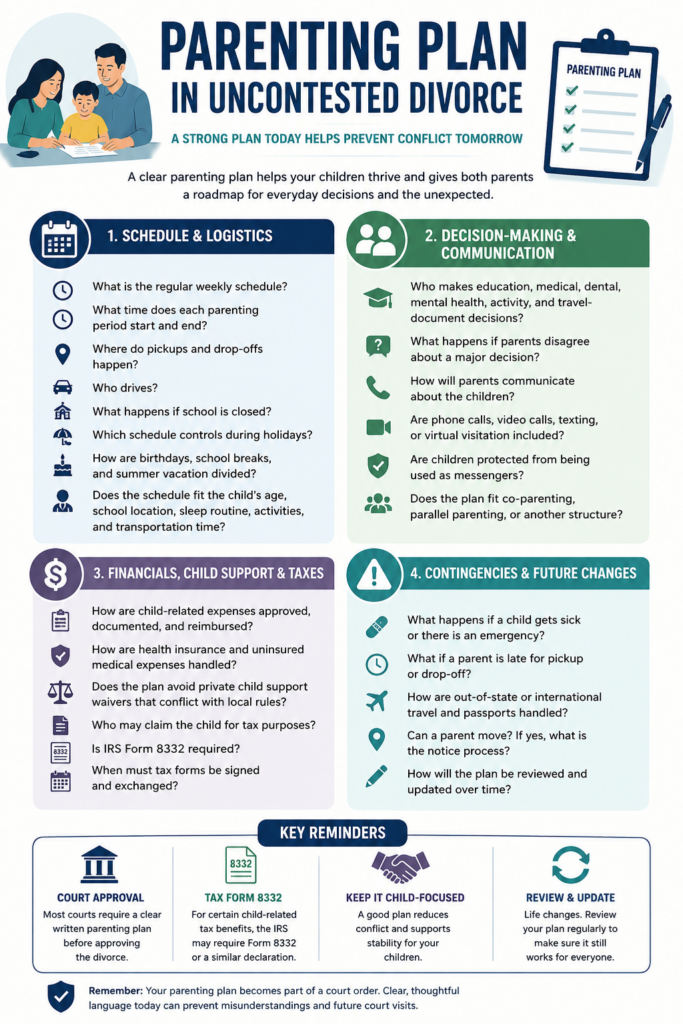
2. Quick Parenting Plan Audit Before You File
Before you file, pressure-test your divorce parenting plan against four practical categories. These questions are not a legal checklist — they are the gaps that most often cause conflict later or a request from the court for clearer terms.
Schedule and Logistics
- What is the regular weekly schedule, and what time does each parenting period start and end?
- Where do pickups and drop-offs happen, and who drives?
- What happens when school is closed for a day or a break?
- Which schedule controls during holidays — the regular one or a separate holiday schedule?
- How are birthdays, school breaks, and summer vacation divided?
- Does the schedule fit the child’s age, school location, sleep routine, activities, and travel time between homes?
Decision-Making and Communication
- Who makes education, medical, dental, mental-health, activity, and travel-document decisions?
- What happens if the parents disagree about a major decision?
- How will the parents communicate about the children, and how fast should each respond to a non-emergency message?
- Are phone calls, video calls, or a co-parenting app included?
- Does the plan protect the children from being used as messengers?
- Does the plan fit co-parenting, parallel parenting, or another structure?
Financials, Child Support, and Taxes
- How are child-related expenses approved, documented, and reimbursed?
- How are health insurance and uninsured medical costs handled?
- Does the plan leave child support to the applicable order, guideline, or worksheet rather than trying to waive or replace it privately?
- Who may claim each child for tax purposes, and does any parent need to sign IRS Form 8332?
- When must tax forms be signed and exchanged?
Travel, Relocation, and Future Changes
- What travel notice is required, and what details must be shared?
- How are passports handled, and does out-of-state or international travel require written consent?
- What happens if one parent wants to relocate, and what does your state’s relocation-notice law require?
- How must temporary schedule changes be documented, and what process is required for permanent changes?
When a court reviews the parenting and parenting-time terms, the legal test in most U.S. states is the best interests of the child, and that test is defined by each state’s custody statute. The factors vary, but courts commonly look at safety, stability, school continuity, the child’s routine, each parent’s ability to care for the child, and any history of abuse or neglect. Child support is decided separately, under the state’s support guidelines, not under the best-interest factors.
3. Why a Divorce Parenting Plan Must Be Specific
A parenting plan in an uncontested divorce needs to be specific because “we agree” does not tell either parent what to do when life gets messy. A plan that can be followed without constant negotiation is easier for a judge to approve and easier to live with.
Language like this sounds cooperative:
“The parents will share time with the children as agreed.”
The problem is that it answers nothing. Who has the children on school nights? What time does the weekend start? Who gets Thanksgiving this year? What happens if one parent later wants every weekend? The table below shows the same terms written loosely and then written specifically. The right column is a more specific version, not required or automatically enforceable text — adapt it to your court’s form and your family.
| Vague language | More specific version |
|---|---|
| “Parents will share holidays equally.” | “Parent A will have Thanksgiving in odd-numbered years from Wednesday at 6:00 p.m. until Sunday at 6:00 p.m. Parent B will have Thanksgiving in even-numbered years on the same schedule.” |
| “Parent B gets reasonable phone contact.” | “The children may have one video or phone call with the off-duty parent each evening between 7:00 p.m. and 7:30 p.m., unless the child is asleep, ill, or at an activity.” |
| “Parents will split transportation.” | “The parent beginning parenting time will pick up the children from school, daycare, or the other parent’s home at the start of that parent’s time.” |
| “Parents will make school decisions together.” | “The parents will consult in writing before any major school change, including enrollment, special-education decisions, tutoring, grade retention, or transfer.” |
Specific language cuts down on future arguments and helps a judge see that the plan can work outside the courtroom.
4. What Makes a Judge Question an Agreed Plan
Even when both parents sign the same divorce parenting plan, a judge can send it back if it looks incomplete, unsafe, or unrealistic. These are common reasons, not a complete list, and how strictly a court reviews an agreed plan varies by jurisdiction.
The plan is too vague to enforce
Phrases like “liberal parenting time,” “as agreed,” or “reasonable access” without a real schedule give a judge nothing to enforce later. If no one can tell what the plan requires, the court may ask for clearer terms before approving it.
The schedule ignores the child’s age, school, or routine
A “standard” schedule that ignores a parent’s overnight shift, a child’s special-education needs, a long commute between homes, or a toddler’s difficulty with long separations can draw questions. Age-appropriate scheduling means the plan matches the child’s actual needs, not just a preference for equal-looking time. Whether a court probes this at all in an agreed case depends on local practice.
The plan tries to bypass child support or safety rules
Parenting time and child support are connected in many places, but they are not the same thing. A parenting plan should not be used to privately waive child support, skip a required worksheet, or work around local child-support guidelines. If there are abuse concerns, a protective order, substance-abuse issues, unsafe housing, or child-welfare involvement, a simple uncontested plan may not be enough. Depending on the jurisdiction, a court may appoint a guardian ad litem, custody evaluator, or parenting coordinator — the title, the authority, who pays, and whether the role exists at all are set by local law.
5. Regular Parenting Schedule Options
The regular schedule is the foundation of the plan. It says where the children are during normal school weeks, weekends, and non-holiday periods. The options below are common examples parents negotiate — they are drafting starting points, not court-approved standards. A court can require different terms, and some states have a presumptive schedule or a parenting-time guideline you should check first.
| Schedule type | How it works | Often chosen when | Trade-off |
|---|---|---|---|
| Every other weekend | One parent has most weekdays; the other has alternating weekends, sometimes with a midweek dinner or overnight. | Parents live far apart or have very different work schedules. | Less balanced time; works best when school-night exchanges would be disruptive. |
| 2-2-3 | Parent A has 2 days, Parent B has 2 days, then the parents alternate a 3-day weekend. | Younger children who benefit from frequent contact with each parent. | Frequent transitions are hard if the parents live far apart or communication is tense. |
| 2-2-5-5 | Each parent has the same two fixed weekdays every week, and the parents alternate long weekends. | Parents who want a predictable school-week routine. | Many parents prefer this over 2-2-3 because recurring tutoring, therapy, sports, or childcare lands on the same parent each week. |
| Week-on / week-off | The children spend one full week with each parent. | Older children, or parents who live close to each other. | Long gaps between contact can be hard for infants and toddlers. |
| Primary residence plus midweek time | The children live mainly with one parent and see the other midweek and on weekends. | Families that need a stable school-week base. | Less overnight time for the other parent, but fewer school-night disruptions. |
| Nesting | The children stay in one home while the parents rotate in and out. | Short transition periods where the parents can afford and manage shared housing. | Expensive and demanding; needs clear rules for costs, privacy, guests, and an end date. |
Visual Comparison: Common Rotations
| Schedule | Mon | Tue | Wed | Thu | Fri | Sat | Sun |
|---|---|---|---|---|---|---|---|
| 2-2-3, Week 1 | A | A | B | B | A | A | A |
| 2-2-3, Week 2 | B | B | A | A | B | B | B |
| 2-2-5-5 | A | A | B | B | Alternates each week | ||
| Week-on / week-off | Parent A all week, then Parent B all week the following week. | ||||||
A strong schedule names the parent responsible for each day, the start and end time of each parenting period, the exchange location, the summer schedule, what happens when school is closed, and whether extra parenting time can be requested when the other parent is unavailable.
Instead of “Parent B will have the children every other weekend,” try: “Parent B will have parenting time every other weekend from Friday after school until Sunday at 6:00 p.m. If school is not in session on Friday, Parent B will pick up the children from Parent A’s home at 5:00 p.m.”
As a general parenting consideration — not a legal rule — infants and toddlers often do better with shorter, more frequent contact than with long separations; elementary-age children usually need consistency around homework, bedtime, and activities; and teenagers may need more flexibility for work, sports, friends, and school commitments.
6. Right of First Refusal
A right-of-first-refusal clause says that if one parent cannot personally care for the children during that parent’s scheduled time, the other parent gets the first chance before a babysitter, relative, new partner, or other caregiver is used. It is optional, and it is not recognized or enforced the same way in every state.
Illustrative concept only, not ready-to-sign language: “If either parent is unable to care for the children for more than four consecutive hours during that parent’s scheduled parenting time, that parent will offer the other parent the opportunity to care for the children before arranging third-party care.”
This can help when both parents want maximum time with the children, and it can reduce resentment when one parent routinely leaves the children with someone else. But a clause that is too broad becomes a conflict machine. If you use one, define how many hours trigger it, whether routine daycare is excluded, how notice is given, how quickly the other parent must respond, whether grandparents or a stepparent are exceptions, and whether make-up time applies if the other parent declines. If communication is poor or one parent would use the clause to monitor the other, it may create more problems than it solves.
7. Holidays, Birthdays, and Special Days
Holiday terms are one of the biggest tests of whether a parenting plan in an uncontested divorce is complete. The normal weekly schedule does not automatically solve Thanksgiving, winter break, religious holidays, birthdays, or long weekends.
Your plan should address the major holidays, the religious holidays that matter to your family, New Year’s Eve and Day, Mother’s Day and Father’s Day, the children’s birthdays, the parents’ birthdays, school breaks, and summer vacation.
| Method | How it works | Example |
|---|---|---|
| Alternating years | The parents switch a holiday each year. | Parent A has Thanksgiving in odd years; Parent B has it in even years. |
| Split holiday | Each parent gets part of the same holiday. | Parent A has Christmas Eve; Parent B has Christmas Day. |
| Fixed holiday | One parent always gets a specific day. | Mother’s Day with the mother; Father’s Day with the father. |
| Priority schedule | The holiday schedule overrides the regular schedule. | Parent B gets Thanksgiving even if it falls in Parent A’s normal week. |
State clearly whether the holiday schedule overrides the regular weekly schedule. Without that sentence, parents disagree about which one controls. Avoid “parents will divide holidays fairly.” Use: “The holiday schedule controls over the regular weekly schedule. Parent A will have the children for Thanksgiving in odd-numbered years from Wednesday at 6:00 p.m. until Sunday at 6:00 p.m. Parent B will have the same period in even-numbered years.”
8. School Breaks and Summer Vacation
School breaks need their own language because they last longer than a normal holiday and often involve travel, childcare, or vacation planning. Your plan should explain how spring break and winter break are divided, whether summer follows the regular schedule or a special one, how much vacation time each parent may take, whether vacation weeks must be consecutive, how much notice is required, and what happens if both parents request the same week.
“Each parent may take up to two non-consecutive weeks of vacation with the children during summer break. Each parent must give written notice of requested dates by May 1. If both parents request the same week, Parent A has priority in odd-numbered years and Parent B has priority in even-numbered years.”
If the plan does not spell out school breaks, parents end up renegotiating the same issue every year.
9. Legal Decision-Making for the Children
Parenting time is about where the children are. Legal decision-making is about who has authority to make major choices. A good plan keeps these separate and addresses education, health care, dental and vision care, mental-health care, religion if relevant, extracurricular activities, childcare, and passports and travel documents.
| Option | What it means | Possible issue |
|---|---|---|
| Joint decision-making | Both parents must agree on major decisions. | Can deadlock if the parents disagree. |
| Divided decision-making | Each parent controls certain categories. | Needs clearly defined categories. |
| Final decision authority | The parents consult, but one has the final say on certain issues. | May need careful wording; some courts scrutinize it. |
| Day-to-day authority | The parent currently caring for the child makes routine daily decisions. | Does not replace the major-decision rules. |
Joint decision-making sounds fair, but it fails if the plan does not say what happens when the parents disagree. A stronger process says the parents will discuss the issue in writing, exchange the relevant information, consult a teacher or medical provider if needed, try mediation if appropriate, and then use whatever process the court requires if the issue still cannot be resolved. This matters most for school transfers, therapy, surgery, special education, and high-cost activities. Whether mediation or a parenting class is required before a court will hear a decision dispute depends on your jurisdiction.
10. Co-Parenting, Parallel Parenting, and Nesting
A parenting plan should match how the parents actually communicate. Not every uncontested divorce involves warm, flexible co-parenting — some parents agree on the divorce but still need firm boundaries.
- Co-parenting works when the parents can communicate respectfully, share information, and make decisions together. A co-parenting plan can allow more flexibility because there is a track record of cooperation.
- Parallel parenting is more structured. It can limit direct calls, require written communication or a parenting app, reduce contact at exchanges, and make each parent responsible for day-to-day rules in that parent’s home. It can lower conflict, but it should not be used to hide a safety concern.
- Nesting keeps the children in one home while the parents rotate in and out. It can reduce disruption during a short transition, but it is often expensive and emotionally hard.
A nesting plan should say who pays the mortgage or rent, utilities, repairs, groceries, and cleaning; which rooms or storage each parent may use; whether overnight guests are allowed; how pets and mail are handled; and when the arrangement ends. For example: “Neither parent will have overnight guests in the nesting residence while the arrangement is in effect. Each parent will leave the home reasonably clean, remove personal items from shared areas, and restock ordinary household supplies used during that parent’s nesting period.” Without rules like these, nesting can turn a child-focused arrangement into a new source of conflict.
11. Communication Rules
Communication rules keep information from getting scattered across texts, calls, emails, and messages sent through the children. Many post-divorce conflicts start there. Your plan should identify the preferred method, a response time for non-emergency messages, emergency-contact rules, how school and medical updates are shared, whether the parents will use a co-parenting app, and a clear statement that the children are not messengers.
“Non-emergency communication about the children will be by email, text, or parenting app. Each parent will make reasonable efforts to respond within 24 hours. Emergencies may be communicated by phone call or text. The children will not be asked to relay messages about scheduling, support, or legal matters.”
12. Virtual Visitation and Child-to-Parent Contact
Virtual visitation — scheduled phone or video contact with the off-duty parent — can help when the parents live far apart, one parent travels for work, or the children spend longer blocks with one parent during school breaks. Several states recognize it by statute; others simply allow parents to include it. The plan can cover phone calls, video calls, text messages, bedtime calls, reasonable privacy during calls, and limits on excessive contact during the other parent’s time. For younger children, a short scheduled call often works best; for older children, flexible texting may be more realistic. The goal is balance: contact should support the child’s relationship with both parents without disrupting homework, meals, bedtime, activities, or the other parent’s scheduled time.
13. Pickups, Drop-Offs, and Transportation
Transportation language is one of the most practical parts of a divorce parenting plan. It heads off arguments about who drives, where exchanges happen, and what to do when school is closed. Address where and what time exchanges happen, which parent drives, what happens if a parent is late, who else may pick up or drop off, and whether exchanges are at school, daycare, a home, or a neutral public place.
“When school is in session, exchanges occur at school and the parent beginning parenting time picks the children up. When school is not in session, the exchange occurs at the receiving parent’s home at 5:00 p.m. Each parent will be on time and will notify the other as soon as possible if delayed more than 15 minutes.”
If the parents want make-up time for missed parenting time, the plan should say when and how it happens.
14. Child-Related Expenses and Child Support Boundaries
A parenting plan can address child-related expenses, but it should not be used to get around child-support law. In most U.S. states and Canadian provinces, child support is set by a guideline calculation, and the parents have to follow the applicable support order, guideline, worksheet, medical-support rule, and any income-withholding requirement. A private agreement does not change an existing order or a required filing, and a court can reject an off-guideline number or require a written explanation and a completed worksheet before approving it. For more on how a judge reviews an agreed support figure, see our guide to child support and court approval in an uncontested divorce.
Child-related expenses that a plan can allocate include school supplies, childcare, health insurance, uninsured medical costs, dental and vision expenses, therapy, extracurriculars and sports fees, lessons, tutoring, school trips, and phone plans for older children. A strong plan says how extra expenses are approved, shared, documented, and reimbursed.
“Neither parent will enroll the children in an extracurricular activity that creates a shared expense unless both parents agree in writing before enrollment. Reimbursement requests must include proof of payment and be paid within 30 days.”
Depending on the jurisdiction and the form, some documents — a financial affidavit, a support worksheet, or the agreement itself — may need to be signed before a notary or a deputy clerk. Confirm what your court requires.
15. Tax Dependents, the Child Tax Credit, and IRS Form 8332
Tax language can make or break a parenting plan in an uncontested divorce. If the parents do not address who claims each child, both may try to claim the same child and one return gets rejected.
Under federal rules, the custodial parent for tax purposes is the parent the child lived with for the greater number of nights during the year (if the nights are equal, the parent with the higher adjusted gross income). The custodial parent has the default right to claim the child. To let the noncustodial parent claim the child, the custodial parent signs IRS Form 8332 (or a substantially similar written statement), and the noncustodial parent attaches it to the return. Key points from IRS Publication 504:
- For any decree or agreement dated after 2008, the noncustodial parent cannot attach pages of the divorce decree instead of Form 8332.
- The release must be unconditional. It cannot be made to depend on the noncustodial parent being current on child support. A plan clause that ties the tax claim to support payment does not meet the federal rule.
- Form 8332 transfers only the dependency claim and the child tax credit / credit for other dependents (and the additional child tax credit). It does not transfer head-of-household filing status, the earned income credit, or the child and dependent care credit — those stay with the parent who otherwise qualifies, usually the custodial parent.
- The form can release the claim for one year, for specified years, or for all future years. Many parents release one year at a time so a missed year is easy to correct.
A workable clause looks like this:
“Parent A may claim Child 1 as a dependent in odd-numbered tax years and Parent B may claim Child 1 in even-numbered tax years, provided the claiming parent is otherwise eligible under IRS rules. For any year the noncustodial parent is entitled to claim the child, the custodial parent will sign an unconditional IRS Form 8332 and deliver it by February 1 of the filing year. This does not transfer head-of-household status, the earned income credit, or the child and dependent care credit.”
The IRS publishes Form 8332 at Rev. December 2025; check Publication 504 or a qualified tax professional before relying on tax-dependent language.
16. Travel, Relocation, Passports, and the UCCJEA
Travel rules should separate ordinary trips from relocation. A weekend in another state is not the same as moving the child far away.
Ordinary travel
Address how much notice is required before a trip, what details must be shared (dates, destination, where the child will stay, emergency contact), whether out-of-state or international travel needs written consent, whether travel can cut into the other parent’s scheduled time, and who holds the child’s passport.
Passports for a child under 16
For a U.S. child under 16, federal law requires both parents or legal guardians to consent to a passport. If one parent cannot appear in person, that parent submits a notarized Form DS-3053, Statement of Consent. Parenting-plan language does not replace this process. The one exception is a court order that gives one parent sole legal custody or the exclusive right to apply for the passport — then that parent can apply with the order. If a passport dispute is likely, build the DS-3053 obligation into the plan and keep a calendar reminder, because the form is only valid for 90 days.
Relocation and the UCCJEA
Relocation is different from travel. Moving a child a significant distance often requires advance written notice, the other parent’s consent or a court order, and sometimes a formal relocation hearing. The notice period, the distance that triggers it, and the standard the court applies are all set by your state’s own relocation statute and the existing order — there is no single national mileage rule. Do not bury a possible move in general travel language; if one parent may relocate, get legal guidance before finalizing the plan.
In the United States, interstate custody questions are governed by the Uniform Child Custody Jurisdiction and Enforcement Act (UCCJEA), adopted in nearly every state. The UCCJEA decides which state’s court has authority to make, enforce, or modify a custody order when parents or children move across state lines — usually the child’s “home state.” It is a jurisdiction statute, not a travel or relocation rule, and it does not apply to Canadian provinces, which have their own rules for interprovincial and international custody matters.
17. Dispute Handling and Future Changes
No plan can predict every future issue. Children grow, work schedules change, parents move. A court-ready plan says how the parents will handle disagreements before running back to court.
A practical process: the parents first discuss the issue directly, then exchange written proposals, then use mediation if appropriate, and then seek court help if it still cannot be resolved. The plan should also say how urgent decisions get made while a dispute is pending. Mediation is a process where a neutral person helps parents try to reach agreement; it is not a judge deciding. Some courts require mediation or a parenting class before certain custody disputes are heard — check your jurisdiction.
Temporary vs. permanent changes. Switching a weekend for a family event is a one-time change. Moving from every-other-weekend to week-on/week-off is a permanent change. Most plans say that temporary adjustments do not permanently change the order unless both parents follow the proper process and, where required, the court approves. Once an order is entered, many states require a substantial or material change in circumstances before they will modify custody, parenting time, or support — but the exact threshold varies by state, by the type of order, by how long it has been in place, and it is sometimes easier when both parents agree to the change. Confirm temporary changes in writing through a text or parenting-app message so there is no later argument about whether the plan changed for good.
18. Final Court-Readiness Review
Before you file, read the plan as if one parent stops cooperating six months after the divorce. If it would still tell both parents exactly what to do, it is strong. Check that:
- the regular schedule names a parent and a time for every day;
- the school-week routine is protected and the child’s age and needs were considered;
- holidays and school breaks are defined, and the plan says which schedule controls;
- major decision-making is addressed, with a deadlock process;
- transportation is practical and communication rules are clear;
- child support is left to the applicable guideline or order, not privately waived;
- tax-dependent language matches the IRS rules, including an unconditional Form 8332;
- travel, passports, and any possible relocation are handled deliberately;
- you are using your court’s current parenting-plan form and any mandatory language.
Then run one last “future conflict” test. If the plan depends on constant goodwill, it is probably too vague. If it answers predictable conflict points before they happen, it is more likely to survive real life.
19. When to Get Legal Help Before Filing
Consider getting legal advice before finalizing a parenting plan if the schedule is actually disputed, one parent wants to move, there are safety concerns, one parent has substance-abuse or mental-health issues affecting parenting, a child has significant medical or educational needs, one parent is refusing contact without a clear safety reason, child support is unclear, or there are existing custody, protective, dependency, or child-welfare orders.
Legal guidance also helps when the plan involves international travel, immigration concerns, unusual tax language, relocation, disputed decision-making, or a possible guardian ad litem or custody evaluator. Getting help does not always mean a court fight — sometimes it just means an hour of advice before you sign something that will affect your family for years.
20. How PlainDivorce Fits Into the Process
PlainDivorce sells self-help uncontested divorce kits for people who agree on the major issues and want to complete a cooperative divorce without turning it into a legal battle. For parents, the paperwork usually has to coordinate the parenting plan, child-support documents, financial disclosures, and the marital settlement agreement. The kits are designed to help you understand the paperwork path and organize your documents — but a kit does not replace your court’s specific forms, decide whether your plan is legally sufficient, or substitute for legal advice. Confirm the current coverage for your state or province on the site, and confirm the required forms with your court.
Next step: review your local requirements before filing. Some courts require a specific parenting-plan form, a child-support worksheet, a parenting class, a mediation step, notarized signatures, or mandatory language. Check your eligibility to see the paperwork path for your situation.
21. FAQ: Parenting Plan in an Uncontested Divorce
Do we need a parenting plan if we agree on everything?
Usually, yes. If you have minor children, most courts require a written parenting plan or an equivalent custody and parenting-time order before finalizing the divorce, even when the parents agree. What it is called, what it must contain, and whether you use a mandatory statewide form depend on your court. Check its current self-help materials and local rules for your case.
What is the difference between a parenting plan and a parenting schedule?
The parenting schedule is one part of the plan — it says when the children are with each parent day to day, on holidays, and during school breaks. The full plan also covers legal decision-making, communication, transportation, travel and relocation, child-related expenses, tax dependents, right of first refusal, and how disputes are handled.
Can we write our own parenting plan in an uncontested divorce?
In many places, parents can propose their own plan if it meets local requirements and the court finds it acceptable. Some jurisdictions require a specific form or mandatory language, and some have a presumptive parenting-time schedule you should start from. Check your local court rules before you file.
What is the best parenting schedule for a divorce?
There is no single best schedule. The right one fits the child’s age and routine, the distance between homes, each parent’s work schedule, transportation, and how well the parents communicate. As a general parenting consideration, younger children often do better with frequent shorter contact and older children can handle longer blocks, but that is not a legal rule and some states have their own parenting-time guidelines.
What is right of first refusal in a parenting plan?
It gives the other parent the first chance to care for the children when the scheduled parent cannot, for a defined period such as four or six hours, before a babysitter or other caregiver is used. It can be useful, but a threshold set too low creates constant friction, so it needs a clear trigger, notice, and response rules. It is not recognized or enforced the same way in every state.
Does the parenting plan decide child support?
Not by itself. Child support is set by your state or province’s guideline calculation and is usually handled through separate forms, worksheets, or an order. A parenting plan can allocate extra child-related expenses, but parents cannot privately waive guideline support or override an existing support order, and a court can reject an off-guideline number.
Who claims the child on taxes after divorce?
By default, the custodial parent — the one the child lived with for more nights during the year. The parents can agree to let the other parent claim a child, but for a post-2008 decree that requires a signed IRS Form 8332, the release cannot be conditioned on paying support, and it moves only the dependency claim and the child tax credit — not head-of-household status, the earned income credit, or the dependent care credit.
What is the UCCJEA, and why does it matter?
The UCCJEA is the Uniform Child Custody Jurisdiction and Enforcement Act, adopted in nearly every U.S. state. It decides which state’s court has authority over a custody order when parents or children move across state lines. It matters most when relocation, interstate enforcement, or modifying an existing custody order is in play. It does not apply to Canadian provinces.
Can the parenting plan be changed later?
Often, yes, but not automatically. Parents can usually agree to small one-time changes in writing. A long-term change generally needs a formal modification, and many states require a substantial or material change in circumstances before a court will modify custody, parenting time, or support. The exact standard varies by state and by the type of order.
What if the other parent does not follow the parenting plan?
Once the plan becomes a court order, not following it can have legal consequences, but the available steps — from a written demand to a contempt motion or an enforcement action — depend on your jurisdiction and the facts. Keep written records of missed exchanges or denied time. If the problem is serious, repeated, or affects the child’s safety, get legal help.
22. Bottom Line
A parenting plan in an uncontested divorce should do more than record that both parents agree. The strongest plans are clear, child-focused, and practical: they name a parent and a time for every day, define holidays and school breaks, separate decision-making from parenting time, keep child support on its guideline track, match the IRS rules on Form 8332, and handle travel and relocation deliberately — while leaving room for the parents to cooperate when life changes.
Build the plan on your court’s current form and local rules, treat every sample clause here as a starting point rather than final text, and get legal advice on the parts that carry the most risk. If you and the other parent are working together, check your eligibility with PlainDivorce to see the paperwork path for your state and family.
Sources and local rules can change. Use this guide as a plain-English organizer, then verify the current filing requirements with the official court or government source for your jurisdiction.

About Harry D
Expert contributor at PlainDivorce, helping Canadians and American navigate simple uncontested divorces with clarity and confidence.