How Long Does an Uncontested Divorce Take? Timeline and Waiting Periods
How long does an uncontested divorce take? In most simple cases, plan on a few weeks to about six months from filing to a signed judgment. The single biggest factor is your state’s mandatory divorce waiting period — for example, 60 days after filing in Texas and at least six months after service in California. On top of that, your court’s processing speed, how service is handled, and whether your paperwork is accepted the first time all move the date.
“Uncontested” does not mean instant. A missing signature can cost more time than a disagreement. A service waiver signed on the wrong day can be rejected. An incomplete financial form can sit in a review queue for weeks before anyone tells you what is wrong. A cooperative spouse does not fix a defective filing packet.
This guide explains the real uncontested divorce timeline: the clocks that control it, how the agreed route and the default route differ, why agreed cases still stall, and what you can do before filing to cut avoidable delay.
TL;DR
Three clocks run at once: your paperwork, the mandatory waiting period, and your court’s processing speed. You control the first one entirely, and it’s where almost all avoidable delay lives. A cooperative spouse does not fix a defective filing packet.
- Plan on a few weeks to about six months for a simple case with complete paperwork and valid service or a waiver. Children, a home, a retirement account, or one rejected filing push it longer.
- What starts the waiting-period clock matters more than its length. Texas counts 60 days from filing. California’s six months runs from service or the respondent’s appearance, whichever comes first — so a slow service step pushes the whole finish date back.
- A waiting period is not a residency requirement and not court backlog. Residency asks whether you can file there at all; the waiting period asks how long the court must wait to finalize. Both affect your date.
- Waiting periods are rarely waivable. Texas drops its 60 days only on specific family-violence findings. Most states have no exception at all — don’t plan around one.
- The agreed route removes the response deadline; the default route adds it. A default means waiting the full response window (commonly 20–30 days after service), and the judge generally can’t grant more than the petition asked for — so the petition has to be complete and specific.
- Watch for the invisible rejection. You file, nothing happens, you assume the court is slow — then a deficiency notice arrives. The delay started before you knew there was one.
- Three small defects cause outsized setbacks: a name that differs across forms, a waiver or consent signed too early (or without required notarization), and a settlement agreement that contradicts the proposed decree.
- The side-by-side test. Lay the petition, the agreement, and the proposed decree next to each other. Names, dates, property, debt, support, parenting, and retirement terms should all match. If the agreement gives away the house and the decree is silent, the judge may not sign.
- Service is a legal step, not a courtesy. A friendly spouse can still sign the wrong form, sign on the wrong day, or skip a notarization — and a text or email is not service.
- “The judge signed it” is not always the finish line. Entry of judgment, the statutory minimum, and local terminology decide when the marriage legally ends.
- Retirement has a shadow timeline. Your divorce can be final while a 401(k) split is still pending — the plan administrator, not the judge, approves the QDRO. Get the plan’s written procedures before finalizing settlement wording. IRAs use a transfer incident to divorce; withdrawing and writing a check instead is taxable to you and can trigger the 10% penalty.
- Choosing a fault ground can move you off the fast track where your state still allows one — it invites proof, discovery, and hearings. No-fault keeps the case on the paper-review path.
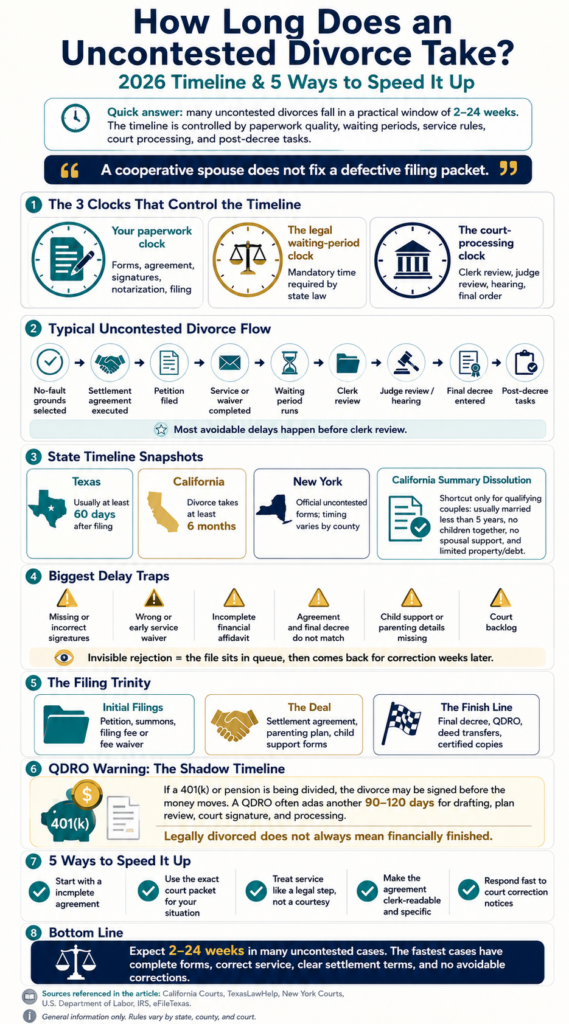
1. Quick Answer: How Long Does an Uncontested Divorce Take?
How long does an uncontested divorce take? For a straightforward case with complete paperwork, correct service or a valid waiver, and no long waiting period, the practical range is often a few weeks to about six months. Cases with a home, a retirement account, children, or a rejected filing run longer. Two hard limits sit inside every timeline: your state’s waiting period and your court’s processing speed.
The numbers below are PlainDivorce planning estimates, not official figures. No public dataset tracks a nationwide “typical” uncontested divorce time, and the rules differ enough between states that a single number would mislead. Use these as a budgeting frame, then confirm the waiting period and processing time with your own court.
| Timeline stage | What happens | Usually controlled by | Delay risk |
|---|---|---|---|
| Paperwork preparation | Petition, any settlement agreement, parenting plan, support and disclosure forms, signatures | You and your spouse | High if forms are incomplete |
| Filing | Petition or complaint is submitted to the correct court | You, the e-filing system, the clerk | Medium |
| Service or waiver | The other spouse is formally served, signs an allowed waiver, or joins the filing | You, your spouse, a process server, court rules | High if done incorrectly |
| Waiting period | Mandatory pause before the court can finalize | State law or court rule | Usually cannot be shortened |
| Court review | A clerk or judge reviews the file; some courts hold a short hearing | The court | Mostly outside your control |
| Final order | The decree, judgment, or final order is signed and entered | The judge and the court | Delayed if corrections are required |
| Post-decree tasks | Retirement order, deed transfer, certified copies, name change, account transfers | You, plan administrators, agencies | High if retirement or real estate is involved |
Most uncontested cases are filed on no-fault grounds — “irretrievable breakdown,” “irreconcilable differences,” or “incompatibility,” depending on the state. A no-fault filing tells the court you are not asking a judge to decide who caused the divorce, which keeps the case off the evidence-and-hearing track.
Where your state still allows a fault ground, such as adultery, cruelty, or abandonment, choosing it can add proof, discovery, and hearing steps and can move the case off the simple uncontested path. Grounds and the effect of fault allegations vary by jurisdiction, so check what your state actually requires.
Plain-English rule: agreement or non-opposition speeds up a divorce, but paperwork controls whether the court can actually finish it.
Need help organizing the forms? Start with a PlainDivorce uncontested divorce kit so your paperwork is prepared as one packet instead of one form at a time.
2. Two Routes to an Uncontested Divorce, and How Each Affects Timing
“Uncontested” describes the outcome, not one procedure. A divorce is uncontested when the other spouse does not fight it — and that happens in two different ways, each with its own timeline.
Route 1: The agreed, joint, or consent route
Both spouses sign. Depending on the state, that looks like a joint petition or joint application, a signed settlement agreement plus a consent or appearance form, or one spouse filing and the other signing a waiver or affidavit. New York, for example, runs an Uncontested Joint Divorce Program where the spouses file their papers together.
Timing: this route removes the response deadline because there is nothing to respond to. The clock is your paperwork, the waiting period, and court review. It is usually the faster path when the agreement is complete and correctly drafted.
Route 2: The default or non-response route
One spouse files and formally serves the other. If the served spouse never answers or appears within the response deadline, the filing spouse asks the court to finish the case by default. The spouses do not need a signed agreement for this route, and a self-represented (“pro se”) filer can use it. One trade-off: in a default, the relief the court grants generally cannot exceed what the petition asked for, so the petition has to be complete and specific.
Timing: this route adds the service step and the full response window — commonly 20 to 30 days after service, set by your state — before you can request a default. Service problems are the most common reason this route stalls.
Many states also allow a hybrid: a default paired with a written agreement the court adopts. Check which routes your court offers before you decide how to file, because the forms and the timeline differ.
3. The Three Clocks That Control the Uncontested Divorce Timeline
To understand how long an uncontested divorce takes, think of the timeline as three clocks running at once.
Clock 1: Your paperwork clock
The time it takes to gather information, prepare the forms, draft any agreement, review the details, sign, notarize if required, and file. This is the clock you control the most, and the one where DIY cases lose the most time.
Clock 2: The legal waiting-period clock
Most jurisdictions require a set amount of time to pass before a court can finalize a divorce. California Courts states that a divorce there takes at least six months to finish. Under Texas Family Code section 6.702, a court generally cannot grant a divorce until the 60th day after the suit is filed. You usually cannot shorten this clock.
Clock 3: The court-processing clock
After the paperwork is filed and the waiting period runs, the court still needs time to process the case. A clerk may check the file first. A judge reviews the final documents. Some courts hold a short uncontested hearing; others decide entirely on the papers. Staffing, holidays, and filing volume all affect this clock, which is why two people in the same state can have very different timelines.
An example flow, not a universal sequence
A typical agreed case moves in roughly this order. Yours may skip steps, combine them, or use different names — joint, consent, and paper-only proceedings all look different. Use your court’s packet and instructions as the authority.
No-fault grounds selected
      ↓
Settlement agreement executed (agreed route) OR petition prepared for service (default route)
      ↓
Any required financial disclosure and child-support forms completed
      ↓
Petition or joint application filed with the court
      ↓
Case number issued
      ↓
Service completed and proof filed, waiver filed, or joint filing accepted
      ↓
Mandatory waiting period runs
      ↓
Court review of the file (clerk and/or judge), if your court reviews before entry
      ↓
Judge review or short uncontested hearing
      ↓
Final decree or judgment signed and entered
      ↓
Post-decree tasks (retirement order, deed transfer, certified copies, name change, account changes)
Most avoidable delay happens before a judge ever sees the file — in preparation, service, and any early review your court performs.
4. The Divorce Waiting Period: The Floor You Usually Cannot Move
A divorce waiting period is a mandatory amount of time that must pass before a court can finalize the divorce. When people ask how long an uncontested divorce takes, this is the rule they most often miss.
States start the clock at different events: the filing date, the service date, the response date, the date both spouses sign, a required separation date, or the date of a conditional judgment. A few examples of how much the trigger matters:
- Texas measures its 60 days from the date the suit is filed. Section 6.702 also lists narrow exceptions: no waiting period is required if the court finds the respondent was finally convicted of, or received deferred adjudication for, a family-violence offense against the petitioner or a household member, or the petitioner has an active family-violence protective order or magistrate’s emergency-protection order against the respondent.
- California does not count from filing at all. Under Family Code section 2339, a dissolution is not final until six months after the date the summons and petition are served on the respondent, or the date the respondent appears, whichever comes first. The court can extend that period for good cause.
- Other states range from no waiting period to several months, and some tie the clock to a period of living separately.
A waiting period is not the same as ordinary court backlog, and it is not the same as a residency requirement. A residency requirement asks whether you have lived in the state or county long enough to file there. A waiting period asks how long the court must wait before finalizing. Both affect your timeline, and both should be confirmed with your court before you count on a finish date.
5. Timeline Snapshots: Texas, California, New York, and Canada
How long does an uncontested divorce take in your state or province? The answer depends on local rules. Use these snapshots as routing points, then confirm the current rules with your court before filing.
Texas uncontested divorce timeline
Texas has a 60-day waiting period that runs from the filing date, with the family-violence exceptions noted above. In practice, an agreed Texas case is often finalized somewhere between about two and four months, longer if service is not completed, the decree is incomplete, children are involved, or the court’s docket is crowded. If you are preparing your own case, use a state-specific packet: start with the Texas uncontested divorce kit.
California uncontested divorce timeline
California is not a fast final-decree state. The judgment cannot be final until six months after service or the respondent’s appearance, whichever is first, so the earliest realistic finish is about six to seven months even when both spouses cooperate.
California also has a shortcut called summary dissolution, but it is narrow. In general it is for spouses married less than five years, with no children together, no request for spousal support, limited property and debt, and full agreement on how to divide everything. California Courts publishes current dollar limits (recently under $57,000 in community property and under $57,000 in separate property for each spouse, excluding cars), but the full qualification checklist — not the summarized version — controls, so check the current court checklist. A summary dissolution still becomes final six months after filing. If you are in California, start with the California uncontested divorce kit.
New York uncontested divorce timeline
New York publishes official uncontested-divorce forms and, since 2025, an Uncontested Joint Divorce Program. A case can be uncontested by agreement, by consent, or by default when a served spouse does not answer. Court fees are at least $335: a $210 index-number fee to start the case plus a $125 Note of Issue fee, according to New York Courts. Timing depends on the county, whether children are involved, and how quickly the court works its uncontested calendar — often a few months, and longer in busy counties.
New York is a good example of why “uncontested” does not mean “one form.” The packet can include a summons, a verified complaint, affidavits, child-support forms if there are children, and the judgment papers, and the exact packet depends on whether the case is joint, by consent, or by default. If you are filing in New York, start with the New York uncontested divorce kit.
Other states
If you are outside Texas, California, or New York, check four things first: whether there is a waiting period and what event starts it, whether service can be waived, whether your court requires a hearing or allows paper-only review, and whether joint or consent filing is available. Those four answers set your timeline.
Canada: provincial and territorial timelines
In Canada, divorce is governed nationally by the Divorce Act, but court procedure is set by each province and territory. Terms like “simple divorce,” “joint divorce,” and “desk divorce” are useful search signals, not one shared process. Ontario, for example, distinguishes a simple application (divorce only) from a joint application (both spouses agree on everything), each with its own requirements. A divorce based on one year of living separate and apart also cannot be finalized before that year is up. Check your province or territory’s court site for the applicable steps and timing.
6. Why Agreed Cases Still Get Delayed
Here is the part most timeline articles skip. A court is not only asking, “Do both spouses agree?” Depending on local rules, it may also check whether this is the correct packet, whether all required forms are included, whether signatures are in the right places, whether service is valid, whether any children’s forms are complete, and whether the proposed order matches the agreement and the petition.
A cooperative spouse does not fix a defective filing packet.
The invisible rejection
Some delays do not feel like delays at first. You file. Nothing happens. You assume the court is slow. Then a notice arrives — a rejection, a deficiency notice, a correction request, or a returned filing. If your court performs an early review, the file may have been waiting for someone to flag the problem the whole time. That is the invisible rejection: the delay starts before you know there is one.
Three small mistakes that create real setbacks
- Name mismatch. One form uses a maiden name, another a married name, and the proposed order a shortened version. Many courts want the names to match exactly or be clearly explained.
- Signature-date problem. A waiver, affidavit, or consent is signed before the petition is filed, before service is valid, or without a required notarization. The court can reject it and make you redo it.
- Agreement/order mismatch. The settlement agreement says one thing and the proposed final decree says another. If the judge cannot tell which version controls, the file goes back.
These are not legal fights. They are paperwork defects — and paperwork defects are one of the most common reasons an uncontested divorce takes longer than expected. How your court handles a rejection (a fast correction window versus a full refile) depends on its own deficiency procedure.
7. The Three Document Groups That Control Your Speed
Every court names its forms differently, so a long master list creates more confusion than clarity. Instead, focus on three groups of documents. Which specific forms fall into each group, and whether every group applies, depends on your court and your facts.
Group 1: The initial filing
This starts the case: a petition, complaint, application, or joint petition, plus items like a summons, a case information sheet, and the filing fee or a fee-waiver request. It tells the court who is filing, where the case belongs, what grounds apply, and what relief is requested. A no-children petition used in a case with children, or a petition filed in the wrong county, can cost weeks.
Group 2: The agreement (agreed route)
If your case runs on agreement, this group tells the court what the spouses decided: the marital settlement agreement or separation agreement, and, where they apply, a parenting plan, a child-support worksheet, a financial affidavit, and health-insurance and expense terms. The agreement has to be specific enough for a judge to enforce. “We will divide our debts” is weak. “Spouse A pays the Visa ending 1111; Spouse B pays the Mastercard ending 2222; each indemnifies the other for the debt assigned” is enforceable.
A default case may not need a signed agreement at all, but the petition then has to carry the detail the court needs.
Group 3: The finish-line documents
These let the judge finalize and let the parties carry out the judgment: the proposed final decree or judgment, any findings or affidavits your court requires, a retirement order if benefits are divided, deed-transfer documents if real estate is involved, and certified copies for name changes, agencies, and account changes. The final decree must match the petition and any agreement. If the agreement gives the house to one spouse but the decree is silent about the house, the judge may not sign it.
The practical test: lay the initial filing, the agreement, and the proposed decree side by side. Names, dates, and property, debt, support, parenting, and retirement terms should all match.
PlainDivorce tip: this is where a self-help kit helps most — it lets you prepare the case as one packet instead of guessing one form at a time. A kit is a general organizing aid; it does not guarantee your court will accept the filing. Start with the PlainDivorce uncontested divorce kit.
8. Filing and Service: The Step People Underestimate
Even in an uncontested divorce, the court needs proof that both spouses know about the case. Depending on the state, that can be formal service of process, a waiver or acceptance of service, an acknowledgment, a joint petition, a signed consent or appearance, or court-approved electronic notice.
Service delays an uncontested divorce when the wrong person serves the papers, proof of service is missing, a waiver is signed too early, a waiver is not notarized when the state requires it, the other spouse cannot be located, or the filing spouse assumes a text or email is enough. If both spouses cooperate, check whether your court allows a waiver, acknowledgment, joint filing, or consent process — the rule is not the same everywhere. For more detail, see the PlainDivorce guide to serving divorce papers in an uncontested divorce.
E-filing helps with submission but does not fix an incomplete packet. Where e-filing is offered, systems like the one described at Texas Courts give self-represented filers electronic tools; in Texas, e-filing is allowed for unrepresented parties, not required, and the filer is still responsible for submitting the correct documents.
9. Court Processing and Whether You Need a Hearing
Court processing time begins when the filing reaches the court. Depending on the court, it can include clerk review, case-number assignment, fee or fee-waiver processing, signature and notary checks, a service review, hearing scheduling, judge review, and entry of the final order.
Some uncontested divorces are finalized entirely on the papers. Others need a short hearing — sometimes called a prove-up hearing, final hearing, uncontested hearing, or default hearing. Processing time shifts with local staffing, judge availability, holidays, filing volume, e-filing and rejected-document queues, and whether the case involves children. County-level procedure is why two people in the same state can wait very different amounts of time.
Note that “the judge signed it” is not the universal moment of finality. Entry or filing of the judgment, the statutory waiting period, and local terminology all control when the marriage legally ends — California’s Family Code section 2339, for instance, sets the earliest possible date regardless of when the paperwork is ready. If your case involves children, review the child-related paperwork carefully and see the PlainDivorce guide to child support and court approval in an uncontested divorce.
10. How an Agreement or Non-Opposition Narrows the Case
An uncontested divorce is generally quicker because it removes the issues that drive most delay. A contested case can involve discovery, interrogatories, requests for production, depositions, temporary orders, custody motions, financial subpoenas, contested hearings, and a trial.
When the spouses have already agreed, or the served spouse does not oppose the case, the court usually does not need to decide who is telling the truth or divide disputed assets after a trial. That is why an agreed or non-opposed case is normally faster. It does not mean every one of those steps is impossible: under local rules the court may still require financial disclosure, ask for evidence, or hold a short hearing before it signs. The real driver of your timeline is whether the paperwork is complete, specific, and filed correctly — not the emotional temperature of the agreement.
11. The Retirement-Order Timeline: Final Divorce, Unfinished 401(k)
If your divorce divides a private-sector employer retirement plan — a 401(k) or many pensions — the decree may not be the last step. You may need a Qualified Domestic Relations Order (QDRO). The U.S. Department of Labor explains that a QDRO creates or recognizes an alternate payee’s right to receive all or part of a participant’s retirement benefits, and that the plan administrator decides whether an order qualifies. A QDRO does not have to be a document physically separate from the decree, but it must meet the statutory content and the administrator must approve it.
Two limits on that: QDRO rules apply to plans governed by ERISA and the Internal Revenue Code. An IRA is not divided by a QDRO — it moves by a “transfer incident to divorce” handled with the custodian under the decree; taking a withdrawal and writing your spouse a check instead is taxable to you and can trigger the 10% early-withdrawal penalty. Government and military retirement systems use their own order formats.
The shadow timeline
Your divorce can be final while the retirement transfer is still pending. A QDRO can involve drafting the order, sending it to the plan for review, revising it if the plan rejects the language, submitting it to the court for signature, returning the signed order to the plan, and waiting for the administrator to process the division. The plan sets its own review timeline, and federal guidance gives no fixed number of days, so ask the plan for its written QDRO procedures before you finalize the settlement wording. Do not treat “the judge signed the decree” as the finish line when retirement division is involved, and consider QDRO-specific or legal help before filing the final decree — these mistakes are hard to fix later.
12. Seven Ways to Reduce Avoidable Delay
You usually cannot shorten a mandatory waiting period, but you can cut the avoidable delay around it.
- Settle the terms before you touch the forms. Confirm agreement on property, debt, support, parenting time, decision-making, child support, health insurance, tax-related child claims, retirement division, who signs what, and whether service can be waived. Forms are easy once the deal is done.
- Pick the right route. Decide early whether you are filing jointly, by consent, or heading toward a default, because the forms and the timeline differ.
- Use the exact packet for your situation. Not a no-children packet if you have children, not a generic form from a forum. Use current court forms or a current self-help kit for your state or province.
- Treat service as a legal step, not a courtesy. A friendly spouse can still sign the wrong form, sign too early, or skip a required notarization.
- Make the agreement court-readable. Identify accounts, debts, vehicles, deadlines, and responsibilities specifically. Vague terms create judge questions, and judge questions create delay. If property and debt are involved, review the PlainDivorce guide to property division in an uncontested divorce.
- Match every document. Names, dates, and terms should be identical across the petition, the agreement, and the proposed decree.
- Respond to court notices immediately. If a rejection or correction request arrives, read it closely, fix the exact issue, and resubmit the way the court instructs.
13. Before-You-File Timeline Checklist
Use this before submitting an uncontested divorce:
- Decide your route: agreed/joint, consent, or default after service.
- If it is an agreed case, confirm both spouses agree on every required issue.
- Identify your state’s waiting period and the event that starts it.
- Use the correct divorce packet for your location.
- Check whether your case has children, property, support, or retirement issues.
- Complete any financial-disclosure and child-support forms your court requires.
- Make the settlement agreement, or the petition in a default case, specific.
- Prepare a detailed parenting plan if children are involved and your court requires one.
- Confirm whether service is required or can be waived, and how proof is filed.
- Complete signatures, dates, notarization, and any e-signature rules correctly.
- Confirm names match across all forms.
- Confirm the agreement matches the proposed final order and the petition.
- File in the correct court, and keep copies of everything.
- Watch for court notices after filing.
- If retirement is divided, confirm whether a QDRO or a transfer incident to divorce applies, and request the plan’s procedures.
Want a cleaner filing packet? Start with the PlainDivorce uncontested divorce kit before you file.
14. When to Get Legal Help
Not every uncontested divorce is just a timeline problem.
If your spouse has a lawyer and you do not, this is no longer a basic paperwork timeline. Get your own legal advice before signing.
Also consider help before filing if you feel pressured to sign, do not understand the agreement, your spouse controls most of the financial information, there are pensions or stock options, you own real estate together, one spouse has major debt, a child has significant medical or educational needs, you disagree about child support, one spouse lives outside the country, there has been abuse or coercion, or you received a court rejection notice you do not understand.
Legal help does not have to mean hiring a lawyer for the whole case. Many people use limited-scope help to review paperwork, explain local rules, or fix a rejected filing — often one consultation is enough.
PlainDivorce is not a law firm and does not provide legal advice. Divorce rules vary by state, province, territory, county, and court.
15. Bottom Line: How Long Does an Uncontested Divorce Take?
So, how long does an uncontested divorce take? Plan on a few weeks to about six months in most simple cases, with the finish date controlled by your state’s divorce waiting period, your paperwork quality, service, court processing, and any post-decree tasks like a retirement order.
The fastest uncontested divorces have complete forms, clear terms, correct service or a valid waiver, no fault allegations, and no avoidable corrections. The slowest are held up by missing forms, vague agreements, service mistakes, child-related omissions, retirement issues, or court backlog. Focus on what you control before filing: complete information, the right route, the right forms, clean signatures, specific terms, and fast responses to the court.
Ready to prepare your paperwork? Download your state-specific PlainDivorce uncontested divorce kit to organize the forms and reduce avoidable filing delays.
16. FAQ: How Long an Uncontested Divorce Takes
How long does an uncontested divorce take if we both agree?
Agreement removes the response deadline and the contested-hearing track, but it does not make the divorce immediate. In most simple agreed cases, plan on a few weeks to about six months from filing to a signed judgment. Your state’s waiting period sets the floor, and your court’s processing speed, service, and paperwork quality decide the rest. Confirm the waiting period with your own court.
What is the fastest an uncontested divorce can be finalized?
It depends on local law. Some states have no waiting period, so a clean case can finish in a few weeks once the court processes it. Others set a hard minimum: Texas generally bars a decree before day 60 after filing, and California will not finalize until six months after service or the respondent’s appearance. Those minimums cannot usually be shortened.
Is an uncontested divorce faster than a contested divorce?
Usually, yes. When the spouses agree or the served spouse does not oppose the case, the court generally does not need discovery, temporary orders, contested hearings, or a trial — the steps that make contested cases take a year or more. Under local rules the court can still require financial disclosure, evidence, or a short hearing before it signs the judgment.
What is the biggest cause of delay in an uncontested divorce?
Outside the mandatory waiting period, paperwork defects are the most common cause: missing forms, missing or mis-dated signatures, invalid service or waiver documents, incomplete financial information, vague settlement terms, child-support paperwork problems, and mismatches between the agreement and the proposed order. How quickly a rejection can be cured depends on your court’s deficiency procedure.
Can a divorce waiting period be waived?
Usually not. Most waiting periods are mandatory. A few states have narrow exceptions — Texas, for example, removes its 60-day wait where the court makes certain family-violence findings — but many states have none. Check your state or court rules before assuming the period can be shortened, and do not count on an exception.
Do we need a hearing for an uncontested divorce?
It depends on the court. Many uncontested divorces are finalized on the papers with no appearance. Others require a short hearing — a prove-up hearing, default hearing, or final uncontested hearing — often lasting only a few minutes. Your court’s local rules and the type of case (joint, consent, or default) determine which applies.
Does having children make an uncontested divorce take longer?
It can. Depending on your state and county, a case with children may require a parenting plan, a child-support calculation, health-insurance and expense terms, sometimes a parenting class, and closer court review before a judge signs. Each added requirement is a little more time. If children are involved, see the PlainDivorce guide to uncontested divorce with children.
Can retirement division delay getting your share?
Yes. If a 401(k) or employer pension is divided, a QDRO may be needed, and the plan administrator has to approve it. The divorce can be legally final before the plan processes the transfer. IRAs are different: they move by a transfer incident to divorce with the custodian, not a QDRO. Request the plan’s written QDRO procedures before you finalize the settlement wording.
Can PlainDivorce file my divorce for me?
PlainDivorce provides self-help divorce paperwork and state-specific kits. It is not a law firm and does not provide legal advice or file on your behalf. You are responsible for checking your local court’s current filing rules and deciding whether legal advice is needed for your situation.
Sources and local rules can change. Use this guide as a plain-English organizer, then verify the current filing requirements with the official court or government source for your jurisdiction.

About Harry D
Expert contributor at PlainDivorce, helping Canadians and American navigate simple uncontested divorces with clarity and confidence.