To learn how to serve divorce papers, start with the court where the case is filed, because service of process in a divorce is set by local rules, not one national rule. In most cases the court needs one of four things: a joint filing where there is no one to serve, a valid signed waiver or acknowledgment from the other spouse, formal delivery by someone the court allows, or a judge’s permission to use another method when ordinary service is not possible. A spouse who is properly served and then does not respond can still reach a finished divorce through a default process, without signing anything.
This guide explains what service of process means in a divorce, the difference between an agreed case and a default case, and each route for giving legal notice — joint filing, a waiver of service, an acceptance or acknowledgment of service, formal personal service, and court-authorized alternative service. Treat it as a list of questions to ask, then confirm every specific with the official instructions for your state, territory, or province.
New to the process? Start with what an uncontested divorce is and whether your case qualifies. For the full filing path, see the uncontested divorce process. If your spouse may not sign or respond, compare uncontested vs. contested divorce first.
TL;DR
There is no national rule for serving divorce papers — the court where you file decides who may serve, what gets delivered, and what proof it accepts. Your job is to pick the right route and match it to that court’s exact form.
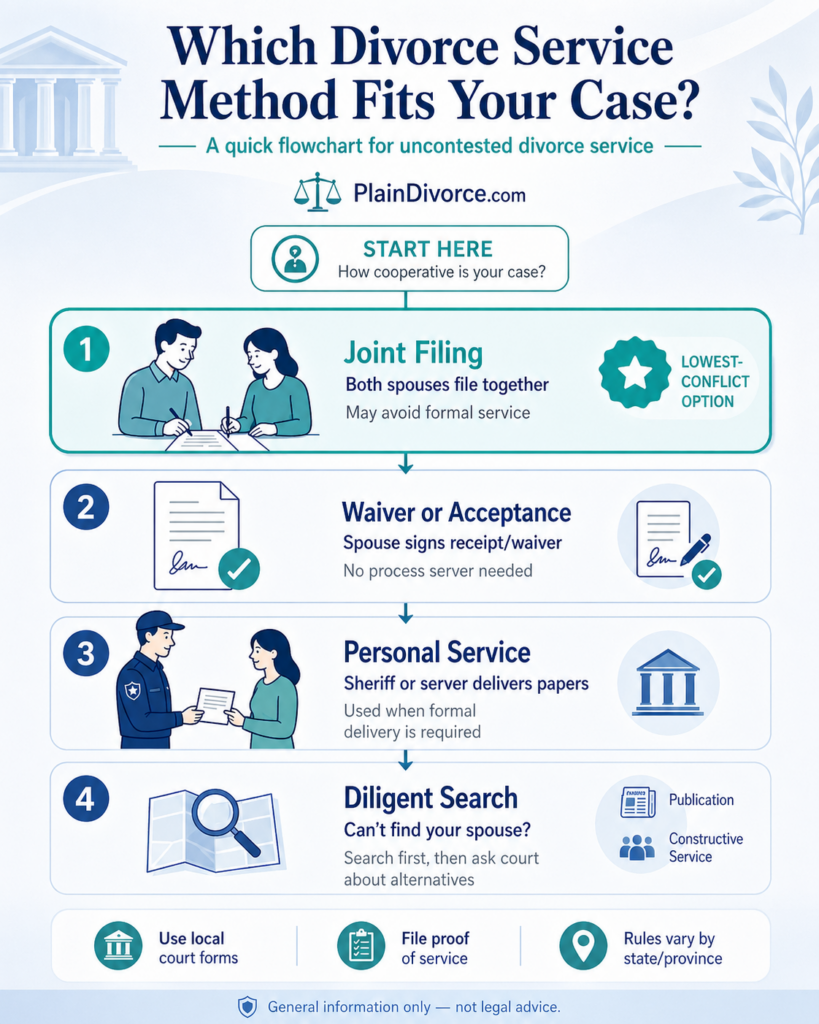
- Four routes to proper notice: file jointly (often no one to serve), get a signed waiver or acknowledgment, arrange formal service, or ask a judge for court-authorized alternative service. A default isn’t a fifth service method — it’s what happens after valid service when no one responds.
- You usually can’t hand the papers over yourself. Most courts require a sheriff, a process server, or a non-party adult. Doing it yourself can invalidate the service.
- A waiver deals with NOTICE, not TERMS. Signing one says you know about the case — it does not mean you agree to the property split, support, or parenting plan. That’s a separate settlement agreement.
- Waiver timing is strict. Texas, for example, requires it to be signed after filing, sworn before a notary who isn’t an attorney in the case, with the spouse’s mailing address. Signed a day early or on the wrong form and it’s rejected.
- A spouse who won’t sign doesn’t stop you. Serve validly, let the response deadline pass, and many courts let you finish by default — no signature needed.
- Publication can narrow your outcome. When a spouse is served by publication or posting, the court may be unable to order support or transfer property. It’s a last resort requiring a documented diligent search first.
- Clearing the clerk isn’t the finish line. A clerk screens the packet; a judge decides whether service was legally valid — and defective service can get raised later and force you to start over.
- On the proof of service, name the documents — petition, summons, financial statement, parenting plan — not “divorce papers.”
- Never reuse another jurisdiction’s form. Waiver, acknowledgment, acceptance, and consent are different mechanisms with different legal effects, even within one country.
1. Start Here: Service Is a Local Rule, Not One National Rule
There is no single method for how to serve divorce papers across the United States and Canada. Who may serve, what has to be delivered, whether mail counts, what the proof looks like, and how long you have — all of it is set by the court where the case is filed. An article can tell you what to look for. It cannot tell you the rule.
Use this guide as a question list. Before you file or serve anything, read the official instructions for the court that will handle your case: a state or territorial court self-help site in the US, or the provincial or territorial court in Canada. The federal Department of Justice Canada makes the same point — the Divorce Act is federal, but the process, including service, runs through provincial and territorial courts.
One more distinction to fix early. An agreed or joint case, where both spouses sign, is not the only kind of uncontested divorce. A case can also finish by default when one spouse is validly served and simply does not respond. Both are routes to a final order. They involve different service steps, which is why the rest of this guide separates them.
2. What Service of Process Means in a Divorce
Service of process is the formal step that tells the other spouse a divorce case exists and what response, if any, is required. It is not a formality the court can overlook. It protects a basic fairness principle: before a court makes orders that affect someone’s rights, that person should get legally sufficient notice and a chance to be heard.
In the United States this idea is tied to due process. In Canada, courts often describe similar fairness requirements as natural justice. Either way, the court is looking for a reliable record that the other spouse received proper notice, gave that notice up in writing, or joined the case from the start. A text, a phone call, an email, or a spouse saying “I got the papers” does not satisfy the rule unless the court’s own procedure allows that method and that proof.
California’s courts describe the standard version plainly in their guide to serving court papers: someone other than you gives the papers to the other side, and the court needs proof of how and when that happened. New York’s courts explain in how legal papers are delivered that a divorce defendant must be told of the case in person, with the delivery proved by an affidavit of service. These are examples of how two systems handle it, not a rule that applies everywhere.
3. Four Ways a Divorce Case Gets Proper Notice
Across most US and Canadian courts, a divorce case satisfies the notice requirement through one of four routes. The names, forms, and legal effects differ by jurisdiction, so use this as a map, then check your court’s version of each.
| Route | How notice happens | Where it can fit | What to confirm locally |
|---|---|---|---|
| File together | Both spouses sign the opening documents. Some courts treat a joint filing as having no respondent to serve. | Both spouses agree to divorce and will sign from the start. | Whether your court offers a joint petition or joint application, and the full document set it requires. |
| Signed waiver, acknowledgment, or consent | The other spouse signs a court form accepting notice or confirming receipt of the papers. | One spouse files first; the other cooperates but you are not filing jointly. | The exact form, when it may be signed, whether it must be notarized, and what it does and does not waive. |
| Formal service | A person the court allows — often a sheriff, a process server, or an adult who is not a party — delivers the papers. | The other spouse will not sign, or your court requires service even in an agreed case. | Who may serve, exactly which documents must be delivered, the deadline, and the proof form. |
| Court-authorized alternative service | A judge approves another method — substituted service, service by mail, posting, or publication — after ordinary service cannot be completed. | The other spouse cannot be located or is evading service. | The search declaration the court requires, and any limit this route places on the relief the court can grant. |
If both spouses cooperate, the first two routes usually avoid the cost and delay of a process server. Whether a joint filing is even available, and what it removes, is a local question: Ontario, for example, says a joint divorce application needs no service because there is no respondent, while a one-spouse “simple” application still has to be served. Do not assume your court works the same way.
4. Service Terms You May See, and Why the Exact Form Matters
Courts use different words for the service paperwork. Depending on where you file, you may see:
- Proof of service, affidavit of service, or return of service
- Notice and acknowledgment of receipt
- Waiver of service, waiver of citation, or waiver of the issuance and service of process
- Acceptance of service or admission of service
- Consent, appearance, or answer and waiver
- Joint petition or joint application
These are not interchangeable. A waiver, an acknowledgment, an acceptance, and a consent can have different legal effects, different timing rules, and different signing formalities in the same country. A form that is correct in one state or province can be rejected in the next one. Do not reuse a waiver, proof of service, or acknowledgment form from another jurisdiction unless your court specifically accepts it, and always use the current version of your court’s own form.
5. How to Serve Divorce Papers: A Low-Conflict Decision Path
When you are deciding how to serve divorce papers in a cooperative case, work through these questions in order.
- Can both spouses file together? If yes, check whether your court offers a joint petition or joint application and what it requires. This route may remove the need to serve anyone.
- If one spouse files first, will the other sign a service form? If yes, find your court’s exact waiver, acknowledgment, acceptance, or consent form and its signing rules.
- If your spouse will not sign but can be located, who is allowed to serve? Arrange formal service through a sheriff, a licensed process server, or another adult your court permits — usually not you.
- If your spouse cannot be located, have you done a diligent search? You cannot skip straight to publication. The court will expect a documented search and a signed declaration before it authorizes another method.
- If your spouse is served and does not respond, is a default available? After the response deadline passes, many courts let the filing spouse move forward by default. Your spouse does not have to sign anything for this to work.
6. Path 1: File Together, and There May Be No One to Serve
In some uncontested cases, both spouses can start the case together. This may be called a joint petition, joint application, joint divorce, or, in a few places, a simplified or summary dissolution. Because both people are already in the case, some courts treat the filing as having no respondent, so there is nothing to serve.
A joint filing tends to work when both spouses agree to divorce, both will sign the opening documents, property and debts are resolved, any parenting and support terms are worked out, and the court allows a joint filing for that type of case. It does not mean automatic approval. The court can still require financial disclosure, review parenting terms, or send the packet back for correction.
Pro tip: a joint filing is rarely just two signatures on one form. Courts often want a full packet — the settlement agreement, financial disclosures, parenting documents, a proposed judgment, and sworn statements. Confirm the whole document set before you rely on this route. If both spouses are cooperating, start with your jurisdiction’s guide, such as uncontested divorce in California or uncontested divorce in Ontario.
7. Path 2: A Signed Waiver, Acknowledgment, or Consent
If you file first and your spouse cooperates, many courts let the other spouse sign a form instead of being served by a sheriff or process server. Depending on the jurisdiction, that form is a waiver of service, an acknowledgment or acceptance of service, a notice and acknowledgment of receipt, or a consent. They are different mechanisms, and the details are set by statute or court rule where you file.
Texas shows how specific these rules can be. Under Texas Family Code section 6.4035, a divorce waiver of service may be signed only after the suit is filed, must acknowledge that the spouse received a copy of the filed petition, must state the signing spouse’s mailing address, and must be sworn before a notary who is not an attorney in the case — with an exception if the spouse is incarcerated. A waiver signed a day too early, on the wrong form, or without the notarization that state requires can be rejected. Another state may not use a waiver at all, or may require something different.
A waiver or acknowledgment generally deals with notice, not the terms of the divorce. Agreeing that you know about the case is not the same as agreeing to the property division, support, or parenting plan — that is the job of a separate settlement agreement, sometimes called a marital settlement agreement, separation agreement, or property settlement agreement. Read the form to see exactly what it waives, whether it also gives up later notices, and whether your spouse still needs to file an appearance or answer.
Pro tip: before your spouse signs anything, confirm four things with your court’s instructions — when the form may be signed, whether it must be notarized or witnessed, exactly which documents your spouse must have received first, and whether a separate response is still needed. To see where this fits in the wider process, read what is an uncontested divorce.
8. Path 3: Formal Service by Someone the Court Allows
If your spouse will not sign a service form, or your court requires service even when both spouses agree, someone delivers the papers formally. The filing court’s rule — not a general custom — decides who may serve and how.
Two labeled examples show the pattern. In California, the person who serves the summons and petition must be at least 18 and not a party to the case; it can be a friend, a relative, a professional process server, or the county sheriff, and the papers are served after the case is filed. In Ontario, an application must be delivered by special service, done by someone other than the party who is at least 18. Many other courts follow a similar “non-party adult” rule, but the age, any licensing requirement, and whether the filing spouse is ever allowed to hand over the papers all vary. Check before you assume.
The service packet often includes more than the petition: the summons or court notice, financial disclosure forms, parenting forms if there are children, any local notices, blank response forms, and temporary order paperwork if it applies. Some courts want file-stamped copies with a case number. The practical rule: do not hand the papers to your spouse yourself unless your court’s instructions clearly say that is allowed, and confirm the full list of what must be delivered.
Sheriff or Private Process Server: Questions to Ask
Where both are options, cost and speed depend entirely on your county and your spouse’s situation, so ask rather than assume:
- What does the sheriff’s civil-process division charge, and how long is its current turnaround?
- Does your court require a private process server to be licensed or registered?
- How many service attempts are included, and are evening and weekend attempts covered?
- Will the server provide the exact proof-of-service form your court accepts, notarized if required?
- Has the server handled family court papers in your court before, and will the proof list every document served by name?
A low service fee is not a bargain if the proof does not meet your court’s rules and the case stalls.
Substituted Service
If your spouse cannot be handed the papers in person, some courts allow substituted service — for example, leaving the papers with another responsible adult at your spouse’s home or usual workplace and then mailing a copy, or another court-approved method. Substituted service is not a more convenient option you can simply choose. It usually requires strict compliance with the rule, and in some places you need the court’s permission first.
9. Path 4: The Default Route After Valid Service
A cooperative spouse who will not sign paperwork is not the end of the road. If your spouse is validly served and does not respond by the deadline, many courts let the filing spouse finish the case by default. The other spouse does not have to sign anything.
California is a clear example of how this splits. Its default guidance describes a true default, where the judge decides the case on what the filing spouse submitted plus the law, and a default with agreement, where the spouses have a signed written settlement that gets attached to the judgment even though no response was filed. A missed response deadline — 30 days after service in California — is what opens this route.
Two cautions. First, default is procedural: if the petition, the summons, the service, or the proof of service is defective, the court can refuse the default and make you redo the step. Second, a true default can produce narrower relief than an agreed judgment — a court may decline to divide assets or order support that were not properly requested and served. Default rules are technical and vary widely, so read your court’s default instructions before you rely on this path.
10. Proof of Service: The Record the Court Keeps
Whatever route you use, the court keeps a record that notice happened. That record is the proof of service, and its form depends on the method and the jurisdiction.
- Formal service: the server completes and signs a proof of service, affidavit of service, or return of service. New York requires it to be signed before a notary; California’s Proof of Service of Summons is signed under penalty of perjury. Both are examples, not a universal rule.
- Service by mail: the court may need the signed return receipt, or a signed acknowledgment form. In California, mail service works only if the other spouse signs and returns a Notice and Acknowledgment of Receipt.
- Waiver, acknowledgment, or consent: the signed form itself is the record, filed with the court, sometimes notarized.
- Joint filing: both signatures on the opening documents show the court that both spouses are participating.
Pro tip: if the form asks which documents were delivered, name them — petition or application, summons, financial statement, parenting plan, proposed judgment — rather than writing “divorce papers.” Make a copy of the full packet before service and keep the signed proof afterward. If the court later asks what was delivered, you do not want to rely on memory.
11. If You Cannot Find Your Spouse
If you cannot locate your spouse, you cannot simply pick another method. You have to ask the court for permission, and most courts require a diligent search first — documented, serious efforts to find the other spouse.
A diligent search commonly covers the last known address, current and former employers, phone numbers and email, social media, relatives and known contacts, postal forwarding information, property and tax records, and other public records. What counts as “enough” is set by your court. You typically file a sworn declaration describing each step and why ordinary service did not work.
If the court is satisfied, it issues an order authorizing another method — substituted service, service by posting, or service by publication in an approved newspaper for a set period. The exact steps, the wait, and the proof are all in that order; publication is not automatically a newspaper process everywhere. This route can also limit what the court can do. California, for instance, notes that when a spouse is served by publication or posting, the court may not be able to order that spouse to pay support or transfer property, and property division is limited to what was listed in the filed papers.
A missing spouse makes service harder and can narrow your outcome, but a court-authorized method plus a default is still a defined way to finish. Because the requirements are strict and a mistake can undo the judgment later, get legal help before relying on publication or another substitute method.
12. Where Divorce Filings Get Held Up, and Who Decides
Two different people can stop a case over service, and they are not doing the same job.
A court clerk or an e-filing system screens the packet at intake — is the right form here, is it signed, is the fee correct, is the proof of service attached. A clerk can reject or return a filing that does not meet those rules, but a clerk is not your lawyer and generally cannot tell you what to do.
A judge decides whether service was legally valid. Even if a clerk accepts the packet, defective service on the initiating papers can be raised later as a defense. New York’s courts explain that if legal papers are not served correctly when a case starts, the judge can require the filer to start over — a dismissal without prejudice.
So getting the packet past the counter is not the finish line. A few practical habits reduce the risk either way: use your court’s current forms, list the documents served by name, have the server complete the proof exactly as the form directs, sign consistently using your full legal name as it appears in the case caption, and keep a complete copy of everything. For a wider look at filing problems, read why divorce paperwork gets rejected.
13. Serving a Spouse in Another State, Province, or Country
If your spouse lives outside the state, province, or territory where you file, the sending court’s rules still govern how service must be done, and there may be extra requirements for out-of-area service. Confirm them before you serve.
International service is more technical. When your spouse is in another country, service may be affected by the HCCH 1965 Service Convention, but only where the Convention is in force between your country and the destination country. The Convention provides channels for transmitting the documents; it does not supply the destination country’s substantive service rules, and your own court’s procedure still applies. Check the destination country’s status and any declarations it has made, and get legal help before serving someone abroad.
14. Does Service Work Differently in Canada and the United States?
The underlying idea is the same on both sides of the border: the other spouse must receive proper notice or take part in the case properly, and the court needs proof. The mechanics differ.
In the United States, divorce service is governed by each state’s or territory’s court procedure, and the specific court’s rules control the actual steps. In Canada, the Divorce Act is federal, but filing and service run through provincial and territorial courts, so the forms, deadlines, permitted methods, and proof requirements depend on where you file. The Department of Justice Canada directs applicants to their province’s or territory’s own court rules and forms.
For local detail, use the relevant PlainDivorce guide, such as uncontested divorce in Ontario, California, New York, or Texas.
15. Jurisdiction Checklist: Ask These Before You Serve
Instead of relying on a general rule, answer these for the court where you are filing:
- Is a joint petition or joint application available for our case, and does it remove the need to serve?
- Does the court accept a waiver, acknowledgment, acceptance, or consent, and what is the exact form?
- When must that form be signed, and does it need notarization or a witness?
- Does the waiver or acknowledgment give up only service, or also later notices?
- Who is allowed to serve the papers, and can the filing spouse ever do it?
- Must a private process server be licensed or registered?
- Are file-stamped copies required before service?
- Does the summons or notice expire if service is not completed in time?
- Is service by mail allowed, and if so must it be certified, registered, or signed for?
- Is email, electronic, or court-portal service allowed in family cases?
- Which proof of service form must be filed, and how is it signed?
- How long does the other spouse have to respond, and what happens if they do not?
- What are the rules if the spouse lives out of state, out of province, or abroad?
- If the spouse cannot be found, what search and what court order are required?
16. When to Get Legal Help
Self-help works well when both spouses agree and the paperwork is straightforward. Some service situations are better handled with a lawyer, often through a single consultation or a document review rather than full representation. Consider legal help if:
- you do not know where your spouse is, or your spouse is avoiding service
- you need substituted service, service by posting, or service by publication
- your spouse lives in another country
- there is family violence, coercion, or a safety concern
- you need urgent court orders, or there are significant property, pension, or business issues
- you disagree about children or support, or you are unsure what rights you might give up
- the court has rejected your service paperwork more than once
Getting advice does not turn a cooperative divorce into a fight. A limited consultation before filing can prevent the mistakes that cause the biggest delays. For a broader comparison of your options, read online divorce vs. lawyer vs. mediation.
17. How to Serve Divorce Papers: FAQ
Do I have to serve divorce papers if the divorce is uncontested?
Often, yes. If one spouse files first, the other spouse usually must receive formal notice, sign a valid waiver or acknowledgment, or be served and then not respond so the case can proceed by default. If both spouses file jointly, some courts treat the case as having no respondent, so no service is required. Check your court’s rule for your route.
What is the easiest way to serve divorce papers?
It depends on the court. Where a joint petition or joint application is available and both spouses will sign, there may be no one to serve at all. If one spouse files first, a signed waiver or acknowledgment of service is usually simpler and cheaper than hiring a process server, as long as the other spouse cooperates and uses the court’s current form.
Can I hand divorce papers to my spouse myself?
Usually not. Many courts require the papers to be delivered by a sheriff, a process server, or an adult who is not a party to the case. California, for example, requires a server who is at least 18 and not part of the case. Check your court’s rule before you hand anything to your spouse, because doing it yourself can invalidate the service.
What is a waiver of service in a divorce?
A waiver of service is a court form the non-filing spouse signs to say formal service is not required. It confirms the spouse knows about the case and, depending on the form, that they received the filed papers. The exact name, timing, and signing rules vary; Texas, for instance, requires it to be signed after filing and sworn before a notary.
Does signing a waiver of service mean I agree to the divorce terms?
No. A waiver of service deals with notice of the case. It does not, by itself, mean you agree to the property division, debts, support, or parenting plan. Those terms are handled in a separate settlement agreement. Read the waiver carefully to see whether it also gives up your right to receive later notices or to file a response.
What happens if my spouse will not sign anything or respond?
You will likely need formal service. Once your spouse is validly served, the response clock starts — 30 days in California, and different elsewhere. If your spouse does not respond by the deadline, many courts let you finish the case by default, without your spouse signing anything. Default rules are technical, so read your court’s default instructions.
Can divorce papers be served by mail or email?
Sometimes. Some courts allow service by mail if the other spouse signs and returns an acknowledgment form — in California this is the Notice and Acknowledgment of Receipt. Others require certified or registered mail with a signed receipt, and some do not allow mail service to start a divorce at all. Email or portal service in family cases is limited and court-specific. Check the official instructions.
What if I cannot find my spouse, or my spouse lives in another country?
If you cannot find your spouse, you generally must complete a diligent search, file a sworn declaration of your efforts, and ask the court to authorize another method such as posting or publication — which can limit the relief the court grants. If your spouse is abroad, the Hague Service Convention may apply where it is in force between the two countries, but your court’s own rules still govern. Get legal help in both situations.
18. Bottom Line
Learning how to serve divorce papers comes down to one question answered locally: what does the court where you are filing accept as proof that the other spouse had proper notice or joined the case? In a cooperative divorce, that is often a joint filing or a signed waiver or acknowledgment. If your spouse will not sign, formal service followed by a response deadline — and, if there is no response, a default — is still a defined path to a final order.
Use this guide as a checklist of questions, not a rulebook. Before you file or serve, read the official service instructions for your state, territory, or province, and use the current forms. If your case is simple and both spouses agree, start with the uncontested divorce process, then confirm your jurisdiction with a PlainDivorce kit for California, Texas, New York, or Ontario.
PlainDivorce provides self-help divorce information and document kits. It is not a law firm, it is not your process server, and this article is not legal advice. Service methods, forms, deadlines, and proof requirements vary by state, province, and territory and change over time. For advice about your situation, consult a licensed family lawyer in your jurisdiction.
Sources and local rules can change. Use this guide as a plain-English organizer, then verify the current filing requirements with the official court or government source for your jurisdiction.

About Harry D
Expert contributor at PlainDivorce, helping Canadians and American navigate simple uncontested divorces with clarity and confidence.