Simple Divorce vs. Joint Divorce in Ontario: Which Route Is Faster in 2026?
A simple divorce Ontario application is filed by one spouse (the applicant) against the other (the respondent) and asks the court for a divorce only. A joint divorce Ontario application is filed by both spouses together, as joint applicants, with no respondent and no service step. Both use the same starting form — Form 8A, Application (Divorce) — and both can be finished as an Ontario desk divorce, meaning a judge reviews the paperwork without a hearing.
The faster route is not always the friendlier one. A joint divorce skips formal service, but it stalls the moment one spouse stops signing. A simple divorce puts one spouse in control of the timeline, but it adds a service step and a response deadline. This guide is written for self-represented Ontario spouses choosing the cleaner paperwork path.
Fast answer: Choose a joint divorce if both spouses are organized, responsive, and ready to sign every document. Choose a simple divorce Ontario application if one spouse wants to move forward and the other will not oppose the divorce but also will not reliably help with paperwork.
TL;DR: Simple vs. Joint Divorce in Ontario, in 60 Seconds
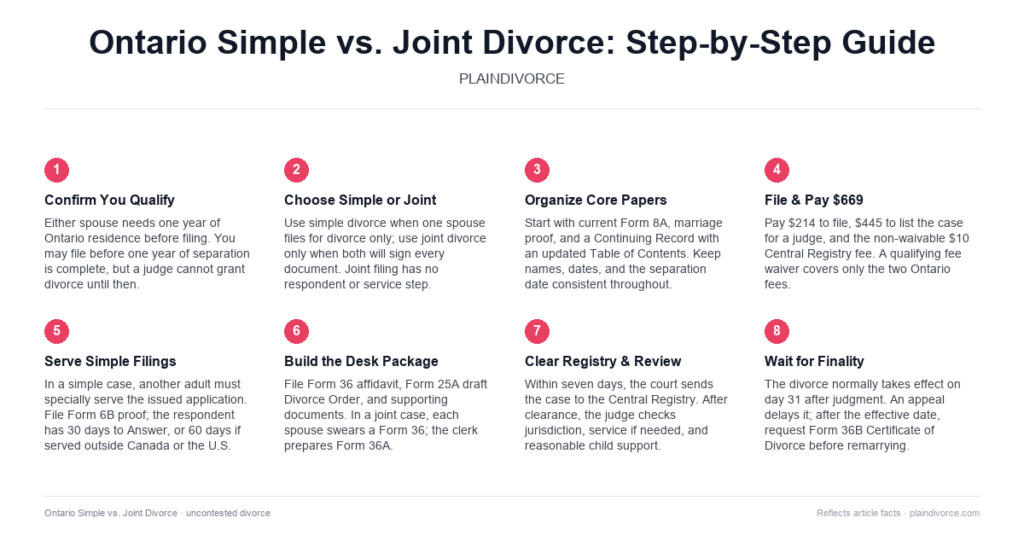
- Same form: both routes start with Form 8A, Application (Divorce), dated April 1, 2024. A simple application has an applicant and a respondent; a joint application has two joint applicants and no respondent.
- Who qualifies: either spouse must have lived in Ontario for at least one year before the case starts, and you must be separated for one full year before the divorce is granted (adultery or cruelty are the other grounds).
- Biggest difference: a simple divorce requires special service on the respondent, who then has 30 days to file an Answer (60 days if served outside Canada or the United States). A joint divorce skips service entirely.
- Cost: $214 to file, $445 to place the application on the list for a judge, plus a $10 federal Central Registry fee that cannot be waived — about $669 in court fees before extras.
- Finish line: a judge reviews the final package (Form 36 affidavit, draft Form 25A order); the court clerk prepares the Form 36A certificate. The divorce takes effect on the 31st day after it is granted.
1. First, Do You Qualify? Residency and Grounds
Before you pick between a simple and a joint divorce, confirm that an Ontario court can grant your divorce at all. Two federal rules decide this, and neither route around them.
Residency: one year in Ontario
Under section 3(1) of the Divorce Act, an Ontario court has jurisdiction only if either spouse has been habitually resident in Ontario for at least one year immediately before the case starts. It does not have to be the filing spouse. If one of you moved to Ontario ten months ago and the other still lives in Alberta, you wait two more months or file in Alberta.
Grounds: the one-year separation
Every Canadian divorce is granted on one ground: breakdown of the marriage. Under section 8 of the Divorce Act, breakdown is established by living separate and apart for at least one year immediately before the court decides the case, or by the other spouse’s adultery or physical or mental cruelty. Almost every uncontested divorce — simple or joint — uses the one-year separation.
- You can file before the year is up. The year just has to be complete before a judge grants the divorce.
- You can be separated under the same roof if you are living genuinely separate lives.
- Section 8(3) lets you try reconciliation for up to 90 days total without restarting the clock. Move back in for four months and the clock resets.
Practical tip: Pick one separation date and use it on every form. A separation date that changes between Form 8A and the Form 36 affidavit is one of the most common reasons a judge sends the package back for correction.
2. The 30-Second Decision Matrix
The core difference between a simple divorce Ontario application and a joint one is control versus cooperation. A simple divorce is driven by one spouse. A joint divorce needs both spouses participating from the first signature to the last.
| Question | Simple divorce (sole application) | Joint divorce |
|---|---|---|
| Who files? | One spouse, as the applicant. | Both spouses, as joint applicants. |
| Is there a respondent? | Yes — the other spouse. | No respondent. |
| Who signs Form 8A? | The applicant. | Both spouses must sign and date it. |
| Is service required? | Yes. The issued application must be specially served on the respondent. | No. There is no one to serve. |
| Who controls the timeline? | The applicant, once service is done. | Both spouses — one stalled signature holds up the file. |
| What can it ask for? | Divorce only (plus costs, if claimed). | Divorce, or divorce plus support and parenting orders both spouses agree to. |
| Best fit | One spouse is organized; the other will not oppose but will not help. | Both spouses are organized, responsive, and ready to sign. |
| Main correction risk | Defective service, missing proof of service, wrong address, filing the next step too early. | Mismatched signatures or names, one spouse’s Form 36 affidavit missing, changed dates. |
| Can it be a desk divorce? | Yes, if uncontested and the package is complete. | Yes, if both spouses complete every joint document. |
Do not choose on emotion. Many people pick a joint divorce because it sounds friendlier, then wait months for a spouse who signs the first page and disappears. If your spouse is slow, avoidant, or unreliable, a simple divorce usually moves more predictably — as long as you can still serve them.
Clerk-level tip: A file both spouses call “uncontested” can still be returned for correction if the names, dates, marriage details, service documents, and draft order do not tell the same story across every form.
3. What Is a Simple Divorce in Ontario?
A simple divorce Ontario application is a sole application in which one spouse asks the court for a divorce and nothing else — no property claim, no support claim, no parenting order. The filing spouse is the applicant; the other spouse is the respondent. Under Rule 36 of the Family Law Rules, either spouse may start a divorce case this way, whether or not the other spouse agrees.
The word “simple” is a procedural label, not a promise. The prescribed form still lets a simple applicant claim costs, and the court still runs the full paperwork review. “Simple” means the only substantive order requested is the divorce — it does not mean the court overlooks technical defects because the spouses get along.
A typical simple divorce
Two spouses sign a separation agreement covering parenting, child support, spousal support, property, debts, pensions, and the home. Months later, one spouse files a simple application for the divorce itself. If the application is prepared correctly, the other spouse is served properly, and no Answer is filed, it can finish as an uncontested desk divorce.
Why a “simple” file gets sent back
Common reasons a judge returns a simple divorce for correction: the marriage certificate is missing and the application does not explain why; legal names do not match the marriage certificate; the respondent was not served in the required way; the Affidavit of Service is incomplete; child support information is unclear; the Continuing Record is disorganized or its Table of Contents is not updated; or the Form 36 affidavit contradicts the original Form 8A.
4. What Is a Joint Divorce in Ontario?
A joint divorce Ontario application is filed by both spouses together as joint applicants. There is no respondent, so there is nothing to serve. Rule 36 allows this whenever both spouses want the divorce to proceed and are willing to sign the required documents. The current Form 8A also lets joint applicants ask for support or parenting orders they both agree to — but that changes the paperwork (see section 5).
A typical joint divorce
Both spouses have been separated for over a year, have resolved every issue, and want the divorce finalized. They sign Form 8A together, each swears their own Form 36 affidavit, and they file the package as one. It often feels less adversarial because neither spouse is “suing” the other.
Joint does not mean casual
A joint divorce still demands precision. If one spouse signs using a different version of their name, uses a different address, changes the separation date, or never completes their own affidavit, the file is returned. A joint divorce is a shortcut around the applicant-versus-respondent service structure — not a shortcut around accuracy.
Practical tip: Both spouses should review and sign the same final version of every document. Never have one spouse sign an early draft and the other sign a later edited copy.
5. The Workflow, Side by Side
Both routes can end at the same desk divorce review, but they do not start the same way.
| Stage | Simple divorce | Joint divorce |
|---|---|---|
| 1. Prepare Form 8A | One spouse prepares it as the applicant. | Both spouses prepare and sign it as joint applicants. |
| 2. File and pay | Applicant files, pays $214, and pays the $10 federal Central Registry fee. | Joint applicants file together, pay $214, and pay the $10 Central Registry fee. |
| 3. Give notice | The issued application is specially served on the respondent under Rule 6. | No service — both spouses already filed. |
| 4. Response window | Respondent has 30 days to file an Answer (Form 10); 60 days if served outside Canada or the U.S. | None. Both spouses continue preparing the final package. |
| 5. Final package | Applicant files the Form 36 affidavit, 3 copies of the draft Form 25A order, and addressed envelopes. | Each spouse files their own Form 36 affidavit, plus the draft Form 25A and envelopes. |
| 6. Clerk’s certificate | The court clerk prepares the Form 36A Certificate of Clerk and puts the file in front of a judge. | |
| 7. Judge’s review | The judge grants the divorce, returns the documents for correction, changes the draft order, or refuses it after giving you a chance to respond. | |
| 8. Effective date | If granted, the divorce takes effect on the 31st day, then you can request a Certificate of Divorce (Form 36B). | |
If a joint divorce also asks for support: the electronic filing rules require the draft support deduction order, the prescribed support-deduction information form, and any Form 13 or 13.1 financial statement required by Rule 13. A joint parenting or decision-making order needs the applicable Form 35.1 affidavit. A joint divorce that asks for “just the divorce” avoids all of that.
Quick example: If your spouse says, “I don’t care, just handle it,” that sounds like a joint divorce — but a joint divorce still needs their active signature and their own sworn affidavit. A simple divorce may fit that spouse better.
6. The Biggest Difference: Service
Service — formally delivering the court documents to the other party — is the single biggest procedural difference between a simple divorce Ontario application and a joint one. Ontario family service rules are in Rule 6 of the Family Law Rules.
Service in a simple divorce
The applicant must arrange special service of the issued application on the respondent. The applicant cannot serve it personally; it is normally done by another adult — a friend, a family member over 18, or a professional process server. Whoever serves it then swears proof of service, commonly on Form 6B, Affidavit of Service. This step exists so the court can see the respondent had proper notice and a fair chance to respond.
Service in a joint divorce
There is none. Both spouses are applicants, so the paperwork already shows that both are asking for the divorce. That does not make a joint divorce risk-free — each spouse still needs to understand what they are signing, and a joint divorce should never be used to pressure a spouse or rush past support issues.
When a simple divorce stops being simple
If the respondent cannot be found or dodges service, you may need a Form 14B motion for substituted service or an order dispensing with service. Under Rule 6(15), the court will approve a substitute method only after you show the specific steps you took to locate and serve the person and explain why your proposed method would likely reach them. Rule 6(16) lets the court dispense with service entirely when reasonable efforts have failed and no substitute method could reasonably be expected to work. Both take time and evidence.
Practical tip: If your spouse is reachable by text or email but you do not have a physical address, do not assume informal digital contact counts as service. Get legal help before filing if locating or serving your spouse is uncertain.
7. The Ontario Desk Divorce Package: Form 36, Form 36A, Form 25A
An Ontario desk divorce is the common name for an uncontested divorce a judge decides on the documents, without anyone appearing in court. It is not a separate type of divorce — it describes how the file is reviewed. A simple divorce or a joint divorce can both finish as a desk divorce if the package is complete.
- Simple divorce = one spouse files.
- Joint divorce = both spouses file together.
- Desk divorce = a judge reviews the uncontested file on paper.
What the final package contains
- Form 8A, Application (Divorce) — starts the case (April 1, 2024 version).
- Form 6B, Affidavit of Service — proves service in a simple divorce.
- Form 36, Affidavit for Divorce — the sworn evidence supporting the divorce (April 1, 2024 version). In a joint divorce, each spouse swears their own.
- Form 25A, Divorce Order — the draft order the judge signs; file three copies plus addressed, stamped envelopes.
- Form 36A, Certificate of Clerk (Divorce) — prepared by the court clerk, not by you, once the required documents are filed (December 1, 2020 version).
- Continuing Record and Table of Contents — the official structure that organizes everything filed.
- Marriage certificate or marriage registration certificate — required unless the application states it is impractical to get one and explains why.
- Central Registry of Divorce Proceedings clearance — handled through the court (see section 8).
Under Rule 36, once the affidavit, draft order, and supporting documents are filed, the clerk prepares the Form 36A certificate and presents the file to a judge. The judge can grant the divorce as drafted, have the clerk return the documents for correction, grant it with changes to the order, or refuse it after giving you a chance to file a further affidavit or attend court. There is no “registrar rejection” — there is a clerk’s check and then a judge’s decision.
High-value warning: Filing Form 8A is not a complete desk divorce. If Form 36 says something different from Form 8A, the draft Form 25A does not match what was requested, or the Continuing Record has no updated Table of Contents, the judge will send the package back before the divorce is granted.
8. The Central Registry (CRDP) Step
Every Ontario divorce application connects to a federal check through the Central Registry of Divorce Proceedings (CRDP), run by the federal Department of Justice.
Here is who does what. The court — not the spouses — must notify the Registry of each divorce application it receives, using a registration form filed within seven days. The Registry checks whether there is another pending or already-granted divorce between the same two spouses. If it finds none, it sends a clearance back to the court. The spouses do not file a separate clearance application; you pay the $10 fee with your filing and the court handles the rest.
This matters for timing because the court generally needs the Registry’s response before the divorce can be granted. It is one of the quiet administrative steps that a simple or joint divorce both pass through.
Paperwork insight: The Registry matches on identity and marriage details. If your names, birth names, marriage date, or place of marriage are inconsistent across your forms, keep them consistent — the divorce file depends on those details being exact.
9. Ontario Divorce Fees and Fee Waivers
As of September 2026, the Superior Court of Justice charges the following for a divorce, per Ontario’s family court fees page. Fees change; confirm the current amounts before you file.
| Fee | Amount | Can it be waived? |
|---|---|---|
| File the application (Form 8A) | $214 | Yes, with an approved fee waiver |
| Place the application on the list for a judge | $445 | Yes, with an approved fee waiver |
| Federal Central Registry of Divorce Proceedings fee | $10 | No — this fee cannot be waived |
The two Ontario fees are the same whether you file a simple or a joint divorce, and they are the same whether you file online or on paper. If you are on a low income or receiving social assistance, you may qualify for a court fee waiver, which covers the $214 and $445 Ontario fees — but never the $10 federal fee. A fee waiver does not fix filing mistakes, defective service, or an incomplete package.
Budget for extras too: commissioning affidavits, a process server for a simple divorce, a replacement or certified-translated marriage certificate, envelopes and copies, and the Certificate of Divorce after the divorce is final.
Money trap: The cheapest route is not the one with the lowest first payment. It is the one your situation can finish without returned forms, failed service, or a restarted file.
10. Which Is Actually Faster: Simple or Joint?
There is no published Ontario dataset that says one route is faster on average, so treat what follows as practical judgement, not a rule. The logic is straightforward: a joint divorce trades the service step for a dependency on two people finishing paperwork; a simple divorce takes on the service step but then lets one applicant carry the file to the finish line.
| Your situation | Route that usually moves better | Why |
|---|---|---|
| Both spouses organized and responsive | Joint divorce | No service step, and both will actually sign. |
| One spouse says “handle it” but won’t sign reliably | Simple divorce | The applicant controls the file after proper service. |
| Spouse cannot be located | Get legal help first | Substituted-service motions can add weeks. |
| Support, parenting, or property may be disputed | Get legal help first | The case may not fit a divorce-only route. |
| Complete separation agreement already signed | Either can work | Choose on cooperation and whether service is practical. |
Speed trap: A joint divorce becomes slower than a simple one the moment a spouse signs the first document and then goes quiet when the final affidavit or a correction is needed.
Whichever route you pick, timing also depends on court processing, whether the judge returns documents for correction, the Central Registry response, and any marriage-certificate issue. For a realistic picture, read our guide on how long an uncontested divorce takes.
11. The 31-Day Rule, the Certificate, and Remarriage
A divorce order is not the same as being free to remarry. Under section 12 of the Divorce Act, a divorce takes effect on the 31st day after the day the judgment is rendered. Ontario’s Form 25A reflects this: it states the divorce takes effect 31 days after the order, and that neither spouse can remarry until it does.
Two exceptions:
- Earlier date (s. 12(2)): a court can order an earlier effective date only if there are special circumstances and both spouses agree and undertake not to appeal.
- Appeal pending (s. 12(3)): if the judgment is appealed, the divorce does not take effect on day 31 — it waits until the appeal period runs out.
After the divorce takes effect, either spouse can request a Certificate of Divorce (Form 36B) from the court. That certificate — not the order itself — is the document most people need to remarry or to update pension, benefit, and government records.
Remarriage warning: Do not book a wedding based on the day the judge signs the order. Confirm the effective date and get the Certificate of Divorce first.
12. Children and Child Support
A simple or joint divorce can ask for “divorce only,” but if there are children of the marriage, the court still reviews child support. Under section 11(1)(b) of the Divorce Act, the judge has a duty to satisfy themselves that reasonable arrangements have been made for the support of any children of the marriage, having regard to the applicable guidelines. If they are not satisfied, they must stay the divorce until the arrangements are fixed.
The Form 36 affidavit reflects this. It asks you to state the Child Support Guidelines table amount and the amount actually being paid, and to explain any difference. “We agreed to no child support” is not, by itself, enough — the court needs to see why the arrangement is reasonable. If support is below the table amount, waived, informal, or unpaid, get legal advice before filing. Our uncontested divorce with children guide walks through what the court expects.
Practical tip: Child support belongs to the child, not the parents. A judge can accept a departure from the table amount, but only with a reason on the record.
13. Property, Debts, and the Six-Year Clock
A divorce-only application does not divide property. In Ontario, dividing net family property (equalization) is governed by the provincial Family Law Act, and it is usually handled in a separation agreement or a separate court claim — not in the divorce itself.
There is a deadline you need to know before you separate the divorce from unresolved property. The Form 36 affidavit itself carries the warning: an equalization claim is barred after the earliest of these —
- six years after the date of separation, or
- two years after the divorce is granted, or
- six months after a spouse’s death.
A court can extend the time only in narrow circumstances. A signed separation agreement fixes the numbers, but it does not stop these clocks if you later need to enforce or vary a claim. If property, a pension, a business, or the matrimonial home is not fully resolved, do not treat the divorce as the finish line — see our guide to property division in an uncontested divorce and get advice first.
14. Master Pre-Filing Checklist
Read the quick scan first. Then check only the column for your chosen route. If anything is uncertain, fix it before you submit.
Quick scan
- Jurisdiction: either spouse has lived in Ontario for at least one year.
- Grounds: one consistent separation date, and the one-year mark will pass before the divorce is granted.
- Identity: legal names, birth names, and addresses match across Form 8A, the affidavits, the Continuing Record, and the draft order.
- Marriage proof: marriage certificate or registration certificate in hand — or a clear explanation of why it is impractical to get one.
- Route: simple if one spouse will file alone; joint only if both will sign and stay responsive.
- Children: table amount and actual amount stated, with a reason for any difference.
- Package: Form 8A, Form 36 (one per applicant in a joint divorce), draft Form 25A, and the Continuing Record all say the same thing.
- Fees: $214 + $445 + the non-waivable $10 — or an approved fee waiver for the two Ontario fees.
- Finish: plan for the 31-day effective date and the Certificate of Divorce.
Route comparison
| Item | Simple divorce | Joint divorce |
|---|---|---|
| Form 8A | Signed by the applicant; names a respondent. | Signed and dated by both spouses; no respondent. |
| Marriage certificate | Applicant manages it. | Both spouses check certificate-name differences first. |
| Separation date | Respondent could challenge a wrong date. | Both spouses confirm it before signing. |
| Service (Rule 6) | Plan the server and Form 6B before the next step. | Not applicable. |
| Answer window | Wait 30 days (60 if served abroad) before proceeding. | None. |
| Form 36 affidavit | One, from the applicant; must match Form 8A and the service history. | One from each spouse; both must be consistent. |
| Form 36A | Prepared by the court clerk, not the applicants. | |
| Draft Form 25A | Must not request relief that was not in Form 8A. | Must reflect the joint request accurately. |
| Extra claims | Divorce only (plus costs). | Support needs Form 13 + support deduction order; parenting needs Form 35.1. |
| Continuing Record | Add service documents and later affidavits correctly. | File both spouses’ materials in the right format. |
15. Filing a Simple or Joint Divorce Online
Ontario lets you file a simple or a joint divorce online through the Justice Services Online and Family Submissions Online portals. You pay the filing fee by Visa, Visa Debit, Mastercard, or Debit Mastercard. The $10 Central Registry fee is collected the same way and, again, cannot be waived.
Online filing is a delivery method, not a cure for inconsistent forms. If Form 8A conflicts with Form 36, the service proof is defective, the Continuing Record is disorganized, or the marriage-certificate issue is unresolved, the file is still returned for correction. For a simple divorce, do not let the online step make you forget service. For a joint divorce, make sure both spouses reviewed and signed the same version before anything is uploaded.
16. When to Get Legal Help Before Filing
Talk to a family lawyer before choosing a simple or joint divorce if any of these apply:
- There is family violence, coercive control, or fear.
- Your spouse is pressuring you to sign quickly, or has a lawyer and you do not.
- You do not fully understand the documents.
- There are children and child support is unclear, below the table amount, or unpaid.
- Either spouse owns a business or has a pension.
- There is a matrimonial home, mortgage, refinance, or title issue.
- One spouse may be hiding money or debt.
- One spouse lives outside Ontario or Canada, or cannot be located for service.
- Immigration status, bankruptcy, or tax debt is involved.
- You are not sure your separation agreement is fair or complete.
A self-help kit can organize uncontested paperwork. It is not a substitute for legal advice when rights, safety, disclosure, support, or property are uncertain. If you have not settled the issues yet, start with our settlement agreement checklist.
17. How PlainDivorce Helps Ontario Filers
PlainDivorce is a self-help service for people preparing an uncontested Ontario divorce without a lawyer. If your case is paperwork-focused, uncontested, and suitable for self-help, the Ontario kit walks you through choosing the route, completing Form 8A as a simple or joint applicant, handling service and Form 6B, preparing the Form 36 affidavit, organizing the Continuing Record, and drafting the Form 25A order so it matches the application.
The point is not just to fill in forms. It is to give you a package that reads the same on every page — consistent names and dates, complete signatures, clear child support information, and a draft order that matches what you asked for — so the review goes smoothly.
Important: PlainDivorce is not a law firm and does not provide legal advice. This guide is general legal information and self-help education for uncontested divorce planning in Ontario. If your situation involves legal uncertainty, children, support, property, pensions, pressure, or safety concerns, speak with a lawyer before filing.
18. FAQ: Simple Divorce and Joint Divorce in Ontario
Is a simple divorce the same as an uncontested divorce in Ontario?
Not exactly. A simple divorce Ontario application describes the type of application — a sole filing that asks for a divorce only. “Uncontested” describes the status — the respondent does not file an Answer or dispute the case. A simple application becomes uncontested when the response period passes with no Answer. A joint divorce is uncontested by design because there is no respondent.
Is a joint divorce always faster than a simple divorce?
No. A joint divorce is usually faster when both spouses cooperate, because it skips service. But it depends on two people completing every document. If one spouse delays signatures or a correction, a joint divorce can run slower than a simple divorce, where one applicant controls the filing steps after service is complete. There is no official Ontario data showing one route is faster on average.
Do we have to be separated for a year before we file?
No. You can file on the one-year-separation ground before the year is complete. The Divorce Act only requires the full year to pass before a judge grants the divorce. In practice, many people file a few months in so the paperwork is moving while the clock runs. Adultery and cruelty are the other grounds and do not require a waiting period.
Do we need a separation agreement before filing for divorce?
Not always. A divorce-only application does not require a separation agreement. But if you have children, property, debts, or a pension, most spouses resolve those in a separation agreement first, because a simple or joint divorce does not divide property or set long-term support on its own. If those issues are unresolved, get legal advice before filing.
Can we file a joint divorce if we have children?
Yes, if the child arrangements are clear. Before granting any divorce, the judge must be satisfied that reasonable child support arrangements have been made, having regard to the Child Support Guidelines. Your Form 36 affidavits need to state the guideline table amount and the amount being paid, and explain any difference. A joint divorce that also asks for a support or parenting order needs extra forms (Form 13, a support deduction order, or Form 35.1).
What if my spouse agrees to the divorce but will not sign anything?
A simple divorce Ontario application is usually the better fit. A joint divorce needs your spouse’s signature on Form 8A and their own sworn Form 36 affidavit. A simple divorce only needs you to serve them properly; if they file no Answer within 30 days, you can carry the file forward without another signature from them.
Who prepares Form 36A, the Certificate of Clerk?
The court clerk. This is a common misunderstanding. After you file the Form 36 Affidavit for Divorce, the draft Form 25A order, and the supporting documents, the clerk prepares the Form 36A certificate and presents the file to a judge. You do not fill out Form 36A yourself.
Can Ontario divorce court fees be waived?
The two Ontario fees can — $214 to file and $445 to place the application on the list — if you qualify for a fee waiver based on low income or social assistance. The $10 federal Central Registry of Divorce Proceedings fee cannot be waived by anyone. A fee waiver does not make an incomplete or inconsistent package acceptable.
When does an Ontario divorce become final, and when can I remarry?
A divorce takes effect on the 31st day after the judge grants it. A court can set an earlier date only if there are special circumstances and both spouses agree and undertake not to appeal; a pending appeal pushes the date later. To remarry, you generally need the Certificate of Divorce (Form 36B), which you request from the court after the effective date.
What is the Continuing Record?
It is the official court file that organizes every document in your case, front to back, with a Table of Contents that must be updated each time something is filed. A missing or out-of-date Table of Contents is one of the most common reasons a divorce package is returned for correction — in both simple and joint divorces.
19. Conclusion: Which Route Should You Choose?
The choice between a simple divorce Ontario application and a joint one comes down to who files, who signs, whether service is practical, and how much cooperation is realistic.
A simple divorce is filed by one spouse and served on the other. It fits when one spouse is ready to move forward and the other will not oppose the divorce but also will not reliably help — as long as they can still be served.
A joint divorce is filed by both spouses together, with no service step. It fits when both spouses are organized, responsive, and willing to sign every document through to the end.
Both can finish as an Ontario desk divorce, decided by a judge on the documents. But “uncontested” is not “automatic.” The court still needs the residency and one-year-separation tests met, accurate and consistent forms, proper service where required, the Central Registry clearance, clear child support information, a complete Form 36 affidavit, an organized Continuing Record, and a draft Form 25A order that matches the application. Get that package right and either route can move quickly.
Sources and local rules can change. Use this guide as a plain-English organizer, then verify the current filing requirements with the official court or government source for your jurisdiction.

About Harry D
Expert contributor at PlainDivorce, helping Canadians and American navigate simple uncontested divorces with clarity and confidence.