Desk Divorce in Canada: How the Paper Route to an Uncontested Divorce Works
A desk divorce is an uncontested divorce that a judge decides from the filed documents, without either spouse attending an oral hearing. It is not a separate kind of divorce created by a national rule. Federal law lets a court grant a divorce on the application of one or both spouses, and where the local court allows it, a complete and unopposed file can be signed off “at the desk.” The spouses assemble the required forms, prove the ground for divorce, prove service if one spouse was served, address child support, and submit a draft order for the judge to sign.
The route is not automatic. A desk divorce can still sit in a registry queue, get returned for corrections, or stall before the judge sees it. Court staff will not care whether you call it a desk divorce, a desk order divorce, a simple divorce, a joint divorce, or a paper divorce. They will care whether the current forms are signed, sworn or affirmed, served, filed, paid for, and consistent across the package.
TL;DR
“Desk divorce” is a plain-language label, not a term in the Divorce Act. It just means an uncontested divorce a judge signs off from the file. The clerk will not care what you call it — only whether the current forms are used, properly sworn, served, paid for, and consistent with each other.
- One year of habitual residence in the filing province is what gives that court jurisdiction. Get this wrong and nothing else in the file matters.
- The divorce does not divide your property. Splitting the house, accounts, pensions, and debts is provincial law — a separation agreement or a separate claim. Alberta says outright that its uncontested-divorce forms do not deal with property.
- But unresolved property does not block the divorce either. An application can ask for the divorce alone. Unsettled property is a reason to get advice, not a reason to wait.
- “Corollary relief” is narrower than it sounds: under the Divorce Act it means child support, spousal support, and parenting orders. It does not include property or debt.
- The marriage is not over when the judge signs. A divorce normally takes effect on the 31st day after judgment. Two exceptions: the court can set an earlier date where there are special circumstances and both spouses undertake not to appeal, and an appeal pushes the date later.
- Do not book a wedding on the strength of a signed order. Marriage-licence issuers and many pension, immigration, and financial institutions want the Certificate of Divorce — which you request from the court that granted it, never from the Central Registry.
- The Central Registry step is not yours to file. The court registrar transmits the case information within seven days of filing. Your job is making sure the marriage date, separation date, names, and dates of birth are identical across every form — inconsistencies get the registration flagged, and applicants often mistake that for a slow judge.
- You can file before the separation year is up, but the court cannot grant the divorce until it is complete. Reconciliation attempts totalling up to 90 days do not reset the clock.
- Parents cannot simply agree to skip child support. The court must be satisfied that reasonable arrangements have been made having regard to the guidelines, and must hold the divorce until they are. That is a duty, not a discretionary check.
- The wrong marriage certificate is a common rejection. A wallet card or a decorative church certificate is often refused; many courts want the government-issued certificate or a certified vital-statistics copy. A foreign marriage may also need a certified copy, a translation, and an affidavit of translation — solve this early.
- Published court fees, 2026: Ontario $214 to file plus $445 to list it for a judge plus the $10 registry fee, with a $25 certificate; Alberta $310 to commence, registry fee included; BC’s certificate is $40 in person or $50 by mail. Add service, commissioning, and copies.
- Watch the swearing deadlines. BC’s Form F38 desk-order affidavit generally must be sworn within 30 days of filing the application, and where separation is the only ground, not before the one-year mark.
1. Desk Divorce Eligibility Fast-Track
Use this quick filter before spending time on forms. A desk divorce may fit if you can answer “yes” to all three questions.
| Question | If yes | If no |
|---|---|---|
| Has either spouse been habitually resident in the province or territory where you plan to file for at least one year immediately before the case starts? | A court in that province generally has jurisdiction to hear the divorce. | Do not file there yet. Confirm which province or territory can take the case. |
| Do you agree on the divorce itself and on any parenting and support arrangements for children of the marriage? | The matter may suit an uncontested, documents-only process. | The case may need negotiation, mediation, legal advice, or a contested process. |
| Will the other spouse either sign a joint application or not oppose the divorce after being properly served? | A joint or an undefended sole application may work. | A desk divorce cannot proceed until service and the response period are handled correctly. |
Property and debt do not have to be fully divided before you can get a desk divorce. A divorce application can ask for the divorce alone, or for the divorce plus support and parenting orders. Dividing property is a separate, provincial process. Unresolved property may be a reason to get advice first, but it does not by itself block the divorce. More on that in section 13.
If any answer is “no,” the useful next step is not more general reading. It is to identify the correct province, the correct court, and whether you need limited legal advice before filing. Our eligibility check is a fast starting point.
2. Desk Divorce Checklist: What to Confirm Before the Forms
Before starting a desk divorce, confirm the file is actually ready. This checklist should come before the forms, not after them.
- You are legally married and can prove it with an acceptable marriage certificate or record.
- At least one spouse has been habitually resident in the filing province or territory for at least one year.
- You know the correct court and registry for divorce filings where you live.
- You know whether you are filing a joint application or one spouse is filing and serving the other.
- You know which ground for divorce you are relying on, usually one-year separation.
- You have the current court forms for your province or territory, not an old PDF.
- You know the current filing fee, any hearing or final-step fee, and the certificate fee.
- You have addressed parenting arrangements if there are children of the marriage.
- You have worked out child support using the correct guideline income and table amount.
- You have addressed spousal support, if it is relevant.
- You understand that dividing property, debts, and pensions is usually a separate provincial process, and you have a plan for it even if it is not part of the divorce order.
- You understand the service rules if one spouse must be served, and you have proof of service.
- You know the court registrar sends your file information to the Central Registry of Divorce Proceedings.
- You know the divorce usually takes effect on the 31st day after the judge grants it, subject to the exceptions in section 6.
- You know whether you will need a Certificate of Divorce and how to request it.
- You know when to get legal help.
If several items are unclear, slow down before filing. A returned desk divorce package usually costs more time than careful preparation at the start.
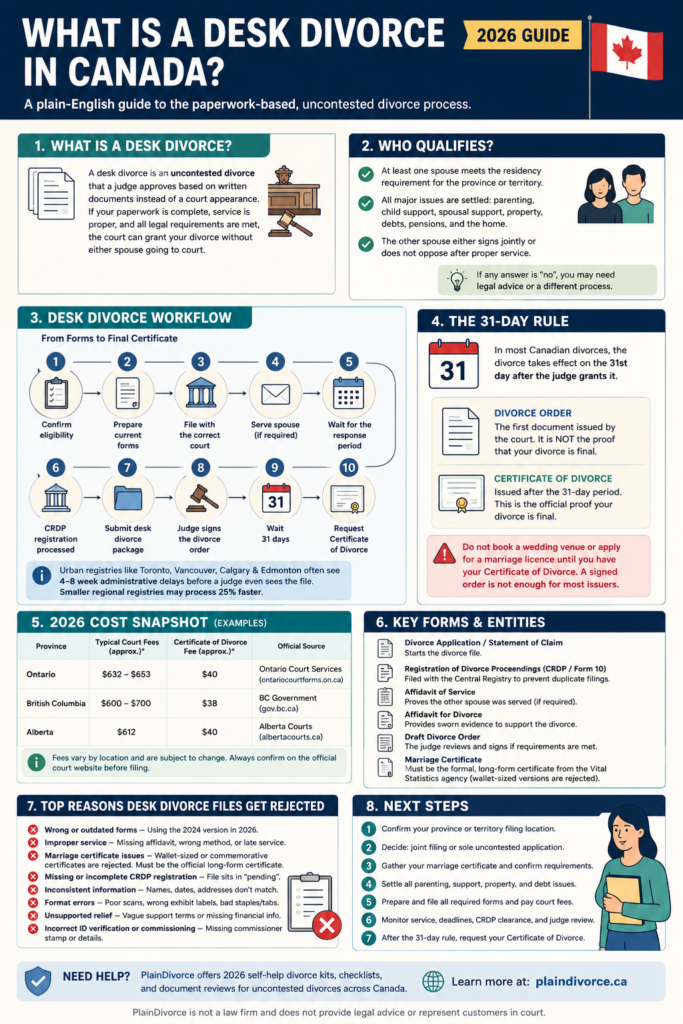
3. Desk Divorce Workflow: From Application to Certificate
The desk divorce workflow is easier to follow as a sequence. Steps and names vary by province, but the shape is consistent.
Desk Divorce Workflow (example, not a universal sequence)
- Confirm jurisdiction and the ground for divorce.
- Prepare the current forms for your province or territory.
- File the application with the correct court and pay the fee.
- The court registrar sends file information to the Central Registry of Divorce Proceedings.
- Serve your spouse, if this is a sole application.
- Wait out the response period, if one applies.
- Submit the final desk divorce package, including the sworn affidavit and draft order.
- A judge reviews the file and signs the divorce order.
- The divorce takes effect, normally on the 31st day (see the exceptions in section 6).
- Request a Certificate of Divorce from the court, if you need proof.
Processing time is not fixed and is not published as a national figure. It depends on the registry, its current workload, whether documents are returned for correction, and judge availability. If your court posts processing updates, use those. If not, ask the registry how long recent uncontested divorce packages have taken after final submission, and build in time for at least one round of corrections.
A “paper divorce” still moves through human review, court queues, service deadlines, the Central Registry step, and the 31-day period before the divorce takes effect. Treat any timeline you are quoted as a planning estimate, not a promise. Our guide to how long an uncontested divorce takes covers this in more depth.
4. What Desk Divorce Means, and the Local Names for It
“Desk divorce” is a plain-language label, not a term from the federal Divorce Act. It generally means an uncontested divorce decided from written court documents rather than a courtroom hearing. The phrasing “desk order divorce” is common in British Columbia and elsewhere in Western Canada, where a spouse asks for a “desk order.” Court terminology varies by province, territory, court, and registry.
Depending on where you file, the same general idea may be called:
- desk divorce or desk order divorce
- uncontested divorce
- simple divorce (Ontario uses “simple application” for a divorce-only claim)
- joint divorce or joint application
- sole or undefended divorce
- affidavit divorce or paper divorce
- divorce without an appearance or hearing
The clerk will not care what you call it. The clerk will care whether the current form is used, whether the affidavit is sworn or affirmed properly, whether service is proven, whether the fee is paid, whether the proof of marriage is acceptable, and whether the draft order matches the evidence in the file.
| Term | Plain-English meaning | What can still go wrong |
|---|---|---|
| Desk divorce / desk order divorce | A paperwork-based divorce a judge reviews without a full hearing. | The file can be returned if the forms, service, support information, or draft order are wrong. |
| Uncontested divorce | Neither spouse is fighting the divorce or the related issues. | “Uncontested” does not mean “automatic.” A judge still checks the legal requirements. |
| Joint application | Both spouses apply together and both sign. | Both spouses must cooperate, sign, and give consistent information. |
| Sole or undefended application | One spouse applies, serves the other, and the other does not respond or oppose. | Improper service or a missed response deadline can delay the file. |
| Contested divorce | The spouses disagree about the divorce, parenting, support, or property. | The case may need conferences, motions, evidence, negotiation, or a trial. |
For federal divorce information, see Justice Canada’s divorce resources and the Divorce Act. For local procedure, use the official court or government site for your province or territory.
5. Desk Divorce Costs: What Provinces Actually Publish
People searching for a desk divorce are usually trying to avoid the cost of a lawyer-led, contested divorce. That is realistic in a genuinely simple case, but court fees still apply and they vary by province. The figures below are the ones published on official fee pages as of 2026. Anything else you see quoted for a province should be treated as a planning estimate until you check that province’s own fee schedule.
| Province | Published 2026 court fees for an uncontested divorce | Official source |
|---|---|---|
| Ontario | $214 to file the application, plus $445 to list an uncontested divorce for a judge, plus the $10 Central Registry fee on a divorce claim. A Certificate of Divorce is $25. | Ontario family court fees |
| Alberta | $310 to commence a Statement of Claim for Divorce. That amount already includes the $10 Central Registry fee. | Alberta court fees |
| British Columbia | Supreme Court filing fees apply to start the claim and to the desk order materials; confirm the current amounts with the registry. A Certificate of Divorce is $40 in person or $50 by mail. | BC: how to get your divorce certificate |
Other provinces and territories use different forms, fee schedules, and court names. Before you rely on a province-specific price, check that province’s official court fee page or ask the court registry. For a wider view, see our roundup of divorce filing fees by state and province. On top of court fees, budget for serving your spouse if required, commissioning affidavits, certified copies of your marriage certificate, and printing.
Desk Divorce vs. Lawyer-Led Divorce: Cost Comparison
| Path | Cost categories | Best fit | Risk |
|---|---|---|---|
| DIY desk divorce | Court fees, service costs, certificate fees, printing, commissioning, and any document-kit cost. | Simple uncontested cases with children’s issues settled and no dispute about the divorce itself. | Returned documents can add weeks, and property is still your responsibility to resolve separately. |
| Self-help kit plus unbundled legal help | Court fees, plus a document kit, plus a limited-scope lawyer review of one part of the file. | Uncontested cases where the spouses agree but want a lawyer to check a separation agreement or the final package. | A limited-scope retainer reduces some risk, but it does not fix inaccurate facts, hidden disputes, or bad service. |
| Lawyer-led uncontested divorce | Court fees plus a lawyer’s fee for the whole file. | Cases with children, support, pensions, out-of-country service, or uncertainty. | Costs more, but reduces drafting and rejection risk. |
| Contested divorce | Higher legal fees, court events, motions, expert reports, and trial preparation. | Cases with disagreement, safety concerns, non-disclosure, or complex assets. | More expensive and slower, but sometimes necessary. |
Unbundled legal services: in many Canadian family matters, some lawyers offer limited-scope retainers, such as reviewing a separation agreement, checking a desk divorce package, commissioning an affidavit, or advising on service. Availability and rules differ by province and by lawyer. Your provincial law society can point you to lawyers who take limited-scope work.
6. The 31-Day Rule and Its Exceptions
A common mistake is assuming the marriage is over the moment the judge signs the order. Under the Divorce Act, the general rule is that a divorce takes effect on the 31st day after the day the judgment is rendered. That timing matters if you want to remarry, update legal records, handle immigration paperwork, change benefits, or prove your marital status.
The 31-day rule is not absolute. Two exceptions in the Divorce Act can change the effective date:
- An earlier date. The court can make the divorce effective sooner if it is satisfied that special circumstances exist and both spouses agree and undertake that no appeal will be taken. This is not routine and must be asked for.
- A later date. If the judgment is appealed, the divorce does not take effect on day 31. The effective date shifts until the appeal is finally dealt with.
The document you receive first is the divorce order or judgment. The document many people need later is the Certificate of Divorce, which confirms the divorce has taken effect and states the date. You request it from the court that granted the divorce, not from the Central Registry. Not everyone needs a certificate, but marriage-licence issuers and some pension, immigration, and financial institutions ask for one.
Remarrying: do not book a non-refundable venue or apply for a marriage licence on the strength of a signed order alone. Confirm the effective date and get the certificate first. For the federal timing rule, see Justice Canada’s divorce fact sheet and the Divorce Act.
7. The Central Registry of Divorce Proceedings
Every divorce filed in Canada is reported to the Central Registry of Divorce Proceedings, usually called the CRDP. It is run by the federal Department of Justice in Ottawa, and its job is to catch duplicate divorce proceedings involving the same two spouses in different courts.
Here is what actually happens, and who does it. Under the Central Registry of Divorce Proceedings Regulations, the court registrar, not the applicant, must send prescribed information about the case to the Registry within seven days after the divorce application is filed. The Registry searches its records for other pending or past proceedings between the same spouses and sends a notification back to the registrar. On most divorce claims there is a $10 federal registry fee, which some provinces build into the filing fee.
You generally do not file a separate “CRDP clearance” yourself. What you should do is make sure the marriage date, separation date, names, and dates of birth on your forms are correct and consistent, because that is the information the registrar transmits. If the details are wrong or inconsistent, the registration can be flagged, and that can hold up the file. If your province’s court instructions describe a specific registry-clearance step or a known processing delay, follow those.
Do not confuse the Central Registry with a Certificate of Divorce. The Registry does not issue your certificate. For a certificate, you contact the court that granted the divorce. Official reference: Justice Canada — The Central Registry of Divorce Proceedings.
8. Forms That Show Up in a Real Desk Divorce File
The exact form names depend on the province or territory. This list is a guide to the kinds of documents a desk divorce file usually contains, not a complete set for any one court:
- Divorce application, claim, or Statement of Claim that starts the file.
- Registration of Divorce Proceedings information for the Central Registry (transmitted by the registrar).
- Affidavit or proof of service showing the other spouse was served, on a sole application.
- Sworn affidavit for divorce setting out the evidence that supports the divorce.
- Draft divorce order for the judge to sign.
- Marriage certificate or acceptable proof of marriage.
- Child support information, including income disclosure, if there are children of the marriage.
- Corollary relief materials if the court is asked to make child support, spousal support, or parenting orders alongside the divorce.
- Certificate of Divorce request after the divorce takes effect, if you need proof.
A note on the phrase “corollary relief.” Under the Divorce Act it means a claim for child support, spousal support, or a parenting order. It does not mean property or debt division. Splitting the house, accounts, pensions, and debts is governed by provincial law and is usually a separate claim or a separation agreement, not part of the federal divorce order.
Ontario examples (list is not exhaustive): an uncontested file ordinarily starts with Form 8A, the Application (Divorce). The final package can also include Form 36 Affidavit for Divorce, Form 25A Divorce Order, Form 36A Certificate of Clerk (Divorce), and Form 36B Certificate of Divorce. British Columbia examples for a desk order divorce may include Form F3 Notice of Family Claim (sole) or Form F1 Notice of Joint Family Claim, Form F36 Certificate of Pleadings, Form F37 Child Support Affidavit, Form F38 Affidavit — Desk Order Divorce, and Form F56 Certificate of Divorce. The BC Form F38 affidavit generally must be sworn within 30 days of filing the divorce application, and where separation is the only ground, not before the one-year mark. Alberta commonly begins with a Statement of Claim for Divorce, and its uncontested-divorce forms expressly do not deal with dividing property.
These form sets are not interchangeable. Always use the current forms and checklist published by the court where you are filing. Alberta Courts, Ontario Court Services, and the BC government all publish their own family-law form lists and step-by-step instructions.
9. Why Desk Divorce Files Get Sent Back
When a desk divorce package is returned, it is rarely because the spouses changed their minds. It is usually because the file is not registry-ready or judge-ready. The specific requirements below are common examples; the exact rules depend on your court and whether you file on paper or electronically.
Common Registry Checks Before Filing
- Use the current form version, not an old saved PDF or a form copied from a blog post.
- Make sure every affidavit is signed, dated, and sworn or affirmed before a person authorized in your province, such as a commissioner for oaths, a lawyer, or a notary.
- Do not let names, addresses, marriage dates, separation dates, or children’s details differ across the forms.
- Follow the registry’s formatting instructions for attachments, exhibits, scans, page order, and tabs.
- If your marriage certificate is an exhibit, make sure it is labelled as the court requires and that a stamp does not cover the text, registration number, names, dates, or seal.
- Check that service proof, commissioning details, and ID verification are complete before you submit the final package.
The proof of marriage is the wrong type
A wallet card, a decorative church certificate, or a commemorative certificate can be rejected. Many courts want the government-issued marriage certificate or a certified copy from the vital statistics agency or equivalent authority. If the marriage happened outside Canada, the court may also require a certified copy, a translation, and an affidavit of translation. Solve this early, not as a last-minute attachment.
Service is not proven or does not match the file
Service mistakes are one of the fastest ways to stall a sole application: the wrong person served the documents, dates are missing, the affidavit of service is incomplete, names are inconsistent, or the method used is not one the local rules allow. If the court is not satisfied the other spouse got proper notice, the judge may not grant the order. Our guide to serving divorce papers in an uncontested divorce covers the basics.
The file information sent to the Central Registry does not line up
If the marriage date, separation date, names, or dates of birth on your forms are inconsistent, the registration the registrar sends to the Central Registry can be flagged. Applicants sometimes think the judge is slow when the file is actually held up at the registration stage. Consistent data across every form prevents this.
The package looks simple, but the relief asked for is not
A desk divorce gets harder when the paperwork asks for orders that are vague, unsupported, or inconsistent with the separation agreement: unclear child support terms, missing income disclosure, an unexplained request for no child support, or unclear parenting terms. The judge has to be able to grant exactly what the draft order says, based on the evidence in the file.
Scans, exhibits, or page order do not meet registry standards
Some registries are strict about scan quality, exhibit labels, page order, and whether a sworn affidavit was altered after signing. If you are e-filing, a blurry scan or a combined PDF in the wrong order can be as damaging as a missing signature. Other frequent triggers include filing in the wrong court, an unsigned draft order, and missing commissioner details on sworn documents.
10. How a Desk Divorce Usually Works
The exact procedure depends on the province or territory. Most desk divorce files follow this general path.
Step 1: Confirm jurisdiction and residency
Divorce law is federal, but the process is local. A court in a province has jurisdiction if either spouse has been habitually resident in that province for at least one year immediately before the case starts. Confirm the correct court, court office, filing method, and fee schedule for that province.
Step 2: Confirm the ground for divorce
Most uncontested desk divorces rely on one year of living separate and apart, because it is easiest to prove on paper. The Divorce Act also allows adultery or cruelty, but those need more evidence. You can file a separation-based application before the full year has passed if you are already living separate and apart, but the court cannot grant the divorce until the year is complete. A reconciliation attempt of up to 90 days total does not reset the clock.
Step 3: Settle corollary relief before final review
Corollary relief means the family orders the Divorce Act allows alongside the divorce: parenting and decision-making, child support, and spousal support. A desk divorce works best when these are already agreed and documented. Property and debt division is separate and provincial; you can deal with it in a separation agreement or a provincial court claim.
Step 4: Choose a joint or a sole application
In a joint application, both spouses apply together and sign the required documents. In a sole application, one spouse applies, serves the other, waits out the response period, and then asks the court to proceed without opposition. Each court has its own form set and its own name for these routes.
Step 5: Prepare the forms and supporting documents
This is where many files succeed or fail. Use the current court forms. Make sure names, dates, addresses, marriage details, the separation date, children’s information, and the requested order terms match across the whole file.
Step 6: File, serve, and wait for the response period
Filing opens the court file, and the registrar reports it to the Central Registry. Service gives the other spouse formal notice on a sole application. The responding spouse then has a set time to respond, and that period varies by province, location, and method of service. Do not guess the deadline.
Step 7: Submit the final desk divorce package
After the waiting and service steps, the final package goes to a judge. The judge checks jurisdiction, proof of marriage, the ground for divorce, service, and whether reasonable arrangements have been made for child support. If everything checks out, the judge signs the divorce order.
Step 8: Track the order, the effective date, and the certificate
Once the order is granted, calendar the effective date. Normally the divorce is final on the 31st day, unless the court set an earlier date or the judgment is appealed. After it takes effect, request a Certificate of Divorce from that court if you need official proof.
11. Desk Divorce Timelines: A Reality Check
A desk divorce is not instant, even when the spouses agree. The timeline is affected by the registry’s workload, the Central Registry step, service deadlines, judge review time, any returned documents, and the 31-day period before the divorce takes effect. There is no official national processing figure, so treat any number you are given as a planning estimate tied to a specific registry.
| Stage | What can slow it down | Planning note |
|---|---|---|
| Opening the file | Wrong court, missing fee, inconsistent registration information, an outdated form version. | Confirm the court and the fee before filing. |
| Central Registry step | Inconsistent marriage or separation dates, names, or dates of birth on the forms. | Keep every date and name identical across the file. |
| Service and response period | Improper service, a spouse outside the province or country, a missing affidavit of service. | Build service and the full response window into your estimate. |
| Registry review | A rejected scan, incomplete attachments, the wrong filing path, a busy registry. | Ask the local registry about recent uncontested divorce processing times. |
| Judge review | Missing income disclosure, an unclear draft order, an inconsistent affidavit. | Clean paperwork matters more than any speed claim. |
| Effective date | The divorce normally takes effect on the 31st day, later if appealed. | Do not plan a remarriage around the signing date. |
If your court posts processing updates, use those first. Otherwise, ask the registry how long recent uncontested divorce packages have taken after final submission, and avoid old forum estimates unless they are recent and from the same registry.
12. Desk Divorce With Children
A desk divorce with children can still be uncontested, but the paperwork has to be stronger. The court may need details about where the children live, each parent’s parenting time, decision-making responsibility, each parent’s income, the child support table amount, and any special or extraordinary expenses such as childcare and health costs.
Parents cannot simply agree to skip child support. Before it grants the divorce, the court must be satisfied that reasonable arrangements have been made for the support of the children of the marriage, having regard to the applicable child support guidelines. If it is not satisfied, it must put the divorce on hold until the arrangements are fixed. That is a duty in the Divorce Act, not a discretionary check.
For federal child support information, see Justice Canada’s child support resources, and check the child support forms and disclosure rules for your province or territory. Our guide to an uncontested divorce with children walks through the parenting and support paperwork.
13. Desk Divorce and Property
A desk divorce ends the marriage. It does not, on its own, divide the house, the accounts, the pensions, or the debts. Dividing family property is governed by provincial and territorial law, for example Ontario’s Family Law Act, British Columbia’s Family Law Act, or Alberta’s Family Property Act. Alberta even states plainly that its uncontested-divorce forms do not deal with property division.
That means you have two things to handle, not one: the divorce, and the property settlement. Most couples deal with property in a written separation agreement before or alongside the divorce, and some also get a provincial court order. Before you file, review the family home, bank accounts, vehicles, credit cards and loans, pensions and RRSPs, investments, any business interest, tax refunds and debts, and what happens if one spouse does not pay a shared debt.
If the divorce is simple but the property picture is not, get legal advice before you sign a separation agreement or file the divorce. Our guide to property division in an uncontested divorce and the separation agreement checklist are good starting points.
14. When a Desk Divorce Is Not the Right Path
A desk divorce may not be appropriate if there is disagreement, pressure, a safety risk, hidden money, a complex property or pension picture, uncertain parentage, unresolved support, or trouble serving the other spouse.
Consider speaking with a family lawyer, a legal clinic, or a court self-help service if:
- your spouse has a lawyer and you do not
- you feel pressured to sign
- there is family violence, coercive control, or fear
- you do not understand your rights or whether the agreement is fair
- you have children and disagree about parenting or support
- one spouse owns a business, or there are pensions, real estate, or major debts
- one spouse is outside Canada, or you cannot find your spouse
- your marriage certificate is from another country and needs translation or extra proof
- you need an order for alternative or substituted service
- the court has already returned your documents
Getting help does not mean starting a contested divorce. A short legal review often prevents a paperwork problem from turning into a real dispute.
15. Desk Divorce FAQ
What is a desk divorce in Canada?
A desk divorce is an uncontested divorce a judge decides from the filed documents, without either spouse appearing at a hearing. It is not a separate type of divorce. Federal law lets a court grant a divorce on the application of one or both spouses, and where the local court allows it, a complete and unopposed file can be reviewed and signed “at the desk.” The forms, names, and fees are set by each province or territory.
Is a desk divorce the same as an uncontested divorce?
Practically, yes. “Desk divorce” and “desk order divorce” describe how an uncontested divorce is processed: on paper, without a courtroom hearing. “Uncontested” means neither spouse is fighting the divorce or the related parenting and support issues. It does not mean automatic. A judge still checks jurisdiction, the ground for divorce, service, and child support before granting the order.
How much does a desk divorce cost in Canada?
Court fees vary by province. Ontario publishes $214 to file, $445 to list an uncontested divorce for a judge, a $10 Central Registry fee, and $25 for a Certificate of Divorce. Alberta charges $310 to start a Statement of Claim for Divorce, which already includes the $10 registry fee. British Columbia charges $40 or $50 for the certificate, plus filing fees you should confirm with the registry. Add service, commissioning, and copy costs on top.
How long does a desk divorce take?
There is no official national figure. On a one-year-separation ground, you cannot finalize before the separation year is complete. After the final package is submitted, processing depends on the registry’s workload, whether documents are returned, and judge availability, and the divorce then takes effect on the 31st day. Ask your local registry what recent uncontested packages have taken, and plan for at least one round of corrections.
When is a desk divorce final?
Normally on the 31st day after the judge grants the divorce. Two exceptions apply: the court can set an earlier effective date if there are special circumstances and both spouses agree and undertake not to appeal, and if the judgment is appealed the divorce does not take effect until the appeal is resolved. The Certificate of Divorce, issued by the court that granted the divorce, states the effective date.
Do we have to divide property before a desk divorce?
No. A divorce application can ask for the divorce alone, or the divorce plus child support, spousal support, or parenting orders. Dividing property and debts is a separate process under provincial law, usually handled in a separation agreement or a provincial court claim. Unresolved property can be a good reason to get legal advice first, but it does not by itself prevent the court from granting the divorce.
Can we agree to no child support in a desk divorce?
Only if the court is satisfied it is reasonable. Before granting the divorce, the court must be satisfied that reasonable arrangements have been made for the children of the marriage, having regard to the child support guidelines. In practice that means providing income information and an explanation for any departure from the table amount. If the court is not satisfied, it must hold the divorce until the arrangements are fixed.
What if my spouse lives in the United States or another country?
A desk divorce can still work, but service becomes the key issue. You must follow your court’s rules for serving someone outside the province or outside Canada. Do not assume email, text, or ordinary mail is enough unless the rules or a court order allow it. If you cannot locate your spouse, you may need a court order for substituted or alternative service, and legal help is usually worth it at that point.
Do I need a Certificate of Divorce?
Not everyone does, but many people need one. A signed divorce order is not always accepted as proof that the divorce is final. Marriage-licence issuers, and some immigration, pension, and financial institutions, ask for the Certificate of Divorce, which confirms the divorce took effect and gives the date. You request it from the court that granted the divorce, not from the Central Registry.
What if my spouse started the divorce and then stopped?
Your options depend on the province, what has already been filed, and whether you need to respond, counterclaim, or continue the existing file. Do not assume you can simply take over your spouse’s application without checking the court rules or getting advice.
16. Next Steps: Start a Desk Divorce Without Guessing
A desk divorce is a practical option when the divorce is genuinely uncontested and the paperwork is judge-ready. The best next step is not to download random forms from a search result. Start with the correct province, the correct court, the current forms, and a complete checklist.
- Confirm your province or territory and that the one-year residency rule is met.
- Decide whether you are filing a joint application or a sole application with service.
- Locate an acceptable marriage certificate and check whether the court needs a certified copy.
- Settle parenting and child support, and make a separate plan for property, pensions, and debt.
- Prepare the divorce application, the sworn affidavit, proof of service, and the draft order using current forms.
- File with the correct court and pay the current fee. The registrar reports the file to the Central Registry.
- Track service, the response deadline, judge review, the effective date, and the Certificate of Divorce.
If your case is uncontested, PlainDivorce’s self-help divorce kits can help you organize the forms and steps for your province. If there are disputes, safety concerns, pressure, complex assets, unresolved children’s support, or uncertainty about your rights, get legal help before moving forward.
This article is general information, not legal advice, and it is not a substitute for advice from a lawyer licensed in your province or territory. PlainDivorce is not a law firm. Court rules, forms, and fees change; confirm the current requirements with your court or a lawyer before you act.
Sources and local rules can change. Use this guide as a plain-English organizer, then verify the current filing requirements with the official court or government source for your jurisdiction.

About Harry D
Expert contributor at PlainDivorce, helping Canadians and American navigate simple uncontested divorces with clarity and confidence.