Divorce Filing Fees by State and Province: What to Budget in 2026
Divorce filing fees in the United States and Canada mostly run from under $100 to a little over $450 to open a case, but the exact number is set locally, not nationally. Courts set fees by state or province, and often by county, court division, filing method, and case type. This guide compares divorce filing fees by state, uncontested divorce court fees, and the divorce filing fee by province in Canada, then shows you how to confirm the real amount with the court before you file.
TL;DR
There is no national divorce filing fee in either country. The base fee is set by the state or province, then the county, parish, district, or court division adds its own charges — which is why two courthouses in the same state can bill different totals for the same case.
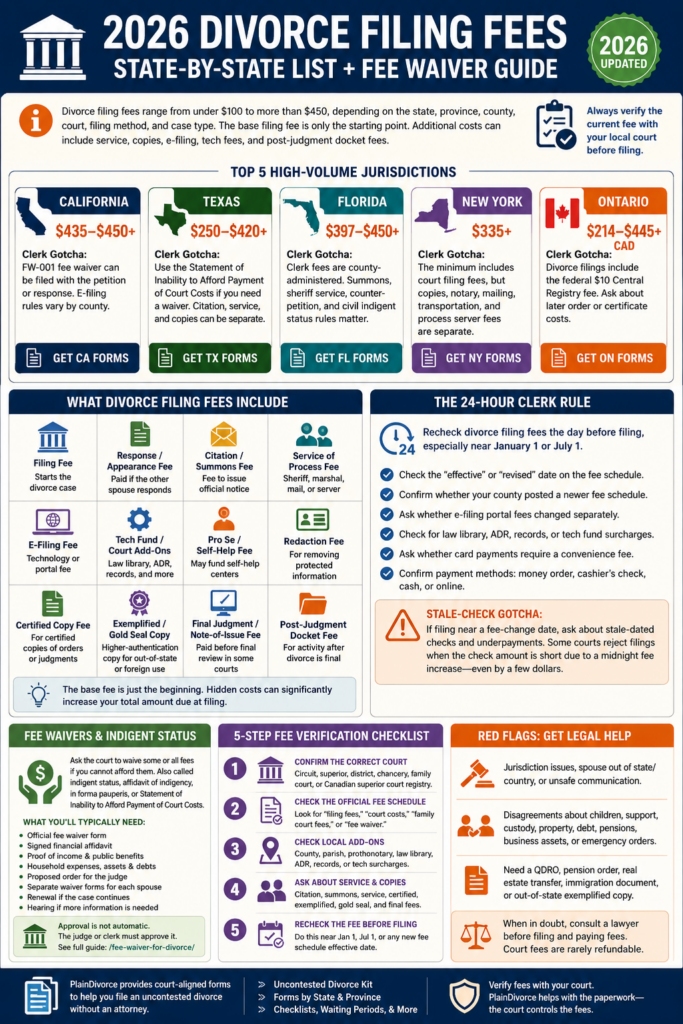
- Confirmed U.S. figures show the spread: California $435–$450, New York at least $335 ($210 index number + $125 Note of Issue), North Dakota $160, Florida about $408 plus roughly $10 per summons. Most other states land somewhere between $100 and $450.
- Fees can rise without warning. North Dakota doubled its initial-pleading fee from $80 to $160 effective July 1, 2025. Schedules commonly change January 1 and July 1 — recheck shortly before you file.
- Case type sometimes changes the price. Vermont charges $90 for a stipulated divorce and $295 for a contested one. Most states charge the same to open either, and the cost gap opens later through motions and hearings.
- The opening fee is often not the last court fee. A summons or citation, a final-judgment or note-of-issue fee, certified copies, and post-judgment filings can each be billed separately.
- Ontario’s number is cumulative, not one fee: $214 to file, $445 to place the case on the hearing list, plus the $10 federal Central Registry fee. Quebec is $241 for a joint application versus $362 for a non-joint one; Alberta’s $310 already includes the registry fee.
- Every Canadian divorce carries the $10 Central Registry fee — waived for someone receiving provincial legal aid where provincial law allows it.
- An agreed filing can eliminate the service line entirely. Where the court’s rules allow a signed waiver or acceptance of service, you skip the sheriff or private-server fee — and a private server’s charge was never a court fee to begin with.
- The e-filing portal can add cost the fee schedule doesn’t show. In Texas the vendor typically adds roughly 3% on a card plus a small county service fee, while an e-check is usually flat.
- Request a fee waiver with the first papers, not later. It goes by different names — indigent status, affidavit of indigency, in forma pauperis, Statement of Inability to Afford Court Costs — approval is never automatic, and it may not cover a private process server, notary, or outside copy service. California’s waiver also expires 60 days after judgment.
- A certified copy and an exemplified copy are not the same thing. Out-of-state, immigration, pension, or foreign uses may need a higher-authentication copy or an apostille — ask the receiving agency what it requires before you order one.
- Filing fees are often non-refundable, even if you dismiss the case or filed in the wrong court. If that matters to your decision, ask the clerk before you pay.
1. Find Your State or Province Fast
Use the selector below to jump to your jurisdiction in the U.S. or Canada directory. For a simple case, remember that uncontested divorce court fees can still include service, copies, portal charges, and local surcharges on top of the opening fee.
United States: Alabama · Alaska · Arizona · Arkansas · California · Colorado · Connecticut · Delaware · District of Columbia · Florida · Georgia · Hawaii · Idaho · Illinois · Indiana · Iowa · Kansas · Kentucky · Louisiana · Maine · Maryland · Massachusetts · Michigan · Minnesota · Mississippi · Missouri · Montana · Nebraska · Nevada · New Hampshire · New Jersey · New Mexico · New York · North Carolina · North Dakota · Ohio · Oklahoma · Oregon · Pennsylvania · Rhode Island · South Carolina · South Dakota · Tennessee · Texas · Utah · Vermont · Virginia · Washington · West Virginia · Wisconsin · Wyoming
Canada: Alberta · British Columbia · Manitoba · New Brunswick · Newfoundland and Labrador · Northwest Territories · Nova Scotia · Nunavut · Ontario · Prince Edward Island · Quebec · Saskatchewan · Yukon
If the fee looks out of reach, read the fee-waiver section before you file. Many courts want the fee-waiver request submitted with the first divorce papers, not later.
2. How to Read These Fee Estimates
There is no national divorce filing fee in the United States or Canada. Every number in this guide is a PlainDivorce planning estimate built from public court information, not a figure published on a single official schedule. Use it to set a rough budget, then confirm the exact amount with your court.
- Fees are set locally. A state or province sets the base fee, and in many places the county, parish, judicial district, or court division adds its own charges. Two courthouses in the same state can bill different totals.
- The opening fee is not the whole cost. Summons or citation issuance, service of process, e-filing charges, certified copies, and a later final-judgment or hearing fee can all be separate line items.
- Case type can change the fee. A few courts charge less for an agreed or joint filing than for a contested one. Vermont, for example, lists $90 for a stipulated divorce and $295 for a contested divorce.
- Ranges are wide on purpose. Where PlainDivorce could not confirm a single current figure from an official schedule, the estimate is shown as a range and the row tells you which office to call.
Where an official court page publishes a specific current fee, this guide cites it and names the effective date. For a full cost picture beyond the courthouse, see uncontested divorce cost.
3. Uncontested Divorce Comes in Two Forms
An uncontested divorce is not one thing, and the form it takes changes what you pay. Both routes start with the same base filing fee in most places, but the add-ons differ.
- Agreed, joint, or consent divorce. Both spouses sign a written settlement or a joint petition. The responding spouse usually signs a waiver or acceptance of service, so you often skip the sheriff or process-server fee. Some jurisdictions also charge a lower court fee for a joint filing or waive it with a mediation certificate.
- Default, or no response, after valid service. One spouse files, serves the other properly, and the other never answers within the response window. There is no signed agreement. You pay for formal service and, at the end, for a default-judgment package. In a default, the relief the judge can grant cannot exceed what the petition asked for.
New York, for example, runs an uncontested track for couples who agree and also lets a case proceed when a served spouse does not answer. Before you budget, decide which route fits, then read how to serve divorce papers so you do not pay for service you do not need.
4. What a Divorce Filing Fee Actually Covers
Divorce filing fees are the court charges paid to open a divorce case. Depending on the jurisdiction, the same charge is called a filing fee, petition fee, complaint fee, dissolution fee, index number fee, registry fee, application fee, or court cost. In a simple case, uncontested divorce court fees usually start with the opening fee and may not end there. The table below lists charges that may apply; not every court bills every line.
| Fee type | What it means | Where it varies |
|---|---|---|
| Filing fee | Starts the divorce case | Varies by county, parish, district, court division, and case type |
| Response, answer, or appearance fee | Paid if the responding spouse files a formal response | Some agreed, joint, or consent filings avoid it with a waiver |
| Citation or summons fee | Fee to issue official notice to the other spouse | Often separate from the filing fee |
| Service of process fee | Cost to legally deliver papers | Sheriff, marshal, private process server, certified mail, or publication can each cost a different amount; private-server fees are not court fees |
| E-filing fee | Technology or portal charge for online filing | Third-party portals can add convenience or card-processing fees on top of the court fee |
| Technology or automation fund fee | Local court surcharge | Appears as a court technology, automation, records, or electronic-filing add-on in some fee schedules |
| Law library or ADR surcharge | Local court add-on | Common in county-based fee schedules; not charged everywhere |
| Redaction fee | Fee for removing protected information from a filing | Can apply where filings include Social Security numbers or restricted identifiers |
| Parent education or family services fee | Program charge in cases with children | Set by the state and sometimes the county; may be waived with the filing fee |
| Certified copy fee | Fee for a certified copy of the final decree or judgment | Needed for a name change, refinancing, retirement, benefits, or agency records |
| Exemplified or authenticated copy | Higher-authentication copy for out-of-state or foreign use | Costs more than a regular certified copy; the receiving agency decides what is required |
| Final judgment, decree, or note-of-issue fee | A later fee before final review in some courts | A common surprise when the first fee is not the last court fee |
| Post-judgment fee | Fee for court activity after the divorce is final | Can apply to enforcement, modification, a retirement order, or a later certified copy |
| Fee waiver request | Request to waive court costs for hardship | Called indigent status, affidavit of indigency, in forma pauperis, or a statement of inability to afford costs, depending on the jurisdiction |
If you are still gathering paperwork, walk through the uncontested divorce process before you pay the court. Whether a filing fee can be refunded if you dismiss the case is a local rule, so ask the clerk before you file if that matters to you.
5. Recheck the Fee Before You File
Court fee schedules are often revised at the start of a fiscal or calendar year. Common effective dates are January 1 and July 1, but this varies by court system. As a practical habit, confirm the fee shortly before you file, especially near those dates.
- Check the effective or revised date printed on the fee schedule.
- Confirm whether your county posted a newer local fee schedule.
- Ask whether e-filing portal fees changed separately from court fees.
- Ask whether card payments carry a convenience fee.
- Confirm accepted payment methods: money order, cashier’s check, cash, card, or online payment.
Some courts will not accept a filing if the payment is short. If you are filing right around a fee-change date, ask the clerk what happens to an underpayment before you mail a check. Use the same check for divorce filing fees by state, the divorce filing fee by province, and any local uncontested divorce court fees that sit outside the main statewide schedule.
6. U.S. Divorce Filing Fees by State: 2026 Planning Estimates
The table below gives a planning-estimate range for divorce filing fees by state because court costs shift by county, local surcharge, service method, e-filing portal, and case type. Rows marked Verified cite a current official figure; unmarked rows are PlainDivorce estimates you should confirm with the clerk. This is a budgeting aid, not a court-published schedule.
| State / District | 2026 planning estimate | Status | Notes and next step |
|---|---|---|---|
| Alabama | $200–$400+ | Estimate | Circuit court and county costs vary. Ask about an affidavit of substantial hardship if you cannot afford the fee. |
| Alaska | $150–$300+ | Estimate | Check the Alaska Court System fee schedule. Ask whether the waiver covers service and copies. |
| Arizona | $250–$400+ | Estimate | Superior Court fees vary by county. Response fees and parent-education fees can be separate. |
| Arkansas | $150–$250+ | Estimate | Circuit clerk fees vary. Ask whether the summons and sheriff service are included. |
| California | $435–$450 | Verified | California Courts lists a $435–$450 filing fee to start a divorce. If it is out of reach, request a fee waiver on Form FW-001. California Courts: file divorce papers |
| Colorado | $200–$300+ | Estimate | Check Colorado Judicial Branch fees and e-filing rules. Ask whether card or portal fees apply. |
| Connecticut | $350–$400+ | Estimate | Marshal service, parenting education, and certified copies can be separate. |
| Delaware | $150–$250+ | Estimate | Check Family Court fees before filing. Ask about fee-waiver forms if income is limited. |
| District of Columbia | $80–$120+ | Estimate | Check D.C. Superior Court family filing fees and waiver rules. |
| Florida | ~$408 + $10 summons | Verified | The dissolution-of-marriage filing fee is set by state law at about $408, plus roughly $10 per summons issued; clerks report small county differences. Confirm with your circuit clerk. uncontested divorce in Florida |
| Georgia | $200–$300+ | Estimate | Superior Court fees vary by county. Sheriff service and parenting-seminar fees can be separate. |
| Hawaii | $100–$300+ | Estimate | Verify Family Court filing fees by circuit. Copy and certification fees can be separate. |
| Idaho | $150–$250+ | Estimate | District court fees vary by case type. Ask whether e-filing service fees apply. |
| Illinois | $250–$400+ | Estimate | County circuit clerk fees vary widely. Larger counties can charge higher filing and appearance fees. |
| Indiana | $150–$250+ | Estimate | The Indiana Trial Court Fee Manual sets a statewide civil filing fee plus local automation and document-storage fees; e-filing costs vary. Ask the clerk for the current total. |
| Iowa | $250–$300+ | Estimate | Check Iowa Judicial Branch fees and electronic-filing rules. |
| Kansas | $200–$400+ | Estimate | District court fees vary by filing type and include a statutory docket fee. Ask about sheriff service and certified-copy fees. |
| Kentucky | $150–$250+ | Estimate | Circuit clerk costs and service fees vary by county. Ask whether an affidavit of indigency is available. |
| Louisiana | $300–$500+ | Estimate | Parish clerk fees vary significantly. Ask about citation, sheriff service, and local court funds. |
| Maine | $100–$200+ | Estimate | Verify Maine Judicial Branch fees. Service costs and certified copies can be separate. |
| Maryland | $150–$250+ | Estimate | Circuit court fees do not always include sheriff service or later copy fees. |
| Massachusetts | $200–$300+ | Estimate | Probate and Family Court filing can include a surcharge. Ask about certified and attested copies. |
| Michigan | $175–$300+ | Estimate | Fees can depend on whether minor children are involved. Judgment and copy costs can be separate. |
| Minnesota | $350–$420+ | Estimate | District court fees are among the higher ones nationally. Ask about fee waiver, e-filing, and copy fees. |
| Mississippi | $150–$250+ | Estimate | Chancery court filing fees vary by county. Ask whether process and certified-copy fees are separate. |
| Missouri | $150–$250+ | Estimate | Circuit court fees vary by county and filing method. |
| Montana | $150–$250+ | Estimate | Verify the current district court fee schedule and service costs. |
| Nebraska | $150–$300+ | Estimate | County district court costs and service fees can apply. |
| Nevada | $250–$350+ | Estimate | District court fees vary by county. Clark and Washoe can differ from rural counties. |
| New Hampshire | $250–$300+ | Estimate | Verify Circuit Court Family Division fees before filing. |
| New Jersey | $300–$350+ | Estimate | The court adds a parents-education fee in cases with children. Ask about FM docket costs. |
| New Mexico | $130–$200+ | Estimate | District court fees vary. Fee-waiver forms are available for low-income filers. |
| New York | At least $335 | Verified | New York Courts states an uncontested divorce costs at least $335 in court fees: a $210 index-number fee plus a $125 Note of Issue fee. Each motion is $45. New York Courts: filing an uncontested divorce |
| North Carolina | $225 + service | Estimate | The absolute-divorce civil filing fee is set statewide by the General Assembly, plus a sheriff service fee. Ask the clerk of superior court about indigent filing status. |
| North Dakota | $160 | Verified | The district court fee for an initial pleading, which includes a divorce petition, rose from $80 to $160 effective July 1, 2025 (NDCC 27-05.2-03). North Dakota Courts: notice of fee increases |
| Ohio | $200–$400+ | Estimate | Domestic relations court deposits vary by county. Parenting, decree, and certified-copy costs can be separate. |
| Oklahoma | $180–$300+ | Estimate | District court fees vary by county and case type. Ask about a pauper’s affidavit if needed. |
| Oregon | $300–$320+ | Estimate | Check the statewide circuit court fee schedule. E-filing and copy fees can be separate. |
| Pennsylvania | $150–$450+ | Estimate | Pennsylvania is county-driven. Prothonotary fees vary sharply, especially if custody is filed with the divorce. uncontested divorce in Pennsylvania |
| Rhode Island | $150–$250+ | Estimate | Verify Family Court filing and service costs. |
| South Carolina | $150–$250+ | Estimate | Family Court filing fees and service fees can be separate. Ask about indigent status if needed. |
| South Dakota | $95–$200+ | Estimate | Clerk of courts fees vary. Confirm local court costs. |
| Tennessee | $200–$400+ | Estimate | Chancery or circuit court fees vary by county. Fees can differ in cases with children. |
| Texas | $300–$400+ (county-set) | Verified | District clerk fees are set by county; large counties commonly land near $350 to $375, plus separate citation and service charges. Texas uses a Statement of Inability to Afford Court Costs for a fee waiver. uncontested divorce in Texas |
| Utah | ~$375 | Estimate | The district court sets a statewide divorce filing fee near $375; online filing costs can be separate. Verify on the Utah Courts fee page. |
| Vermont | $90 stipulated / $295 contested | Verified | The Vermont Judiciary stipulated-divorce checklist lists a $90 filing fee plus service fees; the contested checklist lists $295. A fee-waiver application is available. |
| Virginia | $85–$150+ | Estimate | Circuit court fees vary by locality and can include sheriff or service fees. |
| Washington | ~$255 | Estimate | The Superior Court petition fee is set near $255 statewide, plus any county surcharge. Fee waivers are available in many courts. |
| West Virginia | $135–$200+ | Estimate | Family court filing fees are set by statute plus county fees; confirm by county. |
| Wisconsin | ~$185 | Estimate | The divorce filing fee is set close to $185 statewide; it is higher when child support or maintenance is requested. Confirm with the clerk of circuit court. |
| Wyoming | $85–$150+ | Estimate | Verify district court filing and service fees locally. |
Pair the cost picture with timing. Read the divorce waiting period by state and how long an uncontested divorce takes so your budget and your calendar line up before you start.
7. Canada Divorce Filing Fee by Province: 2026 Planning Estimates
In Canada, divorce is governed by the federal Divorce Act, while provincial and territorial superior courts run the filing process and set the court fees. Every divorce application also carries a $10 federal Central Registry of Divorce Proceedings fee, waived for a person receiving provincial legal aid where provincial law allows it. Use this section to compare the divorce filing fee by province, then confirm with the local registry.
| Province / Territory | 2026 planning estimate (CAD) | Status | Notes and next step |
|---|---|---|---|
| Alberta | $310 | Verified | Alberta lists a $310 commencement fee for a Statement of Claim for Divorce, and it includes the $10 Central Registry fee. Alberta: court fees |
| British Columbia | $210+ ($200 claim + $10 registry) | Estimate | Supreme Court fees are in Appendix C of the Supreme Court Family Rules; a Certificate of Mediation can exempt the Notice of Family Claim fee. Final-application and certificate fees can be separate. uncontested divorce in British Columbia |
| Manitoba | $200–$250 | Estimate | Court of King’s Bench fees are set by the Court Services Fees Regulation. Legal Aid Manitoba clients may have the fee waived. |
| New Brunswick | $100–$200 | Estimate | Confirm current Court of King’s Bench family division fees. |
| Newfoundland and Labrador | $100–$250 | Estimate | Supreme Court family division fees can vary by document. |
| Northwest Territories | $100–$250 | Estimate | Confirm Supreme Court filing fees and waiver options. |
| Nova Scotia | $200–$250 | Estimate | Verify Supreme Court (Family Division) fees for a divorce by agreement or joint application. |
| Nunavut | $100–$250 | Estimate | Confirm with the Nunavut Court of Justice registry. |
| Ontario | $214 + $445 + $10 (cumulative) | Verified | Ontario charges $214 to file the application, $445 to place it on the list for hearing, plus the $10 Central Registry fee. These are separate charges, not one fee. Ontario: family court fees |
| Prince Edward Island | $100–$250 | Estimate | Verify Supreme Court registry fees before filing. |
| Quebec | $241 joint / $362 non-joint (+ $10 registry) | Verified | As of January 1, 2026 the Superior Court charges $241 for a joint divorce application and $362 for a non-joint application, before the federal $10 registry fee. Quebec: tariff of court costs |
| Saskatchewan | $200–$300 | Estimate | Confirm Court of King’s Bench fees before filing. |
| Yukon | $100–$250 | Estimate | Confirm Supreme Court filing fees and waiver options. |
Because the divorce filing fee by province can differ from registry to registry, and because a later divorce order or certificate can carry its own fee, confirm both the first filing fee and any final-step fee with the court.
8. Costs Beyond the Filing Fee
Local court add-ons
Some courts add local charges such as a law library fund, a court technology or automation fund, records management, family services, an ADR or dispute-resolution fee, or a self-help center fee. Not every court bills these. Where they exist, they are why uncontested divorce court fees can run higher than a base filing fee on a simple chart.
Citation, summons, and service fees
The filing fee opens the case. Issuing a citation, summons, or notice can be a separate charge. Serving the papers can mean sheriff service, marshal service, certified mail, a private process server, or publication, each priced differently, and a private server’s fee is not a court fee.
In an agreed or joint divorce, the responding spouse can often sign a waiver or acceptance of service where the court’s rules and forms allow it, which avoids a paid service attempt. A waiver does not remove the need to meet the jurisdiction’s service rules; it is one allowed way to meet them. Read how to serve divorce papers before paying for service you may not need.
E-filing portal fees
Many courts allow or require electronic filing. In some jurisdictions a third-party portal adds a convenience, transaction, or card-processing charge on top of the court fee. In Texas, for example, the state e-filing vendor typically adds a card fee of roughly 3 percent plus a small court service fee in many counties, while an e-check is usually a flat charge.
Ask whether a self-represented filer must use the portal or can file in person, and whether the fee schedule you are reading includes the portal charge.
Certified and authenticated copies
A standard certified copy of the decree is usually enough for a name change, a mortgage, or a benefits update. Some out-of-state, immigration, pension, or foreign-record uses need a higher-authentication copy, sometimes called an exemplified, triple-seal, or gold-seal copy, and sometimes an apostille or authentication from the state or the U.S. Department of State.
These labels are not interchangeable and the price varies by court. Ask the receiving organization and the issuing court exactly which authenticated record they require before you order one. The U.S. State Department explains the federal document authentication process for use abroad.
Post-judgment fees
A case can still generate fees after the final decree. Post-judgment activity may carry a charge for a motion to enforce, a modification filing, a contempt filing, a certified copy after judgment, or a retirement-division order. If your divorce divides retirement, pensions, real estate, or out-of-state records, ask the clerk which post-judgment steps have their own fee, and review the marital settlement agreement terms before you file.
Children-related costs
If you have minor children, your court may require a parenting class, a mediation orientation, a child-support worksheet, or extra family-court processing. These requirements and any fees are set by your state and sometimes your county. Review uncontested divorce with children and the parenting plan checklist before filing.
9. Fee Waivers, Indigent Status, and In Forma Pauperis Requests
A fee waiver asks the court to let you file without paying some or all court costs because you cannot afford them. Depending on the jurisdiction, the request is called a fee waiver, indigent status, an affidavit of indigency, an in forma pauperis request, a poor person application, a waiver of costs, or a statement of inability to afford payment of court costs. Courts generally look at income, household size, public benefits, expenses, assets, and whether paying the fee would block access to the court, but the exact form, proof, and process differ by state and often by court.
Examples by jurisdiction
- California: file Request to Waive Court Fees (FW-001); the court’s decision is on Order on Court Fee Waiver (FW-003). Applicants are told to use pay stubs and bills to complete the form, not to turn them in. A granted waiver expires 60 days after the judgment, dismissal, or final decision. See California Courts: ask for a fee waiver.
- Texas: file a Statement of Inability to Afford Payment of Court Costs (current title: Statement of Inability to Afford Court Costs or an Appeal Bond) to ask the court to waive filing fees and other court costs.
- New York: a filer who cannot afford the fees can apply for a waiver under CPLR 1101; if granted, the court waives the $210 index-number fee, the $125 Note of Issue fee, and motion fees. See New York Courts: filing an uncontested divorce.
- North Dakota: file a Petition for Waiver of Filing Fees and Costs with a supporting financial affidavit through the North Dakota Courts self-help resources.
- Canada: most provinces and territories have a court-fee waiver or indigent-status process, and a person receiving provincial legal aid is generally exempt from the $10 Central Registry fee where provincial law allows it.
What a fee waiver may and may not cover
A fee waiver is not automatic; a judge or clerk must approve it. Where it is granted, it usually covers court-charged costs. It does not always cover a private process server, a notary, an outside copy service, or another third-party provider. Ask the clerk what your waiver covers, whether both spouses need to file their own request, and whether it must be renewed if the case continues. Read the uncontested divorce eligibility questions before you file.
10. Five-Step Fee Verification Checklist
- Confirm the correct court. Divorce is filed in circuit court, superior court, district court, chancery court, family court, domestic relations court, a court of common pleas, or a Canadian superior court registry, depending on the jurisdiction.
- Find the official fee schedule. Look for filing fees, court costs, family court fees, a civil fee schedule, domestic relations fees, or fee waiver on the court’s own site.
- Check for local add-ons. A statewide fee can exclude county, parish, prothonotary, law library, ADR, records, or technology surcharges.
- Ask about service and final copies. Confirm the cost of citation or summons, service of process, certified copies, any authenticated copy, and any final-judgment or hearing fee.
- Recheck shortly before you file. Do this near January 1, July 1, or any date a new fee schedule takes effect.
This routine heads off the most common filing-day problem for self-represented filers: arriving with the wrong payment after a fee changed or a local add-on was left out of the base number. Use it for divorce filing fees by state, the divorce filing fee by province, and any local uncontested divorce court fees.
11. Get Legal Help Before You Pay the Filing Fee
Some situations are worth a consultation before you file. A filing fee does not buy back a filing strategy that should have been reviewed first. Consider limited-scope legal help, a tax professional, or a specialist if:
- You are unsure which court has jurisdiction, your spouse lives in another state, province, or country, or you cannot safely communicate with your spouse.
- You disagree about children, child support, custody, property, debt, pensions, a business, or an emergency order.
- You need a retirement-division order, a real estate transfer, an immigration-related document, or an authenticated copy for use in another country.
Often one consultation is enough. When you budget, compare court filing fees separately from attorney fees, mediation fees, and document-preparation costs. For the bigger picture, read uncontested divorce cost.
12. How PlainDivorce Can Help
PlainDivorce provides self-help, state- and province-specific uncontested divorce paperwork so you can prepare a filing without paying for an attorney. PlainDivorce is not a law firm, does not file for you, and does not guarantee that your court will accept a particular filing. PlainDivorce also does not set uncontested divorce court fees, so always confirm the current court-controlled amount before filing.
- Check your uncontested divorce eligibility
- The uncontested divorce process, step by step
- Divorce waiting period by state
- Marital settlement agreement checklist
- Parenting plan checklist
Before buying any kit or filing paperwork, verify the current court fee with your court. PlainDivorce helps with the paperwork path; the court controls divorce filing fees, payment methods, fee waivers, and clerk processing rules.
13. FAQ: 2026 Divorce Filing Fees
What is the average divorce filing fee in the United States?
There is no official national average. As a PlainDivorce planning range, many U.S. divorce filing fees land between roughly $100 and $450 to open a case, but the real number depends on the state, county, court, filing method, and case type. Confirmed examples show the spread: California is $435 to $450, New York is at least $335, and North Dakota is $160. Service, citation, response, e-filing, and copy fees can add to the total.
Which states have higher divorce filing fees?
Higher-cost jurisdictions are generally ones where the base fee, local surcharges, or clerk fees push the total past $350 or $400. California, Minnesota, and many metropolitan Texas and Florida counties are examples to check carefully. A divorce filing fees by state comparison shows the broad range, but you still need to confirm the figure with your county.
Why do different websites show different divorce filing fees?
They use different counties, older fee schedules, or a total-cost estimate that mixes in attorney or mediation costs instead of the court filing fee alone. Some pages also blend uncontested divorce court fees with private service costs. Always check the court’s own fee schedule and its effective date.
Are uncontested divorce filing fees lower than contested divorce filing fees?
Usually the first filing fee is the same either way, and the cost gap opens later through motions, hearings, service, and legal fees. But it is not a universal rule. Vermont, for example, charges $90 to file a stipulated divorce and $295 for a contested one, and some courts set a lower fee for an agreed or joint filing. Check your court’s schedule for both case types.
Can both spouses split the filing fee?
Yes. Spouses can privately agree to split the cost, and a settlement can allocate it. The court still needs the required fee paid in full by the filing party, or an approved fee waiver, before it will process the case. A private reimbursement arrangement does not change a court order or any statutory responsibility.
Can I get a divorce filing fee waived?
Many courts let a low-income filer request a fee waiver, indigent status, an affidavit of indigency, or in forma pauperis status. Approval is not automatic, and you have to submit financial information on the court’s form. The specific form, the proof required, and how long a waiver lasts vary by jurisdiction, so use your own court’s current instructions.
Does a fee waiver cover service of process?
Sometimes. A waiver can cover court-charged costs, but it may not cover a private process server, a notary, or an outside copy service. Ask the clerk exactly what your waiver covers before you assume service is free.
Do I pay the filing fee online or at the courthouse?
It depends on the court. Some courts take online filing and online payment, some require mail or in-person filing, and some require e-filing for lawyers but not for self-represented filers. Online payment may add a card or portal fee that is not on the court’s fee schedule.
Is a divorce filing fee refundable?
Often not, but this is a local rule. Many courts do not refund a filing fee once the case is opened, even if you dismiss it or filed in the wrong court. If a possible refund matters to your decision, ask the clerk before you file.
What is an exemplified copy in divorce?
An exemplified copy is a higher-authentication court copy, sometimes called a triple-seal or gold-seal copy, used for some out-of-state, foreign, immigration, or pension purposes. It costs more than a standard certified copy. Because the labels and requirements are not uniform, ask the agency that wants the document and the issuing court which authenticated record you actually need.
How should I compare the divorce filing fee by province in Canada?
Compare the first court filing fee, the $10 federal Central Registry fee, any final-order or divorce-certificate fee, and any online-filing charge. Confirmed examples: Alberta is $310 including the registry fee, Ontario is $214 plus $445 plus $10, and Quebec is $241 for a joint application or $362 for a non-joint one plus $10. The local superior court registry controls the amount due.
Are uncontested divorce court fees the same as total divorce cost?
No. Uncontested divorce court fees are court-controlled charges such as filing, service, copies, portal fees, and final-order costs. They do not include a document-preparation service, mediation, lawyer review, financial advice, or tax advice. See uncontested divorce cost for the full picture.
Why compare divorce filing fees by state before filing?
Comparing divorce filing fees by state helps a self-represented filer budget for the court-controlled part of the process and remember to check county-specific add-ons before submitting papers. It also flags when a fee waiver is worth requesting.
14. Conclusion
Divorce filing fees are set by state, province, and often county, and they change by court, filing method, case type, and service method. The numbers in this guide are PlainDivorce planning estimates; the rows marked Verified cite a current official figure.
Before you file an uncontested divorce, confirm the correct court, read its official fee schedule and effective date, ask about citation and service costs, prepare a fee-waiver request if you need one, and check whether a certified or authenticated copy will be required after the divorce is final.
The safest budget is the base fee plus local add-ons, service, e-filing, copies, and any post-judgment court costs. Once the court cost is confirmed, use the correct uncontested divorce kit to prepare the paperwork for your state or province.
Sources and local rules can change. Use this guide as a plain-English organizer, then verify the current filing requirements with the official court or government source for your jurisdiction.

About Harry D
Expert contributor at PlainDivorce, helping Canadians and American navigate simple uncontested divorces with clarity and confidence.