Uncontested Divorce Cost in 2026: What It Really Adds Up To
The uncontested divorce cost most people pay is the court filing fee plus a handful of smaller items: service of process, e-filing or card fees, certified copies, and—if the case calls for them—a parenting class, a retirement order, a deed transfer, or a document kit. Court filing fees are set county by county and commonly run somewhere between about $100 and $450. Everything on top of that is a private-market price that varies by where you live and what your settlement has to cover.
This guide looks at the numbers from the paperwork side: what a divorce cost without lawyer help really looks like, how online divorce cost compares with filing on your own or using mediation, where cooperative spouses waste money, and where a cheap divorce cost turns expensive because the documents did not finish the job.
TL;DR
The filing fee is the entry ticket, not the price. What actually decides your total is whether the case involves children, a house, or a retirement account — and whether the paperwork finishes the job or leaves something to fix later.
- Court filing fees are set county by county, commonly around $100–$450. California lists roughly $435–$450; New York totals at least $335 ($210 index number + $125 Note of Issue). There is no national figure — check your own court’s fee schedule.
- Rough planning brackets: ~$300–$900 filing it yourself, ~$500–$1,500 with a kit, ~$1,500–$5,000+ once mediation, lawyer review, kids, a home, or retirement are in play.
- A spouse who won’t sign doesn’t make it contested. If service is valid and no answer is filed, many courts finish the case by default — but the judge generally can’t grant more than the filing papers asked for.
- Ask for a fee waiver before you pay, not after. Waivers cover court fees and some later court costs — never mediation, a kit, or a QDRO drafter.
- Compare payment methods at checkout. A ~3% card fee on a $350 filing costs about $10 more than a flat e-check charge. It’s the easiest add-on to miss because it appears only on the last screen.
- Service can often cost $0. Where the court accepts a waiver, acknowledgment, or joint filing, cooperative spouses skip the server fee entirely.
- Your decree does not bind your creditors. The CFPB is explicit: assigning a joint debt to one spouse doesn’t stop the lender from collecting from either name. Only a refinance, novation, or approved assumption releases a borrower.
- Settlement language alone does not move retirement money. A private 401(k) or pension needs a QDRO the plan administrator accepts — get the plan’s written procedures before you finalize wording. Budget several hundred to $1,500+ where a drafter is required. IRAs use a transfer incident to divorce; government and military systems use their own orders.
- Form 8332 decides who claims a child, not your agreement. The release must be unconditional, and it moves only the dependency claim and child tax credits — head-of-household, EITC, and the child and dependent care credit stay with the custodial parent.
- Alimony executed after 2018 is not deductible and not taxable to the recipient. Pre-2019 agreements keep the old rule unless a later modification expressly adopts the new one.
- Don’t shop counties. Venue is fixed by law and residence. Filing in the wrong one gets the case rejected or transferred — costing far more time than any fee difference saves.
- The expensive mistake is underpaying for documents, not overpaying up front. A house kept with the mortgage in both names, an unrecorded deed, a “divided” 401(k) with no qualifying order — each is cheap to write and costly to unwind.
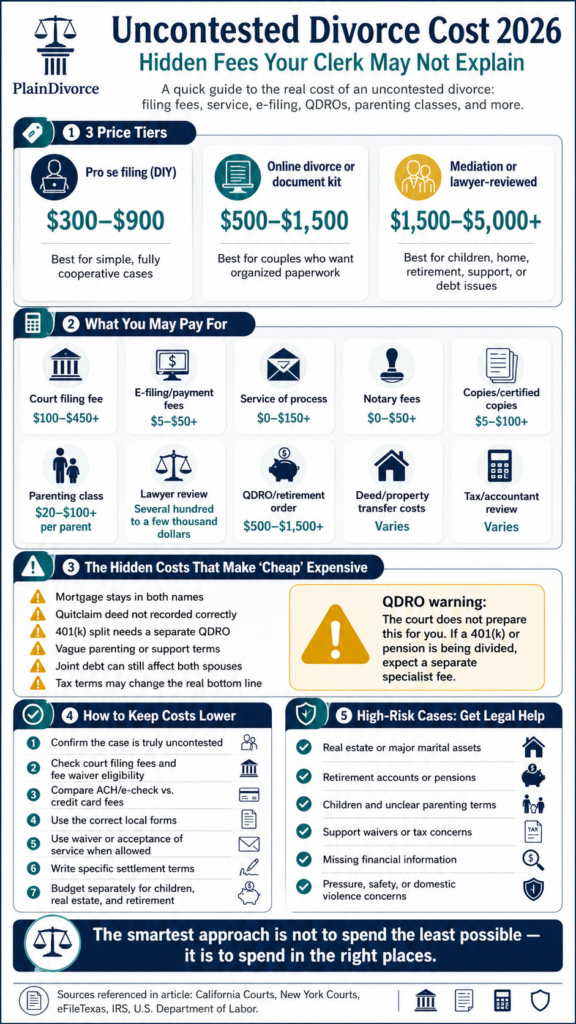
1. Uncontested Divorce Cost at a Glance
Use this as a starting frame before you choose a filing path. The ranges are PlainDivorce planning estimates built from public court fee schedules and typical private-market prices; they are not a national dataset and not a guarantee. Your final uncontested divorce cost depends on your county, your filing method, your settlement terms, and whether children, a home, support, debt, taxes, or retirement accounts are involved.
| Cost Scenario | Planning Estimate | Usually a Fit When |
|---|---|---|
| File it yourself (pro se) | Roughly $300–$900 | No minor children, no home to divide, no retirement split, and the other spouse agrees or does not contest |
| Online divorce or document kit | Roughly $500–$1,500 | Cooperative spouses who want organized paperwork but not full attorney handling |
| Mediation or lawyer-reviewed uncontested divorce | Roughly $1,500–$5,000+ | Children, a home, support, retirement, significant debt, or settlement terms that are not fully worked out |
The court filing fee is only the entry ticket. Sections 3 through 11 walk through each item that can be added to it, and section 14 shows how to get an exact number for your own court.
2. Two Routes to an Uncontested Divorce, and How Each Affects Cost
“Uncontested” does not always mean both spouses sit down and sign together. In most places a divorce can finish without a trial in one of two ways, and the cost profile is different for each.
- An agreed, joint, or consent case. Both spouses sign the key papers—often a written settlement agreement plus a consent form, a joint petition, or a joint application. Extra cost here is mostly the settlement agreement: drafting it yourself, buying a kit, or paying for review. Service is often reduced to a signed waiver or acknowledgment.
- A default or no-response case. One spouse files, serves the other correctly, and the other never responds by the deadline. New York’s court guidance describes an uncontested divorce as one where the defendant signs the appropriate document or “defaults by failing to answer.” California runs a “default” process and a separate “default with agreement” process. Extra cost here is service of process and a default judgment package; the relief the court grants generally cannot exceed what the filing papers requested.
So a spouse who will not sign does not automatically push you into an expensive contested case. If service is done validly and no answer is filed, many courts let the case finish by default. New to the topic? Start with what is an uncontested divorce and uncontested divorce eligibility.
3. Court Filing Fees: Your Starting Number
The court filing fee is the first and usually largest fixed part of the uncontested divorce cost. It is the fee to open the case, and depending on where you file it may be called a filing fee, petition fee, complaint fee, or index-number fee. It is set by each court or county, not nationally, so two counties in the same state can charge different amounts.
Two official examples show the spread and why you must check your own court:
- California. The Judicial Branch self-help site states the fee to file for divorce is generally $435–$450, describes listed amounts as estimates, and offers a fee waiver for filers who cannot afford it: California Courts, file for divorce.
- New York. Court fees for an uncontested divorce total at least $335—a $210 index-number fee to start the case plus a $125 Note of Issue fee—not counting photocopies, notary, service, or mailing: New York Courts, uncontested divorce overview.
If the filing fee is a barrier, check fee-waiver or fee-deferral eligibility before you pay. California explains that a waiver lets eligible people file without paying court fees and can cover some later court costs as well: California Courts, ask for a fee waiver. A waiver does not cover private costs such as mediation, a document kit, or a retirement-order drafter.
The useful question is not “how much is divorce” in the abstract. It is: what does my court charge to file, what does my county require on top of that, and what has to be paid before the judgment is entered?
4. E-Filing and Payment-Processing Fees
Many courts now accept or require electronic filing through a state portal or an electronic filing service provider. These systems are convenient, but the payment screen can add to the total, and how much it adds is set by that system and that court—there is no national rule.
Texas is a documented example. The statewide system, eFileTexas, runs on Tyler Technologies’ Odyssey platform. Paying court fees by credit card there adds a percentage-based processing fee of roughly 3%, and many counties add a small court service fee; some Texas districts charge no convenience fee at all. Where an ACH or e-check option is offered, it is usually a flat charge instead of a percentage. See the Texas Judicial Branch overview of electronic filing in Texas.
Practical step: on your own portal, compare the card fee against the bank-transfer fee before you submit. On a $350 filing fee, a 3% card fee is about $10 more than a flat e-check charge—small, but it is one of the easiest add-ons to miss because it appears only at checkout, after the forms are done.
5. Service of Process: What It Costs When It Is Required
Service of process means giving the other spouse the filed papers in a way the court accepts. It is part of the uncontested divorce cost only when your court requires formal service—many jurisdictions let cooperative spouses use a signed waiver, acknowledgment, acceptance of service, or a joint filing instead, which can bring this line to zero.
If formal service is required, budget for it and check three things with your court: who is allowed to serve (for example a sheriff, a court officer, or a licensed private server), what proof document you must file afterward (an affidavit, proof, or return of service), and the deadline to complete it. The charge, the method, and the server are all set by the jurisdiction and sometimes the local court. Costs climb when the other spouse is hard to locate, lives out of state, needs multiple attempts, or when service by publication is ordered. For the mechanics, see how to serve divorce papers in an uncontested divorce.
Getting service wrong is expensive in time rather than dollars: a defective service can force you to redo it and can delay or block the judgment.
6. The Full Line-Item Budget
Here is the item-by-item list to price out for your own case. Treat the amounts as PlainDivorce planning estimates, and confirm each one locally.
| Cost Item | Planning Estimate | Why It Matters |
|---|---|---|
| Court filing fee | Often ~$100–$450, set by county | Opens the case; check your court’s fee schedule for the exact amount |
| E-filing or card-processing fee | Flat few dollars, or ~2–3% on a card | Added by some portals; may be avoidable with e-check or fee waiver |
| Service of process | $0 with a waiver; otherwise a local server or officer fee | Applies only if formal service is required |
| Proof or affidavit of service | Usually little or no separate cost | Proves service was done correctly |
| Notary | $0–$50+ depending on documents and state | Needed where signatures or affidavits must be notarized |
| Copies and certified copies | A few dollars per copy; certified copies cost more | Needed for records, name changes, benefits, and proof of divorce |
| Parenting class | Free to ~$100+ per parent, where required | Required in some courts when minor children are involved |
| Online divorce or document kit | Varies by provider | Helps produce organized paperwork; court fees are usually charged separately |
| Mediation | Hourly or per-session; varies widely | Helps spouses finish unresolved issues before filing |
| Lawyer review or limited-scope help | Consultation or flat-fee review; varies by market | Checks for legal risk before you sign |
| QDRO or other retirement order | Often several hundred to $1,500+, plan permitting | May be needed to divide an employer retirement plan (see section 9) |
| Deed preparation and recording | Preparer fee plus a county recording fee; may include transfer tax | Applies when one spouse transfers a real-estate interest |
| Tax or accountant review | Varies | Useful when support, a home sale, dependency claims, or retirement transfers are involved |
7. Divorce Cost Without a Lawyer: DIY, Online Kit, Mediation, Lawyer Review
The goal is not the lowest sticker price. It is the lowest-cost option that still produces complete papers the court will accept and that actually work after the judgment. A low divorce cost without lawyer help is only a saving if nothing has to be redone later.
| Option | Relative Cost | Best For | Main Risk |
|---|---|---|---|
| File it yourself (pro se) | Lowest | Simple cases; full agreement, or the other spouse does not contest | Wrong forms, returned paperwork, terms that are missing or too vague |
| Online divorce or document kit | Low to moderate | Cooperative spouses who want organized paperwork | Court and service fees are usually separate; provider’s own eligibility screen applies |
| Mediation | Moderate | Spouses who agree on divorcing but need help settling details | May not include the final court documents; a mediator is neutral, not your advocate |
| Lawyer review or limited-scope help | Moderate | People who want advice on a specific issue before signing | A limited engagement does not include filing or court appearances unless you arrange it |
| Full lawyer-handled uncontested divorce | Highest uncontested option | More complex uncontested cases | Cost depends heavily on scope and local rates |
If you have no children, no real estate, no retirement to divide, no support question, and no debt dispute, filing yourself or using a document kit is often enough. If children are involved, read uncontested divorce with children before assuming the paperwork is simple. If you are dividing property, debt, support, or a home, work through a marital settlement agreement checklist and the property division guide before you sign. For the sequence of steps, see the uncontested divorce process.
8. What Makes a Cheap Divorce Expensive Later
The costly mistake is rarely overpaying up front. It is underpaying for incomplete documents. A low cheap divorce cost becomes expensive when the judgment says the spouses agree but leaves no workable path to carry the agreement out.
Common examples: one spouse keeps the house while the mortgage stays in both names; a quitclaim deed is signed but never recorded; a retirement account is “divided” in the settlement but no qualifying order is entered; a car is awarded to one spouse without moving the loan and title; or a joint debt is assigned to one spouse even though the creditor can still pursue both.
On that last point, the Consumer Financial Protection Bureau is direct: a divorce decree or property settlement “may allocate debts to a specific spouse, but it doesn’t change the fact that a creditor can still collect from anyone whose name appears as a borrower,” and sending the creditor a copy of the decree “doesn’t end your responsibility on a joint account”: CFPB, debt after divorce. The decree binds the two spouses to each other; only the lender can release a borrower, through a refinance, a novation, or an approved assumption, and whether that is possible depends on the loan contract and applicable law.
Real estate and retirement create the most expensive post-judgment surprises. If one spouse keeps the home, the agreement should address a refinance deadline, a backup sale trigger if refinancing is denied, the title transfer, and who pays the deed, recording, appraisal, and closing costs. Budget for a preparer fee and a county recording fee, and check whether a transfer tax applies.
9. QDROs, Retirement Orders, and IRA Transfers
Dividing retirement is one of the most commonly under-budgeted parts of a divorce, because the settlement language alone does not move the money.
For a private-sector employer plan governed by federal law—a 401(k) or many pensions—the mechanism is a Qualified Domestic Relations Order (QDRO). The U.S. Department of Labor explains that retirement interests can be assigned only through an order that meets the requirements of ERISA and the Internal Revenue Code, and that the plan administrator decides whether a given order qualifies: U.S. Department of Labor, QDROs. Nothing in federal law requires the QDRO to be a document separate from the decree, but many plans prefer it that way and publish their own model language and procedures.
- Get the plan’s written QDRO procedures before you finalize the settlement wording, so the order matches what the plan will accept.
- Budget for a drafter only if your plan or court requires one. Where a specialist or attorney prepares and revises the order, plan on several hundred dollars to $1,500 or more; complex or multiple plans cost more.
- An IRA is different. IRAs are not divided by a QDRO. They move by a “transfer incident to divorce” under the tax code, handled directly with the IRA custodian under the decree.
- Government and military retirement systems use their own order types and terminology—not a private-plan QDRO—so confirm the correct instrument with that system.
If your settlement divides a plan but no qualifying order is entered and accepted, the receiving spouse may not get the assigned funds when expected. Paying a drafter now is usually cheaper than an enforcement fight later.
10. Divorce With Children: Where Costs Rise
An uncontested divorce with children generally costs more than one without, because courts ask for more detail before entering a judgment that affects kids. Exactly what is required is set by your state and sometimes your county, so treat the following as items that may apply rather than a universal checklist.
- A parenting class for one or both parents, where the court requires it—often free to about $100 per parent.
- A parenting plan and a child-support worksheet or calculation on your court’s current forms.
- Terms for health insurance, uninsured medical costs, childcare, school expenses, holidays, transportation, and—if the parents intend it—which parent claims the child for taxes.
- More detailed review by the court, which in some places will not approve a one-sentence agreement on custody or support.
Check your court’s current packet for cases with children, and see the uncontested divorce with children guide and the parenting plan guide for what a complete filing usually contains. If your court files are public, ask how to keep a child’s Social Security number and a protected address out of the public record.
11. Taxes Can Change the Real Cost
Divorce can affect filing status, who claims the children, child-related credits, retirement transfers, support treatment, home-sale gain, and joint tax debt. The IRS collects the basics on one page: filing taxes after divorce or separation.
Claiming a child. A clause in a settlement agreement does not by itself decide who claims a child for federal tax. For decrees and agreements executed after 2008, the custodial parent—the one with more overnights—generally must sign IRS Form 8332 (or a substantially similar statement) releasing the claim, and the release must be unconditional. That release moves only the dependency claim and the child tax credit, additional child tax credit, and credit for other dependents. It does not transfer head-of-household filing status, the earned income credit, or the child and dependent care credit—those stay with the custodial parent: IRS, About Form 8332.
Spousal support. For divorce or separation agreements executed after 2018, alimony and separate-maintenance payments are not deductible by the payer and not included in the recipient’s income. An agreement executed before 2019 keeps the old rule unless it is later modified and the modification expressly says the post-2018 repeal applies: IRS Topic No. 452. State income-tax treatment can differ, so confirm your situation with a tax professional. A support figure that feels fair can land very differently after tax than either spouse expects—if support, a home sale, dependency claims, retirement transfers, or joint tax debt are in play, budget for tax or legal review before signing.
12. Venue: File Where It Is Legally Proper
Jurisdiction is whether a state’s courts can hear your divorce at all; venue is which court location within that system is the correct one to file in. Venue is fixed by law and local rules—usually tied to where one or both spouses live—not by which courthouse looks cheaper or faster.
Do not assume you can shop for a low-cost county. Filing in the wrong venue can get the case rejected or transferred, which costs more time than any small fee difference. What is worth checking: whether your state lets spouses file a joint petition in any county, whether the petitioner or the respondent must live in the filing county, whether a hearing is required, and whether local forms or e-filing rules differ. Use that information to file correctly—not to save money.
13. Low, Medium, and High Cost Examples
These four sketches use PlainDivorce planning estimates to show where a case tends to land. Your numbers depend on your county and your facts.
The No-Kid, No-Asset Couple
Likely path: file it yourself, or a document kit
Planning estimate: roughly $300–$900
No minor children, no house, no retirement to split, no support request, no major joint debt. The costs are the filing fee, a service waiver or service fee, notary, copies, e-filing charges, and certified copies at the end.
The Parents Who Agree on Everything
Likely path: document kit or court forms, sometimes with a lawyer review
Planning estimate: roughly $700–$2,500+
The parents agree on parenting time, support, insurance, and expenses. The case is uncontested, but the paperwork is more detailed, and a parenting class and a support worksheet may be required.
The Homeowners With a 401(k)
Likely path: lawyer review plus a retirement-order drafter, or full attorney handling
Planning estimate: roughly $2,000–$5,000+
They agree in principle, but the agreement has to handle the house, the mortgage, the deed, a refinance deadline, the retirement division and its qualifying order, and debt allocation. A basic form packet does not cover this.
The Almost-Agreed Couple
Likely path: mediation plus document preparation
Planning estimate: roughly $1,500–$5,000+
They agree on divorcing but still disagree on parenting, support, or debt. Mediation costs more up front; for some couples it settles the open points so the case can be filed as uncontested rather than contested.
14. How to Keep Uncontested Divorce Cost Lower
You keep the uncontested divorce cost down by paying for the right help at the right time—not by skipping steps that are expensive to fix later.
- Get an accurate number for your court first. Find the county clerk’s fee schedule, the fee-waiver form, the self-help center, and the packet for cases with children. Do this before you rely on any blog figure, including this one.
- Confirm the case is genuinely uncontested—either both spouses agree, or the other spouse is not going to contest after valid service.
- Check fee-waiver or deferral eligibility before paying. Apply through the court if you cannot afford the fee.
- Compare payment methods on your e-filing portal. A percentage card fee can be more than a flat e-check charge.
- Use the correct local forms. Statewide forms, county forms, e-filing cover sheets, and local addenda all matter.
- Use a service waiver or acknowledgment where the court allows it. Cooperative spouses can often skip a server fee.
- Write specific settlement terms. Replace “split it fairly” with who pays, how much, when, and what proof is required.
- Budget separately for children and for retirement. A parenting class, a support worksheet, and a qualifying retirement order are their own line items when they apply.
- Handle deed and mortgage details in the agreement. Refinance deadline, title transfer, who pays costs, and a backup sale plan.
Want organized paperwork before you pay court fees?
See whether your case fits a simpler process with the PlainDivorce eligibility check, then use a state kit for California, Texas, or New York. A kit is a general organizing aid; it does not guarantee your court will accept the filing.
15. When to Bring in Legal, Tax, or Financial Help
Getting advice is not an admission that the divorce is a fight. Any of the following is a reason to consider limited-scope legal help, a tax professional, a financial advisor, or a domestic-violence, immigration, or bankruptcy specialist—often a single consultation is enough:
- Your spouse has a lawyer and you do not.
- You feel pressured or unsafe, or you are being rushed to sign.
- You cannot get full financial records, or you suspect something is missing.
- There is real estate, a business, a pension, a 401(k) or IRA, or significant joint debt.
- One spouse will pay or waive support.
- Parenting or support terms are still unclear.
- Immigration, bankruptcy, tax, or safety issues are part of the picture.
- You do not fully understand what the agreement does.
Limited-scope or unbundled help—one consultation, a document review, or one issue such as the retirement order—can protect either spouse from a costly mistake without the price of full representation.
16. FAQ About Uncontested Divorce Cost
How much does an uncontested divorce cost in 2026?
It starts with your county’s court filing fee, commonly somewhere between about $100 and $450, plus smaller items like service, copies, and e-filing fees. As a planning frame, PlainDivorce estimates roughly $300–$900 for a simple case you file yourself, $500–$1,500 with an online kit, and $1,500–$5,000 or more when mediation, lawyer review, a home, children, or retirement accounts are involved. Confirm your court’s actual fees before you rely on any range.
What is the cheapest way to get an uncontested divorce?
Usually filing yourself with your court’s official forms, when both spouses cooperate and there are no children, real estate, retirement accounts, support issues, or major debts. You still pay the court filing fee, any service cost, notary, copies, e-filing fees, and certified copies. If you cannot afford the filing fee, ask the court about a fee waiver.
How much does a divorce cost without lawyer help?
A divorce cost without lawyer help is mainly the court filing fee plus service or waiver costs, notary, copies, mailing, certified copies, e-filing fees, and any required parenting class. If you use a document kit or online service, that fee is charged on top. The wide variation between cases comes from children, real estate, and retirement, not from the base filing.
Is online divorce cost lower than lawyer fees?
Online divorce and document-preparation services generally cost less than full attorney handling, but what you get is paperwork help, not legal advice or a fairness check. If you have children, property, support, retirement accounts, tax questions, or safety concerns, a limited-scope lawyer review can be worth the added cost. Compare what a specific service includes before assuming it is the cheaper option overall.
Are court filing fees included in online divorce cost?
Usually not. Many online divorce services charge for document preparation only. The court filing fee, service fees, e-filing charges, notary, parenting classes, certified copies, and any retirement-order cost are typically separate. Check each provider’s page for exactly what its price covers.
Why does an uncontested divorce with children cost more?
Courts ask for more before approving a judgment that affects children. Depending on your state and county, that can mean a parenting plan, a child-support worksheet, health-insurance and expense terms, and sometimes a parenting class, plus closer review of the agreement. Each added requirement is a small cost or a bit more time.
What hidden fees should I budget for?
The ones people miss: e-filing or card-processing fees at checkout, service of process, certified copies, a parenting class, a QDRO or other retirement order, deed preparation and recording, refinance-related costs, notary, mailing, and tax or legal review when the agreement carries risk.
Do I need a QDRO in an uncontested divorce?
Only if you are dividing a private-sector employer retirement plan such as a 401(k) or many pensions. The plan administrator decides whether the order qualifies, so get the plan’s written QDRO procedures before finalizing the settlement wording. IRAs are not divided by a QDRO—they move by a transfer incident to divorce—and government and military systems use their own order types.
Can I avoid paying the court filing fee?
Many courts offer a fee waiver or deferral based on income or hardship. You apply through the court and must meet its requirements. A waiver can cover some later court costs too, but not private costs like mediation, a document kit, a retirement-order drafter, or a lawyer.
17. The Real Uncontested Divorce Cost
The real uncontested divorce cost is the total of getting from “we agree”—or “the other spouse will not contest”—to a judgment that actually works afterward.
A simple case you file yourself may be just the filing fee, service or a waiver, notary, copies, and certified copies. A document kit adds a preparation fee but can reduce confusion. Mediation costs more but can keep a shaky case uncontested. A limited-scope lawyer review costs more than filing alone but protects you when children, property, debt, support, taxes, or retirement are involved.
The smart approach is not “spend the least.” It is “spend in the right places”: less on paperwork you can safely handle, more on the pieces that are expensive to fix later—retirement orders, real-estate transfers, support terms, parenting plans, tax language, and unclear debt.
Helpful next reads: what is an uncontested divorce, uncontested divorce eligibility, and the uncontested divorce process.
PlainDivorce provides self-help divorce information and document kits. It is not a law firm, and this article is not legal advice. Filing fees, forms, and procedures vary by state, province, and territory and change over time, and the dollar ranges here are planning estimates rather than official figures. For advice about your specific situation and an exact cost for your court, consult your county court’s self-help resources and a licensed family lawyer or tax professional in your jurisdiction.
Sources and local rules can change. Use this guide as a plain-English organizer, then verify the current filing requirements with the official court or government source for your jurisdiction.

About Harry D
Expert contributor at PlainDivorce, helping Canadians and American navigate simple uncontested divorces with clarity and confidence.