Divorce Waiting Period by State: A 2026 Timeline and Reality Check
A divorce waiting period by state is the minimum time that must pass before a court can enter a final divorce judgment. It ranges from none at all to a year or more of living apart. But the number by itself does not tell you when you will be divorced. The two questions that actually control your timeline are: what event starts the clock, and what has to be finished before a judge can sign.
This guide explains the uncontested divorce waiting period the way it works in practice: the clock triggers (filing, service, signing, or separation), the residency rule that comes first, the finality rules that come last, and the state-specific traps that quietly add weeks. It compares 10 selected states side by side, then shows how to keep your own case moving.
TL;DR
The length of the waiting period matters far less than what event starts it. Four separate clocks stand between you and a final divorce — residency, separation, waiting period, and finality — and only one of them is the number people quote.
- Filing-triggered states: Texas (60 days from filing) and Florida (20 days from filing). The clock starts the moment the case opens.
- Service-triggered states are the trap. California’s six months runs from service or the respondent’s appearance — not filing. Washington needs 90 days since both filing and service, so the later event controls. Wisconsin’s 120 days runs from service or a joint petition. In these states a filed petition with no service is a clock that never started.
- Separation states run the clock before you file, not after. North Carolina requires a full year apart before the complaint — filing early can get the case dismissed. Virginia requires a year, cut to six months only with a signed agreement and no minor children of the marriage.
- “No waiting period” is not “fast.” Illinois has no statewide cooling-off period for an agreed case, but the judgment still has to resolve property, debt, parenting, and support in full.
- New York’s six months is a ground, not a wait. The sworn six-month breakdown statement is the no-fault ground; what actually blocks the judgment is unresolved equitable distribution, support, or custody.
- The judge’s signature is not always the divorce date. In a Massachusetts 1A case, approval → nisi at 30 days → absolute 90 days after that — roughly 120 days, and no remarriage until the absolute date.
- Residency comes first, always. Texas is not “60 days” — it’s six months in the state and 90 days in the county, then filing, then 60 days. California adds a three-month county rule on top of six months in-state.
- Waivers rarely shorten anything. A signed waiver can avoid formal service and start a service-triggered clock sooner, but it does not erase a mandatory wait. Texas drops its 60 days only on specific family-violence findings; most states have no exception at all.
- Children run a clock of their own. UCCJEA home-state jurisdiction generally needs six consecutive months of the child living in the state. If a parent recently moved, that dispute can outlast the divorce waiting period by a wide margin.
- Use the wait, don’t just serve it. Finish the settlement agreement, parenting plan, support worksheet, disclosures, and proposed decree while the clock runs — and ask your clerk whether final papers can be lodged early, because courts differ.
- Before you remarry, refinance, change benefits, or file taxes as unmarried, confirm the legal termination date with the court — not the date something got signed.
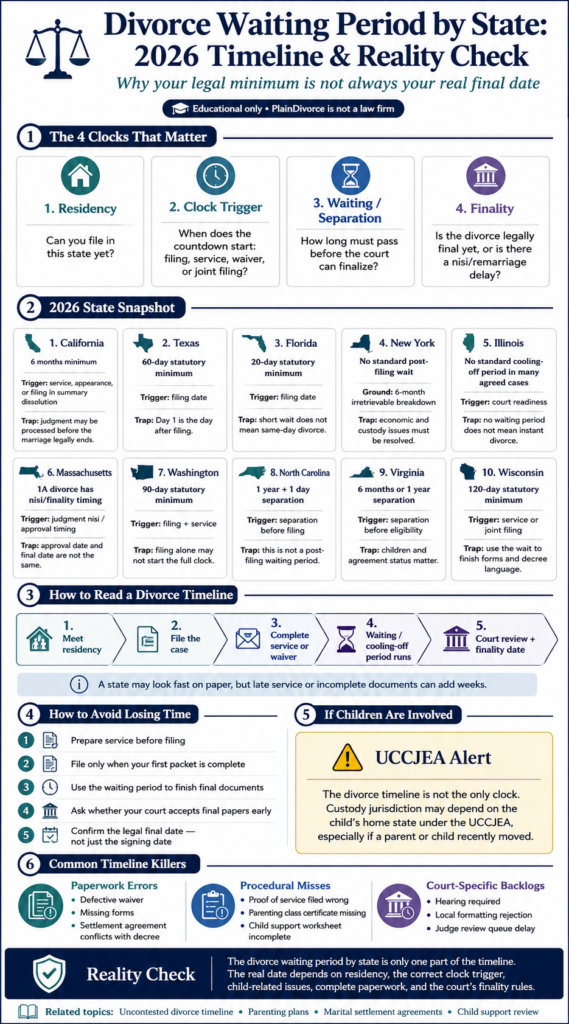
1. How to Use This Divorce Waiting Period Guide
Work the divorce waiting period by state in this order: confirm the residency rule for your state, identify the waiting period and the event that starts it, then check the finality rule that decides when the marriage legally ends. A short statutory period does not guarantee a fast decree if service is late, a waiver is defective, child-support forms are incomplete, or the court requires a hearing.
This is a selected-state comparison for planning, not a 50-state directory, and it is not a substitute for your court’s own instructions. If your state is not in the table, apply the same three checks: residency, waiting period and its trigger, and finality.
2. Uncontested Comes in Two Forms, and Each Has Its Own Timeline
Before you read a waiting period, know which kind of uncontested case you are running. “Uncontested” describes an outcome — the other spouse does not fight the divorce — and that happens two ways.
Route 1: the agreed, joint, or consent route
Both spouses sign. Depending on the state, that is a joint petition or joint application, a signed settlement agreement plus a consent or appearance form, or one spouse filing and the other signing a waiver or acceptance of service. New York, for example, runs an Uncontested Joint Divorce Program in which the spouses file their papers together. This route removes the response deadline because there is nothing to respond to, so the clock is your paperwork, the waiting period, and court review.
Route 2: the default or non-response route
One spouse files and formally serves the other. If the served spouse never answers or appears within the response period, the filing spouse asks the court to finish the case by default. There is no signed agreement requirement for this route, and a self-represented (“pro se”) filer can use it. The trade-off: in a default, the relief the court grants generally cannot exceed what the petition requested, so the petition must be complete and specific. This route adds the service step and the full response window — commonly 20 to 30 days after service, set by your state — before you can request the default.
Many courts also allow a hybrid: a default paired with a written agreement the court adopts. The waiting period is the same either way, but the route changes what else has to happen inside it. Check which routes your court offers before you decide how to file.
3. Three Clocks Before You Are Divorced: Residency, Waiting Period, Finality
Think of the timeline as three separate clocks. Miss any one and the finish date moves.
- Residency clock. How long one spouse must have lived in the state (and sometimes the county) before you can file or before a judgment can be entered. This runs before the case starts.
- Waiting-period clock. The mandatory pause between a triggering event and the earliest date a court can finalize. This is the number most people mean by “divorce waiting period.”
- Finality clock. The gap between the judge’s signature and the legal date the marriage ends — a judgment nisi period, an entry date, or a remarriage restriction.
A fourth item, a required separation period, applies in some states and behaves like a residency prerequisite: it must be satisfied before the divorce can be granted, and you cannot shorten it by filing early. Section 6 covers it.
Need help organizing the forms? Start with a PlainDivorce uncontested divorce kit so your paperwork is prepared as one packet built around your state’s clock.
4. What Starts the Waiting Period: Filing, Service, Signing, or Separation
The fastest uncontested divorce is not always the state with the shortest waiting period. It is the case where the clock starts correctly on day one. A waiting period can start when the petition is filed, when the respondent is served, when a waiver or acceptance of service is signed, when a joint petition is filed, when a judgment nisi enters, or when a required period of living apart is complete.
- Filing-triggered: Texas measures its 60 days from the filing date. Florida measures its 20 days from filing.
- Service-triggered: California’s six months runs from the date of service or the respondent’s appearance, whichever is first. Washington requires 90 days to pass since both filing and service, so the later event controls. Wisconsin’s 120 days runs from service of the summons and petition, or from the filing of a joint petition.
- Separation-triggered: North Carolina and Virginia require a set period of living separate and apart before the divorce can be granted — the clock runs before filing, not after.
The rule: do not ask only, “What is the waiting period?” Ask, “What event starts it, and has that event happened yet?” In a service-triggered state, a prepared petition sitting in a drawer does nothing; the clock waits for valid service or a signed waiver.
5. Divorce Waiting Periods in 10 Selected States (2026)
This table compares 10 states that together cover a large share of U.S. divorces and show how differently the clock can work. It is a selected comparison, not a 50-state directory. Every rule below is tied to a statute, but statutes are amended — confirm the current version with your court before you rely on a date. Each row separates the statutory minimum from the procedural trap.
| State | Residency requirement | Waiting period and what starts it | Finality trap to check | PlainDivorce guide |
|---|---|---|---|---|
| California | One spouse a California resident for 6 months and a resident of the filing county for 3 months (Fam. Code § 2320). Narrow exception: a marriage entered in California may be dissolved here without meeting residency if neither spouse lives in a jurisdiction that will dissolve it. | No judgment terminates the marriage until 6 months after the date the summons and petition are served on the respondent, or the date the respondent appears, whichever is first (Fam. Code § 2339(a)). The court can extend that period for good cause. Summary dissolution runs its own 6 months from filing. | The 6 months does not run from filing. The court may process paperwork earlier, but the judgment states an effective termination date that cannot be before the six months end. | Uncontested divorce in California |
| Texas | One spouse domiciled in Texas for the preceding 6 months and a resident of the filing county for the preceding 90 days (Fam. Code § 6.301). | A court may not grant the divorce before the 60th day after the suit is filed (Fam. Code § 6.702). Day 1 is the day after filing; weekends and holidays count, and if day 60 lands on one, the practical date moves to the next business day. | Section 6.702 lets a court waive the 60 days only where it finds a family-violence conviction or deferred adjudication against the petitioner or a household member, or an active protective order or emergency protection order. Otherwise the 60 days is firm, and late service pushes the real finish past it. | Uncontested divorce in Texas |
| Florida | One party must reside in Florida for 6 months before the petition is filed (Fla. Stat. § 61.021). | No final judgment may be entered until at least 20 days after the petition is filed, unless the court finds that injustice would result from the delay (Fla. Stat. § 61.19). | Twenty days is short, but it is not a same-day divorce. Most Florida courts still require complete financial disclosure and, in many cases, a brief final hearing before a judge signs. | Uncontested divorce in Florida |
| New York | A connection to New York under DRL § 230 must be met before filing — commonly one to two years of residence, shorter where both spouses live in New York and the grounds arose there. | No fixed post-filing cooling-off period. The no-fault ground (DRL § 170(7)) requires a sworn statement that the marriage has been irretrievably broken for at least 6 months, and the court cannot grant the divorce until equitable distribution, spousal and child support, custody and visitation, and fees are resolved by the parties or decided by the court and written into the judgment. | The 6-month breakdown is a ground, not a waiting period. Unresolved money or custody issues block the judgment. Court fees are at least $335: a $210 index-number fee plus a $125 Note of Issue fee. | Uncontested divorce in New York |
| Illinois | One spouse a resident of Illinois, or stationed there in the military, for 90 days before judgment (750 ILCS 5/401). | No mandatory statewide cooling-off period for an agreed case. Irreconcilable differences is the only ground. Living separate and apart for 6 months before judgment creates an irrebuttable presumption that the ground is met, but spouses who agree can ask the court to find irreconcilable differences without completing the full 6 months. | “No waiting period” does not mean instant. The court still needs jurisdiction, complete pleadings, and a judgment that fully resolves property, debt, parenting, and support. | Uncontested divorce in Illinois |
| Massachusetts | Massachusetts residency and venue rules under ch. 208 must be checked before filing. | In an uncontested 1A divorce, the judge approves the separation agreement at a hearing; a judgment of divorce nisi enters 30 days later; the divorce becomes absolute 90 days after that — about 120 days from approval. | The approval date is not the date you are divorced. Neither spouse may remarry until the judgment is absolute. Count 120 days from approval before changing benefits, refinancing, or remarrying. | Uncontested divorce in Massachusetts |
| Washington | No durational residency requirement. One party must be a Washington resident, a service member stationed in Washington, or married to one (RCW 26.09.030). | The court cannot finalize until 90 days have elapsed since both the petition was filed and the respondent was served, or the first publication of the summons. The later event controls. | Filing early does not start the whole clock. If service is delayed, the 90 days effectively runs from the service date, not the filing date. | Uncontested divorce in Washington |
| North Carolina | Plaintiff or defendant must have resided in North Carolina for 6 months before filing (G.S. 50-6). | Not a post-filing wait. The spouses must have lived separate and apart for one full year before the complaint is filed. Courts commonly describe this as “one year and one day.” | Filing before the separation year is complete can get the case dismissed. The separation year is an eligibility rule, not a cooling-off period you can serve after filing. | Uncontested divorce in North Carolina |
| Virginia | One spouse a bona fide resident and domiciliary of Virginia for 6 months before filing (Va. Code § 20-97). | Separation-based. One year of living separate and apart without cohabitation and without interruption, reduced to 6 months where the spouses have a signed separation agreement and no minor children of the marriage (Va. Code § 20-91(A)(9)). | The 6-month route needs both the agreement and no minor children; otherwise it is a full year. An affidavit process under § 20-106 can finalize a no-fault case without a hearing. | Uncontested divorce in Virginia |
| Wisconsin | One spouse a Wisconsin resident for 6 months and a resident of the county for 30 days before filing (Wis. Stat. § 767.301). | The case cannot go to a final hearing until 120 days after the respondent is served with the summons and petition, or 120 days after a joint petition is filed (Wis. Stat. § 767.335). A court may order an earlier hearing only to protect the health or safety of a party or a child, or for other emergency reasons. | The 120 days runs from service or joint filing, not from your first filing. Use the time to finish financial disclosures (§ 767.127) and the settlement agreement so the case is ready on day 120. | Uncontested divorce in Wisconsin |
The state divorce waiting periods above are only reliable when paired with the correct residency rule and clock trigger. A state can look fast on paper, but delayed service, a defective waiver, or an unresolved parenting issue can move the real final date by weeks. For the official picture in your state, use your court’s self-help center — for example, California Courts self-help for California.
For broader planning, compare this page with the PlainDivorce guides to the uncontested divorce process, the marital settlement agreement checklist, and uncontested divorce eligibility.
6. Separation Periods Are Not Waiting Periods
A waiting period usually runs after a filing, service event, waiver, or joint petition. A separation period runs before the divorce can be granted — and in some states before you can file at all. Confusing the two is one of the most expensive mistakes in a DIY divorce.
This matters in North Carolina, Virginia, South Carolina, Louisiana, and other separation-based systems. If a state requires a year of living separate and apart before filing, you cannot fix that by filing early and waiting for the court to catch up. The separation period is part of divorce eligibility, and filing too soon can end the case.
Use this test when comparing the divorce waiting period by state:
- Residency requirement: how long must one spouse live in the state or county before filing?
- Separation period: how long must the spouses live apart before the court can grant the divorce?
- Waiting period: how long after the triggering event before the court can finalize?
- Finality period: when does the divorce become legally final after the judge signs?
7. The Nisi and Finality Trap
Some divorces are approved before they are fully final. A nisi period is the gap between a court’s divorce judgment and the date the divorce becomes final for legal purposes such as remarriage.
Massachusetts is the clearest example. In a no-fault 1A divorce, four dates can differ: the approval date at the hearing, the judgment nisi date 30 days later, the absolute (final) date 90 days after that, and the earliest remarriage date, which is the absolute date. That is roughly 120 days from approval to a final divorce, and remarrying or refinancing before the absolute date is a mistake.
The wrong question is: “Did the judge approve the divorce?” The better question is: what is the legal date my marriage ends? Before remarrying, changing benefits, refinancing property, updating estate documents, or filing taxes as unmarried, confirm the exact final date with the court — and if a retirement account is being divided, remember that a separate order to the plan may still be pending after the divorce is final.
8. Residency and Venue Come Before the Waiting Period
Residency is the prerequisite people miss most. Each state sets its own rule by statute — for example, six months of California residence plus three months in the county under Family Code § 2320, or the connection test in New York DRL § 230. There is no single national “marital connection” test; you have to read your state’s section.
Residency is separate from the waiting period. Texas timeline logic, for instance, is not just “60 days.” It is residency first (six months in the state, 90 days in the county), filing second, and the 60-day period third.
Before filing, confirm state residency, county residency and venue, any military exception, whether either spouse recently moved, whether the spouses live in different states, and whether the children have a different home state for custody jurisdiction. Residency problems can cause rejection, delay, transfer, or dismissal, so treat residency as a prerequisite, not a footnote.
9. Children Add a Separate Clock: the UCCJEA
If minor children are involved, the divorce waiting period is not the only timing issue. Custody jurisdiction is governed by each state’s enacted version of the Uniform Child Custody Jurisdiction and Enforcement Act (UCCJEA), summarized by the Uniform Law Commission.
Under the UCCJEA, a state normally has “home state” jurisdiction to make the initial custody order when the child has lived there with a parent for at least six consecutive months (or since birth, for an infant). The Act also provides narrower bases — significant-connection jurisdiction when no state qualifies as the home state, and temporary emergency jurisdiction when a child present in the state has been abandoned or needs protection.
This becomes a timing problem when a parent recently moved with the child, the spouses live in different states, the child has lived in more than one state in the last six months, or one spouse wants to file for divorce in a state that may not control custody. The divorce waiting period might be 60 or 90 days, but a custody-jurisdiction dispute can run much longer. For a specific situation, check your state’s enacted UCCJEA rather than a general overview.
10. Legal Minimum vs. Real-World Timeline
The legal minimum is the earliest date the court may be allowed to finalize. The real-world timeline is the date the divorce actually becomes final after residency, filing, service, disclosures, child-related documents, clerk processing, judge review, local scheduling, and finality rules.
A 60-day statutory minimum can become a longer timeline if service is delayed, a waiver is signed but filed late, the court requires a hearing, parenting-class proof is missing, the child-support worksheet is incomplete, the proposed decree conflicts with the settlement agreement, or the divorce is approved but not legally final until a later nisi or finality date. How much time each of those adds depends entirely on your state and county — there is no reliable nationwide average.
Use the legal minimum as a planning floor, not a promise. That is why this guide focuses on clock triggers and traps instead of only listing numbers.
11. Delays That Break an Uncontested Timeline
The delays below are examples, not a universal checklist. Whether each one applies, and how a court handles it, depends on state law and local rules — confirm the specifics with your own court.
Paperwork errors
Paperwork defects can stop a judge from signing even when both spouses agree. Common examples: a waiver of service that is not notarized where the state requires it, a settlement agreement that conflicts with the proposed decree, missing retirement-division language, one spouse signing the agreement but not the required court form, or a missing local cover sheet, confidential-information form, or vital-statistics form.
Procedural misses
Procedural misses happen when something was done informally but not completed the way the rules require: a parenting-class certificate that was never filed, a child-support worksheet using the wrong income period, proof of service filed incorrectly, a waiver signed in the wrong sequence, or final documents submitted before the court allows them. Whether final papers can be lodged early for later review varies by court — ask your clerk rather than assuming.
Court-specific processing
Some delays are not visible in the statute. Depending on the court, an uncontested case may need a short prove-up or default hearing, may be reviewed only on certain calendars, may be rejected for local formatting, or may sit until the file reaches a judge’s queue after the waiting period ends. County-level procedure is why two people in the same state can wait very different amounts of time.
“Uncontested” means the other spouse is not fighting the divorce. It does not mean the court will approve an incomplete file. If your paperwork is returned, see the PlainDivorce guide to why divorce paperwork gets rejected.
12. How to Keep the Clock Moving
You usually cannot waive a mandatory waiting period. But you can stop wasting time before the clock starts and around it.
- Pick your route first. Decide whether you are filing jointly, by consent, or heading toward a default after service. The forms and the sequence differ.
- Confirm residency before anything else. Check state and county residency, venue, and any military exception. A petition filed in the wrong county can cost weeks.
- Identify the trigger, then make it happen fast. In a service-triggered state, prepare the waiver, acceptance of service, or joint petition before filing so the clock starts the day the case opens.
- File only when the first packet is complete. Do not file and then spend two weeks sorting out service, notary rules, parenting forms, or disclosures.
- Use the waiting period to finish the final documents. Complete the marital settlement agreement, parenting plan, child-support worksheet, disclosures, proposed decree, and any required class while the clock runs.
- Ask whether final papers can be submitted early. Some courts accept them for later review; others do not. Confirm the local procedure.
- Match every document. Names, dates, and property, debt, support, parenting, and retirement terms should be identical across the petition, the agreement, and the proposed decree.
- Confirm the final date, not just the signing date. Check for a nisi period, an entry requirement, an appeal period, or a remarriage restriction before you act on the divorce.
PlainDivorce provides self-help, state-specific uncontested divorce paperwork designed to help you start the correct court process. It is not a law firm and does not file for you. Pair the right kit with your state’s waiting-period trigger so the paperwork and the clock work together — start at check your eligibility.
13. When to Get Legal Help
Get legal advice before relying on a timeline if you recently moved states, your spouse lives in another state, your child recently moved states, you have a UCCJEA home-state question, your spouse will not sign or cannot be located, you need to divide retirement accounts, you own real estate or a business, you think you need a waiting-period waiver, or there is domestic violence, coercion, or a safety risk.
If your spouse has a lawyer and you do not, this is no longer a basic timeline question. Get your own advice before signing.
Legal help does not have to mean hiring a lawyer for the whole case. Many people use limited-scope help to confirm whether the separation period is met, whether the divorce is final enough to remarry, or how to fix a rejected filing — often one consultation is enough. For related planning, read the PlainDivorce guides to serving divorce papers and an uncontested divorce with children.
PlainDivorce is not a law firm and does not provide legal advice. Divorce rules vary by state, county, and court.
14. FAQ: Divorce Waiting Periods
My state has no waiting period. Can I get divorced today?
Almost never. “No waiting period” means there is no mandatory statutory cooling-off period, not that the case is instant. The court still needs jurisdiction and residency, a properly filed petition, valid service or an allowed waiver or joint filing, complete documents, and a judge’s approval. In practice even a clean case in a no-wait state takes a few weeks to a few months once the court processes it.
Is a cooling-off period the same as a waiting period?
In most divorce contexts, yes. A cooling-off period is a mandatory delay before a court can finalize the divorce, and “waiting period” is the more common term for it. Some states describe it as time to reconsider; others use it to make sure paperwork and disclosures are complete. It is different from a residency requirement and from a required separation period.
My spouse signed a waiver. Does that skip the waiting period?
Usually not. A waiver or acceptance of service can avoid formal service and can start the clock sooner in a service-triggered state, but it does not erase a mandatory waiting period. A few states have narrow exceptions — Texas removes its 60-day wait where the court makes certain family-violence findings — but most states have none. Do not count on an exception.
The judge signed something. Am I legally divorced?
Not always. Some states have a judgment nisi period, an entry requirement, an appeal period, or a remarriage restriction between the signature and the legal end of the marriage. Massachusetts, for example, takes about 120 days from approval to an absolute judgment in a 1A divorce. Confirm the exact termination date with the court before you remarry, refinance, or change benefits or taxes.
We have children. Is the divorce waiting period the only timing issue?
No. A case with children may add a parenting plan, a child-support calculation, health-insurance and expense terms, sometimes a parenting class, and closer court review. If a child recently moved states or the parents live in different states, UCCJEA custody jurisdiction can take longer to sort out than the divorce waiting period itself.
Which state has the shortest divorce waiting period?
Several states have no mandatory cooling-off period at all, so a complete, correctly served case can be finalized as soon as the court processes it. Among states that do impose a wait, Florida’s 20 days after filing is one of the shortest. But “shortest waiting period” is not the same as “fastest divorce” — residency rules, service, disclosure, and court backlog still control the real finish date.
Does the waiting period start when I file or when my spouse is served?
It depends on the state. Texas and Florida count from the filing date. California counts from service or the respondent’s appearance, whichever is first. Washington requires 90 days since both filing and service. Wisconsin counts from service of the summons and petition or the filing of a joint petition. Check your state’s statute before you assume the clock is running.
Can PlainDivorce tell me my state’s exact waiting period?
PlainDivorce provides self-help divorce paperwork and state-specific kits, and each state guide summarizes the current rule. It is not a law firm and does not provide legal advice or file on your behalf. Because statutes and local rules change, confirm the waiting period and clock trigger with your court or its self-help center before you file.
15. Bottom Line: The Waiting Period Is Only One Clock
The divorce waiting period by state is one part of the timeline. The real finish date depends on five questions: have you met the jurisdictional residency requirement, what is the statutory waiting or separation period, what event starts the clock, is there a nisi or finality rule, and are the final documents ready when the court can legally sign?
If you are filing uncontested, start the clock correctly: satisfy residency first, complete service or a valid waiver early, finish the settlement agreement and any child-related forms during the wait, and verify the finality date before making major legal or financial decisions. Use the state comparison here as a starting point, then confirm the current rule with your court.
Ready to prepare your paperwork? Check your eligibility and download the state-specific PlainDivorce uncontested divorce kit built around your court’s process.
Sources and local rules can change. Use this guide as a plain-English organizer, then verify the current filing requirements with the official court or government source for your jurisdiction.

About Harry D
Expert contributor at PlainDivorce, helping Canadians and American navigate simple uncontested divorces with clarity and confidence.