Uncontested divorce eligibility comes down to one test: is there a live dispute for a judge to decide, or not? You may qualify if you and your spouse agree on the terms — parenting, support, property, and debt — or if you file, serve your spouse correctly, and your spouse does not oppose the case. Resolving issues without a trial can cut out litigation steps, but the timing, cost, forms, and hearings all depend on where you file. Use the 12 questions below to check whether an uncontested divorce is likely to fit your situation before you start paperwork.
New to the term? Start with what is an uncontested divorce, then come back here to check whether you qualify.
TL;DR
You likely qualify for an uncontested divorce if there is nothing left for a judge to decide. Everything else — the forms, the timing, whether there’s a hearing — is local. Here’s what actually determines eligibility.
- Two routes qualify, not one. An agreed case (both spouses sign) and a non-opposed case (you serve your spouse correctly and they never respond) are both uncontested. Your spouse going silent doesn’t disqualify you — it just means the service paperwork has to be airtight.
- “We worked it out” usually isn’t specific enough. The test: could a neutral person read your agreement and know exactly who gets what and what each person must do next? Vague terms are the most common reason a “simple” case stalls.
- Residency is necessary but not sufficient. Canada requires a full year in the province or territory; U.S. states set their own periods (and sometimes a county rule). Meeting it still doesn’t guarantee the court can make every order you want — out-of-state property, an out-of-state spouse, or children living elsewhere raise separate jurisdiction questions.
- Qualifying generally doesn’t mean qualifying for the fast track. Streamlined options like Florida’s simplified dissolution or BC’s desk order divorce have tighter rules of their own.
- With children, the court reviews independently. Your parenting plan is checked against the child’s best interests, and child support against the guidelines — parents generally can’t waive or under-set it by private deal.
- Spousal support must be resolved or expressly reserved. Silence on it is not the same as settling it.
- Safety comes before speed. If one spouse feels pressured, controlled, or unable to speak freely, a low-conflict DIY process is the wrong tool regardless of how much you seem to agree.
- Some cases look simple but aren’t: a business, a pension needing a separate order to divide, hidden assets, immigration status tied to the marriage, or an existing court order. These can still settle — with advice first.
- You don’t need a perfect score. The more of the 12 questions below that line up, the more likely an uncontested divorce actually works for you.
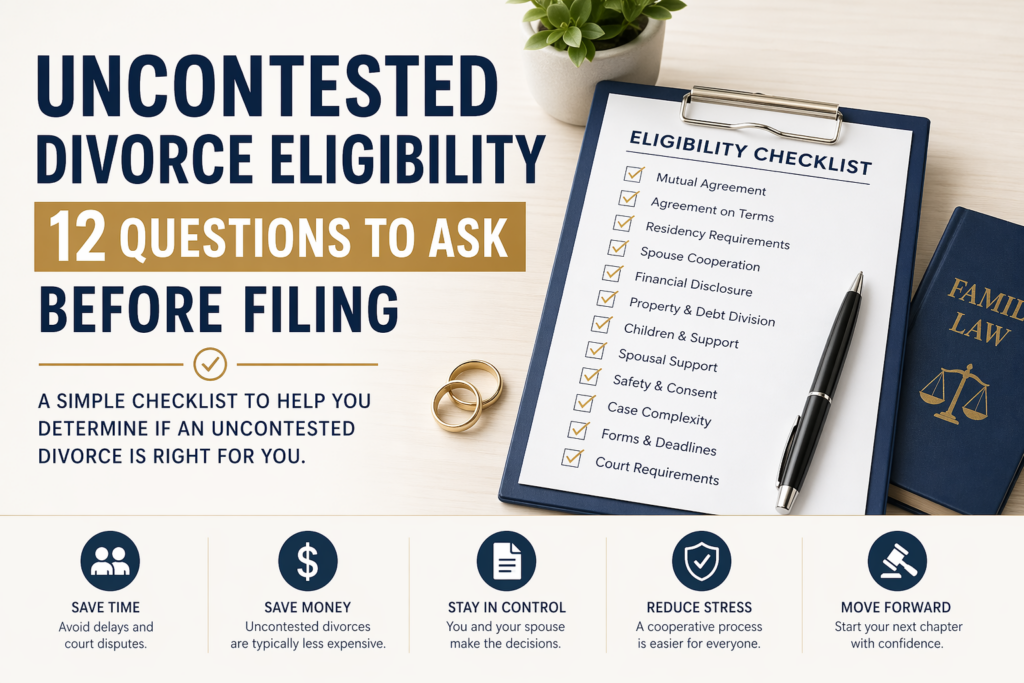
1. The Short Answer: Who Qualifies for an Uncontested Divorce
You are likely a fit for an uncontested divorce when there is nothing for a judge to rule on. In practice that means one of two things:
- you and your spouse agree on the divorce and its terms, and can put that agreement in writing; or
- one spouse files, the other is properly served and does not oppose the case — either by signing a consent form or by never responding within the deadline.
Beyond that, eligibility depends on local rules: a residency period, the correct forms and filing track, any required disclosures or worksheets, and sometimes a short hearing. This article is a nationwide overview for the United States and Canada, so it explains the concepts and then points you to your own court for the specifics.
You do not need a perfect “yes” to every question below. But the more that line up, the more likely an uncontested divorce will actually work for you.
2. Two Pathways: An Agreed Case and a Non-Opposed Case
Most guides describe an uncontested divorce as “both spouses agree.” That is the common route, but it is not the only one, and assuming it is can send you down the wrong path when a spouse goes quiet.
- Agreed or consent case. Both spouses sign the key documents — a settlement agreement, a consent or affidavit form, or a joint application. This is the cleanest form of an uncontested divorce.
- Default or non-opposed case. One spouse files and serves the other correctly. The served spouse does not answer within the deadline, so the case moves ahead without them. New York’s court guidance, for example, describes an uncontested divorce as one where the defendant either signs a document agreeing to the divorce or “defaults by failing to answer the summons or summons and complaint.” Both count as uncontested because there is no dispute on the record.
The practical difference: a default still requires airtight proof that service was done correctly, and some courts hold a brief hearing before signing. A spouse who dodges service slows the case down, but avoiding papers does not by itself create a legal dispute. If a real disagreement is filed — about the divorce, parenting, support, or property — the case becomes contested and a judge has to decide it.
In Canada, the federal Divorce Act allows either or both spouses to apply. What keeps a case uncontested is agreement on the terms, or non-opposition — not whether you file together.
3. What Uncontested Means Where You Live
The underlying idea — no live dispute for the court to resolve — is consistent across the U.S. and Canada. The label and the exact track are not. These are jurisdiction-specific names with different eligibility rules, so treat them as pointers, not synonyms:
| Label | Where it is used and what it means |
|---|---|
| Uncontested divorce | The general term across most U.S. states and Canadian provinces and territories |
| Joint application / joint petition | Both spouses file together as co-applicants; used in many U.S. states and in provinces such as Ontario |
| Desk order divorce | British Columbia’s term for a divorce a judge decides on the paperwork, with no hearing |
| Simplified dissolution of marriage | Florida’s narrow track: no minor or dependent children, limited eligibility, and both spouses must appear |
| Simple divorce / no-contest divorce | Informal phrases people use for the same idea; not statutory terms and not a specific filing track |
Qualifying for “an uncontested divorce” in general does not automatically qualify you for the fastest or simplest track your jurisdiction offers. Those streamlined options usually have tighter rules — on children, property values, or how the case is filed.
4. 12 Questions to Check Your Uncontested Divorce Eligibility
4.1 Is the marriage ending, and will your spouse oppose it?
This is the starting point. An uncontested divorce works best when both spouses accept that the marriage is over. But you do not always need your spouse’s active agreement to the divorce itself — in many places, and under Canada’s Divorce Act, one spouse can ask for the divorce and the case can still be uncontested if the other does not oppose it.
- Good sign: you both want to move forward, or one of you does and the other will not fight the case.
- Red flag: your spouse is filing responses that dispute the terms, or is using the process to keep control.
4.2 Do you agree on the main terms, or is nothing genuinely in dispute?
This is usually the core of eligibility. In an agreed case, you should be able to state clearly:
- how property is divided
- how debts are divided
- whether either spouse will pay support
- the parenting arrangements, if you have children
- child support, calculated under the rules that apply where you live
Ask yourself: could we write our agreement down in plain language without starting a new argument? If not, you may need more discussion, mediation, or legal advice before filing. In a default case there is no signed agreement, but the court still needs your proposed terms to be complete and lawful.
4.3 Do you meet the residency rules where you plan to file?
Every court has rules about who can file there and when. In Canada, you or your spouse must have lived in the province or territory for a full year immediately before applying. U.S. states set their own durational residency periods, and some also have a county requirement.
Residency is not the whole test, though. Meeting it does not guarantee the court can make every order you want — for example, orders affecting an out-of-state spouse, out-of-state property, or children who live elsewhere can raise separate jurisdiction questions. Check the instructions for the specific court where you plan to file, not just how long you have lived there.
4.4 Are you using the right filing track for your situation?
Not every uncontested divorce follows the same path. The correct track can depend on:
- whether you file jointly or one spouse files first
- whether you have minor children
- whether you own a home or other significant assets
- whether support is involved
- whether your spouse will sign a waiver or acceptance of service
- whether your court offers a simplified or summary process, and whether you meet its limits
Joint filing, waiver of service, disclosures, hearings, waiting periods, and final forms are not universal. Canadian federal law leaves the process and forms to each province and territory, and U.S. procedure changes at the state line. Confirm which track fits before you prepare anything.
4.5 Will your spouse cooperate, or has your spouse gone silent after being served?
In an agreed case, cooperation is practical, not just theoretical. It can mean reviewing documents, signing forms, responding on time, accepting service or signing a waiver where allowed, and helping finalize the agreement.
- Good sign: your spouse is reachable and willing to participate.
- Workable: your spouse was validly served and simply does nothing — that can often be finished as a default, not a contested case.
- Red flag: your spouse files a response disputing the terms, or you cannot locate your spouse at all.
If your spouse cannot be found, you may still have options — usually asking the court for permission to serve another way — but the process is slower and the paperwork has to be exact.
4.6 Do you know your court’s financial-disclosure rules?
Financial-disclosure requirements vary widely. Some courts require sworn financial statements, worksheets, or affidavits from one or both spouses; others require very little in a fully agreed, child-free case; a default case has its own rules. Check whether your court requires disclosures, which forms, and which spouse must file them before you assume anything.
Whatever the local rule, a real agreement still depends on full information. If one spouse is hiding money, understating income, or refusing to share records, the case is not a good candidate for a do-it-yourself uncontested divorce.
Pro tip: pull your local court’s forms list early. Knowing which disclosure forms apply — and which are only required in certain cases — saves a rejected filing later.
4.7 Can you divide property and debt in specific terms?
“We already worked it out” is not enough. The plan has to be specific enough to write into an order. You should be able to answer:
- Who keeps the home, the vehicles, or the lease?
- Who refinances or transfers each debt?
- Who gets each bank, pension, and retirement account?
- Who keeps the major household items?
- What happens if one person does not complete a transfer on time?
In Canada, provincial and territorial law governs how property is divided; in the U.S., state law controls. Agreeing does not mean an even split — it means there is no dispute for the judge to resolve.
Simple test: if a neutral person read your agreement, would they know exactly who gets what and what each person must do next? If not, it needs more work before filing.
4.8 If you have children, is the parenting plan complete?
Parents can absolutely qualify for an uncontested divorce, but child-related terms get closer review. You generally need a clear plan covering:
- where the children live and the regular schedule
- holidays, school breaks, and travel
- decision-making responsibility for health, education, and religion
- communication between parents and with the children
- child support
A parental agreement alone does not guarantee approval. A court reviews parenting terms against the child’s best interests, and it checks child support against the applicable guidelines. Under Canada’s Divorce Act, the court must “satisfy itself that reasonable arrangements have been made for the support of any children of the marriage” and can delay the divorce until they are. U.S. states apply their own child-support guidelines the same way. Parents usually cannot waive or under-set support just because a private deal suits them better. Justice Canada’s divorce fact sheet explains how parenting, child support, and spousal support fit together.
- Good sign: a realistic written parenting plan and a support figure that matches the guidelines.
- Red flag: you agree on the divorce but not on the children.
4.9 Have you resolved or expressly reserved support?
Spousal support may be called alimony, maintenance, or support depending on where you live. Not every case includes it — but your proposed judgment or agreement should resolve the issue or expressly reserve it, as local law and your case require. That can look like:
- neither spouse will seek support, and each waives any future claim
- one spouse pays a set amount for a set period
- support is reserved for a later decision, where the rules allow it
If one spouse expects support and the other does not, that is a real disagreement, and the case may not be uncontested yet.
4.10 Is the process safe and voluntary?
This matters more than speed or cost. An uncontested divorce is not a good fit if one spouse feels pressured, afraid, manipulated, or unable to speak freely — including situations involving domestic abuse, threats, stalking, coercive control, financial control, or pressure to sign an unfair agreement. A low-conflict process only works when both people can participate safely and voluntarily. If that is not your situation, talk to a lawyer or a local family-violence service before filing anything.
4.11 Are there complications that make DIY risky?
Some cases look uncontested on the surface but are still too complex for a self-help process:
- hidden or disputed assets
- a business or professional practice
- pensions or large retirement accounts that need a separate order to divide
- complicated real estate
- immigration status tied to the marriage
- existing court orders or a pending case
- bankruptcy overlap or serious tax questions
These cases can still settle by agreement, but getting focused legal advice first is usually the safer path.
4.12 Can you follow through on forms, deadlines, and court instructions?
Even when a case qualifies, an uncontested divorce still takes careful follow-through. Depending on where you file, you may need to:
- choose the correct forms for your track
- sign where required, sometimes before a notary or commissioner
- exchange or file disclosures
- file documents in the right order and pay the filing fee, or apply for a waiver
- serve papers correctly, or file a signed waiver of service
- wait out any required waiting or cooling-off period
- attend a hearing if the court requires one
- submit the final documents exactly as instructed
If the paperwork is incomplete or a deadline is missed, the case stalls — even when everyone still agrees.
5. Quick Eligibility Table
| Question | Yes points toward uncontested | No may mean |
|---|---|---|
| The marriage is ending and your spouse will not oppose the case | An agreed or default route may be open | The case may become contested |
| You agree on the major terms, or nothing is genuinely disputed | You may be ready to file | More negotiation or mediation first |
| You meet the residency rules where you plan to file | The court can accept the filing | Wait, or file in the right place |
| Your spouse is cooperative, or was served and stayed silent | Paperwork can move as agreed or by default | Service problems or a disputed response |
| Finances are fully and honestly disclosed | The agreement is more likely to hold up | DIY may be risky |
| Children’s parenting and support terms are complete | The case can stay simpler | The court may want more detail, or there is a dispute |
| No one is under pressure or fear | A self-help process may be realistic | Safety and legal advice come first |
| No business, pension split, or other legal complexity | Self-help may be manageable | Focused legal advice is worth getting |
6. A Pre-Filing Checklist You Can Save
- The marriage is ending, and my spouse will either agree or not oppose the case.
- We agree on the main terms, or there is nothing genuinely in dispute.
- I meet the residency rules where I plan to file, and I have checked that court’s instructions.
- I know which filing track fits my situation.
- My spouse is reachable, or was properly served.
- I know my court’s financial-disclosure rules and which forms apply.
- Property and debt are divided in specific, written terms.
- The parenting plan is complete, and child support matches the guidelines, if we have children.
- Spousal support is resolved or expressly reserved.
- No one is being pressured, controlled, or made to feel unsafe.
- There are no hidden assets or major legal complications.
- I can handle the forms, deadlines, and court instructions.
7. Can You Get an Uncontested Divorce Without a Lawyer?
In most places, yes — self-representation is generally permitted in an uncontested divorce where the local court’s instructions allow it, and courts publish self-help forms and guides for exactly that. It tends to be more realistic when the case is straightforward and both spouses cooperate.
But “without a lawyer” is not “without care.” You still need to understand the process that applies where you live, use the correct forms, make informed decisions, and follow the court’s instructions closely. DIY makes less sense when there is fear, confusion, a serious imbalance of information or power, or real legal complexity. Even one limited-scope consultation or a document review can be worth it.
8. When to Get Legal Help
Strongly consider legal advice if:
- your spouse disputes the terms, or you cannot agree on children, support, property, or debt
- you suspect hidden assets or inaccurate disclosures
- there has been abuse, intimidation, or coercive control, or you feel pressured to sign
- the case involves a business, a pension, or significant assets
- one spouse lives in another state, province, or country
- jurisdiction is unclear, or the court keeps rejecting your forms
- you do not understand what rights the agreement gives up
Legal help can be full representation, limited-scope advice, or document review — you do not need the same level of help for every issue.
9. What to Do Next if You Think You Qualify
- Confirm residency and the local requirements on your court’s official website.
- Gather your financial information.
- Write down your agreement clearly, or map out the terms you will propose in a default.
- Identify the correct filing track and forms.
- Decide whether a self-help uncontested divorce kit fits your case.
A good next step is to read what an uncontested divorce means, then move to your local guide — for example, uncontested divorce in California, uncontested divorce in Texas, uncontested divorce in New York, uncontested divorce in Ontario, or uncontested divorce in British Columbia.
Before you file, confirm the current instructions on an official site such as USAGov’s state and territory directory, the Government of Canada divorce application guide, or the provincial and territorial family law pages.
10. FAQ
What is the difference between uncontested and contested divorce?
In an uncontested divorce, there is no live dispute for the court to decide — either the spouses agree on the terms, or one spouse files and the other, after valid service, does not oppose the case. In a contested divorce, the spouses disagree about one or more issues, such as parenting, support, property, or debt, and a judge has to resolve them. Uncontested cases are usually simpler and more predictable, but they still follow the local process.
Do both spouses have to sign for an uncontested divorce?
Not always. Joint and consent cases require the other spouse’s signature or participation where local rules say so — a joint application, a settlement agreement, or a waiver of service. But a spouse who is properly served and then does not respond by the deadline may instead be handled through a default procedure, which has its own paperwork and proof-of-service requirements. Check your court’s instructions to see which applies.
Can you have an uncontested divorce with children?
Yes, and many parents do. The agreement usually needs more detail — a full parenting plan and a child-support figure calculated under the applicable guidelines — and the court reviews child-related terms more closely. A judge looks at the parenting plan against the child’s best interests and must be satisfied that reasonable child-support arrangements have been made before granting the divorce.
What if we agree now, but one of us changes our mind later?
If your spouse files a response disputing the terms, the case becomes contested and you may need mediation or a court decision on the open issues. If your spouse simply stops cooperating after being served — missing deadlines or not returning documents — the case is not automatically contested; it may still be finished by default. Either way, revisit the agreement in writing before you go further.
Is an uncontested divorce always faster?
Often, but not always. An uncontested case skips the contested motions and trial, which usually shortens the timeline. But it is still subject to any mandatory waiting or cooling-off period, the court’s scheduling backlog, and whether your paperwork is complete and correct the first time. A nationwide article cannot give you a reliable estimate — check your court’s published timelines.
Does my spouse have to be found and served?
In a sole filing, yes — your spouse must be formally served or must sign an acceptance or waiver of service. In a joint filing, many courts skip service because there is no opposing party. If you cannot locate your spouse, you can usually ask the court for permission to serve another way; that adds time but does not, by itself, make the case contested.
11. Bottom Line
Uncontested divorce eligibility is really about readiness. Is the marriage genuinely ending, is there nothing left for a judge to decide — because you agree or because the case is not opposed — and can you follow a court process carefully to the end? If yes, an uncontested divorce can save time, lower conflict, and make the next steps more manageable.
If not, that does not mean divorce is out of reach. It means a different path — more negotiation, mediation, legal advice, or a default procedure — may fit better. Once your case looks close to uncontested, compare it against your local court’s requirements and forms. See your state or province guide to check eligibility and find the exact steps where you live.
Authoritative references: Department of Justice Canada – how to apply for a divorce, Divorce Act (Canada), section 11, Justice Canada – provincial and territorial family law sites, New York State Courts – uncontested divorce overview, and USAGov – state government websites.
PlainDivorce provides self-help divorce information and document kits. It is not a law firm, and this article is not legal advice. For advice about your specific situation, consult a licensed family lawyer in your jurisdiction.
Sources and local rules can change. Use this guide as a plain-English organizer, then verify the current filing requirements with the official court or government source for your jurisdiction.

About Harry D
Expert contributor at PlainDivorce, helping Canadians and American navigate simple uncontested divorces with clarity and confidence.