Divorce Forms Checklist: The Documents an Uncontested Divorce Actually Needs (2026)
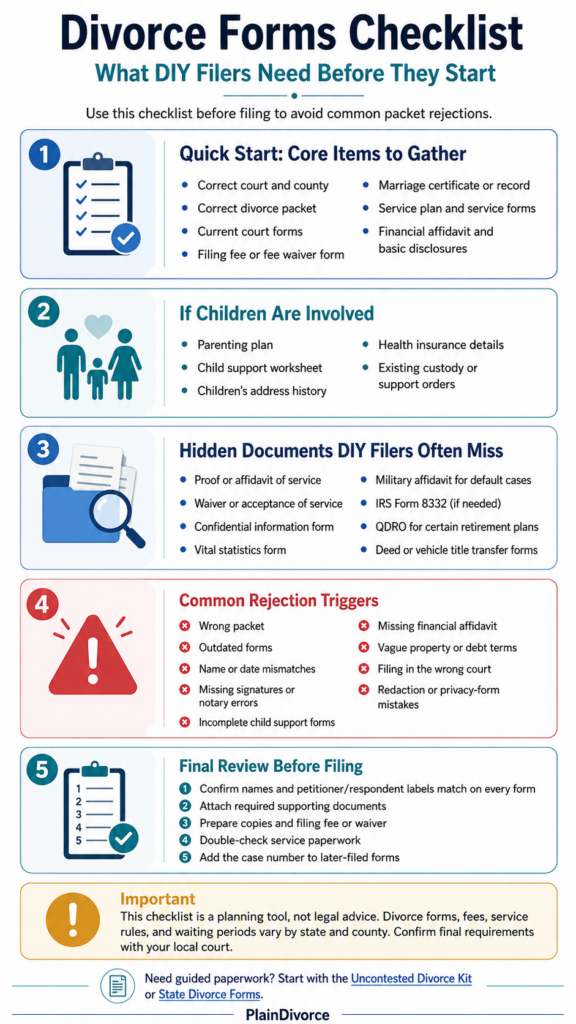
A divorce forms checklist covers six things: the petition or complaint that opens the case, proof that your spouse received legal notice, financial disclosure, any parenting and support documents, your written settlement agreement, and the local cover sheets and supporting orders your court requires. The exact forms, and which ones are mandatory, vary by state, county, and filing route, so treat this as a planning inventory and confirm the final list with your court.
This works as your divorce paperwork checklist and your uncontested divorce documents checklist in one place: a preparation tool that helps a pro se or self-represented litigant gather the right information before opening a single form. It is legal information, not legal advice.
Start here: If you want guided, state-matched paperwork instead of blank forms, use the uncontested divorce kit. For how the whole case moves, read the uncontested divorce process guide.
TL;DR
There is no national divorce packet, so this is a planning inventory, not a filing list. Its job is to get you organized before you download your court’s packet — because the petition is the easy part, and cases stall on the supporting documents nobody prepared.
- Pick your filing route before you open a single form. Agreed, joint, waiver of service, or default — the route decides your service documents and your judgment papers, and switching later usually means redoing forms.
- Financial disclosure is not always a filing. Some courts require a sworn affidavit; some have you exchange disclosures with your spouse and file only a proof of service; a few allow a written waiver. Check before assuming either way.
- The marriage certificate is often not required. Many courts don’t list it as a filing item at all. But if yours does and you married abroad, order it early — certified copies, translations, and apostilles take weeks.
- Don’t serve the papers yourself unless your court allows it. Most require a sheriff, marshal, licensed server, or any adult who is not a party — and invalid service means the case cannot move.
- A default judgment needs a servicemember affidavit. 50 U.S.C. 3931 requires you to state whether the spouse is in military service, or that you cannot determine it. The form name varies; the requirement doesn’t.
- Wage withholding is the federal default for child support under 42 U.S.C. 666 — not something you opt into. It applies unless the court finds good cause or the parties reach a written alternative.
- Decree language does not move the child tax credit. For post-2008 decrees the IRS accepts only a signed, unconditional Form 8332, and it transfers the dependency-based credit alone — head-of-household, EITC, and the child-and-dependent-care credit stay with the custodial parent.
- Your decree does not rewrite a lender’s contract. Assigning a joint mortgage, card, or car loan leaves both borrowers exposed until it’s refinanced, assumed with lender approval, paid off, or closed.
- Retirement usually needs its own order. A QDRO covers ERISA plans, can sit inside the decree, and is qualified by the plan administrator, not the judge. IRAs use a transfer incident to divorce; government, military, and church plans use their own formats. Get the plan’s written procedures before drafting.
- A QMCSO is a plan tool, not a divorce form. It directs a specific group health plan to enroll a child — and it cannot add a benefit the plan doesn’t already offer.
- A judgment often doesn’t transfer title. Real estate and vehicles usually need a separate deed, recording, DMV, or lender-release step under local law.
- The signature block tells you the sequence. Sworn, subscribed, verified, acknowledged, or under penalty of perjury each mean something different. Signing before you read the certificate on that page can mean reprinting it.
- Sensitive data often belongs on a separate sheet. Social Security numbers, birthdates, account numbers, and children’s details usually go on a confidential-information form, not the public filing — and skipping that sheet delays the case as surely as putting the data in the wrong place.
1. How to Use This Divorce Forms Checklist
This is a planning inventory, not a filing checklist. There is no national divorce packet. Once you know your state, your county, and your filing route, download the current packet your court publishes and follow its own list of required and conditional forms. Use everything below to arrive at that step already organized.
A single state can divide its forms several ways at once. New York, for example, publishes separate uncontested-divorce and joint-divorce form sets, and the required documents change depending on whether there are children and which route you use. California’s custody jurisdiction form, the FL-105/GC-120, asks for a five-year address history for each child and details of any other court case. Your divorce forms checklist has to be read against that local list, not instead of it.
| Check | What to confirm | Why it matters |
|---|---|---|
| Correct court | The county, district, circuit, or family court that accepts your filing | Filing in the wrong court can lead to transfer, dismissal, or extra fees |
| Correct packet | With children, without children, joint, default, or a simplified packet if your state offers one | The wrong packet can be returned for correction |
| Current forms | Today’s official state or county forms, or a kit that tracks revisions | Courts and e-filing systems can reject a superseded form version |
| Filing route | Agreed, joint, waiver of service, or default | The route controls which service and judgment forms you need |
| Fees and waiver | Base fee, plus any summons, motion, e-filing, or copy fees, or a fee-waiver request | An unpaid or wrong fee stops the filing |
| Party names | Full legal names for both spouses, used identically on every form | Name mismatches trigger questions and delay |
| Case number | Assigned by the clerk after the first filing | Every later document must carry the same number |
| Supporting documents | Proof of service, confidential-information form, vital-statistics form, and any order the agreement requires (QDRO, deed) | These are the items filers prepare last or skip |
2. Pick Your Filing Route Before You Touch a Form
An uncontested divorce documents checklist starts with the route, because the route decides your service steps and your judgment papers. Most courts reach an uncontested judgment one of two ways: an agreed route, where both spouses sign, or a default route, where one spouse files, serves the other properly, and the other never responds by the deadline. Many states also offer a formal joint filing and a waiver or acceptance of service that skips formal delivery. Use your court’s names for these.
| Situation | Route and packet to look for | Document filers often forget |
|---|---|---|
| No minor children, spouses agree | Petition or complaint, plus the no-children packet; a written agreement if your court requires one | Proposed judgment or decree, if filed with the petition |
| Minor children, parents agree | The with-children packet | Parenting plan, support calculation, and any custody-jurisdiction disclosure, if your court requires them |
| Both spouses want to file together | Joint petition or joint dissolution packet, where the state offers one | Route-specific joint forms and both signatures where the form calls for them |
| One spouse files, the other will cooperate | Petition or complaint, plus a waiver or acceptance of service | The signed, and sometimes notarized, waiver returned and filed |
| One spouse files, the other will not respond | Petition or complaint, plus a summons and the default packet | Proof of service, a servicemember affidavit for a covered default, and the request to enter default |
| Retirement account is being divided | The standard packet, plus a plan order if the plan requires one | A QDRO for an ERISA plan, or the transfer paperwork the specific plan or IRA custodian uses |
| Real estate is transferring | The standard packet, plus the deed and lender steps under local law | The new deed, recording fee, and any refinance or assumption deadline |
Clerk’s Corner: Some courts keep a with-children packet and a without-children packet as separate downloads. Pick the one that matches your children, property, support, and filing route before you start filling anything in. Switching packets later usually means redoing forms.
If you are not sure which route applies, start with your state or county court’s self-help page, then compare it against the what uncontested divorce means guide.
3. Identity, Names, and Party Roles
Most divorce forms open with identifying information. This part of the divorce forms checklist looks trivial, but inconsistent names cause avoidable delay.
Gather for yourself: full legal name exactly as it appears on your government ID, any former names, date of birth, mailing address, physical address, phone, email, occupation, county and state of residence, the date you moved in if the form asks, and whether you need your address kept confidential for safety.
Gather for your spouse, if you have it: full legal name, former names, date of birth, mailing and physical address, phone, email, employer or occupation, and the best address for service.
Petitioner and respondent
Most forms call the spouse who starts the case the Petitioner or Plaintiff, and the other spouse the Respondent or Defendant. Use the same label for the same person on every document: the petition, the summons, the agreement, the parenting plan, and the proposed judgment.
Warning: the name-match problem. If your marriage certificate says Katherine, your ID says Kate, and your form says Katie, expect the clerk or judge to ask about it. Use full legal names consistently unless a form specifically asks for aliases, former names, or a name you want restored.
If you are asking to restore a former name, write the exact name you want restored. Courts usually require it stated clearly in the petition, the agreement, or the final judgment.
4. Marriage Records and Prior Cases
Gather your marriage details and any prior case history before you draft. Whether you have to file a certified marriage record depends on your court: some ask for it, many do not list it as a required filing item. Confirm your court’s instruction rather than assuming.
- Date of marriage.
- City and state, or country, where the marriage took place.
- County that issued the marriage license, if known.
- Marriage certificate or marriage record, and a certified copy only if your court asks for one.
- Date of separation, if your state uses one.
- Whether the spouses still live in the same home.
- Whether either spouse has filed for divorce before.
- Any other court case involving the spouses or the children, including custody, support, protective orders, or bankruptcy.
If you married in another state, you can order the record from the vital-records office or county clerk where it was filed. If you married abroad, check early whether your court wants a certified copy, a translation, an apostille, or a long-form record, because foreign documents take longer to obtain.
Clerk’s Corner: A decorative certificate from the ceremony is not the same as the official record from the vital-records office. If your court asks for a certified marriage record, bring that one.
5. Residency, Venue, and Grounds
Confirm you are filing in the right state and county before you pay a fee. The governing statute, the court rule, and the packet instructions control here, and they differ by state. Most states require at least one spouse to meet a residency period, and some add a county venue rule.
- Your current address, and your spouse’s, if known.
- The date you moved into the state, and into the county.
- Prior addresses if you moved recently.
- Proof of residence, if your court requires it.
- Date of separation, if your state’s ground depends on one.
- The no-fault ground your state uses, in its own words.
- Any waiting or cooling-off period between filing and judgment.
Check how your state defines “separate and apart” or “intent to end the marriage” before you enter a separation date. Some states measure from when spouses stopped living together; others from when one spouse decided the marriage was over; some do not use a separation period at all.
Warning: Filing in the wrong county or state can cause dismissal, transfer, delay, or lost fees. Confirm venue and residency against the statute before you file. For a state-by-state view, see the divorce waiting period by state guide.
6. Service and Notice Documents
Service is how your spouse receives formal notice of the case. If you file jointly, or your court accepts a signed waiver, you may not need formal service at all. Otherwise, this part of the divorce paperwork checklist is where cases stall.
- Your spouse’s service address, and the best time and place to deliver papers.
- Whether your spouse will sign a waiver or acceptance of service.
- The summons and the petition or complaint to be served.
- The proof-of-service form your court uses (affidavit of service, return of service, or acknowledgement of service).
- A notice of appearance or answer form, if your state uses one.
- The deadline for your spouse to respond.
- A servicemember affidavit, if you will ask for a default judgment.
- Any safety concern that affects how service should happen.
Warning: Do not serve the papers yourself unless your court allows it. Many courts require a sheriff, marshal, licensed process server, or any adult who is not a party. Invalid service means the court cannot move the case forward.
If you do not know where your spouse lives, your court has a process for a diligent search and for alternative service by mail, posting, or publication. Do not guess. The how to serve divorce papers guide walks through each method.
7. Children, Parenting, and Support Information
If you have minor children together, the checklist gets longer. Courts review parenting and support terms even when both parents agree. Whether a parenting plan, a support worksheet, and a custody-jurisdiction disclosure are separate required filings depends on your state and your case type, so confirm each against the local packet.
Gather for each child: full legal name, date of birth, current address, school or daycare, health-insurance provider and cost, any special medical or educational needs, the current parenting schedule, any existing custody or support order, and any child-protection or family-violence case.
Many courts also want a multi-year residence history for each child: every address, the dates the child lived there, the adults in the home, any other case involving the child, and anyone who claims custody or visitation rights. California’s FL-105 is a good example of the detail a custody-jurisdiction form can ask for.
For the parenting plan itself, prepare the weekday and weekend schedule, pickup and drop-off logistics, transportation, holidays, school breaks, summer, birthdays, travel-notice rules, communication rules, and a process for changing the schedule.
Clerk’s Corner: A parenting plan should pass one test: could a neutral person enforce it without calling either parent to explain what it means? If not, it is probably too vague.
For drafting help, see the parenting plan guide and the child support and court approval guide.
8. Income, Tax, and Financial Records
Income, tax, asset, and debt records are sensible preparation materials for any divorce. Whether you file a sworn financial affidavit, and how it must be signed, comes from your court’s current packet. Some courts have you exchange disclosures with your spouse and file only a proof of service rather than filing the disclosure itself.
- Your most recent federal tax return, plus W-2, 1099, and K-1 forms.
- Recent pay stubs, and a profit-and-loss statement plus business bank statements if you are self-employed.
- Unemployment, disability, Social Security, or pension income records.
- A monthly expense list and current health-insurance costs.
- Tax-debt notices, refund information, and estimated-payment records.
- The financial affidavit or income-and-expense form, if your court requires one.
If your agreement decides who claims a child for tax purposes, note that the tax result does not follow the divorce court’s wording automatically. For a decree entered after 2008, the custodial parent must sign IRS Form 8332; decree pages cannot be used instead, the release must be unconditional, and it moves only the dependency-based child tax credit, not head-of-household status, the earned income credit, or the child-and-dependent-care credit. See IRS Publication 504.
Warning: the tax-refund gap. “We split the refund” is not an enforceable term. Specify the tax year, the percentage, who files, where the refund is deposited, and when payment is due.
If tax issues are significant, talk to a tax professional before signing the settlement.
9. Property, Asset, and Debt Inventory
Most divorce forms need a property and debt picture even when spouses agree. Make this part of the divorce forms checklist specific enough to support your final agreement.
List the family home, other real estate, vehicles, bank accounts, retirement and brokerage accounts, cryptocurrency, business interests, valuables and collectibles, work equipment, life insurance with cash value, health savings accounts, education savings accounts, and anything owned before the marriage or received by gift or inheritance. For each item, record the description, approximate value, title holder, loan or lien balance, who keeps it, any equalizing payment, and the transfer deadline.
For debts, list mortgages, home-equity loans, vehicle loans, credit cards, personal and student loans, medical and tax debt, lines of credit, business debt, and collection accounts. Record the creditor, the last four digits of the account, the balance, who is named on it, who will pay it, and whether it will be closed, refinanced, transferred, or paid off.
Warning: A divorce order does not rewrite a lender’s contract. If both names are on a mortgage, card, or car loan, the creditor can still pursue either borrower until the account is refinanced, assumed with the lender’s approval, paid off, or closed.
For a deeper walkthrough, read the property division in an uncontested divorce guide.
10. The Supporting Documents DIY Filers Overlook
The petition is only the start. Cases slow down when the main form is ready but a supporting document is missing. Each item below is conditional: it applies only when your court, your route, your plan, or the federal rule below actually calls for it. Check the packet instructions, not just the petition.
Proof or acceptance of service
When: one spouse serves the other, or the other signs a waiver. Why: it proves the court has authority to proceed. Related: how to serve divorce papers.
Confidential information form
When: your court collects Social Security numbers, dates of birth, financial account numbers, or children’s details on a separate sheet. Why: it keeps that data out of the public file. Related: why divorce paperwork gets rejected.
Vital-statistics or divorce-record form
When: your state requires a record-of-divorce form for its vital-records office. Why: it is how the state registers the divorce. Related: your state’s court self-help page.
Servicemember (military) affidavit
When: you ask the court to enter a default judgment and your spouse has not appeared. 50 U.S.C. 3931 requires an affidavit stating whether the spouse is in military service, or stating that you cannot determine it. Why: it protects servicemember rights under the SCRA. The form name and procedure vary by state.
Child-support worksheet
When: your case involves minor children and your state requires the guideline calculation to be shown. Why: the court reviews support against the state guideline even when parents agree, and a below-guideline or zero-support number usually needs written findings. Related: child support guide.
Parenting plan
When: your case involves minor children and your court requires a written plan or custody-jurisdiction disclosure. Why: it sets parenting time, decision-making, transportation, holidays, and communication. Related: parenting plan guide.
Income-withholding order
When: your order includes child support. Under 42 U.S.C. 666, immediate wage withholding is the federal default for covered child-support cases, unless the court finds good cause or the parties reach a written alternative arrangement. Spousal-support withholding and non-IV-D procedures are state-specific. Use your state’s order.
IRS Form 8332
When: the custodial parent is letting the other parent claim a child for the dependency-based child tax credit. Why: for post-2008 decrees, a signed, unconditional Form 8332 is what the IRS accepts; the decree language alone is not. It does not transfer head-of-household status, the earned income credit, or the child-and-dependent-care credit.
QDRO or other retirement-plan order
When: you are dividing an employer retirement plan covered by ERISA. A Qualified Domestic Relations Order can be part of the decree or a separate order, and the plan administrator decides whether it qualifies. An IRA uses a transfer-incident-to-divorce rule instead, and government, military, and church plans use their own order formats. Get the specific plan’s written procedures before drafting.
QMCSO (medical child-support order)
When: a specific group health plan requires a Qualified Medical Child Support Order to enroll a child. Why: it directs the plan to cover the child. It cannot add a benefit the plan does not offer, and the plan administrator decides whether it qualifies. It is a plan-specific tool, not a standard divorce form.
Deed and vehicle-title transfer documents
When: real estate or a titled vehicle changes hands. Why: recording, title, DMV, and lender-release steps are set by local law and the relevant agency or lender; in many places a divorce judgment does not move title on its own. Related: property division.
Discovery, lis pendens, or interrogatories
When: disclosure is incomplete, a claim needs to be recorded against real estate, or the case stops being uncontested. Why: these are state-procedure tools. If your case needs them, it is a sign to slow down and consider legal advice. Related: marital settlement agreement checklist.
Clerk’s Corner: the signature block tells you the sequence. Some forms must be signed in front of a notary, clerk, or witness; others are signed under penalty of perjury with no notary. Read whether the block says sworn, subscribed, verified, acknowledged, or under penalty of perjury, and follow the certificate printed on that form. Signing early can mean reprinting the page.
11. Local Court Filing Details and Fees
Court procedure is local. Two counties in the same state can use different cover sheets, e-filing rules, copy requirements, and hearing procedures. Add these court-specific details to your divorce forms checklist before you submit anything.
- Correct court name and address, and the county or judicial district.
- Filing method: in person, mail, drop box, or e-filing, and the portal name if e-filing is required or available.
- Filing fee, plus any summons, motion, e-filing, or certified-copy fee.
- Fee-waiver or fee-deferral request form.
- Required local forms and the required number of copies.
- Notary, electronic-signature, and redaction rules.
- Waiting period and whether a hearing is required.
- The case number the clerk assigns after filing.
Filing-fee snapshots
Fees change and vary by county. The figures below are dated examples, not current quotes. Verify with your own clerk before filing, and see the divorce filing fees by state guide for a wider view.
| Example | Court filing fee, as checked | Official source |
|---|---|---|
| California (statewide) | $435–$450 to file the petition | California Courts divorce filing page |
| New York (statewide) | At least $335 in total court fees for an uncontested divorce | New York Courts uncontested-divorce fee page |
| Collier County, Florida | About $408 for a dissolution of marriage | Collier County Clerk fee page |
| Bexar County, Texas (2025 schedule) | About $350 without children and $401 with children | Bexar County District Clerk 2025 fee schedule |
Clerk’s Corner: Do not rely on a blog for the final number. Fees can change mid-year, and the clerk may charge separately for the summons, copies, e-filing, or certification.
If the fee is unaffordable, ask the clerk for the fee-waiver, fee-deferral, or indigency form before you file. The uncontested divorce cost guide covers the full budget.
12. Settlement Agreement Documents
Whether your court requires a written agreement depends on the route and the state. When one is required or useful, make it specific enough that each spouse knows exactly what to do after the judgment. Cover:
- Property and debt division.
- Spousal support or alimony, and child support.
- Parenting schedule and decision-making authority.
- Health insurance, tax refunds, and tax debt.
- Real estate and vehicle transfers, and retirement division.
- Name change, attorney’s fees, and deadlines for signing documents after the divorce.
Weak: “We will divide the bank accounts equally.”
Stronger: “The parties will divide the Chase checking account ending 1234 equally based on the balance as of May 1, 2026. Petitioner will transfer Respondent’s share within 10 business days after entry of judgment.”
Weak: “Husband will keep the car.”
Stronger: “Husband will keep the 2021 Toyota Camry, pay the remaining loan, maintain insurance, and complete the title transfer within 30 days after entry of judgment.”
Warning: An agreement that allocates a joint mortgage, car loan, or credit card to one spouse does not release the other from the lender. Confirm a refinance, payoff, assumption, or written release directly with the creditor.
Work through the marital settlement agreement checklist before anyone signs.
13. Review the Packet Like a Clerk Would
Before filing, read the full packet the way an intake reviewer would. This is where a divorce forms checklist turns into a filing-risk review.
- The correct court name appears on every form.
- Petitioner and respondent labels, name spellings, and dates match across all documents.
- Every form the packet lists as required is included, with its attachments.
- Forms are signed, and notary or verification blocks are complete where required.
- Sensitive data is on the confidential form, not the public filing, where your court requires that.
- Copies are prepared, and the fee or fee-waiver request is ready.
- Service documents, the agreement, the parenting plan, the support worksheet, and any proposed judgment are included if your court requires them.
- The case number is added to every document filed after the clerk assigns it.
Warning: the Social Security number trap. Some forms ask for sensitive data, but many courts want it on a confidential sheet rather than the public filing. Redacting the wrong form, or skipping the confidential sheet, can delay the case.
14. The Master Divorce Paperwork Checklist
Use this master divorce paperwork checklist before you start your forms and again before you submit the final packet.
| Category | Gather this | Common mistake |
|---|---|---|
| Identity | Legal names, dates of birth, addresses, ID | Using nicknames or inconsistent names |
| Roles | Petitioner and respondent labels | Switching labels between forms |
| Route | Agreed, joint, waiver, or default | Choosing service forms that do not match the route |
| Marriage | Date, place, and the record if your court asks for it | Assuming a certified certificate is always required |
| Residency | Address history and any proof of residence | Filing in the wrong county or before the residency period is met |
| Grounds | Separation date and the state’s no-fault ground | Using the wrong separation definition |
| Service | Spouse’s address, waiver, proof-of-service form | Serving the papers yourself where it is not allowed |
| Children | Names, dates of birth, address history, school, insurance | Leaving out a prior custody or support order |
| Parenting | Weekly schedule, holidays, transportation | Writing “reasonable parenting time” |
| Support | Income, childcare, insurance, guideline worksheet | Assuming support can be waived without court review |
| Disclosure | Income, expenses, assets, debts, and any required affidavit | Leaving a required disclosure blank or unfiled |
| Taxes | Returns, W-2s, 1099s, and Form 8332 if a child is being released | Relying on decree language instead of Form 8332 |
| Property and debt | Home, vehicles, accounts, creditors, balances, payers | Ignoring that a joint debt stays a lender obligation |
| Retirement | Plan name, balance, proposed division, plan’s own order rules | Assuming the decree alone divides the account |
| Court | Fee, local forms, copies, e-filing, notary rules | Using a superseded form version |
| Supporting docs | Proof of service, confidential form, vital-statistics form, QDRO, deed | Preparing only the petition |
| Final packet | Signed forms, attachments, fee, service plan | Filing before the packet is complete |
15. Filing Problems That Send Packets Back
A court or clerk’s office may return or decline a packet for any of the issues below. Read the notice you receive: it should say what to fix. Requirements and terminology are local.
- Superseded forms. Use today’s version from the official court source or a kit that tracks revisions.
- Wrong packet. A case with children usually needs a different form set than a case without children.
- Service not proven. If the court cannot see valid service or a valid waiver, the case waits.
- Missing support calculation. A parenting agreement is not a child-support worksheet.
- Missing or unfiled disclosure. Some courts require a sworn financial form, or proof that disclosures were exchanged, even when spouses agree.
- Vague property or debt terms. Be specific about accounts, balances, deadlines, and who is responsible.
- Retirement division with no plan order. Confirm whether the plan needs a QDRO or its own form before you assume the decree is enough.
- Redaction and confidential-form errors. Some data must be protected; some must be supplied on a confidential sheet.
- Wrong court. A clean packet filed in the wrong place is still a problem.
- Signed out of sequence. A form that needed a notary may have to be reprinted and signed again.
For a full walkthrough of returned and rejected filings, read why divorce paperwork gets rejected.
16. When to Get Legal Help First
A DIY divorce forms checklist works well when the case is genuinely uncontested, whether you reach that through an agreed filing or a valid default after service. Talk to a lawyer, legal-aid office, family-law clinic, or court self-help center before filing if your spouse has a lawyer and you do not, you feel pressured to sign, there has been family violence or coercive control, you cannot locate your spouse, you disagree about parenting, support is waived or far below the guideline, one spouse owns a business, retirement or real estate is involved, there is tax debt or a possible bankruptcy, there are immigration concerns, or you are unsure the settlement is fair.
Getting help does not have to mean hiring a lawyer for the whole case. Many people use limited-scope or unbundled help to review forms, check settlement terms, or explain their rights before filing.
17. A Note on Terminology and International Divorces
This checklist is U.S.-focused. Divorce terminology differs by place, and the label does not decide finality. Older and international practice uses terms such as decree nisi and decree absolute; U.S. courts more often use divorce decree, final judgment, judgment of dissolution, or decree of dissolution. What matters is which document your court treats as the operative order, and its effective date, not the word on the front.
If you are outside the United States, or dealing with foreign marriage records, foreign service, or property abroad, confirm local rules before relying on a U.S. divorce packet.
18. FAQ: Divorce Forms Checklist
What documents do I need to start a divorce?
At a minimum: the petition or complaint, a summons or a signed waiver of service, and your court’s cover sheet. Most cases also need financial disclosure, and, if there are minor children, a parenting plan and a child-support calculation. Your court’s current packet is the authoritative list. Gather names, marriage details, residency history, income records, and a property and debt inventory before you open the first form.
Do I need my marriage certificate to file for divorce?
It depends on your court. Some ask for a certified marriage record, and a few want it before the final judgment; many do not list it as a required filing item at all. Check your court’s instructions. If a certified copy is required and you married in another state or country, order it early, because those records can take weeks.
What is proof of service in a divorce?
Proof of service is the document showing the court that your spouse received formal notice of the case. Depending on the state it is called an affidavit of service, a return of service, or an acknowledgement of service, and it is completed by whoever delivered the papers. Cases stall when service was skipped, done by someone not allowed to serve, or never filed on the right form.
Is a financial affidavit always required in an uncontested divorce?
No. Some states require a sworn financial affidavit even when spouses agree; others have you exchange disclosures with your spouse and file only a proof of service; a few let you waive disclosure by written stipulation. The requirement, the form, and the signature rule all come from your court’s current packet, so confirm before assuming you can skip it.
Do I need a QDRO to divide a retirement account?
Only for retirement plans covered by ERISA, which are most private employer plans. A QDRO can be part of the decree or a separate order, and the plan administrator decides whether it qualifies. IRAs use a transfer-incident-to-divorce rule instead, and government, military, and church plans use their own order formats. Ask the specific plan for its written procedures before drafting.
What does IRS Form 8332 actually do?
It lets the custodial parent release the dependency-based child tax credit to the other parent. For a decree entered after 2008, the IRS will not accept decree pages instead of a signed Form 8332, and the release must be unconditional. It does not transfer head-of-household filing status, the earned income credit, or the child-and-dependent-care credit, which stay with the custodial parent.
What is a hidden divorce document?
It is a supporting document that is not the petition but is still needed for the case to finish: proof of service, a confidential-information sheet, a vital-statistics form, a servicemember affidavit for a default, a child-support worksheet, a QDRO, or a deed. None of these are universal. Each applies only when your court, your route, or a plan requires it, so read the packet instructions.
Can I file for divorce without my spouse’s address?
Often yes, but you have to follow your court’s rules for a diligent search and then alternative service by mail, posting, or publication. Do not use an old address you know is stale unless the court approves it. Check the court’s instructions or get legal help, because a service defect can undo a judgment later.
19. Bottom Line
A strong divorce forms checklist is a planning inventory and a filing-risk review, not a national form list. Before you start, confirm your court, your route, and your packet. Gather identity, marriage, residency, children, financial, property, and debt information. Then check for the supporting documents that finish a case, proof of service, a confidential-information form, a support worksheet, a vital-statistics form, IRS Form 8332, a QDRO, and any deed or title transfer, and apply each only where your court or a plan requires it.
The goal of this uncontested divorce documents checklist is simple: prepare the packet the court actually needs, not just the forms you found first.
Ready to organize your paperwork? Start with the uncontested divorce kit, or read the uncontested divorce process guide for the full sequence.
Sources and local rules can change. Use this guide as a plain-English organizer, then verify the current filing requirements with the official court or government source for your jurisdiction.

About Harry D
Expert contributor at PlainDivorce, helping Canadians and American navigate simple uncontested divorces with clarity and confidence.