When Not to Do a DIY Divorce: 10 Red Flags and What to Do Instead
DIY divorce works when a case is already simple, safe, and agreed — or when it can proceed by default because your spouse was properly served and chose not to respond. The situations when not to do DIY divorce are the opposite: abuse or coercion, hidden money or unresolved tax debt, a business or large retirement account, immigration stakes, a spouse you cannot serve, and forms that ask questions you cannot answer. Each red flag below is really the same question — do I need a divorce lawyer for this one issue? — and the fix is usually targeted help, not full representation. Pause before you file, clear the risk, then decide whether self-help forms fit.
Select a location to open the matching uncontested divorce guide.
Related reading: what is uncontested divorce, uncontested vs contested divorce, and online divorce vs lawyer.
TL;DR
Every red flag below asks the same narrow question: do I need a lawyer for this one issue? Almost never the whole divorce. Clear the risk with targeted help, then decide whether self-help forms still fit.
- An online service’s eligibility questionnaire is a sales screen, not your court’s definition of who can file. Passing it proves nothing about whether your case is actually ready.
- A pressured “agreement” is not legally contested, and a default is not automatically safe. Using tidy forms to make an opaque case look simple is the core failure mode here.
- If your spouse controls the device, the email that receives court notices, or the card that bought the forms, this is a safety problem wearing a paperwork costume. Use a safer device and talk to an advocate first.
- A DIY kit cannot compel disclosure. Lawyers have subpoenas, interrogatories, document requests, and depositions; a form has none of that and never checks what your spouse wrote on theirs.
- Your decree does not bind the IRS. Publication 504 is explicit: you stay jointly and individually responsible for a joint return — interest and penalties included — even when the decree assigns the debt to your spouse. Relief runs through Form 8857, a separate process entirely.
- Divorce is not automatically fatal to a green card. A conditional resident whose marriage ended in a good-faith divorce can file Form I-751 individually with a waiver — and unlike the joint filing’s 90-day window, that waiver request can go in any time before status expires. Timing still matters, so review before you file.
- The plan administrator qualifies a QDRO, not the judge — the Department of Labor says only the plan can confirm the alternate payee’s right. It can live inside the decree; government, military, and church plans use their own orders; an IRA uses a transfer incident to divorce under IRC 408(d)(6), never a QDRO.
- A QDRO distribution escapes the 10% early-withdrawal penalty under IRC 72(t)(2)(C) — but ordinary income tax still applies unless the share is rolled over, and survivor benefits depend entirely on the order’s wording.
- A small business is rarely a small issue. Value, characterization, reported income, buyouts, and support interact — and whether counting the same income twice (the “double dipping” argument) even applies depends on your state.
- Health coverage has a trap in the definition. A Marketplace Special Enrollment Period requires the divorce to actually cause a loss of coverage — a status change alone doesn’t open one. COBRA needs a 20+ employee plan, runs up to 36 months, and has two separate 60-day clocks.
- The decree does not move the house or release the debt. You may still need a deed, a refinance, or a lender-approved assumption — and the CFPB is blunt that a creditor can still collect from anyone named as a borrower.
- Watch the finality gap. Beneficiary designations, recorded deeds, vehicle titles, closed joint accounts, the retirement order, and benefit changes all outlive the judge’s signature. A case can look finished while none of the actual transfers have happened.
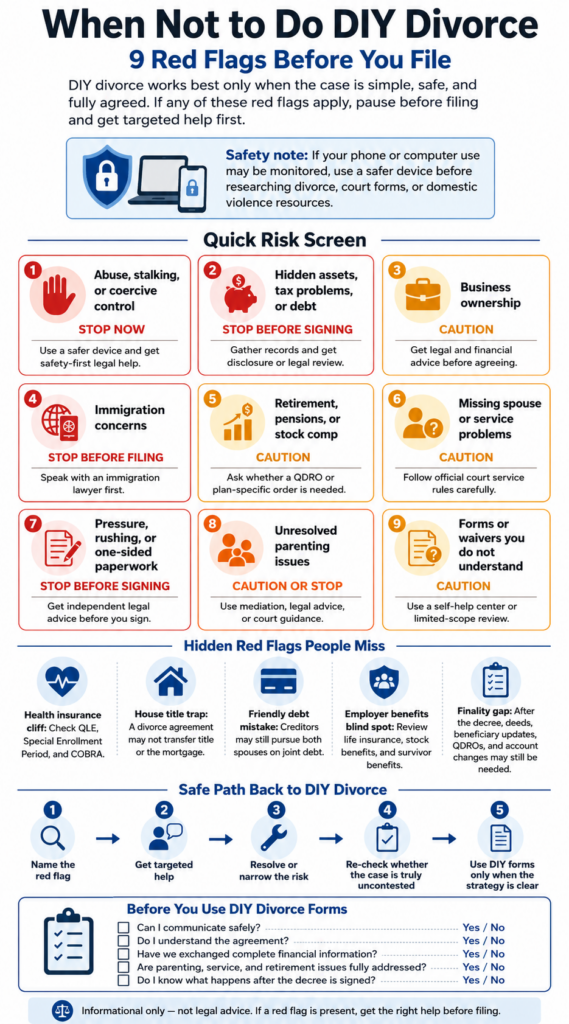
1. Quick Risk Screen: When Not to Do a DIY Divorce
Run this screen before you buy or file anything. If a row applies to your case, it does not always mean you need a lawyer for the whole divorce — but it does mean you should get targeted advice on that issue first.
| Red flag | Stop sign | Why DIY can go wrong | Safer next step |
|---|---|---|---|
| Domestic violence, stalking, or coercive control | Stop now | Negotiation, service, and shared parenting talks may be unsafe. | Use a safer device; contact a domestic violence advocate, legal aid, or a lawyer. Call emergency services if you are in danger. |
| Hidden assets, income, tax problems, or debt | Stop before signing | You may waive property, support, tax, or debt protections without knowing what exists. | Gather records; ask a lawyer about formal disclosure or review before you sign. |
| Business ownership or self-employment | Get advice | Value, income, tax treatment, and support interact in ways a form cannot analyze. | Talk to a family lawyer and, if needed, a valuation or tax professional under the law that governs your case. |
| Immigration status concerns | Stop before filing | Timing and evidence can matter for conditional residence, sponsorship, or a pending application. | Speak with an immigration lawyer before you file or sign. |
| Retirement, pensions, or stock compensation | Get advice | A decree may not divide an ERISA plan by itself; the plan sets the rules. | Ask the plan administrator what order it requires and get help drafting it. |
| Missing spouse or service problems | Get advice | Defective service can delay a case or expose a judgment to challenge. | Follow your court’s current service instructions or ask a self-help center or lawyer. |
| Pressure, rushing, or one-sided paperwork | Stop before signing | The agreement may not be voluntary or fully understood. | Get an independent review before signing anything. |
| Unresolved parenting issues | Get advice or pause | Vague terms often cause conflict, and some courts will not finalize an incomplete plan. | Use mediation, a self-help center, or a lawyer to finish the details. |
| Forms ask questions you do not understand | Get advice | A misunderstood waiver can affect property, support, debt, custody, or default rights. | Use limited-scope legal help or a courthouse self-help center. |
2. What Uncontested Actually Means: Agreed vs Default
People often assume a DIY divorce requires both spouses to talk, share documents, and sign together. That is one route, not the only one. An uncontested case generally moves forward on one of two tracks, and which track you are on changes what “simple” means.
- Agreed, consent, or joint route. Both spouses cooperate: they exchange information, sign a settlement, and often file together. This is the route most DIY kits are built around.
- Default or non-opposed route. You file, serve your spouse the way the court requires, and the response deadline passes with no answer. Many courts still treat this as uncontested. New York, for example, describes an uncontested divorce as one where the other spouse either signs the papers or does not answer, and California has both a “default” path and a “default with agreement” path (see California Courts’ guide to finishing a divorce when a spouse did not respond).
The red flags in this guide can apply to either route. A pressured “agreement” is not automatically a contested case in the legal sense, and a default is not automatically safe. The point is the same: if you are using self-help forms to make a risky or opaque case look tidy, that is when not to do DIY divorce without advice. Note too that an online provider’s own eligibility questionnaire is a sales screen, not your court’s definition of who can file.
3. Red Flag: Domestic Violence, Abuse, Stalking, or Coercive Control
This is the situation when not to do DIY divorce as an ordinary paperwork project. Self-help divorce assumes you can gather information, review documents, and make decisions without fear. That assumption breaks down when there is family violence, stalking, threats, financial control, technology monitoring, or coercive control.
Abuse is not only physical. It can include threats to hurt you, the children, pets, or relatives; monitoring your phone, location, email, or cloud storage; controlling money, documents, or transportation; using immigration, custody, or benefits as leverage; forcing you to sign papers; or using court filings to harass or locate you. That list is illustrative, not a legal definition — your state defines domestic violence and coercive control, and a local advocate or lawyer can tell you what protections you qualify for.
If your spouse controls the device you use, the email account that receives court notices, or the card used to buy forms, the divorce is not just a paperwork issue. It may be a safety issue.
Stop signs: you are afraid of your spouse’s reaction if you file; your spouse monitors your phone, location, or messages; your spouse tells you to sign without reading; or you may need a protective order, a confidential address, or a safe service method.
Lower-risk signs: you can communicate safely and privately, you control your own email and documents, you have time to review paperwork without threats, and no one is using custody, money, or housing as leverage.
Safe Alternative: Safety-First Help
Use a safer device if you think your internet activity may be monitored. Contact a local domestic violence organization, legal aid office, courthouse self-help center, or lawyer before filing, and use your court’s protection-order process if you need it. If you are in immediate danger, contact emergency services. For technology safety, review the National Domestic Violence Hotline’s internet safety guidance.
4. Red Flag: Hidden Assets, Income, Tax Problems, or Debt
Another situation when not to do DIY divorce is when the financial picture is incomplete. An agreed divorce depends on both spouses being honest about money. If one spouse controls the records, will not disclose income, or says “just trust me,” the case is not ready for self-help forms.
Financial red flags include missing bank or brokerage statements, withheld tax returns, money moving to relatives or crypto wallets, undisclosed cards or loans, IRS notices or audits, unpaid tax balances, and a spouse who fills out a financial form while leaving out income, accounts, debt, or property.
Financial Disclosure Is Sworn — and Local
Many courts require each spouse to file or exchange a financial disclosure or affidavit, and in many places you sign it under oath. But the exact form, the verification language, whether it is filed or only exchanged, and the consequences for hiding assets are all set by your state and county. Some states have you serve disclosures on your spouse and file only a proof of service; a few let you waive disclosure by written stipulation. A completed form is not a verified financial picture — a DIY kit does not investigate what the other spouse wrote. If you believe information is being withheld, use your court’s current packet and get legal advice before you sign.
The Joint Tax Return Trap
If you filed joint returns during the marriage, your divorce papers do not bind the IRS. IRS Publication 504 states that after a divorce you remain “jointly and individually responsible” for tax, interest, and penalties on a joint return, “even if your divorce decree states that your former spouse will be responsible.”
If one spouse may be on the hook for tax tied to the other spouse’s omitted income or errors, IRS Form 8857 requests relief from joint liability. Publication 504 describes three types — innocent spouse relief, separation of liability, and equitable relief — each with its own eligibility rules. That is a separate process from dividing property in the settlement.
Stop signs: one spouse controls all bank, tax, payroll, or investment logins; you do not know what accounts or debts exist; tax notices or audits exist; or the financial form looks vague or inconsistent with how the household actually lived.
Lower-risk signs: both spouses can access and review financial records; account lists, balances, debts, and tax issues are disclosed; support is based on real income records; and no one is rushing a financial waiver.
Safe Alternative: Disclosure Before Forms
Before signing, gather tax returns, pay stubs, account and loan statements, mortgage and retirement statements, insurance policies, business records, and credit reports. If key documents are missing, DIY is not the right first step. In more complex cases, lawyers can use formal tools — disclosures, subpoenas, interrogatories, document requests, or depositions — to get missing information. A DIY kit cannot. Use legal advice, limited-scope document review, or a financial review first, and see our guide to the marital settlement agreement checklist.
5. Red Flag: Business Ownership or Self-Employment
Business ownership is an underestimated reason when not to do DIY divorce. A small business can look simple from the outside — a landscaping company, an Etsy shop, a consulting practice, a salon chair, a rental LLC — but the divorce issues can be larger than “who keeps the business.”
A business can raise questions about value, separate versus marital or community property, how income is reported, business debt, buyouts, tax consequences, and how business income affects child or spousal support. In some states and some fact patterns, counting the same business income once to value the business and again to set support is a recognized dispute sometimes called double dipping. Whether that argument applies at all depends on your state’s law and the specific numbers — it is not a universal rule, and a basic form cannot analyze it.
Stop signs: the business supports the household; personal expenses run through business accounts; one spouse does not know the revenue, debt, or tax position; or a buyout, offset, valuation, or ownership transfer is involved.
Lower-risk signs: the business has minimal value and no support dispute; business and personal finances are cleanly separated; records are shared and understandable; and both spouses understand how it will be treated.
Safe Alternative: Valuation or Limited-Scope Review
If either spouse owns a business, speak with a family lawyer and, if needed, an accountant, valuation professional, or tax professional before signing. You may not need full litigation, but you need enough information to know what you are giving up under the law that governs your case.
6. Red Flag: Immigration Status or Sponsorship Concerns
Immigration concerns are a strong sign when not to do DIY divorce without outside advice. Divorce court and immigration agencies are separate systems. A judge can end the marriage, but that does not make the immigration side simple, automatic, or harmless — and divorce is not automatically fatal to a green card.
Divorce can affect conditional permanent residence and Form I-751, marriage-based green card applications, good-faith-marriage evidence, sponsorship obligations, naturalization timing, and abuse-based immigration remedies. USCIS explains that a couple files Form I-751 jointly during the 90-day window immediately before conditional residence expires, but a conditional resident whose marriage ended in a good-faith divorce or annulment can file individually with a waiver of the joint-filing requirement, and that waiver request can be filed at any time before status expires. Timing and evidence still matter, which is why the review should happen before you file for divorce.
Stop signs: a green card, visa, or sponsorship depends on the marriage; an I-751 deadline is approaching; a spouse threatens deportation or immigration consequences; or you need evidence that the marriage was entered in good faith.
Lower-risk signs: no immigration status depends on the marriage; timing has been reviewed; evidence has been preserved; and an immigration lawyer has checked the divorce timing if needed.
Safe Alternative: Immigration Review Before Filing
If either spouse has immigration concerns, speak with an immigration lawyer before filing or signing divorce papers — especially if conditional residence, Form I-751, sponsorship, a pending green card case, or abuse-based relief may be involved.
7. Red Flag: Retirement Accounts, Pensions, QDROs, or Stock Compensation
Retirement benefits are a common reason when not to do DIY divorce too quickly. A bank balance is easy to see. Retirement benefits are easy to underestimate, and they may be the largest asset in the marriage.
Take extra care if either spouse has a 401(k), 403(b), 457, IRA, Roth IRA, defined-benefit pension, government or military pension, teacher or union retirement, RRSP or LIRA, stock options, restricted stock units, an employee stock purchase plan, deferred compensation, or benefits that are not fully vested.
When a QDRO Applies — and When a Different Order Does
A Qualified Domestic Relations Order, or QDRO, applies to retirement plans covered by ERISA — generally private-employer plans. The U.S. Department of Labor is explicit that “only the retirement plan can confirm the alternate payee’s legal right” and “qualify” the order — “not the court or relevant state agency.” A few points people get wrong:
- A QDRO can be part of the divorce decree or a separate order — ERISA does not require a separate document.
- The plan administrator, not the judge, decides whether the order qualifies, against the plan’s own written procedures.
- Government, military (a USFSPA order), and church plans are typically not ERISA plans and use their own order formats.
- An IRA is not divided by a QDRO at all. It uses a “transfer incident to divorce” under Internal Revenue Code section 408(d)(6), handled trustee to trustee.
QDRO Taxes and Survivor Benefits
A properly drafted QDRO lets a payment go to a spouse or former spouse as the alternate payee without the 10% additional tax on early distributions that would otherwise apply (Internal Revenue Code section 72(t)(2)(C)); ordinary income tax still applies unless the share is rolled over. Survivor-benefit elections, the valuation date, and whether the alternate payee actually receives what the decree describes all depend on the order’s wording and the plan’s procedures. Getting the order reviewed by the plan before the decree is final — rather than assuming the decree alone divides the account — is what prevents rejected transfers and lost benefits.
Safe Alternative: Plan Administrator Review
Before finalizing the agreement, ask the plan administrator what documents it requires and request its model QDRO language. If the asset is large, get legal help before signing, and address in writing who prepares the order, who pays for it, when it is submitted, and what happens if the plan rejects it. See our guide to property division in an uncontested divorce.
8. Red Flag: Missing Spouse, Avoidance, or Service Problems
DIY divorce is easiest when both spouses cooperate. If your spouse is missing, avoiding service, living abroad, or refusing to respond, the process can turn technical.
“Service” means giving your spouse formal notice of the case in the way the court requires, and courts take it seriously because it protects due process. The exact steps — who may serve, what proof to file, whether a signed waiver or acceptance of service is allowed, the response deadline, and how to ask for alternative service or a default — are set by your state, and sometimes your county. California, for example, requires that someone other than you serve the papers after filing and that you file a proof of service (see California Courts’ guide to serving divorce papers), but that is an example, not a national rule.
Stop signs: you cannot locate your spouse; your spouse is dodging a process server; you want to serve by text, email, social media, or publication; your spouse lives outside the country; or you want a default but are unsure whether service was valid.
Lower-risk signs: your spouse will sign a waiver or accept proper service; your court clearly allows the method you plan to use; you understand the proof-of-service requirement; and you know the response deadline before seeking a default.
Safe Alternative: Service Rules First
Read your court’s current service instructions before filing, and match them to your route — joint filing, waiver or acceptance of service, agreed, or default. If you cannot find your spouse, ask a lawyer or self-help center about the exact diligent-search steps required before alternative service or publication is allowed. Related reading: how to serve divorce papers.
9. Red Flag: Pressure, Rushing, or Coercion
A divorce agreement should be voluntary. If one spouse is pushing the other to sign quickly, the case is not truly settled, even if it looks uncontested on paper. Pressure sounds like: “Sign today or I will take the kids,” “If you talk to a lawyer I will make this worse,” “You get nothing if you do not sign now,” or “I already paid for the forms, so sign.”
A case can also carry a hidden power imbalance: one spouse controls the bank login, the mortgage portal, the health-insurance account, the tax records, or the immigration documents. The question is not only whether both spouses say yes — it is whether both understand what they are saying yes to. That gap is one of the quieter signs when not to do DIY divorce.
Stop signs: you are afraid to ask questions; your spouse prepared everything and discourages review; you are told not to talk to a lawyer; you are being rushed; or you do not have the records to check the agreement.
Lower-risk signs: you can review documents without fear; you can get an independent review; no one is blocking outside advice; and you have time to understand the agreement.
Safe Alternative: Independent Review Before Signing
Do not sign divorce papers you do not understand, especially if the agreement was prepared by your spouse, your spouse’s lawyer, or a service your spouse chose. Use independent legal advice. How hard an unfair agreement is to undo later — and whether support or parenting terms can be changed — depends heavily on your state’s rules on finality, set-aside, disclosure, and fraud or duress, so the time to get it right is before the decree, not after.
10. Red Flag: Parenting Issues Are Not Fully Resolved
DIY divorce can work when both parents genuinely agree on a practical parenting plan. It is risky when the terms are vague, incomplete, or still disputed.
Parenting red flags include disagreement about where the children live, decision-making authority, school, medical care, religion, holidays, transportation, relocation, communication, child support, health insurance, daycare, or safety concerns such as substance use or untreated mental illness. “We will share time equally” sounds simple but does not answer school nights, exchanges, sick days, summer, holidays, missed visits, travel notice, or what happens when parents disagree.
What a court requires when children are involved varies by state and route. Many courts want a written parenting plan and a child-support calculation, and some require extra filings — for example, California’s FL-105 declaration asks for each child’s residence history and any related cases. Do not assume a generic plan will be accepted; check your court’s current instructions.
Stop signs: you agree “in theory” but not on the actual schedule; one parent wants to move; safety, substance use, or family-violence concerns exist; child support is being guessed rather than calculated; or health insurance, daycare, and medical costs are not addressed.
Lower-risk signs: the schedule is written and realistic; holidays, transportation, breaks, and communication are covered; the child-support worksheet is completed correctly for your state; and both parents understand the plan before filing.
Safe Alternative: Mediation or Parenting Plan Review
If you mostly agree but need help with details, mediation can turn a rough understanding into a specific schedule. If there are safety concerns, a power imbalance, or a relocation dispute, speak with a lawyer before agreeing to a plan. Related reading: parenting plan in an uncontested divorce and child support in an uncontested divorce.
11. Red Flag: You Do Not Understand the Forms or Waivers
One of the simplest signs when not to do DIY divorce is also one of the most important: the forms ask questions you cannot answer.
Divorce forms look simple until they ask about jurisdiction, service, support waivers, property characterization, retirement division, default procedure, tax claims, name changes, or appeal-period timing. If you are thinking “I do not know what this waiver means,” “I am not sure if I am giving up support,” or “I do not know whether we need a separate retirement order,” stop and get help.
Stop signs: you are guessing on legal terms; you are waiving rights just to finish; a court has already rejected your forms; you do not know what happens after filing; or you cannot tell which forms apply to your case and route.
Lower-risk signs: you understand each form before signing; you know which rights are being waived; you understand the next procedural steps; and you know whether extra orders, disclosures, or service forms are needed.
Safe Alternative: Form Review Before Filing
Pause before filing or signing. Use a courthouse self-help center, legal aid, a limited-scope review, or a local lawyer consultation. Many courts also require local forms on top of the statewide set, so read your specific court’s instructions. Related reading: why divorce paperwork gets rejected and the uncontested divorce process.
12. Red Flags People Miss
The obvious red flags are abuse, hidden money, and custody conflict. Some costly DIY mistakes come from issues people do not recognize as legal problems at all.
The Health Insurance Cliff
A spouse covered through the other spouse’s employer usually loses that coverage when the divorce is final. Two options may fill the gap, and they are alternatives to weigh, not guarantees:
- Marketplace coverage. HealthCare.gov says getting divorced or legally separated and losing coverage can open a Special Enrollment Period; a divorce that does not cause a loss of coverage does not.
- COBRA continuation. The U.S. Department of Labor explains that COBRA applies to group health plans of employers with 20 or more employees; divorce is a qualifying event; an eligible former spouse and children can get up to 36 months; and you generally have 60 days from the later of the loss of coverage or the election notice to elect. A qualified beneficiary must also notify the plan of the divorce, usually within 60 days. State “mini-COBRA” rules differ.
Before signing, confirm who provides coverage now, when it ends, whether the divorce causes a loss, and whether the agreement addresses premiums, children’s coverage, and uninsured expenses.
The House Title Trap
If the marital home is involved, the divorce agreement may not be enough by itself. Depending on where you live and who your lender is, you may also need a deed, a refinance, a lender-approved mortgage assumption, or a recording step. If one spouse keeps the house but both names stay on the mortgage, the spouse who moved out can still be on the hook for the loan.
The Friendly Debt Mistake
A divorce agreement can say one spouse will pay a joint card, car loan, or tax debt. But per the Consumer Financial Protection Bureau, that allocation “doesn’t change the fact that a creditor can still collect from anyone whose name appears as a borrower.” The decree binds the two spouses to each other; it does not rewrite the contract with the lender. Before signing, check whose name is on each debt and whether a refinance or account closure is needed.
The Finality Gap
The judge’s signature does not automatically complete every transfer. Depending on your assets, you may still need to update beneficiary designations, record a deed or refinance, transfer vehicle titles, close joint accounts, submit a retirement order, change employer benefits, and set up child-support payments. None of that is a single universal checklist — the steps depend on your lender, plan, insurer, and state. If your DIY plan does not list the after-the-decree tasks, the case can look done while the real-world transfer is unfinished.
13. When DIY Divorce Can Still Work
DIY divorce can be reasonable when the case is genuinely simple: both spouses want the divorce; you can proceed by agreement or by a clean default after valid service; no one is being pressured; both spouses understand the paperwork; property and debt are straightforward; financial information is shared honestly; there are no major unresolved parenting issues; no immigration or business complications exist; retirement division, if any, is simple and the plan’s process is confirmed; and you can follow your local filing and service rules.
For simple cases, review the uncontested divorce eligibility questions and the uncontested divorce process before using forms. If a red flag is present, clear that risk first, then come back to self-help.
14. The Safe Path Back to DIY Divorce
If a red flag applies, do not force the case into a DIY process. Work through these steps instead.
- Name the red flag. Safety, hidden money, parenting, immigration, retirement, service, business ownership, tax debt, health insurance, or confusing forms.
- Get targeted help. You may not need full representation. Depending on the issue, use a one-time lawyer consultation, a limited-scope or unbundled review, mediation, legal aid, a courthouse self-help center, a tax professional, a QDRO preparer, or an immigration lawyer.
- Resolve or narrow the risk. A lawyer reviews the settlement before you sign. A QDRO professional confirms the retirement language with the plan. An immigration lawyer checks the divorce timing. A mediator turns vague parenting terms into a schedule.
- Re-check whether the case is now uncontested. Confirm both spouses still agree (or a clean default is available), the agreement is written clearly, both spouses understand it, the required forms and route are known, and the after-the-decree steps are listed.
- Use forms when the strategy is clear. PlainDivorce is for uncontested paperwork. It is not a substitute for legal advice when the legal strategy is still unclear. When you are ready, the uncontested divorce kit walks through the filing.
15. Pre-DIY Legal Review Checklist
Answer these before using DIY divorce forms. Several “No” answers is a sign it is not yet time for self-help.
| Question | Yes | No |
|---|---|---|
| Can I communicate safely with my spouse, or is a clean default available? | ☐ | ☐ |
| Do I understand every major term in the agreement? | ☐ | ☐ |
| Have we exchanged complete financial information? | ☐ | ☐ |
| Are all bank accounts, debts, tax issues, and assets listed? | ☐ | ☐ |
| Is there any business, pension, 401(k), stock compensation, or deferred compensation? | ☐ | ☐ |
| Do we know whether a QDRO or a different plan order is needed, and have we asked the plan? | ☐ | ☐ |
| Are parenting time, holidays, transportation, and decision-making written clearly for our state? | ☐ | ☐ |
| Have we checked health insurance, COBRA, and Marketplace enrollment timing? | ☐ | ☐ |
| Are immigration issues absent, or already reviewed by an immigration lawyer? | ☐ | ☐ |
| Do we know how service must happen for our route? | ☐ | ☐ |
| Do we know what has to happen after the decree is signed? | ☐ | ☐ |
16. FAQ: When Not to Do a DIY Divorce
Do I need a divorce lawyer for an uncontested divorce?
Not always. Many uncontested divorces are completed without full representation. But if there are safety concerns, complex or hidden finances, immigration stakes, business ownership, major retirement assets, a spouse you cannot serve, or unresolved parenting issues, get legal advice on that issue before you file. Limited-scope help or a courthouse self-help center is often enough.
What are the signs DIY divorce is not right for my case?
The clearest signs DIY divorce is not right are abuse or coercion, hidden money or missing financial records, unresolved joint tax debt, business ownership, large retirement or pension benefits, immigration concerns, a missing or evasive spouse, unresolved parenting disputes, and forms that ask questions you cannot answer. Any one of these is a reason to pause and get targeted advice.
Can I use DIY divorce if my spouse and I agree on most things?
Maybe. “Mostly agree” is not the same as fully resolved. If the open items are minor and you can communicate safely, you may be able to settle them before filing. If an unresolved item involves children, support, property, debt, retirement, immigration, safety, or service, get help with that item first.
Can I start a DIY divorce and bring in a lawyer later?
Usually yes. Many people use limited-scope help partway through. The key is to get advice before you sign or file anything hard to undo — a settlement, a support waiver, or a retirement provision. Some mistakes are far easier to prevent than to fix after a decree.
What is a QDRO, and when do I need one?
A QDRO is a Qualified Domestic Relations Order used to divide a retirement plan covered by ERISA, generally a private-employer plan. It can be part of the decree or a separate order, and the plan administrator — not the judge — decides whether it qualifies. Government, military, and church plans use different orders, and an IRA is split by a transfer incident to divorce, not a QDRO.
What is IRS Form 8857?
Form 8857 requests relief from joint liability on a joint tax return — innocent spouse relief, separation of liability, or equitable relief, each with its own rules. It matters because a divorce decree does not bind the IRS: both former spouses stay jointly and individually responsible for tax, interest, and penalties on a joint return, whatever the decree says.
Does divorce let me change health insurance outside open enrollment?
It can, if you actually lose coverage. HealthCare.gov opens a Special Enrollment Period when a divorce or legal separation causes a loss of health coverage, but not for a status change alone. COBRA may also let an eligible former spouse continue an employer plan for up to 36 months if the plan is covered and you elect in time. Compare both before the divorce is final.
Can divorce affect my green card?
It can affect timing and evidence, but it is not automatically fatal. A conditional resident normally files Form I-751 jointly in the 90-day window before conditional residence expires; if the marriage ended in a good-faith divorce, the resident can file individually with a waiver, which can be submitted any time before status expires. Talk to an immigration lawyer before filing for divorce.
What if my spouse has a lawyer and I do not?
Your spouse’s lawyer does not represent you and is not looking out for your interests. Get your own advice before signing anything, especially where property, support, parenting, retirement, or immigration is involved. A single limited-scope consultation to review the proposed agreement is usually worth it.
PlainDivorce provides self-help divorce kits and general information, not legal advice, and is not a law firm or a substitute for a lawyer. Reading this guide does not create an attorney-client relationship. Court forms, fees, waiting periods, service rules, and disclosure requirements vary by state, province, territory, and county and change over time. For advice about your situation, consult a licensed family lawyer, and if there is any risk to your safety, contact a domestic violence advocate or emergency services first.
Sources and local rules can change. Use this guide as a plain-English organizer, then verify the current filing requirements with the official court or government source for your jurisdiction.

About Harry D
Expert contributor at PlainDivorce, helping Canadians and American navigate simple uncontested divorces with clarity and confidence.