One Year Separation Divorce in Canada: How the Rule Works and When You Can File
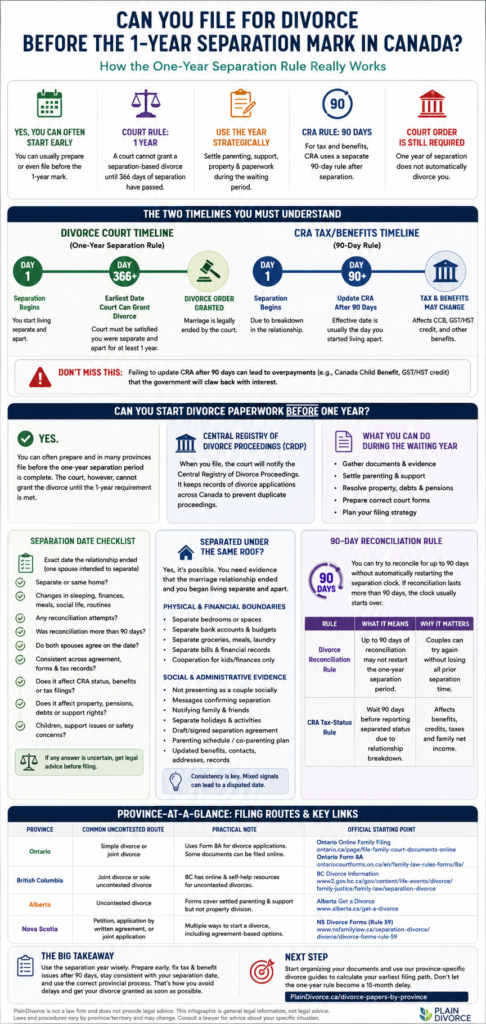
You can usually start preparing your divorce paperwork before you reach the one-year separation mark, but a Canadian court cannot grant a separation-based divorce until you and your spouse have lived separate and apart for at least one full year. The one year separation divorce Canada rule is a rule about when a judge can sign the order, not a rule that forces you to wait 12 months before doing anything. Used well, the separation year is time to confirm your separation date, settle parenting and support, gather documents, and get the right provincial forms ready.
This guide explains the Canada divorce separation rule under the federal Divorce Act, what “separate and apart” means, when you can and cannot file, how the court’s one-year clock differs from the Canada Revenue Agency’s 90-day clock, and how the separation date can affect money long after the divorce is done. Separation before divorce in Canada looks a little different in every province, so the filing sections point you to the process for your jurisdiction.
| Question | Plain-English answer |
|---|---|
| Do we need to be separated for one year? | If you are relying on separation as the basis for divorce, yes. The court needs at least one year of living separate and apart immediately before it decides the divorce. |
| Do we need to wait a year before doing anything? | No. Use the year to settle issues, gather documents, and prepare a complete filing package. |
| Can we file before the year is over? | Sometimes. The federal Act lets a proceeding start before the year ends, but several provinces require the year to be complete before you file. Check your province. |
| Does the CRA use the same one-year rule? | No. For tax and benefits, the CRA uses a separate 90-day rule for separation caused by a relationship breakdown. |
| Does one year of separation automatically divorce us? | No. You still need a court order, and it takes effect on the 31st day after the judge grants it. |
Do not lose 12 months. Check your eligibility and start organizing the right forms now, so you are ready the day the one-year clock runs out.
TL;DR
The one-year rule governs when a judge can grant the divorce — not when you can start working. Treating it as a 12-month freeze is how a one-year rule becomes a 15-month delay.
- One spouse can start the clock alone. Section 8(3)(a) says the intention of either spouse is enough — the other does not have to agree the marriage is over.
- Whether you can file early depends on your province, not the Divorce Act. The federal requirement is that the year exist when the court determines the divorce. Alberta lets you start the action during the year but not file for the divorce until it’s up; Nova Scotia’s joint and written-agreement routes can only be filed after the year.
- The residence year and the separation year are separate clocks. A province needs one year of habitual residence to hear the case — and it does not have to be the spouse who files. If you moved around the time you separated, settle jurisdiction before building the file.
- You can be separated while sharing a home. The test is never whether you shared a roof; it’s whether the relationship ended and at least one spouse intended to live separate and apart. Write down the date and what changed that week, while you remember it.
- There are two unrelated 90-day rules, and people mix them up. One lets you attempt reconciliation without breaking the separation period. The other is the CRA’s threshold for reporting separated status. They have nothing to do with each other.
- The reconciliation 90 days are cumulative, not per attempt. Three two-week reunions count together, and the purpose has to be reconciliation — not a shared lease or a sick child. Go over 90 days total and the clock generally restarts.
- Your CRA status moves long before your divorce does. After 90 days apart the CRA backdates separated status to the first day you lived apart. Not updating it can produce Canada Child Benefit or GST/HST credit overpayments the CRA later claws back.
- The separation date is a financial anchor, and provinces treat it differently. In Ontario it’s usually the valuation date for equalizing net family property. In British Columbia it identifies what counts as family property, but valuation happens at the agreement or hearing — so later growth is not automatically excluded.
- The divorce does not divide property. That’s provincial law, handled by a separation agreement or a separate claim. Alberta’s uncontested forms say so outright — they don’t touch property at all.
- Child support is the one federal bar. Under section 11, where there are children of the marriage the court must be satisfied reasonable support arrangements exist having regard to the guidelines — and must stay the divorce until they do.
- A year of separation does not end a marriage. It only lets a court grant a divorce. Do nothing and you stay legally married indefinitely.
- Nor does the judge’s signature. The divorce takes effect on the 31st day, earlier only with special circumstances and an undertaking not to appeal, later if appealed. For proof, request the Certificate of Divorce from the court that granted it — not the Central Registry, which the court reports to on its own within seven days of filing.
1. What the One-Year Separation Rule Actually Means
Canada has one federal ground for divorce: breakdown of the marriage. Under section 8 of the Divorce Act, you establish breakdown in one of three ways: the spouses have lived separate and apart for at least one year immediately before the court determines the divorce, or one spouse committed adultery, or one spouse treated the other with physical or mental cruelty. The one-year separation route is the no-fault option, and it is the one most self-help and uncontested divorces use.
For a separation-based divorce, the Act requires these facts:
- The marriage has broken down.
- The spouses have lived separate and apart for at least one year immediately before the court decides the divorce.
- The spouses were living separate and apart when the divorce proceeding began.
- At least one spouse intended to live separate and apart. Section 8(3)(a) says the intention of either spouse is enough, so one person can start the clock even if the other disagrees the marriage is over.
Because separation is no-fault, neither spouse has to prove or admit anything embarrassing. That makes the one year separation divorce Canada route well suited to a paperwork-based, uncontested divorce where both spouses accept that the marriage is over.
The real test is not “who moved out.” It is whether the spouses began living separate and apart and whether at least one of them intended the relationship to be over. Moving out is strong evidence of that, but it is not the only way to show it, and it is not always the trigger date.
One year of separation, on its own, does not end your marriage. It only lets the court grant a divorce. If you do nothing, you stay legally married indefinitely. And even after a judge signs the order, the divorce does not take effect immediately — see section 13.
2. Before You File: Are You Eligible for a Canadian Divorce?
The one-year clock is not the only threshold. Before a provincial court can hear your divorce at all, Justice Canada says you must meet three basic criteria:
- A legally recognized marriage. You are married under Canadian law, or under the law of another country in a way Canada recognizes.
- Marriage breakdown. Established by one year of separation, adultery, or cruelty, as in section 1.
- One year of residence. Under section 3 of the Divorce Act, a court in a province can hear your divorce only if you or your spouse has been habitually resident in that province for at least one year immediately before the proceeding starts. It does not have to be the spouse who files.
There is a narrow exception for couples who married in Canada but live in a country that will not divorce them because it does not recognize the marriage. In that case a special Civil Marriage Act route lets one spouse apply to the superior court of the province where they married, without meeting the one-year residence rule. Most people do not need it.
Why this matters for timing: the residence year and the separation year run on their own tracks. If you moved provinces around the time you separated, confirm which province has jurisdiction before you build your file, because that decides which forms and court you use.
3. Separation Date Audit Before You File
Before you write a separation date into any form, run this audit. The date can matter for far more than the divorce clock — especially where property, pensions, support, tax benefits, or parenting are involved.
- What exact date did the marriage relationship end?
- Did at least one spouse intend to live separate and apart on that date?
- Were you in separate homes, or separated under the same roof?
- What changed that day or that week in sleeping arrangements, finances, meals, social life, or household routines?
- Did either spouse try to reconcile later? If so, did the attempts add up to more than 90 days?
- Do both spouses agree on the separation date?
- Does your separation agreement, if you have one, use the same date?
- Will your court forms use the same date?
- Could the date change your CRA status, benefits, or credits?
- Could the date affect property division, pension valuation, debts, or support under your provincial law?
- Are there children, unresolved support, or safety concerns that need legal advice?
If any answer is uncertain, pause before filing. The one-year rule itself is simple, but a disputed or financially significant separation date can create problems that outlast the divorce.
Get legal advice before filing if you and your spouse disagree about the separation date, you lived together during part of the separation, you reconciled for a stretch, you have children without a clear parenting plan, support is unresolved, you own real estate or a business, there are pensions to divide, or anyone feels pressured to sign.
Need a filing path for your province? Start with your provincial guide: Ontario, British Columbia, Alberta, Nova Scotia, or Quebec.
4. Can You Start Divorce Paperwork Before One Year?
You can always prepare before the one-year mark. Whether you can formally file depends on your province. Section 8(2)(a) of the Divorce Act requires the year of separation to exist “immediately preceding the determination” of the divorce — that is, when the judge decides it, not when you file. So the federal Act does not, by itself, force you to wait a year to start a proceeding. Provincial court rules are where the real answer lives:
- Alberta says you may start the divorce action during the one-year period, but you must wait until the year has passed before you actually file for the divorce.
- Nova Scotia allows its joint application and application-by-written-agreement routes to be filed only after the one-year separation period has run.
- Other provinces and territories set their own timing. Some let a sole application be issued earlier; the divorce still cannot be granted until the year is complete.
What everyone can do during the year is the work that actually causes delay when it is skipped: nail down the separation date, order the marriage certificate, complete a parenting plan, exchange income and financial information, reach agreement on support and property, and identify the correct forms and court for your province. A couple who separates on March 1 and spends the year doing this is in a very different position than a couple who waits until the following March to start thinking about paperwork.
When a divorce application is filed, the court — not the spouses — must send a registration to the federal Central Registry of Divorce Proceedings within seven days. The Registry keeps a nationwide record of divorce applications and alerts courts if a second divorce involving the same two spouses is already on file. A small federal fee (for example, $10 in Ontario) is usually collected with your filing fee; Alberta folds it into its commencement fee. You do not file anything separately with the Registry.
Warning: do not assume every province uses the same forms, portal, or timing. Ontario, British Columbia, Alberta, Nova Scotia, Quebec, and every other jurisdiction has its own forms, filing method, affidavits, service rules, and fees.
Do not lose 12 months. Work out your earliest possible filing date with your provincial guide and start building your file now: separation date, marriage certificate, parenting terms, support information, financial disclosure, and the correct local forms.
5. Legal Separation vs. CRA Separation: The 90-Day Tax Rule
The court’s one-year rule and the Canada Revenue Agency’s tax rule are not the same, and they run on different clocks. For tax and benefit purposes, the CRA treats you as separated once you have been living apart from your spouse or common-law partner because of a relationship breakdown for at least 90 days. Once those 90 days have passed, the effective date is backdated to the first day you started living apart.
So while your divorce may still be many months away, your tax and benefit reporting can need attention early. Not updating the CRA after a separation can create overpayments of the Canada Child Benefit or the GST/HST credit, and the CRA can require repayment later. Your family net income for benefit calculations changes once you are separated for CRA purposes.
| Issue | Divorce court | CRA / tax status |
|---|---|---|
| Main question | Can the court grant a divorce? | How should marital status be reported for tax and benefits? |
| Key timeline | One year of living separate and apart for a no-fault, separation-based divorce. | At least 90 days of living apart because of a relationship breakdown before you report separated status. |
| Effective date | The court looks at the separation date and whether the one-year requirement is met. | After 90 days, the CRA treats the effective date as the first day you lived apart. |
| Why it matters | Divorce timing, forms, the Central Registry step, and the final order. | Benefits, credits, GST/HST credit, Canada Child Benefit, and family net income. |
Pro tip: do not put “separated” on a tax form casually, and do not assume a separation date chosen for a court form automatically controls your CRA status. The court timeline, the CRA timeline, and a separation agreement date can each matter in different ways. When benefits are significant, confirm the treatment with the CRA or a tax professional.
6. How the Separation Date Can Affect Property, Pensions, and Support
The separation date is not just a divorce countdown. Under provincial family-property law, it can be a financial anchor point. How it works varies by province:
- Ontario. The separation date is usually the “valuation date” for equalizing net family property. Property and debt are generally valued as of that date.
- British Columbia. Under the Family Law Act, what counts as family property is identified by reference to the date of separation, but family property and debt are generally valued as of the date you make an agreement dividing them or the date of the hearing — not the separation date. Later growth is not automatically excluded.
- Alberta. The uncontested-divorce forms deal only with settled parenting and support. They do not deal with property division at all; that is handled separately under Alberta’s family-property law.
The terminology and mechanics differ, but the practical point is the same: in most provinces, the separation date can affect money, and your provincial property and support law is what makes it relevant. Do not guess a date that looks harmless on a divorce form if it could later matter for the home, bank accounts, debts, a business, pension growth, or support.
The one-year separation rule only answers when a separation-based divorce can be granted. It does not decide how property is divided, whether support is owed, or how a pension is valued. Those are resolved by agreement or in a separate proceeding under provincial law.
One federal rule does bite here. Under section 11 of the Divorce Act, if there are children of the marriage, the court must be satisfied that reasonable child-support arrangements have been made, having regard to the child support guidelines, before it grants the divorce. If it is not satisfied, it must stay (pause) the divorce until the arrangements are fixed. In practice that means providing income information and explaining any departure from the guideline table amount.
- The home: who lives there, who pays which expenses, and how it is valued can become a major issue.
- Pensions: valuation and division often need specialized forms or a valuation and are rarely solved by a basic divorce form.
- Debts: credit cards, lines of credit, tax debt, and the mortgage need careful treatment.
- Support: child support is guideline-driven; spousal support depends on income, roles, and length of the marriage.
- Taxes: transfers, benefits, and support arrangements can have consequences beyond the divorce order.
Warning: a self-help divorce kit can help you prepare uncontested paperwork. It cannot tell you whether a proposed separation date or settlement gives up property, pension, or support rights. If the date affects money, get advice before you sign. Our guide to property division in an uncontested divorce covers this in more detail.
7. Can You Be Separated While Living in the Same House?
Yes. Justice Canada confirms that spouses can be separated while still living in the same home. It is a common arrangement, driven by housing costs, children’s routines, or the time it takes for one spouse to move out.
Separation under one roof is also where confusion is most likely. If both spouses agree on the separation date, the paperwork is usually straightforward. If one spouse later disputes the date, a court will look at the facts to decide whether the couple was truly living separate and apart. The question is never “did you share a roof” — it is whether the relationship ended and at least one spouse intended to live separate and apart.
The lists below are examples of the kind of evidence that can help, not a legal checklist. No single item is required, and courts weigh the whole picture. If a same-roof separation date could be disputed, get local legal advice about the factors your court considers.
Physical and Financial Signs
- Sleeping in separate bedrooms or separate areas of the home
- Separate bank accounts, budgets, or bill-paying arrangements
- Separate groceries, meals, and laundry
- Separate financial records and expense tracking
- Cooperation that is clearly for the children, finances, or housing logistics, not reconciliation
Social and Administrative Signs
- No longer presenting yourselves socially as a couple
- Messages or notes confirming the relationship was over
- Telling close family or friends that you had separated
- Separate holidays and social plans
- A draft or signed separation agreement
- Written co-parenting arrangements or a parenting schedule
- Updated beneficiaries, emergency contacts, mailing addresses, or benefit records
The point is consistency. If your divorce package says you separated on one date but your financial, social, and household records point to another, the date can be questioned.
Pro tip: if you are separating under one roof, write down the date the relationship ended and what changed that day. A short timeline written at the time prevents a lot of confusion when you prepare forms months later.
8. The 90-Day Reconciliation Rule: Trying Again
Canadian divorce law lets spouses try to reconcile without automatically destroying the separation period. Under section 8(3)(b) of the Divorce Act, the one-year clock is not interrupted if the spouses resume living together for a period, or periods that add up to, no more than 90 days, with reconciliation as the primary purpose. Those days can fall before or after you file. Justice Canada confirms this.
Two conditions matter. The 90 days are cumulative, not per attempt — three separate two-week reunions count together. And the purpose has to be reconciliation, not, for example, a shared lease or a sick child. If the reunions add up to more than 90 days, the separation period generally restarts from the later date.
This is the second “90-day” number people mix up. One is about reconciliation during the divorce separation period. The other is the CRA’s tax-reporting rule in section 5. They are unrelated.
| 90-day rule | What it means | Why it matters |
|---|---|---|
| Divorce reconciliation rule | Cohabitation for reconciliation totalling no more than 90 days does not interrupt the one-year separation period. | You can try again without automatically losing all your prior separation time. |
| CRA tax-status rule | You are “separated” for tax purposes after living apart because of a relationship breakdown for at least 90 days. | Your benefits, credits, and family net income are recalculated from the first day you lived apart. |
If you tried to reconcile, keep a record: when each attempt started and ended, whether you resumed living together, and whether both spouses agree on what happened. If the total is close to or over 90 days, or the facts are unclear, get legal advice before you rely on the original separation date.
9. Province at a Glance: Filing Routes and Local Rules
The one-year rule comes from federal law. The filing process is local: your forms, court office, filing method, service rules, and terminology depend on the province or territory where you file. This table is a starting map, not a substitute for your local court rules.
| Province | Common uncontested route | Practical note | Where to start |
|---|---|---|---|
| Ontario | Simple divorce or joint divorce | The application is Form 8A, titled “Application (Divorce),” version-dated April 1, 2024 (effective July 15, 2024). It is one document in a set; a simple or joint case also needs an affidavit and a draft order. Many family documents can be filed online where eligible. | Ontario’s file family court documents online page, and the Superior Court’s official family-law forms list |
| British Columbia | Joint divorce, or a sole undefended divorce | Available where the spouses agree on all family-law issues and need only a divorce order. Family property is identified at separation but valued at agreement or hearing. | The Province’s getting a divorce information page |
| Alberta | Uncontested (desk) divorce | You can start the action during the year but must wait until the year has passed to file for the divorce. The forms cover settled parenting and support only — they do not deal with property division. | The Government of Alberta “Get a divorce” guidance, and the Alberta Courts family forms |
| Nova Scotia | Petition, joint application, or application by written agreement | Joint and written-agreement routes require agreement on parenting, child support, spousal support, and property division, and may be filed only after the one-year period. A petition route stays open when a spouse will not sign. Forms must be filed on paper. | The Nova Scotia Courts family-law divorce pages |
The key takeaway: do not download a generic “Canadian divorce form.” Use the process for your province or territory. If you are in Ontario, start with an Ontario uncontested divorce kit. If you are in British Columbia, Alberta, or Nova Scotia, use a kit or court guide built for that jurisdiction. Not sure yet? How a desk divorce works in Canada walks through the paper route.
10. Myths vs. Reality About the One-Year Separation Rule
| Myth | Reality |
|---|---|
| We cannot do anything until the year is over. | You can settle terms, gather documents, and prepare the package throughout the year. In some provinces you can also commence the proceeding early. |
| Living in the same house means we are not separated. | Not necessarily. Spouses can be separated under one roof if the relationship ended and at least one spouse intended to live separate and apart. |
| A separation agreement is the same as a divorce. | No. An agreement can settle parenting, support, property, and debt. Only a court order ends the marriage. |
| The one-year rule settles money and parenting. | No. It only supports the ground for divorce. The one federal bar is that reasonable child-support arrangements must be in place; property is provincial and separate. |
| CRA separation and divorce separation are the same. | No. The CRA uses a 90-day tax-status rule. The divorce ground uses a one-year rule. |
| The divorce is final the day the judge signs it. | No. It normally takes effect on the 31st day after the judgment, with limited exceptions. |
If you are relying on the one-year separation rule, treat the separation date as a single fact that stays consistent across your court forms, your separation agreement, your tax records, and your financial discussions.
Working on settlement terms? Review our settlement agreement checklist before you finalize the divorce paperwork, and make sure the forms do not contradict the agreement.
11. Day 1 to the One-Year Mark: A Practical Timeline
Use the separation year to build a court-ready file before a judge or registrar can grant the divorce. Treat “one year” as a period, not a fixed calendar date — local procedure controls exactly when your file can move.
Day 1: Confirm the Separation Date
Write down when the relationship ended, who intended to separate, whether one spouse moved out, and what changed if you stayed under one roof. If both spouses agree on the date, use it consistently everywhere.
First 30 Days: Secure Documents
Start gathering your marriage certificate, the children’s details, income documents, any existing court orders, property records, debt statements, benefit information, and any written separation terms.
After 90 Days: Review CRA Status
Once you have been separated for at least 90 days because of a relationship breakdown, check whether your CRA marital status, benefits, or credits need updating. Do not wait for the divorce order to think about tax status.
Months 3 to 9: Settle Parenting, Support, and Property
Work through parenting time, decision-making, child support and special expenses, spousal support, the home, debts, pensions, and tax issues. If you need a separation agreement, finish it before your divorce package depends on those terms. Our guide to an uncontested divorce with children covers the parenting and support side.
Months 9 to 12: Build the Divorce Package
Choose the filing route for your province: simple divorce, joint divorce, desk divorce, or another uncontested process. Confirm whether service is required, whether online filing is available, and whether extra affidavits or a draft order are needed. If a spouse must be served, our guide to serving divorce papers explains the options.
After the One-Year Mark: Move Toward the Order
Once the one-year separation period is complete and your file is in order, the court can grant the divorce if the legal requirements are met and nothing is outstanding — in particular, reasonable child-support arrangements where there are children. Couples who prepared early are less likely to hit a missing certificate, an inconsistent date, or the wrong local form at this stage.
Time-saver: do not wait until the year is up to discover you are missing a marriage certificate, support information, or the correct court form. A PlainDivorce uncontested divorce kit helps you assemble the paperwork so you are ready when the separation clock runs out. For a realistic sense of the full timeline, see how long an uncontested divorce takes.
12. When the One-Year Route Fits a Self-Help Uncontested Divorce
The one-year separation route often fits an uncontested divorce where both spouses accept the marriage is over and no one is asking the court to decide a fight. Depending on the province, it may run as a simple divorce, a joint divorce, a desk divorce, or another uncontested process.
An agreement-based, self-help filing tends to be suitable when:
- Both spouses agree on the separation date.
- The one-year period has passed, or will pass before the court decides the divorce.
- Parenting arrangements are clear.
- Child support is set in line with the guidelines, with income information available.
- Spousal support is resolved, or waived with a clear understanding of what that means.
- Property, debts, pensions, and the home are settled separately, or do not need to be dealt with in the divorce itself.
- No one is being pressured, threatened, or misled.
- The correct local forms and filing rules are being used.
Note that “uncontested” does not always mean both spouses sign. If one spouse is served and simply does not respond, most provinces let the other proceed under their default or undefended rules — Nova Scotia, for example, keeps a petition route for exactly that situation. A self-help kit is built for the agreement-based version, where both spouses cooperate.
PlainDivorce’s self-help kits are for people who want help preparing the correct divorce paperwork for their jurisdiction. They are not a substitute for legal advice, but they can be a practical next step when the case is suitable for self-help filing.
Ready before the one-year mark? Check your eligibility and start preparing with a province-specific kit. The goal is simple: be organized before the court is ready to grant the order.
13. When Your Divorce Is Final: The 31-Day Rule and the Certificate
A divorce judgment does not end your marriage the moment the judge signs it. Under section 12 of the Divorce Act:
- Section 12(1): the divorce takes effect on the 31st day after the day the judgment is rendered. You are free to remarry only after that date.
- Section 12(2): a court can set an earlier effective date, but only where there are special circumstances and both spouses agree and undertake that no appeal will be taken (or any appeal has been abandoned).
- Section 12(3): if the judgment is appealed, the divorce does not take effect on day 31 — it waits until the appeal period and any appeal are resolved.
After the divorce takes effect, you can ask the court that granted it for a Certificate of Divorce. A signed order is not always accepted as proof the divorce is final; a marriage-licence issuer, or an immigration, pension, or financial institution, will often want the certificate, which confirms the effective date. You request it from the court, not from the Central Registry.
14. FAQ: The One-Year Separation Rule in Canada
Can I file for divorce before one year of separation in Canada?
Sometimes. The Divorce Act requires the one-year separation to exist when the court decides the divorce, not when you file, so a proceeding can often be commenced earlier. But provincial rules vary: Alberta lets you start the action during the year but not file for the divorce until the year is up, and Nova Scotia’s joint and written-agreement routes can be filed only after the year. You can always prepare during the year.
Do you have to be separated for one year before divorce in Canada?
If you are relying on separation as the ground, yes. The court cannot grant the divorce until you have lived separate and apart for at least one year immediately before it decides the case. The other grounds — adultery and cruelty — do not have a waiting period, but they must be proven and are rarely used in uncontested divorces.
Can we be separated and still live in the same house?
Yes. Justice Canada confirms spouses can be separated while sharing a home. The question is whether the relationship has ended and at least one spouse intended to live separate and apart. If the separation date could be disputed, keep a dated record of what changed and get local legal advice about the factors your court considers.
Does the one-year separation period start when one spouse moves out?
Often, but not always. Moving out is strong evidence, but the clock generally starts when the spouses begin living separate and apart and at least one of them intends the relationship to be over. A couple separated under one roof can have a start date that is not tied to anyone moving.
Do we need a separation agreement before we can divorce?
Not always. A separation agreement is not the same as a divorce and is not legally required to get one. It is very useful when you need to settle parenting, support, property, debts, or pensions, and where there are children the court must still be satisfied that reasonable child-support arrangements are in place before it grants the divorce.
What happens if we try to reconcile?
You can live together again for reconciliation for periods totalling up to 90 days without interrupting the one-year separation period, as long as reconciliation is the primary purpose. The 90 days are cumulative across all attempts. If the total is more than 90 days, or the facts are unclear, the clock generally restarts and you should get advice before relying on the original date.
Is the CRA 90-day rule the same as the divorce one-year rule?
No. The CRA’s 90-day rule sets when you report “separated” marital status for tax and benefit purposes; once 90 days pass, the effective date is the first day you lived apart. The divorce one-year rule sets when a court can grant a divorce based on separation. A separation date chosen for a court form does not automatically control your CRA status.
When is my divorce actually final?
Normally on the 31st day after the judge grants it. A court can set an earlier date only in special circumstances where both spouses agree not to appeal, and an appeal pushes the effective date back. After it takes effect, request a Certificate of Divorce from the court that granted it if you need proof, for example to remarry.
Do we have to divide property before the divorce?
No. Property and debt division is a separate process under provincial law, usually handled by a separation agreement or a provincial court claim. It is not automatically part of the divorce judgment. The one federal requirement is that reasonable child-support arrangements are in place where there are children of the marriage.
Is the one-year rule the same in every province?
The one-year ground is federal and identical across Canada. What varies is the procedure: forms, fees, filing method, court office, service rules, and whether you can commence the proceeding before the year is complete. Always follow the process for the province or territory where you file.
15. Conclusion: Use the Separation Year Strategically
The one year separation divorce Canada rule means a court can grant a separation-based divorce once the spouses have lived separate and apart for at least one year. It does not mean the divorce happens automatically, and it does not mean you must sit still for 12 months before preparing — or, in some provinces, before starting — the paperwork.
The questions that actually decide how smoothly your divorce goes are practical: are you eligible (legal marriage, one-year provincial residence), when did separation start, can you prove it if challenged, did either spouse try to reconcile, do both spouses agree on the date, have tax and benefit issues been handled, are child support and parenting sorted, and which provincial process applies.
If your divorce is uncontested and your separation date is undisputed, a PlainDivorce kit can help you prepare the right paperwork for your jurisdiction. If there are disputes, safety concerns, unclear support rights, significant assets, pensions, or pressure to sign, get legal advice before moving forward.
Do not let a one-year rule turn into a 15-month delay. Check your eligibility and start organizing your uncontested divorce paperwork now, so you are ready the day the separation clock runs out.
Sources and local rules can change. Use this guide as a plain-English organizer, then verify the current filing requirements with the official court or government source for your jurisdiction.

About Harry D
Expert contributor at PlainDivorce, helping Canadians and American navigate simple uncontested divorces with clarity and confidence.