How to Choose an Online Divorce Service: A 2026 Buyer’s Guide
To choose an online divorce service, match four things to your case: the scope of work it actually performs, whether it screens your eligibility honestly, how accurate it is for your state or province, and how clearly it explains what it does not do. Price comes after those four, not before. Everything below turns that into concrete questions you can ask before you pay.
Some services prepare divorce forms only. Some add written filing instructions. Some offer filing or e-filing help in a limited number of courts. Many advertise “online divorce” but still leave you to print, sign, notarize, serve, file, correct, and follow up with the court yourself. That is why an online divorce service comparison has to go past the headline price. The best online divorce service criteria are scope, eligibility screening, jurisdiction-specific accuracy, transparency about limits, data security, and realistic support.
When you use an online divorce service, you are almost always still a self-represented, or pro se, litigant. You remain responsible for making sure the paperwork fits your court, your facts, your deadlines, and your filing method. A document-preparation service can reduce confusion, but it does not make legal decisions for you and it is not your lawyer.
In Canada? Start with a province-specific guide, such as the Ontario uncontested divorce guide or the desk divorce in Canada overview. This article focuses mainly on U.S. services.
TL;DR
Judge a service on four things before price: what work it actually performs, whether it screens your eligibility honestly, how accurate it is for your court, and how plainly it states what it does not do. A provider that admits “we don’t prepare that order” is more trustworthy than one that never raises the issue.
- You are still self-represented. Buying a form packet does not change your status — the court holds you to the same rules, deadlines, and filing requirements as anyone filing alone.
- “Uncontested” has two routes, and many services only support one. The agreed route needs both signatures; the default route needs valid service and a spouse who doesn’t respond. A provider may limit itself to the agreed route — the problem is when it presents that limit as the legal definition.
- “Works in all 50 states” does not mean the process is the same everywhere. Forms, filing method, residency, waiting periods, service rules, parenting classes, and default procedures are all local.
- Ask the scope question directly: forms only, forms plus written instructions, or forms plus actual filing — and if filing is offered, whether it applies in your county.
- Court filing fees are almost always separate from the advertised price, along with service, notary, certified copies, parenting classes, and local add-ons.
- A fee waiver is not a cost. It is a request to the court to skip its own fees — don’t let a provider bill it as though it were a court charge.
- Decode the two phrases that do the most work. “Attorney-approved” usually means a lawyer reviewed a template, not your facts. “Court-approved forms” means the templates came from court forms, not that your packet has been approved.
- A settlement clause does not decide who claims the child on taxes. For post-2008 decrees the custodial parent must sign an unconditional Form 8332, and that moves only the dependency claim and child tax credit — head-of-household, EITC, and the child-and-dependent-care credit stay put.
- Nor does it release you from a joint debt. The CFPB is blunt: a decree can allocate a debt, but the creditor can still collect from anyone named as a borrower. Only a refinance, an approved assumption, or a written release changes that, and a quitclaim deed leaves the mortgage untouched.
- Retirement is the most common blind spot. “We split it 50/50” is not an order. A private plan generally needs a QDRO — which the plan administrator qualifies, and which can sit inside the decree rather than being a separate document. Government and church plans, military retired pay (USFSPA), and IRAs (transfer incident to divorce) each use something else entirely.
- Correct forms still stall on service. Filing is not serving. Ask whether the service explains who may serve, what proof your court wants, and what happens if you can’t locate your spouse.
- The questionnaire holds your entire financial and family profile. Before typing any of it, get specifics on retention, deletion, sale or sharing, internal access, and encryption — “secure platform” is not an answer, and no single badge is a guarantee.
- The cheapest service is not the lowest-cost service. The lowest-cost one is whichever prevents the expensive mistake — and for a pension, a business, crypto, real conflict, or pressure to sign, that is one limited-scope consultation, not a form site.
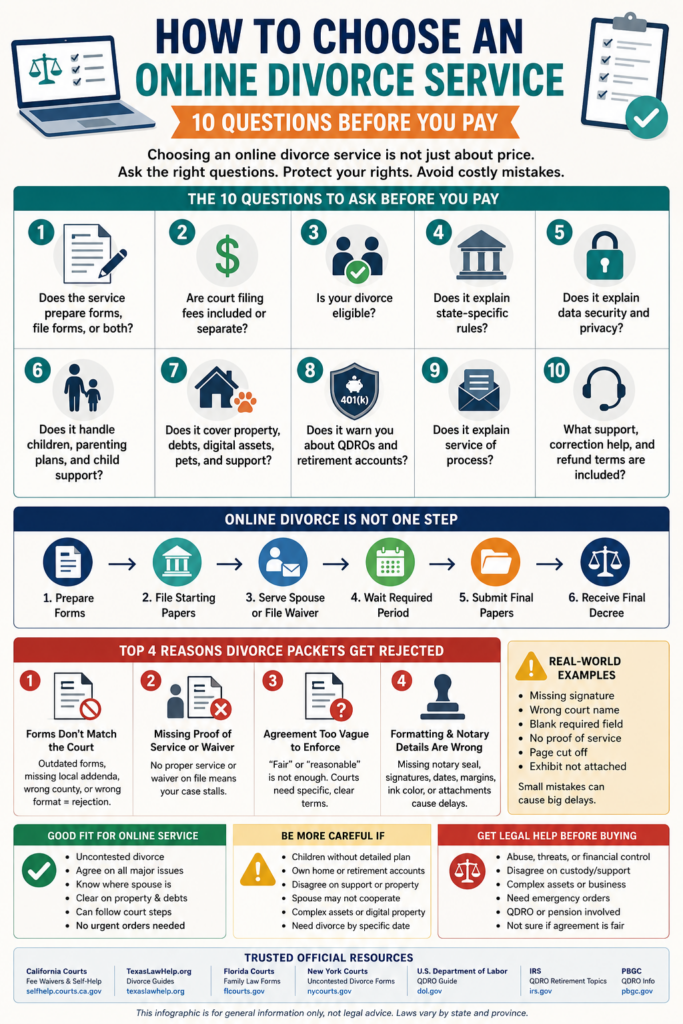
1. What an Online Divorce Service Actually Does
An online divorce service is a paperwork product. You answer a questionnaire, and the service generates completed divorce forms, usually with instructions. Some services stop there. Others add a filing step, a review step, or lawyer access as paid add-ons.
What it is not: it is not the court, and buying a form packet is not the same as your case being accepted, served, or granted. It is also not legal representation. Unless you separately hire a lawyer, you stay self-represented, and the court holds you to the same rules and deadlines as anyone filing on their own.
So the first job in learning how to choose online divorce service options is to figure out exactly which slice of the process each provider covers, and which slice stays with you.
2. When Not to Use an Online Divorce Service
An online divorce service works best for straightforward cases where both spouses cooperate. It is the wrong tool for higher-risk divorces. Pause and get legal advice before buying anything if any of these apply:
- You feel pressured, threatened, controlled, or unsafe. The National Domestic Violence Hotline is a confidential resource for safety planning.
- Your spouse will not cooperate, or you cannot locate your spouse.
- You disagree about custody, parenting time, support, property, or debts.
- You need emergency or protective court orders.
- One spouse has a lawyer and the other does not.
- You own a business, rental property, cryptocurrency, significant investments, or property in more than one state or country.
- A pension, 401(k), 403(b), government or military retirement, or other retirement asset has to be divided.
- You are not sure the agreement is fair, or you are being asked to sign a settlement you do not fully understand.
- You need advice on immigration, bankruptcy, taxes, or domestic violence connected to the divorce.
This is triage, not scare language. In these situations the wrong online divorce service can cost more than a single limited-scope consultation would have, because fixing a signed agreement or a defective filing is harder than getting it right the first time. If you are not sure your case is still uncontested, read what an uncontested divorce is before buying any paperwork service.
3. What Uncontested Really Means and Whether Your Case Qualifies
Many services describe every uncontested divorce as one where “both spouses agree on everything and both sign.” That is only one route. An uncontested divorce is either:
- The agreed route: you and your spouse settle every issue and both sign a joint filing or a settlement agreement.
- The default route: you file, serve your spouse correctly, and your spouse does not respond by the deadline, so the court can finish the case without their signature.
California lets a petitioner finish by default when a properly served spouse does not answer, and New York expressly counts a default as an uncontested divorce. A default case is still exacting: the paperwork and timing have to be precise, and it usually takes longer.
A provider is allowed to limit its own product to the agreed route. The problem is when it hides that limit, or implies its rules are the legal definition. Separate two questions in any online divorce service comparison: does your court allow an uncontested divorce for your facts, and does this specific service support that path? Ask directly:
- Is this service for the agreed route only, or does it also support default?
- Can I use it if my spouse will not sign?
- Can I use it if I do not know where my spouse lives?
- Can I use it with children, a home, or a support request?
- Does it tell me plainly when I should not use it?
Deep dive: work through the 12 eligibility questions to ask before you file before buying any form-preparation service.
4. State-Specific Rules an Online Divorce Service Cannot Ignore
Divorce is jurisdictional. Local rules control the forms, the filing method, residency requirements, waiting periods, service rules, parenting classes, fee waivers, default procedures, and final-judgment requirements. A service that treats “works in all 50 states” as “same process everywhere” creates false confidence. A few examples:
- California: a dissolution cannot be final until at least six months after the respondent is served or first appears, whichever comes first, and the court can extend that. People who cannot afford court fees can ask the court for a waiver. See Family Code section 2339 and California Courts fee-waiver guidance.
- Texas: a court generally cannot grant a divorce before the 60th day after the case is filed. The exceptions are narrow: a final conviction or deferred adjudication for family violence against the petitioner or a household member, or an active protective order against the respondent based on family violence, under Family Code section 6.702.
- Florida: the official family law forms use different dissolution petitions depending on whether the case is a simplified dissolution, has dependent or minor children, or involves property without children.
- New York: an uncontested divorce is a defined packet with route-specific service and final-processing steps, including separate consent and default paths, described in the New York Courts uncontested divorce resources.
- Companion animals: in a few states, including California, New York, and Illinois, courts can make pet-specific orders rather than treating an animal like furniture. See California Family Code section 2605. Most states have no such rule.
When you compare services, look for state-specific or province-specific support, not just a national marketing page. A strong provider explains where its forms apply, where filing help exists, and which court steps remain yours. If timing matters, read the guide to divorce waiting periods by state.
5. Does It Prepare Forms, File Them, or Both?
This is the first buying question because it is where expectations most often break. In any online divorce service comparison, “forms only” and “forms plus filing help” are different products. A service usually does one of three things:
- Prepares divorce forms only.
- Prepares forms and gives written filing instructions.
- Prepares forms and offers filing or e-filing help in some courts.
Before you buy, get direct answers. This is the practical version of how to choose online divorce service options without relying on marketing claims:
- Will the service prepare my divorce forms?
- Will it file the forms with the court, and is filing included or an add-on?
- If filing is not included, will I get step-by-step instructions for my court?
- Will I still need to print, sign, notarize, upload, mail, scan, or serve anything?
- Does any filing help actually apply in my county, state, or court?
A phrase like “start your divorce online” does not tell you whether you are buying a completed form packet, a filing service, or only a guided questionnaire. To understand where online forms end and true court e-filing begins, read the guide to the uncontested divorce process.
6. Are Court Filing Fees Included or Separate?
Court filing fees are almost always separate from the online divorce service price unless the provider clearly says otherwise. The advertised price usually covers document preparation only. Depending on your court and your case, you may also pay for:
- The court filing fee, and any e-filing or convenience fee
- Sheriff, constable, or private process-server fees
- Notary fees and certified copies
- Mailing, printing, or a required parenting class
- Motion fees or local court add-ons
- Any document-preparation surcharge the provider itself charges for extra paperwork
A court fee waiver is not a cost. It is a request to the court to skip its fees if you cannot afford them (California uses form FW-001, for example), so do not let a provider bill it as though it were a court charge.
If a provider advertises a “$199 divorce” but does not disclose filing fees, service fees, or add-ons until later, compare the real total, not the headline. For typical amounts, see the guide to divorce filing fees by state and province.
Pricing Transparency Example
| Cost item | Low-transparency pattern | Transparent-service standard |
|---|---|---|
| Base price | Advertises a low number only | Shows exactly what is included |
| Court filing fee | Not mentioned until after purchase | States clearly that it is separate |
| Children | Extra charge revealed mid-questionnaire | Discloses child-related coverage up front |
| Property agreement | Treated as a premium upsell | Explains whether it is included |
| Filing help | Implied but not actually included | States whether filing is available and where |
| Corrections after a court notice | Unclear or time-limited | Explains the correction policy |
| Subscription | Auto-renewal buried in the terms | States one-time versus recurring cost |
The cheapest service is not always the lowest-cost service. The lowest-cost service is the one that prevents an expensive mistake.
7. Does It Explain Data Security and Privacy?
A divorce questionnaire collects more sensitive information than a normal checkout page: names, addresses, children’s details, employment, income, debts, property, tax details, and bank information. Before you enter any of that, get concrete answers rather than a reassuring label.
- Collection: what information does the service actually require, and what is optional?
- Retention and deletion: how long is your data kept, and can you delete your account and documents on request?
- Sharing and sale: does it sell or share personal information with marketing partners or data brokers?
- Access controls: who inside the company can see your file, and are third-party processors used for payments or storage?
- Encryption: is your data encrypted in transit and at rest?
- Incident response: does the service say how it would notify you after a breach?
Certifications such as SOC 2 can be a useful signal, but they are not a legal requirement and no single badge guarantees safety. The Federal Trade Commission’s Protecting Personal Information guidance describes a risk-based approach: know what you collect, keep only what you need, protect it, and have a response plan. Judge a service against those questions, and keep an eye on your own exposure through IdentityTheft.gov. Privacy belongs in your online divorce service comparison, not in a footnote.
8. Does It Handle Children, Parenting Plans, and Child Support?
If you and your spouse have children together, your divorce packet needs more than a basic petition. Two different standards apply, and a good service keeps them separate:
- Custody and parenting time are judged by the child’s best interests. The court needs a specific schedule, not “reasonable visitation.”
- Child support is usually set by a state guideline calculation. Even in an agreed case, a court reviews the number, and a below-guideline or zero-support deal generally needs findings before a judge will approve it.
Depending on your jurisdiction, the paperwork may also need to address decision-making, the weekly and holiday schedule, transportation and exchanges, health insurance, uninsured medical costs, childcare, relocation rules, a required parenting class, and a parenting-plan attachment.
One federal detail services often skip: who claims the child on taxes. For decrees after 2008, a settlement clause alone generally does not move the child dependency claim. The custodial parent must sign IRS Form 8332 or a similar unconditional release, and that release moves only the dependency claim and the child tax credit. Head-of-household status, the earned income credit, and the child-and-dependent-care credit stay with the custodial parent, and the release cannot be conditioned on paying support.
Ask whether the service includes real parenting-plan content, asks detailed schedule questions, explains guideline child support, warns that parents cannot simply agree to “no child support,” and tells you when to get legal help. A useful online divorce service does not flatten parenting, support, and insurance into one checkbox. For structure, use the parenting plan guide and the guide to child support and court approval.
9. Property, Debts, Digital Assets, and Pets
A divorce needs clear terms for property, debts, and support. A vague agreement creates problems long after the case is final. Your paperwork may need to address bank accounts, vehicles, real estate, mortgages and refinancing, credit cards, personal and student loans, retirement accounts and pensions, business interests, personal property, spousal support, life insurance, and tax issues.
Digital assets are easy to miss because older questionnaires focus on cars and furniture. Cryptocurrency and wallets, online stores, monetized social accounts, business domains, shared cloud storage, subscription accounts, password managers, photo libraries, and loyalty points can all carry financial or practical value.
One rule people get wrong about debt: allocating a joint debt in your settlement, or moving a house by deed, does not release the other spouse from the lender’s contract. As the Consumer Financial Protection Bureau puts it, a decree “may allocate debts to a specific spouse, but it doesn’t change the fact that a creditor can still collect from anyone whose name appears as a borrower.” Removing a borrower takes a refinance, a lender-approved assumption, or a written release. A quitclaim deed moves title but leaves the mortgage in place.
Pets are a newer blind spot. In a handful of states a court can make pet-specific orders; in most it cannot. Either way, an agreement can state who keeps the animal, who pays vet bills, and whether shared care is realistic.
Ask whether the service includes a marital settlement or separation agreement, divides property and debts with specific terms, covers real estate and refinancing deadlines, addresses digital assets and pets, supports spousal-support terms, and flags when a separate deed, refinance document, retirement order, or professional review is needed. If you have a house, retirement accounts, business assets, crypto, major debt, or a likely dispute, slow down before paying. Work through the marital settlement agreement checklist and the guide to property division in an uncontested divorce.
10. Retirement Accounts, QDROs, and Plan-Specific Orders
This is a common failure point. If retirement benefits have to be divided, your divorce decree by itself is often not enough. What you need depends on the type of plan:
- Private employer plans (most 401(k), 403(b), and private pensions) are governed by ERISA and generally need a Qualified Domestic Relations Order (QDRO). It does not have to be a separate document. The U.S. Department of Labor states that a QDRO “may be included as part of a divorce decree or court-approved property settlement, or issued as a separate order,” and the plan administrator, not the judge, decides whether the order qualifies. See the DOL QDRO guide.
- Government and church plans are usually not ERISA plans and use their own court-order formats and rules.
- Military retired pay is divided under the Uniformed Services Former Spouses’ Protection Act with a qualifying order, not a QDRO. See the Defense Finance and Accounting Service.
- IRAs are split as a “transfer incident to divorce” under the decree or separation instrument, with a direct trustee-to-trustee transfer. No QDRO is used. See the IRS IRA FAQs.
An online divorce service may let you write “we split the retirement account 50/50” without preparing the order the plan actually needs. Ask whether it identifies the plan type, explains which order applies, prepares that order or clearly says it does not, and tells you to get the plan administrator’s current written procedures before you sign anything.
Hard stop: if a pension, 401(k), 403(b), or government or military retirement is involved, talk to a lawyer or a QDRO specialist before finalizing. A provider that admits “we do not prepare these orders” is more trustworthy than one that ignores the issue.
11. Does It Explain Service of Process?
Filing forms is not the same as serving the case. In most divorces, the filing spouse has to show that the other spouse received legal notice or gave up formal service. This is service of process, and the proof can be an affidavit or affirmation of service, an acceptance or waiver of service, a sheriff or constable return, or a process-server document.
Which of these steps apply, and in what order, is set by your court’s rules and forms. A rough sequence many people miss:
- You prepare the divorce papers.
- You file the starting papers with the court.
- Your spouse receives legal notice, unless your court allows a waiver or a joint filing.
- Proof of service, a waiver, or an acceptance is filed.
- Response, default, or waiting-period deadlines run.
- Final uncontested papers go in once the required steps are complete.
Ask whether the service explains how to serve divorce papers, includes a waiver or acceptance form where allowed, explains who can serve papers and what proof your court requires, and warns you if you do not know where your spouse lives or if your spouse refuses to sign. People often prepare and file correct forms, then stall because service was never done right.
12. Support, Corrections, and Refund Terms
Support is often the difference between finishing the process and getting stuck after a court notice. But “support” means different things: technical help only, document-preparation questions, general legal information, paid access to an independent lawyer, or almost nothing after checkout. Before buying, check:
- Is support included, and by what channel and hours?
- Is it available after the forms are generated, and can it help with a court rejection notice?
- Is it limited to technical questions, and does the service state clearly that it does not give legal advice?
- Is lawyer review included, optional, or unavailable?
- What is the refund window, and are refunds available once forms are prepared?
- Are court filing fees and add-ons refundable, and what proof does a refund request need?
- Does any guarantee cover only document-preparation errors?
“Attorney-approved” usually means a lawyer reviewed a template at some point. It does not mean a lawyer is reviewing your facts, your packet, or your settlement terms. A self-help service can explain its process and answer document-preparation questions; it should not act like your lawyer unless you are actually hiring one through a clearly disclosed legal service.
13. Why Online Divorce Packets Get Bounced
A clerk is not your lawyer and usually cannot fix your strategy or rewrite your agreement. But a court or clerk’s office can decline a filing, return it for correction, or a judge can decline to grant the divorce at the final stage. The words and rules differ by court, so read the actual notice you receive. These are categories to check, not a ranked national list.
Forms That Do Not Match the Court
Some courts decline paperwork that is outdated, missing a required local cover sheet or addendum, or formatted for the wrong county. This is a bigger risk when a national provider uses generic language for a local procedure.
Missing Proof of Service or Waiver
People assume the case is moving because the petition was filed. If the spouse was not properly served and no valid waiver is on file, the case can stall. The service should explain exactly what proof your court expects.
An Agreement Too Vague to Enforce
“We will divide our property fairly” sounds cooperative but is not enforceable. Courts want specific terms: who gets what, who pays which debt, by when, and what happens on default. The same problem shows up in parenting plans when “reasonable visitation” replaces a real schedule.
Formatting, Signatures, and Notary Details
Some courts return papers for practical defects: a missing notary seal or wrong notarial certificate, cut-off margins, unreadable scans, the wrong page size, missing exhibit labels, or a typed name where a signature is required. Minor-looking issues can still delay the case.
For a fuller list, see the guide to why divorce paperwork gets rejected.
14. Marketing Phrases to Pressure-Test
Online divorce sites use phrases that sound reassuring but do not answer the real question.
- “Start today” may only mean you can start a questionnaire today, not file or finish quickly.
- “Court-approved forms” may mean the forms are based on court templates, not that the court has approved your completed paperwork.
- “Attorney-approved” may mean a lawyer reviewed a template, not your facts or filing strategy.
- “Guaranteed divorce” cannot be literally true; no private website can make a judge grant a divorce. Read the limits of the guarantee.
- “File online” may mean the service is online, not that court filing is handled for you. Ask whether e-filing is actually included.
- “Only $99” may exclude filing fees, service fees, support, corrections, printed copies, property agreements, child forms, and subscriptions.
- “Secure platform” is not specific. Look for the concrete privacy and security answers from Section 7.
The simplest test for how to choose online divorce service options when several sites look alike: the better service avoids vague language and explains exactly what happens after you pay.
15. A Practical Decision Framework
An Online Divorce Service Is a Good Fit If
- Your divorce is uncontested, by the agreed route or a clean default.
- You know where your spouse is, or your court clearly allows a default.
- You understand what property and debts must be divided.
- You can follow filing instructions and handle some court steps yourself.
- You do not need personalized legal advice, and the case has no complex assets or urgent orders.
Be More Careful If
- You have children and no detailed parenting plan yet.
- You own a home or retirement accounts.
- One spouse wants support and the other does not agree.
- You are unsure about debt responsibility or which court to file in.
- You are relying on a waiver, a default, or a special service procedure.
- You have digital assets that are hard to value, or you disagree about who keeps a pet.
Get Legal Advice First If
- You feel pressured to sign, or there is abuse, intimidation, or financial control.
- You do not understand your rights, or your spouse has a lawyer and you do not.
- You disagree about parenting, support, property, or debt.
- You have complex assets, major debt, or need urgent court orders.
- There are immigration, bankruptcy, tax, or business issues tied to the divorce.
- A pension, 401(k), government or military retirement, business, home, crypto wallet, or inheritance is likely to become a dispute.
16. Best Online Divorce Service Criteria: A Checklist
The best online divorce service is not necessarily the biggest brand or the lowest price. Use these best online divorce service criteria to compare substance instead of slogans. Look for a service that:
- Explains exactly what is included, and whether court filing fees are separate
- Identifies whether it prepares forms, files them, or both, and where filing help applies
- Supports your route to an uncontested divorce, agreed or default
- Covers children, property, debts, digital assets, pets, and support when needed
- Explains service of process and residency requirements
- Handles retirement realistically, including QDROs, IRAs, and government or military plans
- Uses plain English and gives practical, court-specific filing instructions
- Has a clear support policy, a realistic correction process, and a visible refund policy
- Explains its privacy and data-security practices before asking for personal details
- Does not promise results it cannot control, and points you to legal help when the case is not simple
A strong online divorce service earns trust by stating both what it does and what it does not do.
17. Common Mistakes When Choosing a Service
- Comparing only the advertised price. A low headline may exclude filing fees, service fees, printed copies, support, review, or filing help. Compare the total expected cost.
- Assuming the service files everything. Many prepare forms but do not file them. That is fine if you expect it, and a problem if you do not.
- Ignoring service of process. Perfect forms still stall if your spouse was not properly served or did not sign a valid waiver.
- Treating children as a checkbox. Courts want a detailed schedule and a guideline support number, not a single field.
- Forgetting retirement orders. A settlement can say retirement is divided while the plan still needs a QDRO or a plan-specific order.
- Ignoring digital assets. Crypto wallets, online stores, domains, and monetized accounts create real value and access issues.
- Using an online service for a real dispute. These products are built for cooperation. If you genuinely disagree, a self-help document service will not resolve it.
- Not reading the refund policy. Read it before buying, especially if you are unsure you qualify.
These are why choosing an online divorce service should be treated like a legal-process decision, not an ordinary checkout.
18. How PlainDivorce Fits Into the Process
PlainDivorce offers self-help uncontested divorce kits for people who want a clearer way to organize and prepare an uncontested divorce. PlainDivorce is not a law firm and does not provide legal advice.
The kits are designed for people who want plain-English paperwork guidance, a calmer way to understand the steps, help organizing forms and requirements, a self-help path that does not pretend the divorce is automatic, and clear signposting to a lawyer, legal aid office, or specialist when that is the better choice. They are not a substitute for legal advice in contested, unsafe, complex, or high-asset cases.
Start by choosing the uncontested divorce kit that matches your state or province and your situation, rather than getting stuck after a court notice because a cheap form site skipped the hard questions.
19. When to Get Legal Help
You do not need a lawyer for every uncontested divorce. Many people finish simple cases with self-help forms, court resources, a document-preparation service, or limited legal advice. But legal help matters when the risks are higher. Consider a lawyer, legal aid office, court self-help center, or family law clinic if:
- You are unsure the agreement is fair, or you feel pressured to sign.
- Your spouse has a lawyer and you do not.
- There is a history of abuse or control.
- You have children and cannot agree on parenting or support.
- You own real estate, a business, retirement accounts, investments, or valuable digital assets.
- You have major debt, or one spouse is asking for spousal support.
- You need emergency orders, or you do not understand what a form or agreement means.
You do not always need full representation. Limited-scope representation, also called unbundled legal services, lets you hire a lawyer for one task: reviewing a settlement, explaining a retirement-order issue, preparing for a hearing, or checking a final packet before filing. The American Bar Association keeps resources on limited-scope and unbundled legal services. That middle ground is often smarter than choosing between a cheap form site and full representation, and a trustworthy online divorce service will encourage it when a case stops being simple.
20. Bottom Line
Learning how to choose online divorce service options is mostly about spotting the gap between marketing and reality. Before you pay, confirm what the service does and does not do, whether court filing fees are separate, whether your route to an uncontested divorce is supported, how service of process works, whether children and support are handled properly, whether property, pet, and digital-asset terms are specific, what kind of order your retirement accounts need, and how your private information is handled.
A good online divorce service is honest about pricing, filing, support, refunds, corrections, privacy, and limits, and it tells you when not to use it. The best choice is not the cheapest website. It is the one that matches your actual divorce, your court’s requirements, and your comfort with handling paperwork as a self-represented litigant.
This article is legal information, not legal advice. PlainDivorce is not a law firm. For guidance on your specific situation, consult a licensed attorney in your jurisdiction.
21. FAQ
What does pro se mean in a divorce?
Pro se means you represent yourself without a lawyer. If you use an online divorce service, you are almost always still a pro se, or self-represented, litigant unless you separately hire a lawyer. The court holds you to the same rules and deadlines as anyone else. A pro se divorce is not an unsupported divorce: you can still use court self-help centers, legal aid, document-preparation tools, and limited-scope legal advice.
Does an online divorce service work if my spouse will not sign?
Sometimes. An uncontested divorce has two routes: an agreed case where both spouses sign, and a default case where you file, serve your spouse correctly, and they do not respond by the deadline. Many courts, including California and New York, let a case finish by default and still treat it as uncontested. The default route demands precise paperwork and takes longer, and not every online service supports it, so check both your court’s rules and the provider’s scope.
Can an online divorce service divide retirement accounts?
Some services include basic retirement language, but many do not prepare the order the plan needs. Private employer plans usually require a QDRO, which the plan administrator must approve and which can sit inside the decree or be a separate order. Government and church plans use their own formats, military retired pay uses a USFSPA qualifying order, and an IRA is split as a transfer incident to divorce with no QDRO. Ask the service which order applies and get the plan administrator’s written procedures before signing.
Should an online divorce service explain data security?
Yes. A divorce questionnaire holds a full financial and family profile. A service should have a clear privacy policy, a secure payment process, and a plain explanation of what it collects, how long it keeps your data, whether it shares or sells information, who can access your file, and whether data is encrypted in transit and at rest. The FTC recommends a risk-based approach rather than any single certification, so judge a service against those specifics.
What is limited-scope representation?
Limited-scope representation, also called unbundled legal services, means hiring a lawyer for part of the case instead of the whole divorce. A lawyer might review your settlement agreement, advise on property division, prepare a retirement order, or handle one court appearance while you do the rest. It is often a practical middle ground between a form site and full representation.
Are court filing fees included in the price?
Usually not. Most online divorce services charge for document preparation only, and the court filing fee is paid separately to the court. You may also owe e-filing fees, service-of-process fees, notary fees, certified-copy fees, or a parenting-class fee. If you cannot afford the court fee, you can ask the court for a fee waiver; that is a request to the court, not a service charge.
What is the best online divorce service?
There is no single best online divorce service; it depends on your location, your court’s requirements, and your situation. The best online divorce service criteria include transparent pricing, clear filing-fee disclosure, support for your route to an uncontested divorce, service-of-process guidance, realistic retirement handling, a visible refund policy, strong privacy practices, and honest warnings about when to get legal help.
Sources and local rules can change. Use this guide as a plain-English organizer, then verify the current filing requirements with the official court or government source for your jurisdiction.

About Harry D
Expert contributor at PlainDivorce, helping Canadians and American navigate simple uncontested divorces with clarity and confidence.