TL;DR: Do I need a lawyer for an uncontested divorce? Legally, no. You can represent yourself in any U.S. state, which is often called proceeding pro se or being a self-represented litigant. Whether a DIY divorce makes sense depends on two tests:
- Test 1: Agreement. Is anything still disputed? If yes, this isn’t a DIY situation.
- Test 2: Complexity. Does your agreement involve issues that need legal judgment, like retirement plans, military service, a home to transfer, or immigration?
- 🟢 GREEN: No major flags. Self-help may be worth considering.
- 🟡 YELLOW: DIY may work with targeted legal help on one issue.
- 🔴 RED: Get legal advice before signing anything or giving up rights.
For practical purposes, “uncontested” tells you that you’re not asking the court to settle a dispute between you. It doesn’t tell you whether your agreement is legally simple. The checklist below helps you tell the difference.
If you feel unsafe: If you are in danger, call 911. For confidential help, contact the National Domestic Violence Hotline at 1-800-799-7233 or text START to 88788. Advocates can help you find urgent protection and legal help.
This guide covers U.S. divorces, and requirements vary by state. In Canada? See our Canadian uncontested divorce timeline or learn what a desk divorce is.
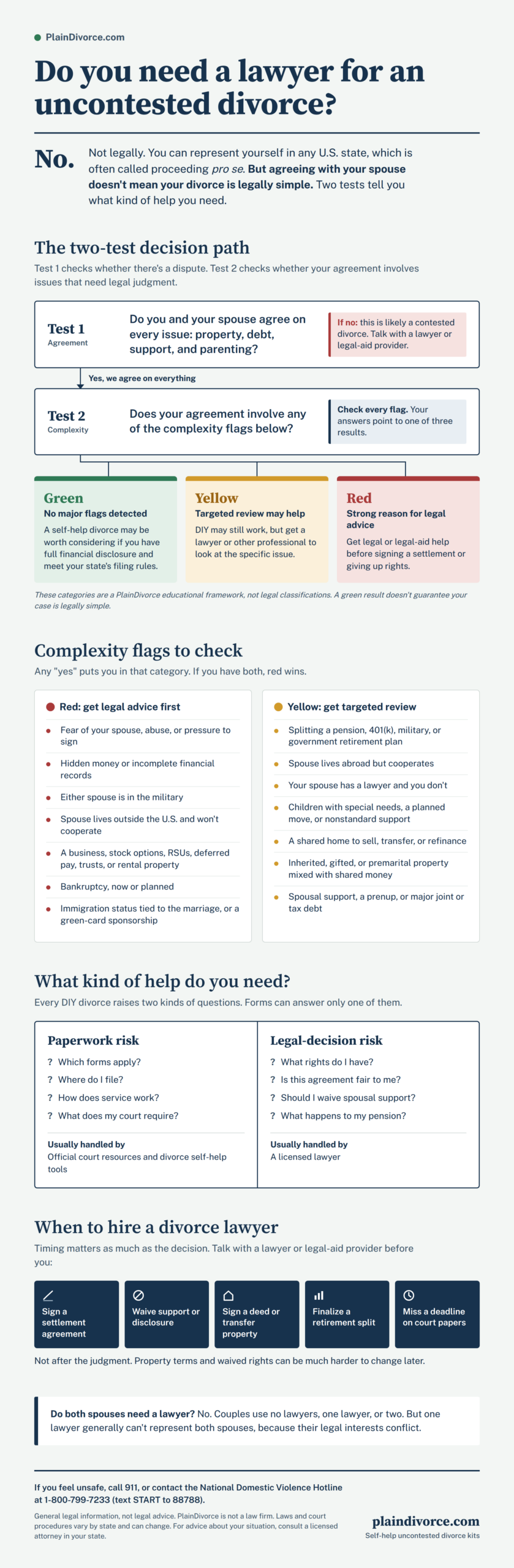
1. The 60-second DIY divorce checklist
Before you start (Test 1): If you and your spouse still need the court to decide property, debt, support, or parenting issues, your case isn’t the simple uncontested situation this checklist is designed for. See uncontested vs. contested divorce, then jump to when to hire a divorce lawyer.
Test 2: complexity. If you agree on everything, answer yes or no to each question. Tap any question to read why it matters.
🔴 RED: any “yes” here is a strong reason to seek legal advice
- Are you afraid of your spouse, or being pressured to sign?
- Do you suspect hidden money, or have you not seen your spouse’s full financial records?
- Is either spouse in the military?
- Does your spouse live outside the U.S. and refuse to cooperate?
- Does either of you own a business, stock options, RSUs, deferred compensation, a trust interest, rental property, or other assets that need valuing?
- Is either of you in, or planning, bankruptcy?
- Does either spouse’s immigration status depend on the marriage, or did one spouse sponsor the other for a green card?
🟡 YELLOW: any “yes” here means targeted review may help
- Will a pension, 401(k), military retirement, or government retirement plan be split?
- Does your spouse live outside the U.S. but cooperate?
- Does your spouse have a lawyer when you don’t?
- Do you have children with special needs, a parent planning to move away, or a support amount different from your state’s guidelines?
- Do you have a shared home that still needs to be sold, transferred, refinanced, or divided?
- Is any property possibly separate (owned before marriage, inherited, or a gift), especially if it was mixed with shared money?
- Will either spouse pay spousal support (alimony), or do you have a prenup or postnup?
- Do you have significant joint debt or tax debt?
What your answers mean
🟢 GREEN: No major complexity flags detected. None of the issues covered by this checklist appeared. A self-help divorce may be worth considering if you have full financial disclosure, understand your agreement, and meet your state’s filing requirements.
🟡 YELLOW: Targeted professional review may help. Your divorce may still be manageable without full-service representation, but at least one issue deserves a closer look from a lawyer or other professional.
🔴 RED: Strong reason to seek legal advice. The issue could seriously affect your rights, safety, finances, or ability to complete the divorce correctly. Get legal or legal-aid help before signing a settlement or giving up rights. If safety is involved, contact a domestic violence advocate, legal aid, or the court right away. Also see when not to do a DIY divorce.
These categories are a PlainDivorce educational framework, not legal classifications. Answering “no” to every question doesn’t guarantee your case is legally simple. It means none of the major issues covered here appeared.
2. Paperwork risk vs. legal-decision risk: what kind of help do you need?
Every DIY divorce involves two different kinds of questions. Knowing which kind you have tells you what kind of help you need.
Paperwork and process questions
- Which forms apply?
- Where do I file?
- What gets filed next?
- How does service work?
- What does my court require?
Usually addressed by: official court resources and divorce self-help tools.
Legal judgment questions
- What rights do I have?
- Is this agreement fair to me?
- Should I waive spousal support?
- Is this division of property appropriate?
- What legal effect will this term have?
Usually addressed by: a licensed lawyer.
People without obvious complexity flags are more likely to face mainly procedural questions. A divorce forms checklist and knowing why courts reject divorce paperwork go a long way. Yellow and red issues raise legal judgment questions, and forms alone can’t answer those.
A lawyer can advise you about your rights, evaluate the consequences of your agreement, draft or review important terms so they’re clear and enforceable, and represent you in negotiations or court.
3. Can I do my own divorce? What a green result can look like
Example: Sam and Priya have been married four years. They rent, have no children, and own no real estate or business interests. They have nothing to divide other than ordinary bank accounts, vehicles, and household belongings. They’ve exchanged their financial information, agree on every term, and neither is asking for spousal support.
If your situation is similarly straightforward, much of the remaining work may be procedural: identifying the forms, filing them correctly, completing service (formally notifying your spouse), and following your court’s uncontested divorce process.
Even a simple case still has to meet your state’s rules:
- Residency and jurisdiction. You must be eligible to file in that state and court. Our uncontested divorce eligibility checklist can help.
- Waiting periods. Some states require time to pass before a divorce can be finalized. See divorce waiting periods by state.
- Financial disclosure. Some states require formal financial disclosure forms even when spouses agree on everything.
Some states also offer simplified or summary divorce procedures for couples who qualify.
Check your state’s uncontested-divorce forms and filing process →
4. Agreement isn’t the same as informed agreement
You can agree on everything and still misunderstand the legal or financial effect of what you’re signing. Generally, an uncontested divorce means there are no issues the court must resolve between you, but states define and process these cases differently.
Example: Alex and Jordan agree that Alex keeps the house and Jordan keeps a retirement account with the same current value. That looks equal on paper. But a home and a retirement account can have very different debt obligations, tax treatment, liquidity, and future costs. Equal account values don’t necessarily mean equal economic value.
Two other issues couples often miss:
- Marital vs. separate property. Property owned before the marriage, an inheritance, or a gift may be treated as separate property in some cases, and mixing it with shared money can complicate that. Learn more about property division in an uncontested divorce.
- Health insurance. Divorce can end eligibility under a spouse’s employer plan. Federal COBRA or state continuation laws may provide temporary coverage in some cases, and notice deadlines can apply. Check the plan before the divorce is finalized. See the U.S. Department of Labor’s separation and divorce guidance.
Why getting the agreement right matters: Some procedural errors can be corrected. But property terms and waived rights can be much harder to change after the judgment. Don’t choose DIY on the assumption that you can simply fix the settlement later.
5. 10 issues to check before choosing a DIY divorce
1. Fear, abuse, or pressure to sign
🔴 RED: You can’t negotiate freely with someone you fear or who is pressuring you.
You may need protections, like a protective order or safety terms in a parenting plan, that self-help forms don’t handle well. Pressure counts too: “sign today or the deal is off,” being told not to read the agreement, threats about the children or money, or being told not to talk to anyone.
Don’t sign an agreement just because your spouse is imposing an artificial deadline. Take time to read it and, when appropriate, get independent advice. Duress (serious pressure or threats) can create grounds to challenge an agreement, but undoing a signed settlement later can require more court proceedings and proof.
2. Hidden assets or incomplete financial disclosure
🔴 RED: You can’t divide fairly what you can’t see.
If your spouse controls the money, gets paid in cash, or you notice unexplained withdrawals or missing statements, you may not know what’s really there. Self-represented spouses may have access to discovery tools (formal ways to request information), depending on the state. But subpoenas, document requests, valuation disputes, and enforcement can quickly make a “simple” case hard to handle without a lawyer.
3. Splitting retirement may require an order beyond your divorce judgment
🟡 YELLOW: The plan may not pay a former spouse until it receives a qualifying order.
Private-employer retirement plans covered by ERISA, including many 401(k)s and traditional pensions, require a domestic relations order that qualifies as a Qualified Domestic Relations Order (QDRO) before the plan can pay benefits to a former spouse. According to the U.S. Department of Labor, a QDRO can be part of the divorce decree or court-approved settlement, or issued as a separate order. What matters is that it meets the legal requirements and the plan’s rules.
Government plans, military retired pay, and IRAs follow different rules. Getting the order wrong, or never getting it done, can mean a promised share isn’t paid, so deal with retirement early. The complexity depends on the type of plan, not just the dollar amount.
4. A military spouse brings federal rules into your divorce
🔴 RED: Federal military rules apply on top of state divorce law.
Before a court can enter a default judgment, federal law requires the filing spouse to submit an affidavit stating whether the other spouse is in military service. Active-duty members can also ask the court to pause the case in some situations. See the U.S. Department of Justice’s servicemember rights resources.
A common myth is that a former spouse needs 10 years of marriage to receive any share of military retired pay. The 10/10 rule only decides whether the Defense Finance and Accounting Service (DFAS) can make direct payments to the former spouse. It applies when the marriage overlapped at least 10 years of creditable military service. If the 10/10 requirement isn’t met, DFAS can’t enforce the property award through direct payments, but the court-ordered award itself can still be valid. Many bases offer free legal assistance offices for eligible families.
5. A spouse abroad can make service of process more complicated
🟡 YELLOW if your spouse cooperates. 🔴 RED if not. International rules may control how your spouse is notified.
Service may need to follow treaties like the Hague Service Convention or the other country’s laws. The U.S. State Department explains the options, and some methods take months. A cooperative spouse may be able to accept service, but whether that works depends on your court and the other country. Improper service can delay or undermine your divorce. Learn more about how to serve divorce papers.
6. Your spouse’s lawyer does not represent you
🟡 YELLOW: Only one of you has someone protecting your interests.
The agreement may look reasonable but favor your spouse. A single review by your own lawyer can show you what you’re giving up. If you’re being rushed to sign, treat it as a red flag (see #1).
7. Parents agreeing doesn’t guarantee court approval
🟡 YELLOW (🔴 RED if there are safety concerns): Courts apply their own standards to terms about children.
Courts review parenting terms under their state’s standards, which usually focus on the child’s best interests, and review child support under the state’s support guidelines. A judge may question support that differs from the guidelines without an explanation, or a vague parenting plan. Get advice if a parent plans to move, a child has special needs, or support departs from the guidelines. See our guides to child support and court approval and parenting plans in an uncontested divorce.
8. Property that needs valuation, classification, or transfer
🟡 YELLOW for a shared home or separate-property questions. 🔴 RED for a business or other complex assets. Some property needs more than an agreement.
If you still need to sell, transfer, refinance, or divide a shared home, the details matter: title, who keeps the mortgage, refinance deadlines, how equity is split, and what happens if a sale stalls. Removing a spouse from the deed does not remove them from the mortgage, because the lender isn’t bound by your divorce agreement.
Inherited or gifted property, or property owned before the marriage, can change what’s divided. A business, stock options, RSUs, deferred compensation, a trust interest, or rental property raises valuation and tax questions that are easy to get wrong.
9. Spousal support, prenups, or serious debt
🟡 YELLOW (🔴 RED for bankruptcy): These terms can follow you for years, and outside parties may not be bound by your agreement.
Spousal support terms can be hard to change later and may have tax effects. A prenup or postnup doesn’t rule out DIY, but questions about whether it’s valid or how it applies need legal review. With large joint debts or tax debts, creditors and tax authorities aren’t bound by your agreement about who pays.
Bankruptcy is a strong reason to get legal advice, because a bankruptcy filing can pause or limit parts of a divorce case, especially property division. See the federal courts’ Bankruptcy Basics.
10. Divorce can affect marriage-based immigration cases
🔴 RED: Timing can affect immigration status in ways family courts don’t address.
Divorce can affect pending marriage-based cases and how a conditional resident removes conditions on residence. USCIS also states that divorce does not end a sponsor’s Form I-864 support obligation. Because the effect depends heavily on immigration status and timing, talk to an immigration attorney before filing.
6. Do both spouses need a lawyer?
No. Couples usually use one of three setups:
- No lawyers. Both spouses represent themselves.
- One lawyer. One spouse hires a lawyer, and the other represents themselves, ideally with an independent review.
- Two lawyers. Each spouse has their own lawyer.
One lawyer generally can’t represent both spouses, because their legal interests conflict. Rules vary by state.
7. You don’t have to hire a lawyer for the whole divorce
Yellow issues often need help with just one piece. Options include:
- Limited-scope help. Many states let lawyers handle only part of a case, such as reviewing an agreement or drafting a QDRO. This is sometimes called “unbundled” services.
- Agreement review. A one-time review before you sign.
- Mediation. If you agree on most, but not all, issues, a neutral mediator can help you work toward agreement. The mediator doesn’t represent either spouse.
- Court self-help centers. Free procedural help. What they offer varies by court.
- Legal aid. Free or low-cost help if you qualify based on income.
A DIY divorce removes attorney fees, not court filing fees, though fee waivers may be available for people who qualify. If cost is driving your decision, compare what an uncontested divorce costs, filing fees by state, and online divorce vs. a lawyer.
8. When to hire a divorce lawyer: timing matters
Talk with a lawyer or legal-aid provider before:
- Signing a settlement agreement (also called a marital settlement agreement or separation agreement). Our marital settlement agreement checklist shows what one usually covers.
- Waiving any right, such as spousal support or financial disclosure
- Signing a deed or transferring property
- Finalizing how a retirement plan will be divided
- Missing a deadline on court papers you don’t understand
Not after the judgment, when your options may be limited. If you already disagree on any issue, legal advice is the better next step. If cost is a concern, ask about limited-scope services, contact your state or local bar association’s lawyer referral service, or find legal aid through the Legal Services Corporation.
9. Where PlainDivorce fits
PlainDivorce is designed for spouses who have already made their decisions and need help with the forms and filing process. It is not for spouses who need someone to decide what agreement they should make.
Our kits help you identify the right forms for your state, understand the order to file them, and know what to do next. PlainDivorce is not a law firm and does not give legal advice. Our kits provide legal information only. Comparing options? See how to choose an online divorce service.
Some yellow situations may still be compatible with self-help paperwork after a lawyer has reviewed the relevant issue. If you landed in the red, a lawyer or legal-aid provider is the right next step, and we’d rather you get the right help than use the wrong tool.
10. Do I need a lawyer for an uncontested divorce? Your next step
If you agree on every issue and none of the major complexity flags above apply, your remaining challenge may be the court process rather than legal decision-making. That’s where your state’s specific requirements matter.
Choose your state to see the forms, filing steps, and court requirements →
Example state guides: Wisconsin, Wyoming, and Washington, D.C.
11. Frequently asked questions
Do I need a lawyer for an uncontested divorce if we agree on everything?
Not legally. But agreement alone doesn’t mean your divorce is simple. Use the 60-second checklist to see whether any complexity flags apply.
Can we use one lawyer if we agree on everything?
Generally, no. A lawyer can usually represent only one spouse because your legal interests differ, even when you agree. Rules vary by state.
Should I have a lawyer review an uncontested divorce agreement?
It’s worth considering if you have any yellow or red issues, or if you’re unsure what you’re giving up. A review before signing is usually far easier than trying to change a final judgment.
Can I hire a lawyer for just part of my divorce?
In many states, yes. Ask local lawyers whether they offer limited-scope or “unbundled” services, such as an agreement review or a retirement division order.
My spouse’s lawyer wrote our agreement. Can I just sign it?
You can, but that lawyer represents your spouse, not you. Consider having your own lawyer review it first, and don’t let anyone rush you.
Is a divorce without a lawyer legally valid?
A properly entered divorce judgment is not less valid because the spouses represented themselves. You still must meet your state’s jurisdiction, service, and other procedural requirements.
Can court staff help me fill out my forms?
The help available varies by court. Staff can generally provide procedural information, but they can’t act as your lawyer or tell you what legal choices to make.
12. Sources used for this guide
Primary sources include U.S. Department of Labor guidance on QDROs and separation and divorce; DFAS former spouse guidance; U.S. Department of Justice servicemember resources; USCIS guidance on Form I-751 and the Affidavit of Support; U.S. State Department international service guidance; the federal courts’ Bankruptcy Basics; and official state court self-help materials.
This article provides general legal information, not legal advice. Laws and court procedures vary by state and can change. For advice about your situation, consult a licensed attorney in your state.
Sources and local rules can change. Use this guide as a plain-English organizer, then verify the current filing requirements with the official court or government source for your jurisdiction.

About Harry D
Expert contributor at PlainDivorce, helping Canadians and American navigate simple uncontested divorces with clarity and confidence.