Uncontested Divorce Canada Timeline: How Long It Takes and What Controls the Clock
Most uncontested divorces in Canada take several months from filing to a final divorce, and cases with a service problem, a missing document, or a child-support gap can run past a year. There is no single nationwide number, because the uncontested divorce Canada timeline is set by two things working together: the federal Divorce Act, which decides whether a court can grant the divorce, and each province or territory’s court procedure, which decides how the paperwork is filed, served, reviewed, and certified.
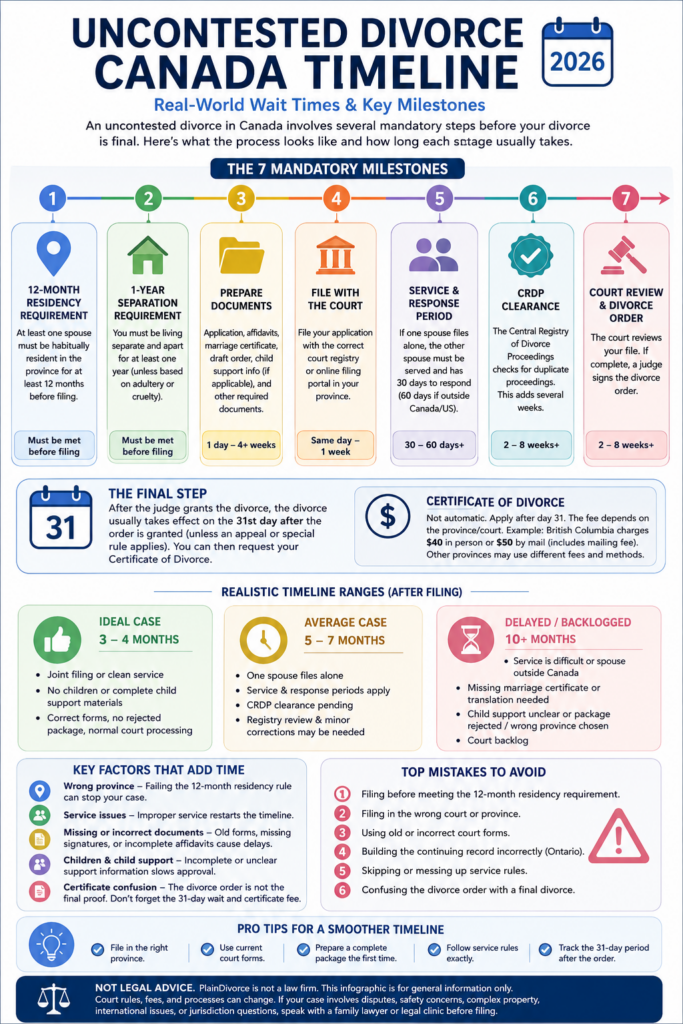
A clean case still moves through a fixed set of steps: preparing the application and affidavits, filing, serving the other spouse if you file alone, the response period, the Central Registry of Divorce Proceedings step, court review, the signed divorce order, and the 31-day period before the divorce takes effect. This guide walks through each step, shows where time is usually spent, and explains how to keep your divorce timeline in Canada as short as the process allows.
| Situation | PlainDivorce planning estimate (not a court standard) | What usually has to be true |
|---|---|---|
| Cooperative, well-prepared case | Several months after filing | Joint application or clean service, no children or a complete child-support package, current forms, a complete first submission, no competing divorce proceeding |
| Typical sole application | Longer, often past the half-year mark | One spouse files and serves, the response period runs, the registry may return the package once for a correction |
| Delayed or backlogged case | A year or more | Service is difficult or the spouse is outside Canada, the marriage certificate is missing, documents need certified translation, child support is unclear, the wrong court was chosen, or the local registry has a backlog |
No government or court body publishes a nationwide or province-by-province “typical” completion time for an uncontested divorce. The ranges above are PlainDivorce planning estimates built from the steps the law requires, not measured data. Your court’s workload, your province’s procedure, and the completeness of your package will move the real number.
Do not lose months to a returned package. Check your eligibility and start organizing the right provincial forms now, so your file is complete the first time it reaches a judge.
TL;DR
Two systems set the clock: the federal Divorce Act decides whether a court can grant the divorce, and your province’s court procedure decides how fast the paper moves. Almost every avoidable delay lives in the second one.
- There is a second one-year rule, and it catches people after a move. A province can only hear the divorce if either spouse has been habitually resident there for a year — and it does not have to be the spouse who files. You can be separated for three years and still be in the wrong province.
- The separation year is measured when the judge decides, not when you file. That means a proceeding can often be commenced earlier, subject to local practice — Alberta, for instance, has you start the action during the year and request the divorce only after it.
- The Central Registry step is the court’s job, not yours. The court transmits the registration within seven days of filing. There is no published clearance time, and a quiet file is usually not a stuck one.
- Do not call Ottawa for a status update. The Registry cannot tell you about your divorce or send your certificate — it can only identify which court processed a divorce and give a reference number. “Is my file ready for a judge?” is a question for the registry where you filed.
- A joint application is the single biggest lever on the timeline, because it removes service and the response period — the two most common sources of delay. The cost is that both spouses must stay engaged long enough to sign.
- A spouse who ignores the papers does not make the case contested. A served, unanswered sole application stays uncontested; it just adds the full response window (in Ontario, 30 days if served in Canada or the U.S., 60 days anywhere else).
- Child support can stall a divorce both spouses agree on. Under section 11(1)(b) the court must be satisfied reasonable support arrangements exist under the guidelines, and must stay the divorce until it is. A thin, unexplained, or below-table support section holds up the whole file.
- Use the current statutory language. The Divorce Act says “parenting time” and “decision-making responsibility,” not “custody” and “access” — documents using the old words can draw a clarification request.
- The marriage certificate is a frequent return trigger. Courts generally want the original; Ontario can waive it if you explain why in Form 36, and a certificate in another language needs a certified translation. Sort this out first, not last.
- Same-roof separation counts, and reconciliation attempts totalling up to 90 days do not reset the year — but the 90 days are cumulative across all attempts.
- The signed order is not the divorce. It takes effect on the 31st day, earlier only with special circumstances and an undertaking not to appeal. The certificate of divorce is a separate request afterward, with its own fee — $25 in Ontario, $40 in person or $50 by mail in B.C.
- Don’t benchmark against a friend’s divorce unless they filed in the same province, by the same route, with the same child-support situation. A joint B.C. desk order and a served Ontario sole application are both “uncontested” and travel completely different paths.
1. The Short Answer: What Controls the Timeline
When people ask how long a divorce takes in Canada, the honest answer is that an uncontested case depends less on conflict and more on process: residency, the one-year separation date, whether you file alone or together, and whether the paperwork is accepted the first time. The uncontested divorce Canada timeline runs through these checkpoints:
- A valid marriage the court can recognize, and a breakdown of that marriage.
- The one-year habitual-residence requirement in the province or territory where you file (with a narrow exception for some non-residents married in Canada).
- The one-year separation period, unless the divorce is based on adultery or cruelty.
- Preparing the application, affidavits, draft order, marriage certificate, and any child-support material.
- Filing with the correct court registry or online portal.
- Service and the response period, if one spouse files alone.
- The Central Registry of Divorce Proceedings step, court review, the divorce order, the 31-day effective-date period, and the certificate of divorce.
Under the federal Divorce Act, the only ground for divorce is breakdown of the marriage. Breakdown is established by living separate and apart for at least one year, or by adultery or cruelty. Most self-help uncontested divorces use the one-year separation route because it does not require proving fault.
The most common practical delay is usually not the one-year separation rule itself, which most couples have already met by the time they start. It is the gap between filing and approval: residency screening, service and proof of service, the response period, court review, and corrections to the final package. If you want a broader comparison of what “uncontested” means, read what an uncontested divorce is, and for the international-style overview of timelines, see how long an uncontested divorce takes.
2. Before the Clock Starts: Marriage, Breakdown, and Residency
Three things have to be true before a Canadian court can even take your divorce: a legally valid marriage, a breakdown of that marriage, and a connection to the province through residency. If any one of them is missing, the timeline has not really started yet.
The One-Year Habitual-Residence Rule
Under section 3(1) of the Divorce Act, a court in a province has jurisdiction to hear a divorce only if either spouse has been habitually resident in that province for at least one year immediately before the proceeding begins. It does not have to be the spouse who files.
This is a major divorce timeline Canada factor after a move. If one spouse just moved from Calgary to Toronto, they cannot assume they can file in Ontario right away. If neither spouse has been habitually resident in Ontario for the full 12 months before filing, Ontario is not yet the right place to start. The options are usually to file in the former province, wait until the residence period is met, or get legal advice about jurisdiction. This is separate from the one-year separation rule: a couple can be separated for well over a year and still face a filing-location problem.
The Civil Marriage Act Route for Non-Residents
This guide covers the ordinary Divorce Act route. There is one narrow exception. Justice Canada explains that spouses who married in Canada, now live outside Canada, and cannot end the marriage where they live because that country does not recognize it, may apply under the Civil Marriage Act to the Superior Court of the province or territory where the marriage was performed. It requires a one-year breakdown by separation and that each spouse has lived for at least a year in a place that will not dissolve the marriage. If this is your situation, get legal advice; the process and timeline are different from a domestic filing.
3. The One-Year Separation Ground and When You Can File
For a separation-based divorce, section 8(2)(a) of the Divorce Act requires the spouses to have lived separate and apart for at least one year immediately before the court determines the divorce, not before you file. That is a federal rule, the same in every province and territory.
Because the year is measured at the determination, a proceeding can generally be commenced before the one-year anniversary, subject to local procedure. Some provinces handle this differently in practice. Alberta, for example, has filers start the action during the year and request the divorce itself only after the year is complete. What never changes: a judge cannot grant the divorce until the full year of separation has passed. For a deeper look at the separation clock, read our guide to the one-year separation rule in Canada.
Two details matter for the timeline:
- Same-roof separation counts. Spouses can be separated while living in the same home. The question is whether the relationship has ended and the spouses are living separate lives. Courts look at the whole picture, so the separation date should be accurate and consistent on every form.
- The 90-day reconciliation window. Under section 8(3)(b), spouses can resume living together for up to 90 days total, with reconciliation as the primary purpose, without resetting the one-year clock. More than 90 days, and the clock starts over.
Adultery and cruelty are the alternative grounds and do not require a one-year wait, but they must be proven and are rarely the faster path for a self-help divorce.
4. The Central Registry of Divorce Proceedings Step
The Central Registry of Divorce Proceedings (CRDP) is a federal registry in Ottawa that keeps nation-wide records of divorce applications. Its job is narrow: Justice Canada explains that if there is another divorce application involving the same two spouses, the Registry lets the courts know so duplicate proceedings can be sorted out.
Here is the part filers often get wrong: the court, not you, handles this step. Under the Central Registry of Divorce Proceedings Regulations, the court must verify the registration information and send it to the Registry within seven days of the divorce application being filed. The Registry then checks its records and notifies the court whether there is a competing proceeding. You pay a small federal fee with the filing (for example, $10 in Ontario; Alberta folds it into its commencement fee), and the court does the rest.
When there is no competing proceeding, this is usually a routine step in the background. There is no published clearance time, and it is not a reason to assume something is wrong with your file. What you can control is keeping the marriage date, separation date, spouse names, and birthdates identical on every form, because that is the information the court transmits.
Trust note: Do not contact the CRDP in Ottawa for routine file-status updates. Justice Canada is clear that the Registry cannot give you detailed information about a divorce or a copy of your divorce certificate. It can help identify the court that processed a divorce and give a reference number. For “is my file ready for a judge?”, call the court registry where you filed.
5. The Paperwork Stack That Controls the Timeline
A judge usually cannot grant the divorce just because both spouses agree. The court needs a complete record showing that the legal requirements are met, so the uncontested divorce Canada timeline often turns on the paperwork stack. The court does not review a “divorce story,” it reviews a file. A small factual gap can become a timeline problem if it stops the registry from putting the documents in front of a judge.
Documents Most Filers Should Expect
- A divorce application, originating application, or joint application (in Ontario, Form 8A, “Application (Divorce),” dated April 1, 2024).
- The original marriage certificate, or an accepted alternative. In Ontario, the court can waive the original if you explain in Form 36 why you cannot get it; a non-English or non-French certificate needs a certified translation.
- An affidavit for divorce (in Ontario, Form 36), sworn or affirmed before an authorized official, covering the legal basis for the divorce, any children, and parenting and support arrangements.
- A draft divorce order or judgment for the judge to sign.
- The federal Central Registry fee, paid with the filing and handled by the court.
- A certificate of divorce request after the divorce takes effect (a separate step, not automatic).
In British Columbia, a desk-order divorce package typically includes a Requisition (Form F35), an Affidavit — Desk Order Divorce (Form F38), a Certificate of Pleadings signed by registry staff (Form F36), a draft Final Order (Form F52), and, where there are children, a Child Support Affidavit (Form F37). The Certificate of Divorce is Form F56. The exact set depends on the claims and the route, so treat any list as a starting point, not a complete package.
Extra Documents Triggered by Your Situation
- If one spouse files alone: an affidavit of service or other proof of service.
- If children are involved: income information, guideline child-support calculations, details of any special or extraordinary expenses, and a clear explanation of the arrangement.
- If the marriage certificate is in another language: a certified translation and any required translator’s affidavit.
- If a spouse’s name has changed: proof or an explanation connecting the current legal name to the name on the marriage certificate.
- If there is a separation agreement: a copy or the agreed terms, where the local process asks for it. See our settlement agreement checklist before you rely on one in a court package.
- If a spouse is outside Canada: extra service proof, a longer response period, and possibly translation.
Stop hunting for forms: old or mismatched forms are one of the easiest ways to add weeks to a simple case. PlainDivorce kits are built around the current filing path for uncontested cases in each province. Check your eligibility to get started.
6. Divorce Order vs Certificate of Divorce: The 31-Day Rule
This is one of the most important timing points in the entire uncontested divorce Canada timeline: a divorce order and a certificate of divorce are not the same document, and receiving the signed order does not mean you are divorced yet.
| Document | What it means | Timeline impact |
|---|---|---|
| Divorce order or divorce judgment | The court order granting the divorce. | Under section 12(1) of the Divorce Act, the divorce takes effect on the 31st day after the day the judgment is rendered. A court may order an earlier date only if there are special circumstances and both spouses agree and undertake not to appeal. A pending appeal delays the effective date. |
| Certificate of divorce | The document confirming the divorce has taken legal effect, and stating the effective date. | Requested after the 31-day period, usually for a fee. In B.C., the certificate is $40 in person or $50 by mail (including a $10 mailing fee), from the Supreme Court registry that granted the divorce. In Ontario, the certificate fee is $25. Other provinces use their own request process. |
Justice Canada confirms that, in most cases, a divorce takes effect 31 days after the judge grants it. B.C. government guidance similarly says to make sure 31 days have passed since the divorce order before requesting the certificate.
Pro tip: Put two dates on your calendar: the day the divorce order is granted, and the 31st day after that. Do not plan a remarriage, immigration update, or name change around the order date. The certificate of divorce is the proof document most agencies want, and it belongs after the second date.
7. Where the Time Is Actually Spent
Most uncontested divorce delays are process delays, not legal disputes. The file usually slows down at one of these points.
The Residency Check
Before the court can deal with the divorce, it must have jurisdiction under section 3(1). After an interprovincial move, this can mean waiting months for the one-year residence period to be met in the new province, or filing in the former province instead.
Waiting for the One-Year Separation Date
Most couples have already met this by the time they start. If not, the divorce cannot be granted until the year is complete, though preparation can usually begin earlier.
Preparing the Documents
This step can take a day or several weeks. The difference is usually organization. The package may need legal names, addresses, marriage details, the separation date, children’s information, support details, proof of marriage, and any prior orders or agreement.
Filing the Application
Some provinces allow online filing for family documents. Ontario, for example, lets people file family court documents online for divorce, parenting, support, and property. Online filing can save a trip to the courthouse, but it does not prevent a return if the forms are incomplete or inconsistent.
Serving the Other Spouse
If one spouse files alone, the other usually must be served under the court’s rules. Service is not a casual email or text. Improper service can stall the file until it is fixed. A joint application avoids this step because both spouses take part from the start. If you are choosing a method, read our guide to serving divorce papers.
The Response Period
After service, the other spouse has time to respond. In Ontario, an Answer must be served and filed within 30 days if the spouse was served in Canada or the United States, or 60 days if served anywhere else. Other provinces set their own periods. If your spouse lives outside Canada, build in extra time for international service and the longer response window.
The Central Registry Step and Court Review
After filing, the court sends the CRDP registration within seven days and waits for the Registry’s notification. The registry then reviews the final package. If it is complete, it goes to a judge. If something is missing, it is returned for correction, which is where a small error becomes a real delay.
The 31-Day Effective-Date Period
After the judge grants the divorce, it takes effect on the 31st day. Only then can the certificate of divorce usually be requested.
8. Province by Province: The Friction Point, Not a Forecast
No court or government body publishes a province-by-province “typical” completion time, so this table does not give one. Instead it names the concrete friction point most likely to affect the uncontested divorce Canada timeline in each jurisdiction, and the fee anchors where they are published.
| Province / Territory | Where the friction usually is |
|---|---|
| Ontario | Location-sensitive. The 30/60-day Answer period, Form 36 completeness, online-filing acceptance, and the original marriage certificate all matter. A continuing record is required for paper filings under Rule 36, but electronically filed divorce applications generally do not need one unless paper documents enter the file. Fees: $214 to file, $445 to place on the list for a judge, $10 Central Registry, $25 certificate. |
| British Columbia | Form-driven desk-order divorce. Friction points are the F35/F36/F38 stack, the F37 Child Support Affidavit if there are children, registry review, and the 31-day wait before requesting the F56 certificate ($40 in person or $50 by mail). |
| Alberta | The divorce judgment package must be complete, and the certificate request is a separate post-effective-date step. The commencement fee is $310 and already includes the $10 Central Registry fee. |
| Quebec | Proceedings are in the Superior Court and in French unless otherwise arranged. Local procedure and document formalities matter, and Quebec offers a joint application on a draft agreement. |
| Manitoba | Court of King’s Bench filing requirements, proof of service, and child-support material when there are children. |
| Saskatchewan | Judicial-centre practice, service and response rules, and whether the desk-divorce material lines up with the original application. |
| New Brunswick | Clearance-certificate timing and filing the final record correctly. The judgment is not proof the divorce is final. |
| Newfoundland and Labrador | Central Registry clearance timing and the certificate request after the divorce is effective. |
| Nova Scotia | Supreme Court (Family Division) process, service requirements, and whether the final package is complete enough for review without follow-up. |
| Prince Edward Island | Correct Supreme Court filing, service, affidavits, and certificate steps. |
| Northwest Territories | Service logistics, court access, and document completeness in a small registry. |
| Nunavut | Service logistics, travel, remote-community access, and complete supporting documents. |
| Yukon | Supreme Court registry instructions, service, desk-divorce review, and the certificate request after the order is effective. |
The biggest provincial difference is not the Divorce Act. It is court administration. For a wider look at what each province charges, see our guide to divorce filing fees by state and province.
Pro tip: Do not compare your timeline to a friend’s divorce unless they filed in the same province, used the same route, had the same child-support situation, and filed through a similar court location. A joint B.C. desk-order divorce and a sole Ontario application with service are both “uncontested,” but they do not move through the same path.
9. Sole, Joint, or Undefended: How the Route Affects Timing
“Simple divorce,” “joint divorce,” and “desk divorce” are province-specific procedural labels, not Canada-wide categories. What matters for the timeline is how the other spouse enters the case.
| Route | How it works | Main timeline effect |
|---|---|---|
| Joint application | Both spouses file together and sign the paperwork. | No service step and no response period, so it removes the most common source of delay. Depends on both spouses staying engaged long enough to sign. |
| Sole application, agreed | One spouse files and serves; the other agrees and may sign a waiver or consent. | Adds service and proof of service, but the response period can be short-circuited by a filed consent. |
| Sole application, undefended | One spouse files and serves; the other does not respond. | Stays uncontested. Adds the full response period (for example, 30 or 60 days in Ontario) before the filer can move for the divorce. No signed agreement is required. |
A joint application usually shortens the uncontested divorce Canada timeline because it removes service friction. But the fastest route is not always the right one. Choose the route that matches your facts, your province’s process, and whether your spouse will cooperate. Our guide to desk divorce in Canada compares the paper routes in more detail.
10. Why Children Can Add Time to an Uncontested Divorce
An uncontested divorce with children can still be granted without a trial, but the court needs enough information to be satisfied that parenting and child support have been properly handled.
Child support is the bigger timeline risk. This is not just the court “asking questions.” Under section 11(1)(b) of the Divorce Act, before granting a divorce the court must be satisfied that reasonable arrangements have been made for the support of any children of the marriage, having regard to the applicable guidelines. If it is not satisfied, it must stay the divorce until it is. So a support section that is thin, waived without explanation, or below the guideline table amount can hold up the whole file, even when both parents agree.
A complete package generally shows income information, the guideline table amount, any special or extraordinary expenses, and a clear explanation of the arrangement. The Divorce Act also uses “parenting time” and “decision-making responsibility” rather than “custody” and “access”; documents using the old language may draw a clarification request. For the details courts look for, read our guide to child support in an uncontested divorce and our overview of an uncontested divorce with children.
Child-support warning: a divorce can be uncontested and still get delayed if the support section is incomplete. PlainDivorce helps organize the child-support and parenting information courts expect. Check your eligibility to start.
11. How to Keep Your Canadian Divorce Timeline Short
The best way to protect your divorce timeline Canada is to remove preventable delays before filing. Work through this checklist:
- Confirm that at least one spouse has been habitually resident in the filing province for at least one year immediately before filing.
- Confirm the correct court for your province or territory.
- Confirm the one-year separation date, or the ground you are relying on.
- Pick your route: joint application, sole application with consent, or sole application undefended.
- Use current court forms for your province, not saved forms from an old kit or a forum.
- Make names match the marriage certificate, or explain any name change.
- Get the original marriage certificate, or prepare the accepted alternative for your province.
- Arrange certified translation if the certificate is in another language and your court requires it.
- Make sure every affidavit is signed, sworn or affirmed, and commissioned correctly.
- For a paper filing that needs one, build the continuing record correctly, with a complete and updated table of contents.
- Include proof of service if one spouse files alone, and wait out the response period before moving for the order.
- Include full child-support information if children are involved.
- Make sure the draft divorce order matches the application.
- Track the 31-day period after the order is granted, then request the certificate of divorce and budget for its fee.
Practical shortcut: a complete first submission is the strongest timeline strategy there is. PlainDivorce helps organize province-specific uncontested divorce paperwork so you are not rebuilding the file after a registry return. Check your eligibility.
12. Common Mistakes That Delay a Canadian Uncontested Divorce
Mistake 1: Filing Before Meeting the Residency Requirement
The one-year separation rule is not the only one-year rule. If neither spouse has been habitually resident in the filing province for a full year immediately before the application starts, the court may not have jurisdiction. This is a common problem after an interprovincial move.
Mistake 2: Filing in the Wrong Court
Filing in the wrong court or registry can lead to a return or a transfer delay, especially if one spouse recently moved, the spouses live in different provinces, or the marriage took place outside Canada.
Mistake 3: A Vague or Inconsistent Separation Date
Some spouses live apart without a clear separation date; others are separated under the same roof. The date should be accurate and identical across every form and affidavit.
Mistake 4: Using Old Forms
Court forms change. A form saved from a previous divorce, a forum, or an outdated website may no longer be accepted. This is one of the most preventable timeline mistakes.
Mistake 5: Getting the Continuing Record Wrong (Paper Filings)
Where a continuing record is required, usually a paper filing, treat it as the formal court file, not a cover page. Missing tabs, missing dates, or an incomplete cumulative table of contents can cause a return before the file reaches a judge. Ontario notes that electronically filed divorce applications generally do not need one unless paper documents enter the file.
Mistake 6: Skipping or Botching Service
If service is required, it must be done properly. The applicant usually cannot simply hand documents to the other spouse unless the rules allow that method. Bad service can restart part of the timeline.
Mistake 7: Calling the Central Registry Instead of the Court
The CRDP cannot tell you whether your local file is ready for a judge. The court registry handling your file is the place to ask whether the registration is back, whether documents were accepted, and whether anything is missing.
Mistake 8: Treating Child Support as Optional
Where there are children, the court must be satisfied that reasonable support arrangements have been made under the guidelines, or it must stay the divorce. Missing income information, unclear calculations, or an unexplained zero-support arrangement can hold up approval.
Mistake 9: Confusing the Divorce Order With Being Divorced
A signed divorce order is a major step, but in most cases the divorce takes effect on the 31st day after the order is granted. The certificate of divorce is the proof document you need after that date.
13. When to Get Legal Help
Legal help is worth it when a timeline problem is connected to legal risk, not just paperwork. Speak with a family lawyer or legal clinic if:
- You recently moved provinces and are unsure where to file.
- You do not know where your spouse is, or your spouse lives outside Canada.
- There is family violence, coercive control, or pressure to sign.
- You disagree about children, support, property, pensions, business interests, or debt.
- You need urgent orders, or you need the divorce recognized in another country.
- You are unsure whether Canada has jurisdiction, or your filing was returned and you do not understand why.
Legal advice does not have to mean starting a fight. Often it means paying for one-time, limited-scope guidance so your uncontested filing does not become a costly correction project. If your uncontested divorce Canada timeline is already delayed by jurisdiction, service, or a child-support gap, that advice is usually faster than guessing at the fix.
14. How PlainDivorce Can Help
PlainDivorce provides self-help uncontested divorce kits for people who want a clearer way to prepare divorce paperwork. A kit is a general organizing aid: it helps you gather the required information and understand the process before you file. It does not guarantee that your court will accept the filing, and it is not a substitute for legal advice.
Ready to prepare your paperwork? Check your eligibility, or start with a province-specific option such as the Ontario divorce kit, British Columbia divorce kit, or Alberta divorce kit.
15. Conclusion: The Real Timeline Is About Process
The uncontested divorce Canada timeline is shaped by more than one date. The one-year separation rule matters, but so do the one-year habitual-residence requirement, service, the response period, affidavits, the Central Registry step, court review, returned forms, child-support material, certificate fees, and the 31-day period before the divorce takes legal effect.
If both spouses cooperate and the paperwork is complete, the process is usually smoother and lands in the “several months” range. If the file has a jurisdiction problem, missing forms, a service issue, unclear support, or foreign-document problems, even an uncontested divorce can take a year or more. The best way to shorten it is not to rush: file in the correct province, submit a complete package the first time, follow service rules exactly, let the court handle the registry step, and keep the difference between the divorce order and the certificate of divorce clear in your own planning.
16. FAQ: The Uncontested Divorce Canada Timeline
How long does an uncontested divorce take in Canada?
There is no official national figure. As a PlainDivorce planning estimate, a cooperative, well-prepared case often takes several months from filing, a typical sole application runs longer, and a case with a service problem, a missing document, or a child-support gap can take a year or more. The timeline depends on the province, the route, service, court review, and the 31-day effective-date period.
What is the fastest realistic divorce timeline in Canada?
A clean joint application, with no children or a complete child-support package, current forms, and no competing divorce proceeding, can be planned around several months after filing. It is not guaranteed. The file still needs court processing, the Central Registry step, review by a judge, and the 31-day period before the divorce takes effect.
Do I have to live in a province for one year before filing for divorce?
For the ordinary Divorce Act route, at least one spouse must have been habitually resident in the province where the divorce is filed for at least one year immediately before the proceeding begins. This is separate from the one-year separation rule and is a common problem after an interprovincial move. A narrow Civil Marriage Act route exists for some non-residents who married in Canada.
Can I file for divorce in Canada before one year of separation?
The Divorce Act measures the one-year separation at the time the court decides the divorce, not at filing, so a proceeding can generally be started before the anniversary, subject to local procedure. Some provinces, such as Alberta, have you start the action first and request the divorce only after the year. A judge cannot grant the divorce until the full year has passed, unless the ground is adultery or cruelty.
What is CRDP clearance and does it delay my divorce?
The Central Registry of Divorce Proceedings checks whether there is a duplicate divorce application involving the same two spouses. The court, not you, sends the registration within seven days of filing and waits for the Registry’s notification. There is no published clearance time. When there is no competing proceeding, it is usually a routine background step, not a hidden delay.
Can I call the Central Registry to check my file?
No. Justice Canada says the Registry cannot give you detailed information about a divorce or a copy of your certificate. It can help identify which court processed a divorce and provide a reference number. To ask whether your file is ready for a judge, contact the court registry where you filed.
When is a divorce final in Canada?
In most cases a divorce takes effect on the 31st day after the judge grants the order. A court can order an earlier date only if there are special circumstances and both spouses agree and undertake not to appeal. A pending appeal delays the effective date. After the divorce is effective, you can request a certificate of divorce as proof.
How much does a certificate of divorce cost?
It depends on the province and court. British Columbia lists $40 in person or $50 by mail (including a $10 mailing fee), from the Supreme Court registry that granted the divorce. Ontario charges $25. Other provinces use their own request process. Budget for it as a separate step after the divorce becomes effective.
Is a joint divorce faster than a sole application?
Usually, because a joint application removes the service step and the response period, which are the most common sources of delay in a sole application. The trade-off is that both spouses have to stay engaged long enough to complete and sign the documents. A sole application that is served and not answered still counts as uncontested.
What delays an uncontested Canadian divorce the most?
Common delays include filing in the wrong province, improper service, missing signatures or commissioning, old forms, a missing marriage certificate, untranslated foreign documents, an incomplete child-support section, a returned continuing record, local court backlog, and confusing the divorce order with the certificate of divorce.
Legal note: PlainDivorce is not a law firm and this article is not legal advice. Court rules, forms, filing portals, fees, and registry practices change and vary by province and territory. If your case involves disputes, safety concerns, complex property, pensions, international issues, jurisdiction questions, or uncertainty about your rights, speak with a family lawyer or legal clinic before filing.
Sources and local rules can change. Use this guide as a plain-English organizer, then verify the current filing requirements with the official court or government source for your jurisdiction.

About Harry D
Expert contributor at PlainDivorce, helping Canadians and American navigate simple uncontested divorces with clarity and confidence.