How long does an uncontested divorce take? In most U.S. states, an uncontested divorce takes anywhere from a few weeks to several months. In states that require spouses to live apart first, it can take more than a year. Your state’s mandatory waiting period sets the earliest date a judge can finalize your divorce. After that, your uncontested divorce timeline depends on how quickly you finish your paperwork, serve your spouse, and how busy your court is.
TL;DR
- Most uncontested divorces take a few weeks to several months. Some take a year or more because of separation rules.
- Your state’s waiting period is the floor. It ranges from none (for example, New York and Illinois) to six months (California).
- Some states also require you to live apart before divorcing, or add a wait after the judge decides.
- The delays you can control: incomplete forms, late service, missing financial disclosures, and final paperwork that never gets submitted.
- The fastest way to get divorced is usually a fully agreed case with correct paperwork, filed where you meet the residency rules.
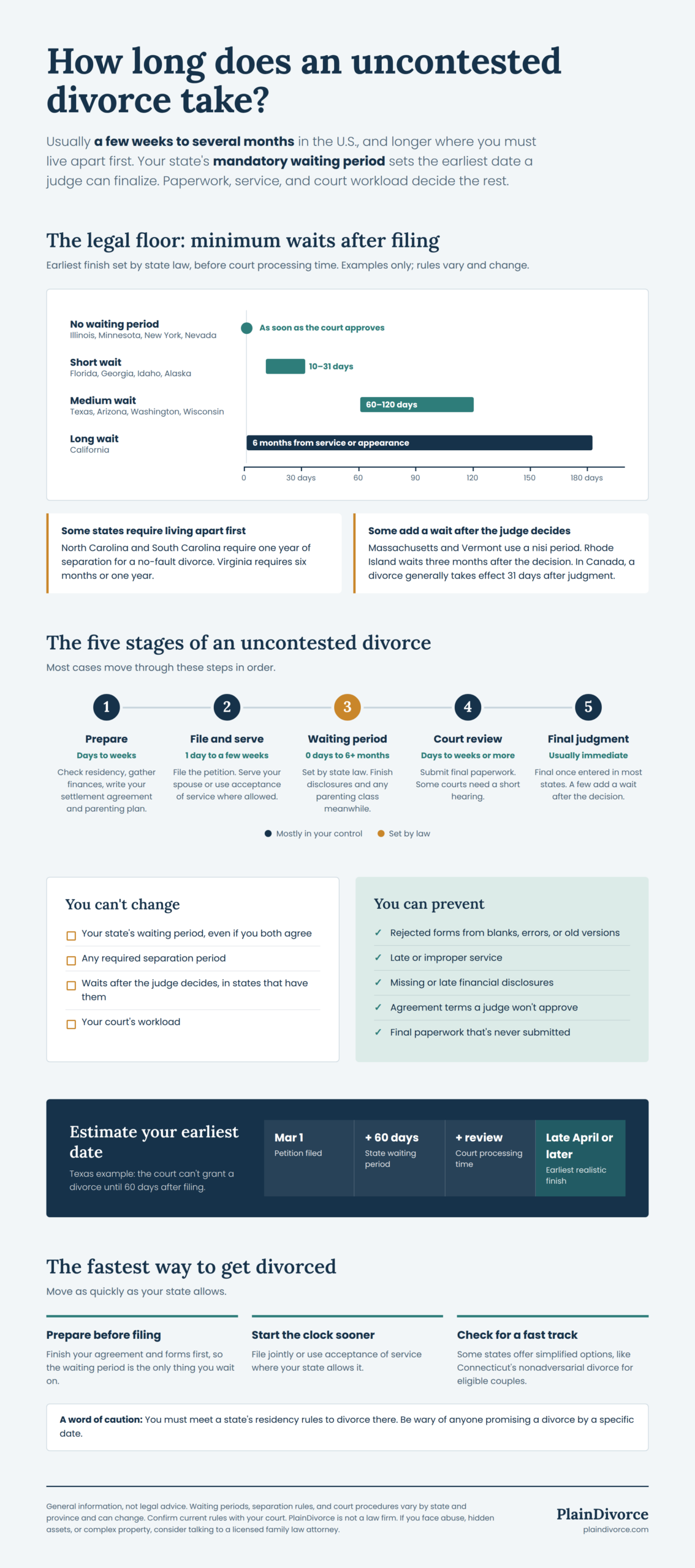
1. How Long Does an Uncontested Divorce Take? A Quick Snapshot
Here’s how soon you could be divorced, based on state law alone:
| If your state has… | Earliest possible finish (before court processing time) | Examples |
|---|---|---|
| No post-filing waiting period | As soon as the court approves your paperwork | Illinois, Minnesota, New York, Nevada |
| A short wait (about 10–31 days) | A few weeks after filing or service | Florida, Georgia, Idaho, Alaska |
| A medium wait (about 60–120 days) | Two to four months | Texas, Arizona, Washington, Wisconsin |
| A long wait (six months or more) | Six months or longer | California |
| A required separation period | Separation time plus the court process | North Carolina, South Carolina, Virginia |
| A wait after the judge decides | Court process plus the post-decision wait | Massachusetts, Rhode Island, Vermont |
These are minimums, not promises. Real timelines run longer once you add preparation, service, and court review.
State rules vary. Each state sets its own waiting periods, forms, and court procedures, and the rules can change. In Canada, divorce is governed by federal law plus provincial court rules. Always confirm the current rules with your state or local court before filing.
2. Who This Article Is For (and Who It’s Not For)
This article is for you if you are:
- A spouse who agrees with your partner on ending the marriage and wants a realistic timeline
- Asking “how soon can I be divorced?” in your state
- Already filed and wondering why your case isn’t final yet
Not sure your case counts as uncontested? Start with the uncontested divorce eligibility checklist or these 12 questions to see if you qualify.
This article is not for you if:
- You and your spouse disagree about children, support, property, or debt. That’s a contested divorce, and timelines are longer and harder to predict. See uncontested vs. contested divorce.
- Your spouse won’t respond or can’t be found. That usually requires extra court steps.
- You’re facing domestic violence or safety concerns. Please see “When to Get Legal Help” below.
3. What “Uncontested” Means for Your Timeline
An uncontested divorce means both spouses agree on every issue. That includes dividing property and debt, spousal support (alimony), and, if you have children, custody, parenting time, and child support.
Agreement speeds things up because the judge doesn’t have to decide anything. The judge mainly checks that your paperwork is complete, follows the law, and is fair, especially for children. In a contested case, the court may need hearings, discovery (formal evidence gathering), and sometimes a trial.
Don’t confuse “uncontested” with “no-fault.” No-fault describes the legal reason for the divorce. Uncontested describes whether you agree. Most uncontested divorces are also no-fault, but the terms aren’t the same.
4. The Uncontested Divorce Timeline, Stage by Stage
Most cases move through five stages. For a full walkthrough of each step, see our guide to the uncontested divorce process.
Stage 1: Preparation (before you file)
Typical time: a few days to several weeks, mostly up to you
Before filing, you’ll usually need to:
- Confirm you meet your state’s residency requirement (how long you must live in the state before filing)
- Check whether your state requires you to live apart before divorcing
- Gather financial records: income, bank and retirement accounts, debts, and property. See property division in an uncontested divorce.
- Write your settlement agreement (often called a marital settlement agreement), which explains how you’ll divide everything. Use this marital settlement agreement checklist.
- Write a parenting plan if you have minor children
- Complete your state’s forms. Our divorce forms checklist can help you keep track.
Time spent here is rarely wasted. A clear, complete agreement is one of the best ways to avoid delays later.
Stage 2: Filing and service
Typical time: one day to a few weeks
You file your petition (sometimes called a complaint) with the court clerk. Many courts now accept electronic filing. See how to file for divorce online. Then your spouse must get formal notice of the case. This is called service, and it’s usually shown to the court with a proof of service form.
In many uncontested cases, the other spouse can sign a form accepting service or waiving formal service. Some states also let spouses file a joint petition together. Learn more in how to serve divorce papers in an uncontested divorce.
Why this matters for speed: in many states, the waiting period doesn’t start until service is complete. A two-week delay in service can mean a two-week delay at the end.
Stage 3: The mandatory waiting period
Typical time: zero days to six months or more, set by state law
This is the part you can’t speed up by agreeing. Many states require a minimum amount of time to pass after filing or service before a judge can grant the divorce. It’s sometimes called a “cooling-off period.”
Use this time well. It’s usually when you finish financial disclosures (the financial information your state requires each spouse to share), sign your settlement agreement, complete any required parenting class, and prepare your final paperwork.
Stage 4: Final paperwork, court review, and any hearing
Typical time: a few days to several weeks or more
You submit your final documents for the judge to review. Some courts approve uncontested divorces on paperwork alone. Others require a short final hearing, which may be in person or remote.
Court processing time is the least predictable part of the timeline. Some courts review paperwork quickly. Busy courts may take much longer. Your local clerk’s office or court website is the best source for current timing.
Stage 5: Final judgment (and any wait after it)
Typical time: immediate in most states, but not all
In most states, your divorce is final once the judge signs the final judgment (also called a decree) and the clerk enters it. A few places add a waiting window after the judge decides:
- Massachusetts and Vermont use a “nisi” period. The divorce isn’t absolute until it ends. The Vermont Judiciary explains its 90-day nisi period.
- Rhode Island generally requires three months to pass after the court’s decision before the final judgment can be entered. You usually file that paperwork yourself. It doesn’t happen automatically.
- Canada generally makes a divorce take effect 31 days after the judgment.
Until your divorce is final, you’re still legally married. That affects remarriage, taxes, insurance, and benefits.
5. Waiting Period vs. Separation Requirement
These are often confused, and the difference can change your timeline by months:
- A waiting period starts after you file or serve. It’s the minimum time before a judge can finalize the case.
- A separation requirement is time you must live apart, usually before you file or before the judge can grant the divorce.
A state with no waiting period can still take a long time if it requires a long separation first. North Carolina and South Carolina, for example, both require one year of separation for a no-fault divorce.
6. Divorce Waiting Period by State
The table below is a quick reference for the divorce waiting period by state. It shows each state’s minimum wait and when the clock usually starts. For more detail on each state’s rules and exceptions, see our full guide to the divorce waiting period by state.
Please read before using: This is general information, not legal advice. Many waiting periods have exceptions, such as hardship or family violence, and laws change. Confirm the current rule with your state court before relying on it.
Last reviewed: [EDITOR: insert date]
| State | Minimum waiting period | Clock usually starts | Notes |
|---|---|---|---|
| Alabama | 30 days | Filing | |
| Alaska | 30 days | Filing | Dissolution hearing must be at least 30 days after filing (Alaska Court System) |
| Arizona | 60 days | Service | |
| Arkansas | 30 days | Filing | Confirm grounds; no-fault ground requires a long separation [EDITOR VERIFY] |
| California | 6 months | Service or the other spouse’s appearance | Longest common post-filing wait |
| Colorado | 91 days | Service or joint filing | |
| Connecticut | 90 days | Return date | Eligible couples using the nonadversarial process may finish in about 35 days |
| Delaware | None after filing [EDITOR VERIFY] | — | Separation period applies before the decree |
| District of Columbia | None after filing [EDITOR VERIFY] | — | Separation requirement applies |
| Florida | 20 days | Filing | |
| Georgia | 31 days | Service | |
| Hawaii | None | — | |
| Idaho | 21 days | Filing and service | Idaho Code § 32-716 |
| Illinois | None | — | |
| Indiana | 60 days | Filing | |
| Iowa | 90 days | Service | |
| Kansas | 60 days | Filing | |
| Kentucky | 60 days | — | Spouses must have lived apart 60 days before the decree |
| Louisiana | 180 days / 365 days | Depends on procedure [EDITOR VERIFY] | Longer period with minor children |
| Maine | 60 days | Service | |
| Maryland | None for most uncontested grounds | — | Grounds changed in 2023 |
| Massachusetts | About 120 days (joint “1A” petition) | Court approval of agreement | 30 days to nisi, then a 90-day nisi period |
| Michigan | 60 days / 6 months | Filing | Longer period with minor children |
| Minnesota | None | — | |
| Mississippi | 60 days | Filing | For irreconcilable differences divorces |
| Missouri | 30 days | Filing | |
| Montana | About 20–21 days [EDITOR VERIFY] | Service or joint petition filing | |
| Nebraska | 60 days | Service | |
| Nevada | None | — | Six-week residency requirement |
| New Hampshire | None [EDITOR VERIFY] | — | |
| New Jersey | None | — | |
| New Mexico | Confirm with court [EDITOR VERIFY] | — | |
| New York | None | — | |
| North Carolina | None after filing | — | One-year separation before filing |
| North Dakota | None | — | |
| Ohio | 30–90 days (dissolution) | Filing | Final hearing falls in this window |
| Oklahoma | 10 days / 90 days | Filing [EDITOR VERIFY trigger for 90-day period] | 90 days with minor children; may be waived in some cases |
| Oregon | None | — | |
| Pennsylvania | 90 days | Service | For mutual consent divorces |
| Rhode Island | 3 months after the court’s decision | Court decision | You file for final judgment after the wait; a shorter wait may apply for long-separation divorces [EDITOR VERIFY] |
| South Carolina | None after filing for one-year separation divorces | — | One-year separation required for no-fault; fault-based divorces have a 3-month minimum after filing |
| South Dakota | 60 days | Service | |
| Tennessee | 60 days / 90 days | Filing | Longer period with minor children |
| Texas | 60 days | Filing | Limited family-violence exceptions (Tex. Fam. Code § 6.702) |
| Utah | 30 days | Filing | May be waived in some cases |
| Vermont | 90-day nisi period after final order | Final order | Six-month separation for no-fault; with children, usually 6 months before final hearing |
| Virginia | None after filing | — | Six-month or one-year separation before divorce |
| Washington | 90 days | Filing and service (whichever is later) | |
| West Virginia | Confirm with court [EDITOR VERIFY] | — | |
| Wisconsin | 120 days | Service | |
| Wyoming | 20 days | Filing |
U.S. territories
Puerto Rico, Guam, and the U.S. Virgin Islands each have their own divorce rules. See our guides for Puerto Rico, Guam, and the U.S. Virgin Islands.
What about Canada?
In Canada, the federal Divorce Act applies in every province and territory. Most uncontested divorces are based on one year of separation. You can usually file before the year is up, but the court generally won’t grant the divorce until the full year has passed. Spouses can sometimes be separated while still living under the same roof.
After a judge grants the divorce, it generally takes effect 31 days later. Processing times for a desk divorce (a paperwork-only divorce with no court appearance) vary widely by province and court location. For a step-by-step look, see the uncontested divorce timeline in Canada. Ontario readers can compare a simple divorce vs. joint divorce, and Quebec readers can start with our Quebec uncontested divorce guide.
7. How to Estimate Your Earliest Divorce Date
You can get a rough estimate in five steps. Your court has the final say, so treat this as a planning tool.
- Find your trigger date. Check the table: does your state’s clock start at filing, at service, or after the court’s decision? Write down that date (or your best guess).
- Add your state’s waiting period. For example, Texas counts 60 days from filing. If you file on March 1, the earliest a judge could grant the divorce is around the end of April.
- Add separation time if it applies. If your state requires a separation period, make sure it will be complete by the date you’ll need it.
- Add a buffer for court processing. Check your court’s website or call the clerk for current review times.
- Add any post-decision wait. In states like Massachusetts, Rhode Island, and Vermont, add the time between the judge’s decision and the final judgment.
The result is your earliest realistic date. Many couples finish later because of the delays below.
8. What Slows Down an Uncontested Divorce Timeline
Waiting periods are fixed. Most other delays aren’t.
Incomplete or incorrect forms
A missing signature, a blank field, an outdated form version, or a math error can get your paperwork sent back. Fixing and resubmitting can cost weeks. Here are the most common reasons divorce paperwork gets rejected.
Late or improper service
If service isn’t done correctly, or proof of service isn’t filed, the case can’t move forward. In states where the clock starts at service, every day of delay pushes back your finish date.
Missing financial disclosures
Many states require these even when spouses agree on everything. Late or incomplete disclosures are one of the most common reasons uncontested cases stall.
Agreement terms a judge won’t approve
Judges review agreements closely, especially anything involving children. Child support that doesn’t follow state guidelines without explanation, or a vague parenting plan, can lead to changes and resubmission. See how courts review child support in an uncontested divorce.
Required classes or local steps
Some courts require a parenting class for divorcing parents, or have local rules about hearings and filing. Missing one can delay your final judgment.
Waiting for something that won’t happen on its own
In many courts, nothing happens automatically when the waiting period ends. You may need to submit final paperwork, request a hearing, or, in some states, file the final judgment yourself after a post-decision wait. If you don’t, your case may simply sit.
9. Checklist: Stay on the Fastest Realistic Timeline
- ☐ Confirm you meet your state’s residency requirement
- ☐ Check for a separation requirement as well as a waiting period
- ☐ Use the current version of your state’s official forms
- ☐ Finish your settlement agreement and parenting plan early
- ☐ Ask whether your state allows a joint petition or acceptance of service
- ☐ File proof of service right away, if required
- ☐ Complete financial disclosures early, not at the last minute
- ☐ Sign up for any required parenting class as soon as you can
- ☐ Put your waiting period end date on your calendar
- ☐ Find out whether your court requires a hearing
- ☐ Submit final paperwork as soon as you’re eligible
- ☐ Confirm the judgment was entered, and whether any post-judgment step or wait applies
If you’d rather not track forms and steps on your own, PlainDivorce state kits explain which forms apply in your state and the order to file them. For example, see the Wisconsin, Wyoming, or District of Columbia kits.
10. What’s the Fastest Way to Get Divorced?
The fastest way to get divorced is usually an uncontested divorce with complete, correct paperwork, filed in a state where you meet the residency rules. To move as quickly as your state allows:
- Check for a simplified procedure. Some states offer a faster track for couples with no children and limited property, such as Connecticut’s nonadversarial divorce.
- File jointly or use acceptance of service where allowed, so the clock starts sooner.
- Prepare everything before filing, so the waiting period is the only thing you’re waiting on.
- Choose your support carefully. Compare online divorce vs. a lawyer, and see how to choose an online divorce service. Speed and cost often go together; see what an uncontested divorce costs and filing fees by state and province.
A word of caution: you generally can’t choose a “faster” state just because it’s faster. You must meet that state’s residency rules. A divorce granted by a court without proper authority over your case can cause serious problems later, including with remarriage and property.
Be wary of anyone promising a divorce by a specific date. No one can guarantee how quickly a court will act.
11. When to Get Legal Help
Self-help works well for many couples, but not all. Consider talking to a licensed family law attorney if:
- There is domestic violence, abuse, threats, or pressure to sign
- You suspect hidden income or assets
- You have retirement accounts or pensions to divide (these often need special court orders)
- You own a business, multiple properties, or complex investments
- Your spouse is in the military or lives outside the country
- You disagree on anything involving your children
- You’re unsure whether your agreement is fair to you
For more warning signs, read when not to do a DIY divorce. Many attorneys offer limited-scope help, such as reviewing your agreement, without handling your whole case. Your court’s self-help center or a local legal aid office may also help.
If you’re in danger, contact local emergency services or the National Domestic Violence Hotline.
12. The Bottom Line
How long does an uncontested divorce take? It depends on two things: your state’s waiting period, which is fixed, and your paperwork, which is up to you.
You can’t make the law move faster. But you can make sure the waiting period is the only thing slowing you down. Prepare early, serve promptly, complete your disclosures, and submit your final paperwork as soon as you’re eligible.
When you’re ready, PlainDivorce’s state-specific kits can help you organize the forms and steps for your state or province.
13. Frequently Asked Questions
How long does an uncontested divorce take if we agree on everything?
Agreement removes court disputes, but it doesn’t remove your state’s waiting period or separation rules. In states with no waiting period, a fully agreed case can be finalized as soon as the court approves your paperwork. Elsewhere, the waiting period sets the minimum, and court processing time is added on top.
Can we waive the waiting period if we both agree?
Usually not. Most waiting periods apply even when spouses agree on everything. A few states let a judge shorten or waive it in limited situations. Check your state’s rules.
Does the waiting period start at filing or at service?
It depends on the state. A few states even start a waiting period after the judge’s decision. See the table above.
Does having children make an uncontested divorce take longer?
Often, yes. Several states have longer waiting periods for parents, judges review parenting plans closely, and some courts require a parenting class. See our guide to an uncontested divorce with children.
Is my divorce final when the judge signs it?
In most U.S. states, yes, once the judgment is signed and entered. A few states, and Canada, add a period after the judgment or decision.
Why is my uncontested divorce taking so long?
Common reasons include rejected forms, missing proof of service, unfinished financial disclosures, court backlog, or final paperwork that was never submitted. Your court clerk can usually tell you what your case is waiting on.
Sources and local rules can change. Use this guide as a plain-English organizer, then verify the current filing requirements with the official court or government source for your jurisdiction.

About Harry D
Expert contributor at PlainDivorce, helping Canadians and American navigate simple uncontested divorces with clarity and confidence.